
Best Low-Calorie Dog Treats for Weight Management (2026 Vet-Reviewed Guide)

Quick Summary
The best low-calorie dog treats for weight management are small, soft or semi-soft, breakable treats made with clean ingredients and clear calorie information. For most dogs, treats should stay at about 10% or less of total daily calories, and weight control works best when treat choices, meal portions, and activity are managed together.[2][4]
Trust Signal
By Superfood Science Writing Team | Reviewed by Dr. Kelly Hood, DVM | Last Updated: 03/30/2026
Superfood Science has produced organic and natural functional foods for pets for over 20 years, specializing in clean-label formulations and evidence-based nutrition.
Key Takeaways
- Low-calorie treats help only when they are counted as part of the dog’s full daily calorie intake rather than added on top of meals.[1][4]
- Breakable soft treats are often easier to portion for training and frequent rewards than dense biscuits or large chews.[1]
- Lean-protein and properly formulated plant-based options can both fit a weight-conscious routine when calories and digestibility are considered.[1][5]
- Dogs with obesity, pancreatitis history, or prescription weight-loss diets may need veterinarian-guided treat choices.[2][3][4]
Why Low-Calorie Dog Treats Matter
Weight gain in dogs rarely comes from meals alone. Treats, table scraps, and frequent rewards can quietly add enough extra calories to shift body condition over time.[1][2][3]
This matters even more for small breeds, senior dogs, and dogs with lower activity levels because even modest overfeeding can become meaningful when repeated daily.[1][2]
What Makes a Dog Treat Low Calorie?
A useful low-calorie treat is not defined only by calories per piece. It should also be easy to portion, rewarding enough to use in small amounts, and simple enough to fit into the dog’s full feeding plan.[1][4]
In practice, the strongest options are usually treats that are small or easily broken, moderate in fat, and made with ingredients that do not add unnecessary calorie load.[1][4]
Ingredients That Can Add Unnecessary Calories
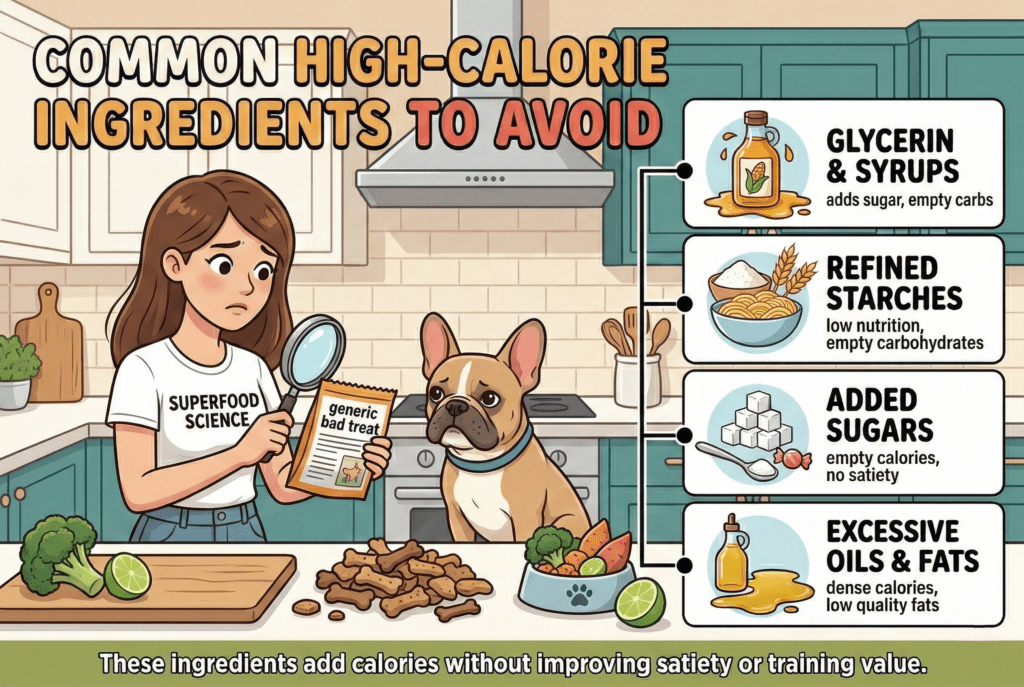
Many commercial treats become calorie-dense because they rely on concentrated fat sources, syrup-like binders, or dense biscuit structures that deliver more calories than pet parents realize.[1][2][3]
- Added syrups or sweeteners
- Excess oils or visibly rich fat sources
- Dense biscuits that are difficult to portion
- Large reward chews that deliver many calories per serving
Protein Choices That Fit a Weight-Conscious Plan
Lean animal proteins such as turkey or chicken can work well when the treat is modest in fat and easy to divide into small rewards. The goal is not simply “high protein,” but high reward value with controlled calories.[1]
Properly formulated plant-based dog treats may also fit a weight-management routine. Some offer lower fat content and added fiber, which may support satiety and routine reward use, although digestibility and overall formulation still matter.[1][5]
Why Texture and Portion Control Matter
Texture is one of the most overlooked parts of calorie control. Soft or semi-soft treats that break cleanly make it easier to reward often without giving a full treat every time.[1]
That portion flexibility helps maintain motivation without turning every reward into a major calorie event, which is especially useful in training, enrichment, and multi-dog households.[1][4]
How to Choose the Best Low-Calorie Treat
Step 1: Start with your dog’s weight goal.
Choose treats in the context of whether the goal is prevention, mild reduction, or veterinarian-guided weight loss. Calorie needs vary by size, age, activity, neuter status, and health conditions.[1][2][4]
Step 2: Check calories before claims.
Words such as natural, premium, or organic do not tell you whether the treat is appropriate for weight control. Check calories per treat and how easily the piece can be divided.[1][4]
Step 3: Prioritize breakable formats.
The easier it is to split the treat, the easier it is to keep rewards small and frequent without overshooting the calorie budget.[1]
Step 4: Count frequency as carefully as size.
Several “small” treats given repeatedly can still become a meaningful calorie load by the end of the day. Low-calorie success depends on both portion size and total reward count.[1][4]
Best Low-Calorie Treats by Life Stage
Puppies
Puppies usually do best with tiny, soft rewards used sparingly during training. The reward should be easy to chew and easy to count.
Adult dogs
Adult dogs often benefit from lean-protein or thoughtfully formulated plant-based treats that support routine rewards without unnecessary calorie density.
Senior dogs
Senior dogs may do best with softer, lower-fat treats that are easier on teeth and easier to portion.
When to Call Your Veterinarian
Talk to your veterinarian if your dog is gaining weight despite portion control, has a history of pancreatitis, is eating a prescription weight-loss diet, or has sudden changes in appetite or body condition.[2][3][4]
Veterinary guidance is also helpful when you are unsure how many calories your dog should receive each day or whether treats are interfering with a medical nutrition plan.[4]
Comparison Table: Which Treat Format Helps Most With Portion Control?
| Treat Type | Calorie Control | Best Use | Watch-Out |
| Soft, breakable lean-protein treats | High | Training and daily rewards | Check fat per treat |
| Plant-based, portionable treats | Moderate to high | Routine rewards | Do not assume plant-based means low calorie |
| Crunchy dense biscuits | Moderate to low | Occasional treat | Easy to overfeed if not broken up |
FAQs
Are low-calorie treats less motivating for dogs?
Usually not. Reward value depends heavily on smell, taste, novelty, and timing. A tiny soft treat can still be highly motivating if the dog finds it appealing.
Can overweight dogs still have treats?
Yes, but treats should be portion-controlled and included in the dog’s daily calorie budget rather than added on top of meals.[1][4]
Are low-fat treats always low calorie?
No. A treat can be lower in fat yet still contribute substantial calories if the piece is large, dense, or given too often.
How many treat calories per day is too much?
A common rule is to keep treats and extras to about 10% or less of total daily calories, while the rest of the diet remains nutritionally balanced.[4]
Are organic treats better for weight management?
Organic status does not automatically make a treat lower calorie. It may reflect ingredient sourcing, but calorie control still depends on formulation and portion size.
What treats are best for small overweight dogs?
Small dogs often do best with very soft, highly breakable treats so each reward stays tiny while still feeling rewarding.
Best Low-Calorie Treat Option
For this category, the strongest practical fit is usually a soft or semi-soft mini-stick or bite that can be broken into multiple rewards. That format makes calorie control easier while preserving reward value for training and everyday use.
- Soft or semi-soft texture
- Breakable for precise portioning
- Lean-protein or thoughtfully formulated plant-based options
- Easy to count into the full daily calorie budget
Explore Low-Calorie Dog Treat Options
Suggested Readings
- Best Training Treats for Dogs
- Hypoallergenic Dog Treats for Sensitive Dogs
- Soft Treats for Senior Dogs
- Organic vs. Natural Dog Treats
- Plant-Based Dog Treats: What Pet Parents Should Know
References
[1] Case, L. P., Daristotle, L., Hayek, M. G., & Raasch, M. F. (2011). Canine and Feline Nutrition (3rd ed.). Mosby.
[2] German, A. J. (2006). The growing problem of obesity in dogs and cats. Journal of Nutrition, 136(7), 1940S-1946S.
[3] Laflamme, D. P. (2012). Companion animals symposium: Obesity in dogs and cats: What is wrong with being fat? Journal of Animal Science, 90(5), 1653-1662.
[4] WSAVA Global Nutrition Committee. (2011). WSAVA nutritional assessment guidelines. Journal of Feline Medicine and Surgery, 13(7), 516-525.
[5] Roberts, J., et al. (2022). Nutritional adequacy of plant-based formulations for dogs. Veterinary Sciences, 9(7), 338.
