
Organic Dog Treats for Small, Medium, and Large Dogs: How to Choose the Right Size in 2026
Quick Answer
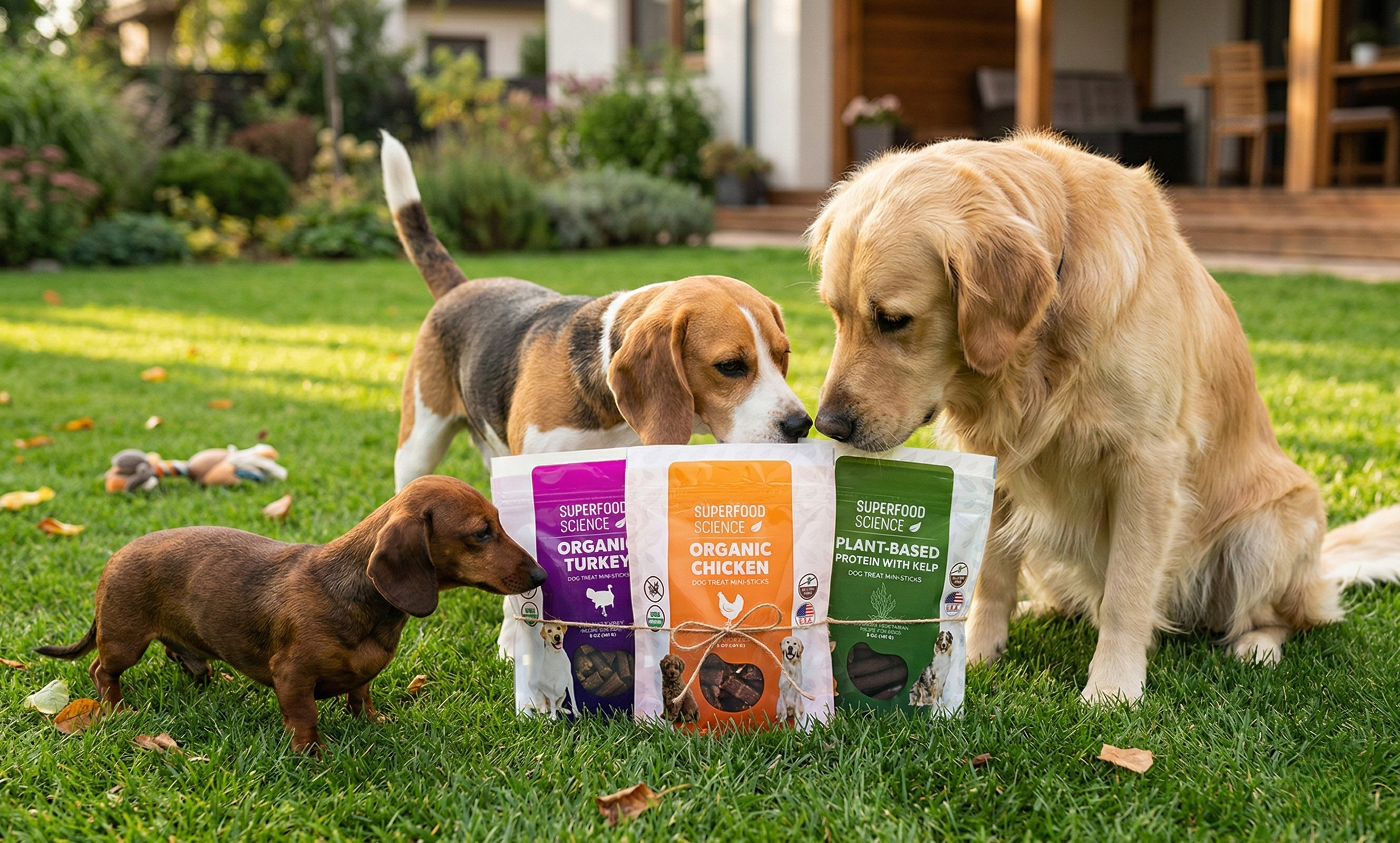
The best organic dog treats in 2026 should match your dog’s size, chewing style, and food sensitivities. In many cases, soft or semi-soft organic mini-stick treats work well for small, medium, and large dogs because they break easily into smaller pieces. As a result, they can support safer chewing and better portion control. Organic turkey and chicken treats are often good choices for dogs that do well with simple, digestible proteins. Meanwhile, natural plant-based options may be a better fit for dogs with poultry sensitivities.
By Superfood Science Writing Team | Reviewed by Dr. Kelly Hood, DVM | Last Updated: 3/3/2026 Superfood Science has produced organic and natural functional foods for humans and pets for over 20 years, specializing in clean-label formulations and evidence-based nutrition.
Key Takeaways
- Treat size should match your dog’s jaw strength, chewing habits, and calorie needs, not just body weight.
- Soft or semi-soft mini-stick treats can be easier to chew for small dogs, seniors, and dogs with sensitive teeth.[10]
- Organic ingredients may help reduce exposure to pesticide residues and artificial preservatives.[2]
- Dogs with chicken or turkey sensitivities may do better with natural plant-based treats.[3]
- Breakable mini-sticks make it easier to control portions for training, enrichment, and everyday rewards.
Introduction
Choosing the right treat size is a small decision that can make a big difference. If a treat is too large, it may be harder for a small dog to chew safely. On the other hand, if a treat is too hard, it may not be ideal for puppies, seniors, or dogs with sensitive teeth. Likewise, treats that are too tiny may not feel satisfying for larger dogs during enrichment time.
For that reason, organic mini-stick treats can be a practical option. Because they break cleanly, dog parents can adjust the size for different breeds, ages, and situations. In turn, this can support safer chewing, easier digestion, and better calorie control.
How Dog Size Affects Treat Choice
A dog’s size can affect chewing strength, bite size, and how easily the dog handles different textures. Therefore, choosing the right size and texture matters.
Small Dogs (20 lbs. or less)
Small dogs have smaller jaws, so oversized or very hard treats can be harder to manage. Therefore, short, soft, breakable mini-sticks are often a smart choice because they:
- are easier to chew
- may lower choking risk
- can be broken into tiny training rewards
- may support sensitive digestion with simple organic proteins[5]
Medium Dogs (20 to 50 lbs.)
Medium dogs usually need slightly larger pieces. However, they still benefit from treats that break easily. Ideally, their treats should:
- offer a moderate chew
- keep calories controlled
- work well during repeated training sessions
Large Dogs (50 lbs. or more)
Large dogs may swallow treats quickly, especially if the pieces are too small. Even so, breakable mini-sticks can still work well because dog parents can:
- break off larger pieces for enrichment
- use tiny pieces for training
- avoid very hard chews that may raise the risk of dental injury[10]
Organic vs. Natural Treats: Which Is Better for Different Dogs?
Dog size alone does not decide whether organic or natural treats are better. Instead, the better choice depends on your dog’s digestion, allergies, and overall health needs.
Organic Turkey or Chicken Mini-Sticks
These may be best for dogs that need:
- clean protein sources with fewer pesticide concerns[2]
- gentle digestion, especially with commonly used proteins like turkey or chicken[5]
- simple formulas for dogs with mild food sensitivities[1]
Natural Plant-Based Mini-Sticks
These may be best for dogs that:
- react poorly to poultry proteins[1][3]
- need a lower-fat option
- do well on plant-forward diets, based on emerging veterinary research[3][6]
In both cases, mini-sticks have one clear advantage: they are easy to break into the right size for the dog in front of you.
Comparison Table: Best Treat Types by Dog Size

| Dog Size | Ideal Treat Texture | Best Organic Options | Best Natural Options |
| Small Dogs | Soft or semi-soft; breakable | Organic turkey/chicken mini-sticks | Plant-based mini-sticks for allergy dogs |
| Medium Dogs | Semi-soft; moderate density | Organic mini-sticks (portion adjusted) | Natural LID (limited ingredient diet) plant-based treats |
| Large Dogs | Breakable semi-soft sticks | Larger broken segments of organic mini-sticks | Larger plant-based segments |
Step-by-Step: How to Choose the Right Treat Size
Treat size should support safety, digestion, and your purpose for giving the treat. So, use these steps to guide your choice.
Step 1: Check Your Dog’s Chewing Strength
First, look at how your dog chews.
- Small dogs and seniors often do best with soft, gentle textures.[10]
- Healthy adult dogs with stronger jaws may handle slightly firmer treats.
Step 2: Match the Treat to the Activity
Next, think about why you are giving the treat.
- For training, use tiny pieces so you can reward often without overfeeding.
- For enrichment, use slightly larger pieces that last a little longer.
Step 3: Think About Digestive Sensitivities
If your dog has stomach or skin issues, ingredient choice matters even more. In that case, look for:
- single-protein organic treats[1][5]
- plant-based formulas for dogs with poultry sensitivities[3]
Step 4: Break Treats Into Custom Portions
Finally, adjust the size to your dog.
- very small bites for toy breeds
- pea-sized pieces for medium dogs
- larger segments for large dogs during light chewing or enrichment
Why Semi-Soft, Breakable Treats Work for All Sizes
Hard chews can raise the risk of tooth damage, especially in small dogs and seniors.[10] By contrast, semi-soft mini-sticks are often easier to manage.
They can help because they:
- are gentler on teeth
- can be broken into safer sizes
- may support easier digestion
- make portion control easier
As a result, they can be especially helpful in homes with more than one dog size.
When to Choose Organic vs. Natural Based on Health Needs
Choose Organic if Your Dog:
- has mild food sensitivities
- does not do well with artificial preservatives
- may benefit from highly digestible proteins[5]
- is a puppy or a senior with a more sensitive digestive system
Choose Natural Plant-Based if Your Dog:
- reacts to poultry proteins[1]
- has ongoing itching or digestive upset linked to some animal proteins
- seems to do well on plant-based formulas, as suggested in newer studies[3][6]
Frequently Asked Questions
Are smaller treats safer for small dogs?
Yes. Smaller dogs usually do better with tiny, soft, or semi-soft pieces. Because of that, smaller treats may help reduce choking risk, support safer chewing, and make it easier to avoid too many calories during training.
Can large dogs eat small treats?
Yes, especially during training. However, for enrichment or slower chewing, slightly larger broken pieces may work better.
Are organic treats better for sensitive dogs?
Often, yes. Organic treats may reduce exposure to pesticide residues and synthetic additives that could bother some sensitive dogs.[2]
Are plant-based treats helpful for dogs with food sensitivities?
They can be. Some studies suggest plant-based diets may support dogs with certain protein sensitivities, especially when animal proteins seem to be a trigger.[3]
Conclusion
The right treat size can help support safer chewing, better dental comfort, and smarter calorie control. Organic turkey and chicken mini-sticks can work well for many dogs because they are easy to digest and easy to portion. Meanwhile, natural plant-based treats may be a useful option for dogs with poultry sensitivity. Overall, soft, breakable mini-sticks are one of the most flexible choices for homes with small, medium, and large dogs.
Explore More Dog Health Tips
- Allergy-Friendly Treats
- Best Organic Dog Treats of 2026
- Organic Puppy Treats Guide 2026
- Training Treats for 2026
References
- Mueller, R. S., Olivry, T., & Prélaud, P. (2016). Common food allergens in dogs and cats. BMC Veterinary Research, 12, 9.
- Benbrook, C. M. (2012). Organic agriculture and reducing exposure to pesticides. Environmental Health Perspectives, 120(5), a182–a183.
- Knight, A., Leitsberger, M., & Light, N. (2021). Vegan versus meat-based dog food: Guardian-reported health outcomes. Animal Welfare, 30(3), 285–300.
- Bizikova, P., Pucheu-Haston, C. M., Eisenschenk, M. N. C., Marsella, R., Nuttall, T., & Santoro, D. (2015). Food allergy testing in dogs: Limitations and recommendations. Veterinary Dermatology, 26(5), 431–e101.
- Case, L. P., Daristotle, L., Hayek, M. G., & Raasch, M. F. (2011). Canine and Feline Nutrition (3rd ed.). Mosby.
- Roberts, J., et al. (2022). Nutritional adequacy of plant-based formulations for dogs. Veterinary Sciences, 9(7), 338.
- de-Oliveira, L. D., et al. (2008). Effects of dietary protein sources on stool quality and digestibility in dogs. Journal of Nutrition, 138(2), 274–275.
- Macías-Montes, A., et al. (2025). Pesticide residues in commercial dry pet food. Environmental Pollution, 336, 122–145.
- Wise, C. F., et al. (2021). Comparative assessment of pesticide exposures in domestic dogs and their owners. Environmental Science & Technology, 55(4), 2619–2630.
- Glickman, L. T., et al. (2012). Non-traumatic dental disorders linked to hard chew treats in dogs. Journal of the American Veterinary Medical Association, 241(6), 737–743.
- Brown, W. Y., & Vanselow, B. A. (2000). Treat texture and its effect on canine training performance. Applied Animal Behaviour Science, 67(1–2), 1–12.
