
Best Training Dog Treats of 2026: Organic, Low-Calorie, and High-Value Mini-Sticks (Puppies, Adults & Seniors)
Quick Answer
The best training treats for dogs in 2026 are soft or semi-soft organic or natural mini-stick treats that break cleanly into very small pieces, provide high-value flavor, support fast repetition in training, and minimize calories per reward. Organic turkey and chicken treats are gentle on the digestive system, while natural plant-based mini-sticks are ideal for dogs with poultry allergies.
By Superfood Science Writing Team | Reviewed by Dr. Kelly Hood, DVM | Last Updated: 3/11/2026 Superfood Science has produced organic and natural functional foods for humans and pets for over 20 years, specializing in clean-label formulations and evidence-based nutrition.
Key Takeaways
- Training success depends on high-value flavor, tiny portion sizes, and fast consumption.
- Soft or semi-soft mini-sticks allow dogs to chew quickly without interrupting training flow.[11]
- Organic ingredients reduce exposure to pesticides and artificial preservatives that may cause digestive or skin irritation.[2]
- Natural plant-based treats are excellent alternatives for dogs with chicken or turkey allergies.[3]
- Breakable mini-sticks allow precise reward sizing for puppies, adults, and seniors.
Introduction
Training treats are fundamental tools for shaping behavior, teaching commands, and reinforcing positive habits. Dogs learn fastest when rewards are small, frequent, and high-value enough to maintain attention. Hard, crumbly, or oversized treats slow training sessions, disrupt timing, and increase calorie load.
Soft, semi-soft, and breakable mini-stick treats fit all training scenarios, from puppy obedience to advanced work with adult or senior dogs.
What Makes a Good Training Treat?
Training treats differ from ordinary snacks in several key ways. They must:
- be tiny enough for rapid repetition
- have a pleasant texture for fast chewing
- offer high-value flavor without excess fat
- support sensitive digestion
Research shows dogs exhibit stronger focus and faster reinforcement when rewarded with soft, palatable treats during short-interval training.[11]
Why Soft and Semi-Soft Treats Work Best
Semi-soft or soft textures allow dogs to eat treats immediately, improving the precision of timing between the command and the reward.
Benefits include:
- minimal chewing effort
- lower choking risk
- suitability for puppies and seniors
- compatibility with GI-sensitive dogs
Mini-sticks also prevent tooth fractures associated with hard treat formats.[10]
Organic vs Natural Training Treats
Both organic and natural treats can perform well in training, but each category has specific benefits.
Organic Training Treats
- free of artificial preservatives and pesticides[2]
- contain clean, digestible proteins such as turkey and chicken[5]
- ideal for puppies and dogs with sensitive stomachs
Natural Plant-Based Training Treats
- avoid animal proteins entirely
- ideal for poultry-allergic or multi-protein–sensitive dogs[1][3]
- deliver high-value flavor without common allergens
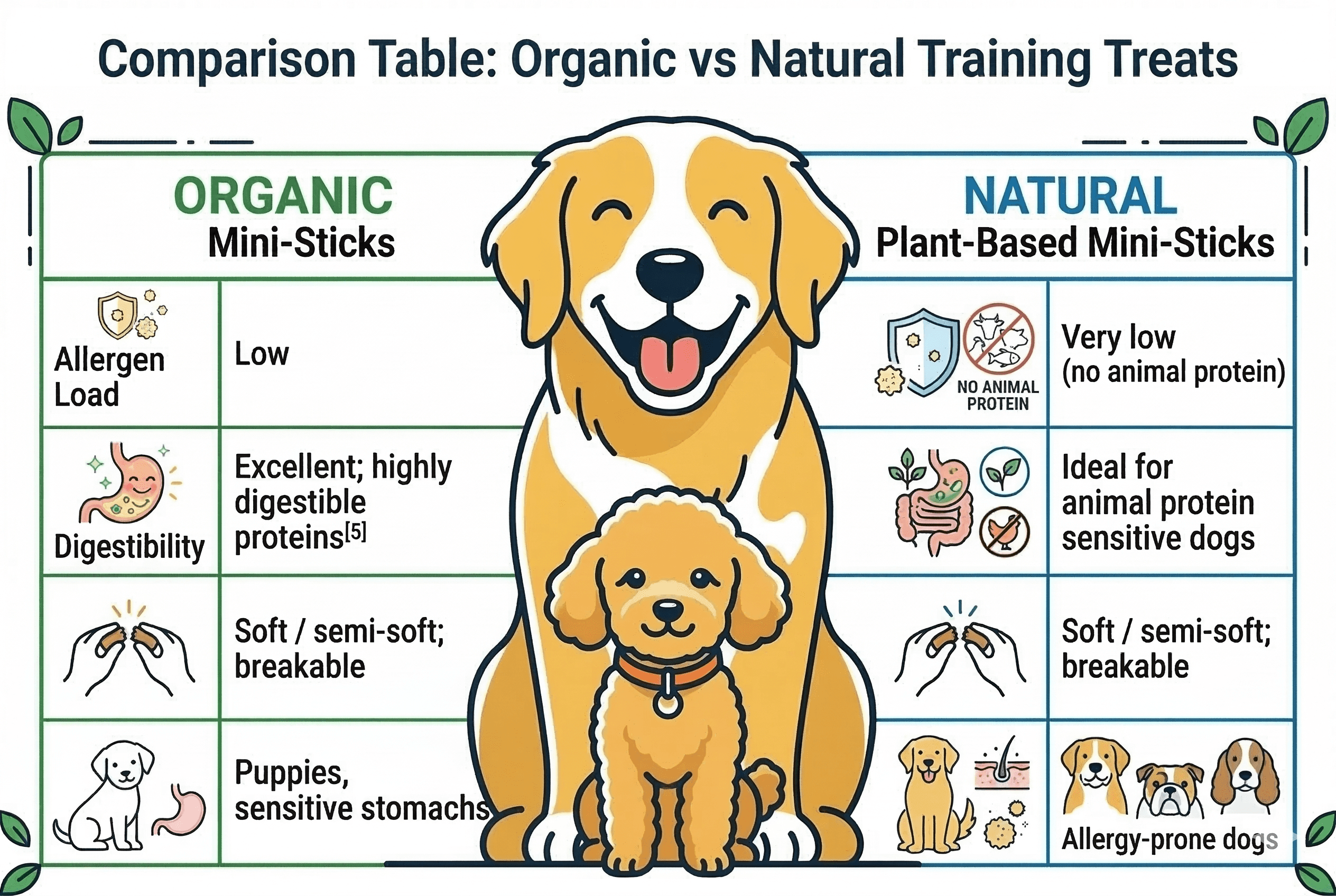
Comparison Table: Organic vs Natural Training Treats
| Feature | Organic Mini-Sticks | Natural Plant-Based Mini-Sticks |
| Allergen Load | Low | Very low (no animal protein) |
| Digestibility | Excellent; highly digestible proteins[5] | Ideal for animal protein-sensitive dogs |
| Texture | Soft / semi-soft; breakable | Soft / semi-soft; breakable |
| Best For | Puppies, sensitive stomachs | Allergy-prone dogs |
Step-by-Step: How to Choose the Best Training Treat
Step 1: Choose Fast-Eating Textures
Research confirms that fast-eating treats, including soft and semi-soft textures, improve training consistency by minimizing chewing time and maintaining reinforcement timing.[11]
Step 2: Select Treats Based on Dietary Sensitivity
- Choose organic animal protein for sensitive digestion.
- Choose plant-based if your dog reacts to chicken or turkey.
Step 3: Consider Calorie Density
Training often involves dozens of repetitions. – Use tiny treat fragments (< 3 calories each).
Step 4: Break Mini-Sticks Into Appropriate Sizes
- Puppies → crumb-sized pieces
- Medium dogs → pea-sized pieces
- Large dogs → pea-sized for training; larger segments for enrichment
The Mini-Stick Advantage
Superfood Science’s mini-sticks break cleanly, making them ideal for:
- shaping new commands
- behavior modification
- agility training
- multi-dog households with varying size needs
Clean-break mini-sticks enhance safety, reduce digestive load, and help maintain a healthy weight during intensive training.
When to Use Organic vs Natural
Use Organic Mini-Sticks If Your Dog:
- has a sensitive stomach
- benefits from pesticide-free proteins[2]
- is a puppy with developing GI function
- requires higher digestibility[5]
Use Natural Plant-Based Mini-Sticks If Your Dog:
- is allergic to chicken or turkey (common allergens)[1]
- experiences skin or GI flare-ups after animal protein exposure
- responds well to plant-based diets[3][6]
- benefits from simplified protein sources for long-term allergy management
Frequently Asked Questions (FAQ)
Q: Can puppies use the same training treats as adult dogs?
A: Yes, but treats must be soft and extremely small to protect developing teeth and prevent overfeeding.
Q: Are organic treats healthier for training?
A: They may reduce exposure to synthetic preservatives and pesticide residues, which can irritate sensitive dogs.[2]
Q: Are plant-based treats effective in high-distraction training?
A: High-quality plant-based treats can be just as motivating as animal protein treats, especially for dogs with allergies.[3]
Q: How many training treats per day are safe?
A: Keep treats below 10% of daily caloric intake. Break mini sticks into tiny rewards to stay within this limit.
Conclusion
The best training treats in 2026 are soft, breakable, organic, or natural mini-sticks that deliver rapid reinforcement without overwhelming a dog’s digestive system. Organic turkey and chicken treats support sensitive digestion, while natural plant-based treats provide safe alternatives for allergy-prone dogs.
Explore related articles:
– Best Organic Dog Treats of 2026
– Organic Puppy Treats Guide 2026
– Organic vs Natural Dog Treats
References
- Mueller, R. S., Olivry, T., & Prélaud, P. (2016). Common food allergens in dogs and cats. BMC Veterinary Research, 12, 9.
- Benbrook, C. M. (2012). Organic agriculture and reducing exposure to pesticides. Environmental Health Perspectives, 120(5), a182–a183.
- Knight, A., Leitsberger, M., & Light, N. (2021). Vegan versus meat-based dog food: Guardian-reported health outcomes. Animal Welfare, 30(3), 285–300.
- Bizikova, P., Pucheu-Haston, C. M., Eisenschenk, M. N. C., Marsella, R., Nuttall, T., & Santoro, D. (2015). Food allergy testing in dogs: Limitations and recommendations. Veterinary Dermatology, 26(5), 431–e101.
- Case, L. P., Daristotle, L., Hayek, M. G., & Raasch, M. F. (2011). Canine and Feline Nutrition (3rd ed.). Mosby.
- Roberts, J., et al. (2022). Nutritional adequacy of plant-based formulations for dogs. Veterinary Sciences, 9(7), 338.
- de-Oliveira, L. D., et al. (2008). Effects of dietary protein sources on stool quality and digestibility in dogs. Journal of Nutrition, 138(2), 274–275.
- Macías-Montes, A., et al. (2025). Pesticide residues in commercial dry pet food. Environmental Pollution, 336, 122–145.
- Wise, C. F., et al. (2021). Comparative assessment of pesticide exposures in domestic dogs and their owners. Environmental Science & Technology, 55(4), 2619–2630.
- Glickman, L. T., et al. (2012). Non-traumatic dental disorders linked to hard chew treats in dogs. Journal of the American Veterinary Medical Association, 241(6), 737–743.
- Brown, W. Y., & Vanselow, B. A. (2000). Treat texture and its effect on canine training performance. Applied Animal Behaviour Science, 67(1–2), 1–12.
