
Hypoallergenic Dog Treats for Dogs in 2026: Ingredients, Benefits, and How to Choose the Right Option

Quick Answer
Hypoallergenic dog treats are designed to reduce the risk of triggering food-related reactions by avoiding common allergens such as chicken, beef, dairy, wheat, and soy. The best hypoallergenic dog treats in 2026 typically feature limited ingredients, simple formulas, clearly named protein sources, and soft, easy-to-break textures that are well-suited for dogs with food sensitivities, digestive upset, or chronic itching.[1][3]
By Superfood Science Writing Team | Reviewed by Dr. Kelly Hood, DVM | Last Updated: 3/27/2026 | Superfood Science has produced organic and natural functional foods for humans and pets for over 20 years, specializing in clean-label formulations and evidence-based nutrition.
Key Takeaways
Hypoallergenic does not mean allergy-proof. It means the treat is formulated to reduce common dietary triggers.[1][3]
The best options are usually limited-ingredient treats with clearly labeled ingredients and no vague animal proteins.
Chicken, beef, dairy, wheat, and eggs are among the most commonly reported food allergens in dogs.[1]
Soft, breakable treats are often easier to use for training and may be gentler for dogs with sensitive digestion or older teeth.[4]
Treats can quietly interfere with an elimination diet, even when the main food has already been cleaned up.[3]
Why Hypoallergenic Dog Treats Matter
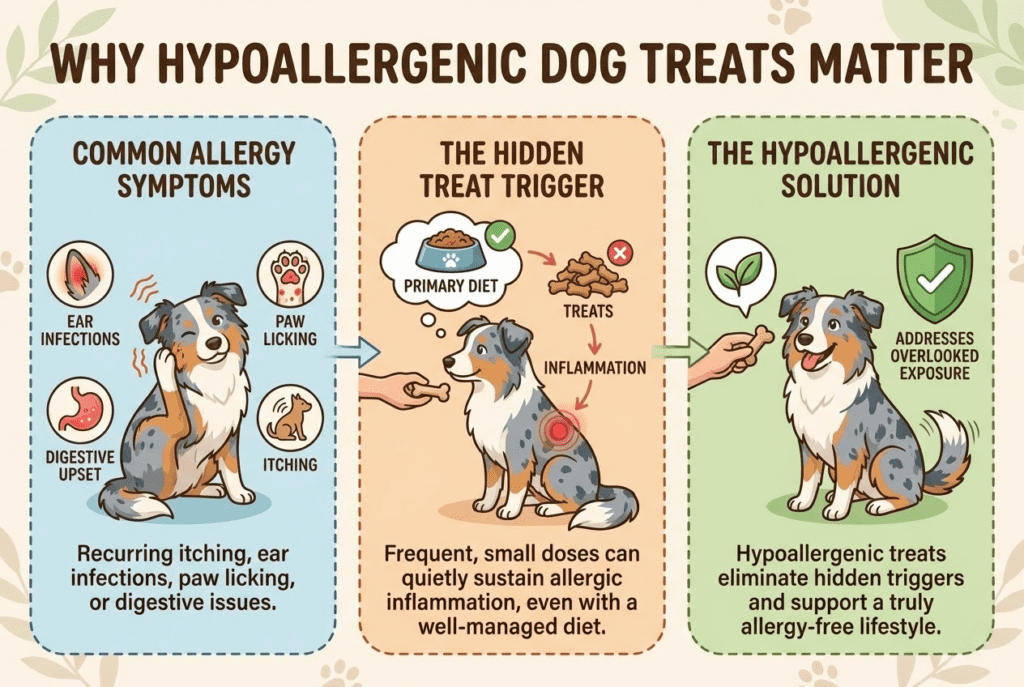
Food sensitivities and food allergies are common concerns in dogs and can present as itching, recurrent ear irritation, paw licking, loose stools, vomiting, or chronic digestive discomfort. Many pet parents focus on the dog’s main food, but treats are often given daily and can become a hidden source of repeated exposure to trigger ingredients.[1][3]
That is why choosing the right treat matters. Even a small amount of a problematic ingredient can make it harder to tell whether a dog is improving. In practical terms, hypoallergenic dog treats are not just snacks. They can either support or undermine a broader diet strategy.[1][3]
What “Hypoallergenic” Means in Dog Treats
In pet nutrition, hypoallergenic does not mean a product is guaranteed to be safe for every dog. It means the formula is designed to reduce the likelihood of triggering a reaction by excluding ingredients that commonly cause problems.[1][3]
In most cases, effective hypoallergenic dog treats share a few traits:
Limited ingredients
Fewer ingredients usually mean fewer possible triggers. This is especially helpful during elimination trials or when a pet parent is trying to narrow down what a dog does and does not tolerate.
Clearly named protein sources
A label that says “turkey” or “salmon” is more useful than one that says “meat meal” or “animal digest.” Clear labeling makes it easier to avoid ingredients that have caused problems before.
No common high-risk fillers or additives
Many pet parents prefer formulas without wheat, dairy, soy, artificial colors, and artificial preservatives when managing a sensitive dog.[1][3]
Common Dog Treat Allergens to Avoid
Reports on adverse food reactions in dogs repeatedly identify a short list of ingredients that appear frequently. The most commonly cited include:
Beef
Beef is a frequent protein in dog foods and treats, which may partly explain why it is often reported in dogs with food reactions.[1]
Chicken
Chicken is common, affordable, and widely used, but that also makes it one of the first proteins many veterinarians and pet parents consider avoiding during a food trial.[1]
Dairy
Some dogs react poorly to dairy ingredients, which can contribute to skin or digestive symptoms.[1]
Wheat
Wheat is not a problem for every dog, but it is still commonly listed among ingredients that may need to be removed in sensitive dogs.[1]
Eggs
Eggs can be a useful ingredient in some formulas, but they are also included among reported food allergens in dogs.[1]
Best Protein Options for Hypoallergenic Dog Treats
Plant-based proteins
Plant-based dog treats remove animal protein exposure entirely, which can be useful for dogs that react to multiple meat proteins or for pet parents trying to simplify an elimination approach. When properly formulated, plant-based treats may also provide fiber and a lighter fat profile.[2]
Novel animal proteins
Some dogs do well with a single animal protein that they have not eaten often before. The goal is not variety for its own sake. The goal is to use a single, clearly identified protein in a simple formula so that tolerance is easier to monitor.
Why Texture Matters in Hypoallergenic Dog Treats
Ingredient choice is the first priority, but texture matters too. Dogs with sensitive digestion or chronic inflammation may do better with soft or semi-soft treats than with hard, brittle chews.
Easier on sensitive digestion
Soft treats are often easier to chew and swallow, which may help dogs with existing digestive irritation.
Better for training
Breakable treats allow smaller portions and more frequent rewards without giving too many calories at once.
More comfortable for seniors
Older dogs or dogs with worn teeth may handle softer textures more comfortably than hard chews.[4]
Lower risk than very hard chews
Very hard chews can increase the risk of dental stress or tooth damage in some dogs, especially seniors or aggressive chewers.[4]
How to Choose the Right Hypoallergenic Dog Treat
Step 1: Identify known trigger ingredients
Start with what your dog has reacted to before. If chicken, beef, dairy, or wheat has caused problems, remove those ingredients completely, including small amounts hidden in treats.[1][3]
Step 2: Choose a limited-ingredient formula
Look for short ingredient decks with simple, recognizable components. This makes it easier to spot possible triggers and track responses over time.
Step 3: Check the protein label carefully
Avoid vague terms like “animal protein” or “meat by-products” when shopping for a dog with food sensitivities.
Step 4: Pick a gentle texture
Soft and breakable treats tend to be more practical for daily use, training, and portion control.
Step 5: Avoid unnecessary extras
Artificial colors, flavorings, and heavily processed filler ingredients may not be necessary in a treat designed for a sensitive dog.
Hypoallergenic Dog Treats by Life Stage
Puppies
Young dogs often benefit from soft, small treats that are easy to chew and easy to portion during training.
Adult dogs
For adult dogs with ongoing sensitivities, the focus is usually consistency. A simple, repeatable treat routine is often more helpful than rotating multiple formulas.
Senior dogs
Senior dogs may benefit from softer textures that are easier on teeth and gums, especially if they also have digestive sensitivity.[4]
Veterinary Note
When a dog has chronic itching, recurring ear problems, or repeated digestive flare-ups, treats should be reviewed just as carefully as the main diet. During a true elimination trial, even small exposures from flavored treats can interfere with the process.[3]
Best Hypoallergenic Dog Treat Features to Look For
When comparing products, the strongest options usually have these characteristics:
Poultry-free or clearly protein-specific
This helps pet parents avoid common trigger proteins more confidently.
Limited ingredients
Short formulas are easier to evaluate and usually easier to troubleshoot.
Soft or semi-soft format
Useful for portion control, training, and sensitive dogs.
No artificial colors or vague flavorings
Cleaner labels make it easier to know what the dog is actually eating.
Product Spotlight
Poultry-Free, Limited-Ingredient Mini Sticks
A good hypoallergenic dog treat option is a poultry-free, limited-ingredient mini stick with a soft texture, clear ingredient labeling, and a breakable format for training or daily rewards.
Ideal features:
- No chicken or beef
- Soft or semi-soft texture
- Easy to break into smaller pieces
- Simple ingredient list
- Suitable for sensitive dogs and everyday training use
➡️ Explore our hypoallergenic dog treat options
Frequently Asked Questions
Are hypoallergenic dog treats prescription-only?
No. Prescription diets exist, but many over-the-counter treats can also be appropriate when they use simple ingredients and avoid a dog’s known triggers.
Can treats cause allergy flare-ups even if the main food is clean?
Yes. Treats are a common source of accidental exposure, especially when they contain chicken, beef, dairy, or other ingredients a dog is trying to avoid.[1][3]
How long does it take to see improvement after removing trigger treats?
Some dogs improve within a few weeks, but timing varies. Skin and digestive symptoms often need time to settle, especially if the dog has had repeated exposure.[3]
Are plant-based dog treats a good option for sensitive dogs?
They can be, especially when a dog reacts to several animal proteins. The key is to choose a nutritionally appropriate product with a clear ingredient list.[2]
What is the biggest mistake pet parents make when choosing hypoallergenic treats?
The biggest mistake is focusing only on marketing words like “natural” or “premium” instead of checking the ingredient list carefully.
Final Thoughts
The best hypoallergenic dog treats are usually the simplest ones. For most sensitive dogs, success comes from avoiding common trigger ingredients, keeping formulas short and transparent, and choosing a soft, practical texture that fits everyday use.
If your dog has chronic itching, ear irritation, or digestive upset, it is worth reviewing treats with the same care you give the main food. That small change can make a meaningful difference over time.[1][3]
More on other related topics
Below are links to additional info. Click the link and learn more.
- Best Limited-Ingredient Dog Treats for Sensitive Stomachs
- Organic vs. Non-Organic Dog Treats: What Matters Most?
- Soft Dog Treats vs. Hard Chews: Which Is Better for Older Dogs?
- Why Dogs Lick Their Paws: Food, Skin, and Environmental Triggers
References
[1] Mueller, R. S., Olivry, T., & Prélaud, P. (2016). Common food allergens in dogs and cats. BMC Veterinary Research, 12, 9.
[2] Knight, A., Leitsberger, M., & Light, N. (2021). Vegan versus meat-based dog food: Guardian-reported health outcomes. Animal Welfare, 30(3), 285–300.
[3] Bizikova, P., et al. (2015). Food allergy testing in dogs: Limitations and recommendations. Veterinary Dermatology, 26(5), 431–e101.
[4] Case, L. P., Daristotle, L., Hayek, M. G., & Raasch, M. F. (2011). Canine and feline nutrition (3rd ed.). Mosby.
