
Mushroom Immune Support for Dogs: What Dog Parents Should Actually Know
Quick Answer
Animal oncologists began investigating mushroom-derived immune support in the late 1990s, largely in response to the high incidence of canine neoplasia, which affects roughly 50% of dogs over age 10. With advanced cancer treatments often exceeding $10,000, many owners are shifting toward proactive, evidence-based wellness.[7][8]
Compounds such as beta-glucans are currently being studied for their role in supporting immune and inflammatory pathways essential for healthy aging. While these supplements are not “cures,” they are valuable components of a broader wellness routine. For the best results, prioritize products that are clearly labeled, appropriately sized for your dog, and reasonable to discuss with your veterinarian—especially for senior pets or those with ongoing health issues.[1][2][3]
By Superfood Science Writing Team | Reviewed by Dr. Kelly Hood, DVM | Last Updated: 05/05/2026
Superfood Science has produced organic and natural functional foods for humans and pets for over 20 years, specializing in clean-label formulations and evidence-based nutrition.
Key Takeaways
- Immune support is wellness support: “Immune support” is a broad wellness concept, not proof that a supplement can prevent or treat disease.[4][5]
- Beta-glucans matter: Beta-glucans are among the best-known mushroom compounds discussed in dog and cat nutrition research.[1][2][3]
- Agaricus blazei Mushroom Supplement for dogs: Agaricus blazei is a well-known functional mushroom used in immune-support supplement discussions, especially in the Japanese veterinary sector, because of its beta-glucan content and long-standing wellness applications.
- Support normal immune system health: The evidence is still evolving, so the safest language is that mushroom supplements may support normal immune system health rather than deliver guaranteed outcomes.[1][2]
- Quality matters more than hype: Product quality, label transparency, feeding format and fit for the individual dog matter more than hype.[4][5][6]
- Symptoms still need veterinary care: If a dog has persistent vomiting, diarrhea, weight loss, poor appetite, or other ongoing symptoms, a veterinary exam matters more than simply adding a supplement.[4][5]
Introduction
Dog parents often hear about mushroom supplements in two very different ways.
One version sounds calm and practical: mushrooms contain compounds such as beta-glucans that may support normal immune function and fit into a broader wellness routine. The other version sounds much bigger, almost magical.
The truth is usually closer to the first version.
Mushroom-based supplements can be an interesting part of a thoughtful pet-wellness plan, but they make the most sense when you understand what they are—and what they are not. They are not a shortcut around routine veterinary care, good nutrition, body-weight management, parasite control, vaccination schedules or paying attention to symptoms when something seems wrong.[4][5]
For American dog parents, the most useful question is not, “Are mushrooms amazing?” Rather, it is, “What does mushroom immune support realistically mean for my dog?”
What “Immune Support” Means in Real Life
Immune support is one of the most overused phrases in the supplement world.
In a practical dog-health context, it usually means a product is being positioned to support normal immune system function or help maintain resilience as part of everyday wellness.
In the dietary supplement world, “immune support” is commonly used as a structure/function-style phrase when it refers to supporting normal immune system function rather than diagnosing, treating, curing, or preventing disease. For pet supplements, the same conservative principle is useful: the phrase should be supported by reasonable evidence, used with realistic expectations, and kept clearly separate from disease-treatment claims.
Why this distinction matters
Pet wellness guidance from WSAVA emphasizes that long-term health is built on fundamentals such as preventive care, nutrition, welfare, parasite control and timely veterinary attention—not on reliance on any one supplement category alone.[4]
That is why mushroom supplements are best viewed as supportive tools that may fit into the bigger picture, not as replacements for the bigger picture.
Why Mushrooms Come Up So Often in Immune-Support Conversations
The main reason mushrooms get so much attention is beta-glucans.
Beta-glucans are naturally occurring polysaccharides found in certain fungi, yeasts and other sources. They are widely discussed because they interact with immune-related pathways and have attracted interest in both human and animal nutrition research.[1][2][3]
What the research suggests
A recent review focused on dogs and cats notes that adding beta-glucans to companion-animal nutrition has been associated with multiple potential health effects, including immune and inflammatory outcomes, although the literature is still evolving and depends heavily on source, dose and context.[1]
A separate 2024 canine study comparing different beta-glucan sources reported measurable effects on immune and inflammatory markers in dogs, reinforcing that the topic is biologically active and worth studying—but not simple enough for sweeping consumer promises.[2]
Why dog parents should stay grounded
Not all mushrooms are the same. Not all beta-glucans are the same. And not every study translates into an everyday result that a dog parent would notice at home.
That is why a calmer, more useful way to think about mushroom immune support is this: the science is interesting, plausible, and growing, but it is still a supplement conversation—not a miracle conversation.
Where Agaricus Blazei Fits In
Among the mushrooms discussed for immune support, Agaricus blazei often stands out because it is particularly associated with beta-glucan content and a long-standing interest in wellness applications.
For dog parents who prefer a focused mushroom supplement rather than a broad blend, Agaricus blazei may be especially appealing because it gives the routine a clear identity: one mushroom species, one daily format, and a more intentional way to add mushroom-based immune support to a broader wellness plan.
Superfood Science’s current product page for Agaricus Bio® Immune Support for Dogs and Cats describes the formula as an organic Agaricus blazei mushroom supplement in 300 mg pull-apart capsules, made for dogs and cats and especially suited to pets under 40 lbs. It is also described as easy to feed and available with recurring delivery options.[6]
Why the format matters
For dog parents, delivery format can matter almost as much as the ingredient. A capsule that can be opened and mixed into food may be easier for some households than a chew, a liquid or a larger powder scoop. That does not make the ingredient more powerful by itself. It just makes the routine and administration easier to follow.
What Stronger Evidence Supports
The strongest takeaways in this area are not the most dramatic ones.
Stronger takeaways
- Good wellness care is still built on basics: nutrition, body condition, preventive veterinary care and paying attention to symptoms.[4][5]
- Beta-glucans are a legitimate area of companion-animal research, including recent work in dogs and cats.[1][2][3]
- Nutritional assessment matters. WSAVA’s nutritional assessment guidance emphasizes that what a pet eats—and how that diet is evaluated—has a meaningful role in health maintenance.[5]
- A product with clear labeling, appropriate sizing and a practical feeding format is easier to evaluate responsibly than a vague one.[5][6]
What does that mean for dog parents?
A mushroom supplement can make sense as part of a routine when the product is transparent and the goal is realistic. For many dog parents, Agaricus blazei can be a practical option: not as a cure-all, but as a targeted mushroom supplement that may support normal immune system health as part of a comprehensive wellness routine.
What Is More Limited or Less Certain
This is where dog parents need a little skepticism.
Limited areas
- Mushroom supplement studies do not all use the same source, dose, extraction method or target outcome.[1][2][3]
- A measurable change in a lab result or biomarker does not always translate into a visible, everyday benefit.
- Dogs vary. Age, size, overall diet, gut tolerance, medical history and the rest of the care plan all matter.
- A supplement can be interesting without being decisive.
That is why the safest language remains: mushroom supplements may support normal immune health, and some ingredients in this category have a meaningful biological rationale and an expanding research base.
Which Dogs May Be Better Candidates for This Conversation
Not every dog owner asks about immune support for the same reason.
Healthy adult dogs whose owners want a simple wellness routine
Some dog parents simply want a focused product that may fit into a daily health-support plan.
Senior dogs
Older dogs are one of the most common groups for wellness-related supplement questions because dog parents often notice lower energy, more subtle changes, or simply want a more intentional daily routine.
Small dogs and multi-pet homes
A smaller capsule size or easy-to-open format may be especially appealing in homes with small dogs or both dogs and cats. Superfood Science currently positions the 300 mg Agaricus Bio format as best for pets under 40 lbs.[6]
When caution matters more
Dogs with chronic vomiting, chronic diarrhea, weight loss, major appetite changes, active medical problems or multiple medications deserve a more individualized discussion with a veterinarian before adding supplements.[4][5]
Practitioner-Recommended Usage Guide
For dog parents considering a mushroom immune-support supplement, a conservative routine looks like this:
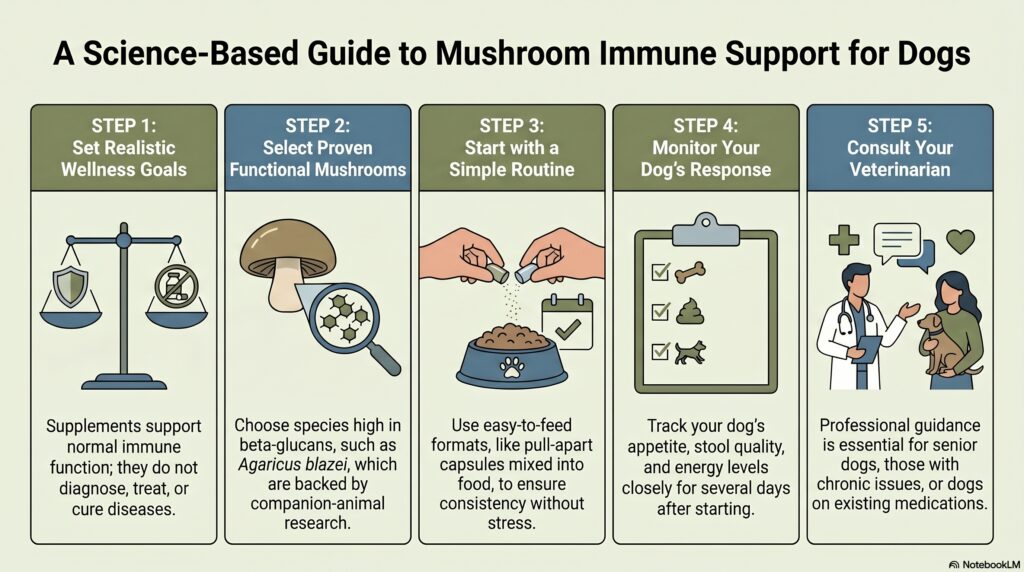
Step 1: Decide whether the goal is realistic
A supplement should fit into a broader wellness plan, not replace one.
Step 2: Read the label closely
Check the ingredient, capsule or serving size, feeding instructions, intended species and whether the company explains the format clearly.[5][6]
Step 3: Start with the simplest routine possible
Do not introduce multiple new supplements, new treats and a food change all at once.
Step 4: Watch the dog, not just the product story
Monitor appetite, stool quality, vomiting, itching, energy and general comfort over several days.
Step 5: Keep veterinary care in the loop when needed
This matters most for seniors, dogs with chronic health concerns, dogs on medication and dogs whose owners are hoping the supplement will solve a symptom rather than support overall wellness.[4][5]
Safety
Mushroom supplements should be approached like any other pet supplement: thoughtfully, gradually and without assuming that “natural” means universally safe.
Potential issues may include digestive upset, poor fit with a dog’s existing care plan or false reassurance when a dog actually needs medical attention.
When to call a vet
Contact your veterinarian if your dog develops repeated vomiting, persistent diarrhea, appetite loss, lethargy or clear worsening after starting any new supplement.[4]
When to seek urgent care
Seek urgent help if your dog has severe vomiting, collapse, marked weakness, inability to keep water down or significant abdominal pain.[4]
How Superfood Science Agaricus Bio Fits This Topic
For dog parents who want a focused mushroom supplement, Agaricus Bio® Immune Support for Dogs and Cats is positioned as a practical Agaricus blazei option rather than a generic mushroom blend. The 300 mg pull-apart capsule format can make daily use easier for small dogs, cats, and multi-pet households, while the single-mushroom focus helps dog parents understand exactly what they are adding to the routine.[6]
The best way to position this product is simple and responsible: Agaricus Bio may support normal immune system health as part of a broader wellness plan that still includes good food, healthy body condition, preventive veterinary care, and attention to symptoms.
FAQ
What does mushroom immune support for dogs actually mean?
Usually, it means a supplement is being used to support normal immune system health as part of a broader wellness routine. It does not mean the product can replace veterinary care or treat disease.[4][5]
Are beta-glucans the main reason mushrooms are used for dogs?
They are one of the main reasons the category gets attention. Beta-glucans are widely studied in companion-animal nutrition and immune-related research.[1][2][3]
Is Agaricus blazei different from a generic mushroom blend?
It can be. Agaricus blazei is its own mushroom species and is often discussed specifically for its beta-glucan content and wellness-oriented use. A focused Agaricus blazei supplement may appeal to dog parents who want a simpler, more identifiable mushroom routine rather than a multi-mushroom blend.
Can dogs and cats use the same mushroom supplement?
Some products are labeled for both species. Superfood Science currently markets Agaricus Bio® Immune Support for Dogs and Cats, but owners should still use the labeled feeding guidance and consult a veterinarian when there are medical concerns.[6]
Are mushroom supplements enough if my dog seems sick?
No. If your dog has persistent symptoms such as vomiting, diarrhea, weight loss, poor appetite, or low energy, the safer next step is a veterinary evaluation.[4][5]
Conclusion
Mushroom immune support for dogs is worth understanding—but not romanticizing.
The science around beta-glucans and companion-animal nutrition is real and growing. At the same time, the most responsible use of that science is still modest: choose transparent products, keep expectations realistic, watch your dog closely, and let supplements support a good wellness routine rather than trying to replace one.
For dog parents who prefer a focused Agaricus blazei option, a product such as Agaricus Bio® Immune Support for Dogs and Cats may fit that role, especially when simple feeding format and small-pet sizing matter.[6]
Explore More Dog Health Topics
- Can Dogs Eat Mushrooms? A Dog-Parent Guide to Safe Mushroom Choices
- What Are Superfoods? Hidden Hazards for Dogs and Cats
- Agaricus Bio® Immune Support for Dogs and Cats
- Caring for Rescued Pets with Agaricus Blazei Mushrooms
References
- Amaral AR, et al. Beta-Glucans Application for Skin Disease, Osteoarthritis, and Other Health Areas in Dogs and Cats. 2024 review indexed in PubMed/PMC. https://pubmed.ncbi.nlm.nih.gov/38930453/
- de Souza Theodoro S, et al. β-glucans from Euglena gracilis or Saccharomyces cerevisiae: effects on immunity and inflammatory parameters in dogs. 2024. https://pmc.ncbi.nlm.nih.gov/articles/PMC11142716/
- Vetvicka V, Vetvickova J. Physiological effects of different types of beta-glucan. Biomed Pap Med Fac Univ Palacky Olomouc Czech Repub. 2007. https://pubmed.ncbi.nlm.nih.gov/18345255/
- World Small Animal Veterinary Association. Principles of Wellness. https://wsava.org/wp-content/uploads/2025/06/Principles-of-Wellness-FINAL.pdf
- World Small Animal Veterinary Association. Nutritional Assessment Guidelines. https://wsava.org/wp-content/uploads/2020/01/WSAVA-Nutrition-Assessment-Guidelines-2011-JSAP.pdf
- Superfood Science. Agaricus Bio® Immune Support for Dogs and Cats product page. https://www.superfoodscience.com/products/agaricus-bio-immune-support-for-dogs-and-cats-all-natural-pet-supplement
- American Animal Hospital Association (AAHA). (2025). 2026 AAHA Oncology Guidelines. Journal of the American Animal Hospital Association.
- MDPI. (2026). Comparative Cancer Genetics and Veterinary Therapeutics in Dogs and Cats: A Species-Aware Framework for Comparative Oncology. Life, 16(3), 430. https://doi.org/10.3390/life16030430
