
Best Organic Dog Treats Made in the USA: A Vet-Safe Guide for Dog Parents
Quick Answer
“Made in the USA” can be a meaningful trust factor for some dog parents, but it is not a shortcut to safety, digestibility or nutritional quality. The best organic dog treats made in the USA are the ones with transparent labels, manageable calories, an appropriate portion size, and a formula your dog actually tolerates. Country of manufacture can be part of the decision, but it should not outweigh ingredient clarity, company transparency and how the treat fits your dog’s health needs.[1][2][3][4]
Featured Snippet Block
Organic dog treats made in the USA can be a reasonable trust preference, but country of manufacture alone does not prove better digestibility or better nutrition. The safest way to compare treats is to focus on ingredient transparency, calorie content, portion size and whether the formula actually works well for your dog.
Trust Signal
By Superfood Science Writing Team | Reviewed by Dr. Kelly Hood, DVM | Last Updated: 04/28/2026
Superfood Science has produced organic and natural functional foods for humans and pets for over 20 years, specializing in clean-label formulations and evidence-based nutrition.
This article uses conservative guidance from WSAVA, FDA, AAFCO consumer resources, Tufts Petfoodology and Merck Veterinary Manual. It is written for dog parents who care about U.S. manufacturing, organic sourcing and safe treat selection without overclaiming what labels can prove.[1][2][3][4][5]
Key Takeaways
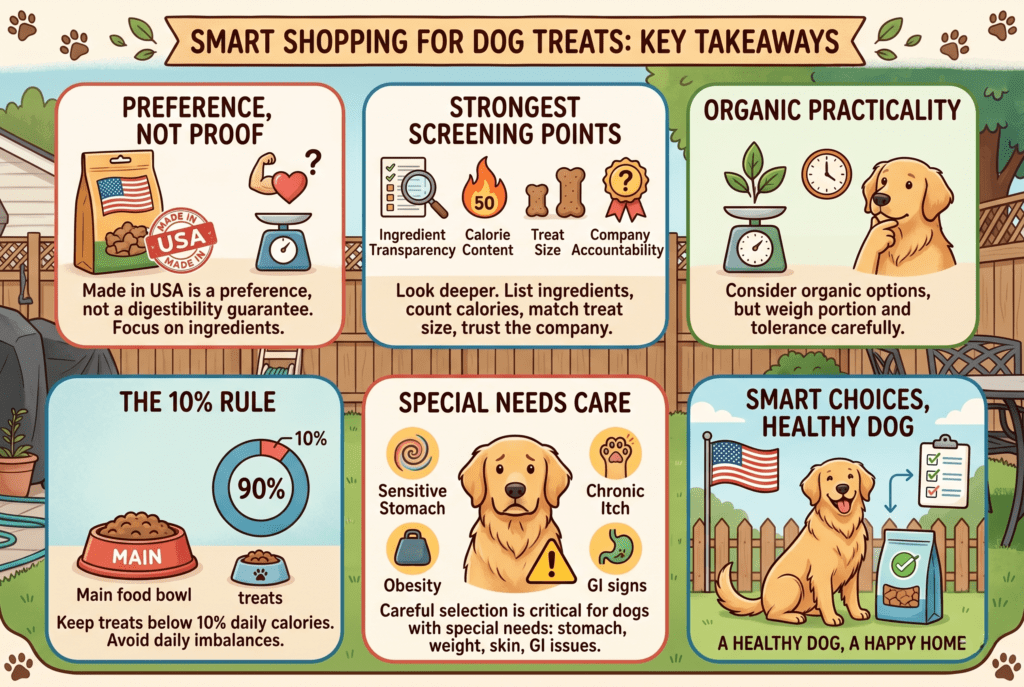
- “Made in the USA”: This is a reasonable shopping preference, but it does not automatically guarantee better digestibility or better nutrition.[1][2]
- What matters most: The strongest screening points are still ingredient transparency, calorie content, treat size and company accountability.[1][2][3]
- Organic context: Organic status may matter to some families, but it should be weighed alongside practical considerations such as portioning and tolerance.[2][4]
- Treat calories: Treats should generally remain at about 10% or less of daily calories to avoid crowding out the main diet.[1][3]
- Sensitive dogs: Dogs with sensitive stomachs, obesity, chronic itch or repeated GI signs need more careful treat selection than patriotic label language alone can provide.[4][5]
Introduction
Many American dog parents feel more comfortable buying treats made in the United States.
That instinct is understandable. When you know where a product is made, or at least feel you have a clearer route back to the company, it can create a sense of trust. For some families, buying U.S.-made dog products also aligns with broader purchasing habits and preferences about sourcing.
Still, it helps to keep that preference in perspective.
A U.S.-made organic treat can still be too rich, too large, too calorie-dense or poorly suited to your dog’s stomach. At the same time, a dog treat made in the USA may offer stronger confidence only when it is paired with something more concrete: a transparent label, practical feeding guidance and a company that takes formulation and quality seriously.[1][2]
What “Made in the USA” Can Tell You
In shopping terms, “made in the USA” can suggest closer familiarity with the brand, easier customer-service access and a supply chain some dog parents simply feel better about.
Why dog parents value it
It can feel more transparent. It can also make owners more likely to look deeper into company practices rather than buying anonymous products on price alone.
What it cannot tell you by itself
It does not confirm that the treat is low-calorie, digestible, appropriate for training or ideal for a sensitive-stomach dog. It also does not prove that the ingredient list is simple or that the company uses sound nutritional reasoning.[1][2][3]
Where Organic Fits Into the Decision
Organic and made-in-the-USA are often bundled together in marketing because both convey trust and quality to buyers.
That can be appealing, but they answer different questions. Organic is usually about ingredient sourcing standards, while made in the USA is about production location and, for some owners, accountability and familiarity.
The safer way to think about both labels
Treat them as supporting information, not final proof.
If the product is organic and made in the USA, that may satisfy part of your values-based checklist. It still needs to pass the practical dog-health checklist too.
The Checklist That Matters More Than Origin Alone
Ingredient transparency
WSAVA emphasizes the importance of company transparency and being able to evaluate the food or treat being fed.[1] If a brand leans heavily on a U.S.-made message but makes calories or full ingredients hard to find, the trust story is incomplete.
Calorie density
This is one of the easiest ways a “good” treat becomes an unhelpful one.
A natural, organic, U.S.-made treat can still become too much of the daily diet if the pieces are large or the calories are high. WSAVA and Tufts both support keeping treats to a level that does not exceed roughly 10% of the dog’s daily calories.[1][3]
Portion size and breakability
Small, easy-to-portion treats are more flexible than oversized ones, especially in households that use treats frequently for training or daily reinforcement.
Formula consistency
Dogs with stable stomachs may tolerate variety well, but dogs with GI sensitivity often do better when formulas are straightforward and consistent instead of constantly rotating.[4][5]
What Dog Parents Often Miss
“Made in the USA” does not mean “best for training”
A large biscuit may be perfectly nice as an occasional treat and still be a poor choice for repetitive training sessions.
“Organic” does not mean “weight-friendly”
Some of the most wholesome-sounding treats are calorie-dense and easy to overfeed.[1][3]
A familiar country of manufacture does not replace vet judgment
If your dog has a history of pancreatitis, food allergy, chronic diarrhea or obesity, you need more than a trustworthy-sounding product story.[4][5]
When U.S.-Made Treats May Be Especially Appealing
There are situations where a made-in-the-USA preference may feel especially important to dog parents.
When you want easier company accountability
Some owners prefer products from companies that feel easier to contact or research.
When you want simpler sourcing decisions
Buying from U.S.-made product lines can simplify shopping if you already use that filter for your household.
When you care about combining values and practicality
For many dog parents, the goal is not just nutrition. It is also confidence. That is valid, as long as the dog’s actual needs stay at the center of the decision.
Practitioner-Recommended Usage Guide
For dog parents comparing organic dog treats made in the USA, a practical approach looks like this.
Step 1: Use country of manufacture as a filter, not the final answer
Start with your preference, but then keep screening for calories, ingredients, size and company transparency.
Step 2: Check the intended use
A treat for occasional reward is different from a treat you plan to use 20 times during a training session.
Step 3: Start with conservative portions
Even a high-quality treat can cause problems when introduced too aggressively or fed too often.[3][4]
Step 4: Watch the dog’s response for several days
Monitor stool quality, appetite, energy and itch flare-ups if your dog is prone to food-related reactions.[4][5]
Step 5: Reassess honestly
Ask not only, “Do I like the label?” but also, “Did my dog actually do well on this?”
Safety
No label should give dog parents false confidence.
Dogs with active vomiting, diarrhea, a known history of food reactions, chronic GI disease, pancreatitis risk or excess weight deserve extra caution before any new treat trial.[1][3][4][5]
When to call a vet
Call your veterinarian if a new treat is followed by repeated vomiting, persistent diarrhea, appetite loss, blood in stool, lethargy or worsening skin signs.[4][5]
When to seek urgent care
Seek urgent help if your dog has severe vomiting, dehydration, profound weakness, collapse or significant abdominal pain after eating a new product.[4]
FAQ
Are dog treats made in the USA safer?
Dog treats made in the USA can offer meaningful peace of mind for many dog parents, especially when the brand is transparent, easy to contact, and clear about ingredients, calories, and sourcing. While “Made in the USA” alone does not automatically prove safety, it can be a valuable trust factor when paired with responsible formulation, clear labeling, and consistent quality practices.[1][2]
Are organic dog treats made in the USA healthier?
Organic dog treats made in the USA can be a thoughtful choice for families who want cleaner ingredient sourcing, fewer unnecessary additives, and more confidence in what they feed their dogs. Organic status does not replace portion control or individual tolerance, but it can support a more intentional treat routine when the formula is simple, appropriately portioned, and well tolerated.[2][3]
What should I check besides where a treat is made?
Start with the made-in-USA and organic labels as helpful trust signals, then look deeper. Check the ingredient list, calorie content, treat size, breakability, intended use, company transparency, and how your dog responds after eating it. The strongest treats combine values-based sourcing with practical dog-health benefits.[1][3][4]
Are U.S.-made treats better for sensitive stomachs?
U.S.-made treats may be especially appealing to sensitive dogs when they come from a transparent company and use a simple, consistent, natural-ingredient formula. Digestive tolerance varies by individual dog, so it is best to introduce any new treat gradually and monitor stool quality, appetite, and comfort.[4][5]
Are made-in-the-USA organic treats good for puppies?
They can be a good option when used mindfully. Puppies still need most of their daily calories from a complete puppy diet, but small portions of organic, natural, made-in-USA treats can be useful for bonding, rewarding, and training when the treats are easy to break, appropriately sized, and well tolerated.[3]
Conclusion
Buying organic dog treats made in the USA can be a thoughtful choice, but it should be a thoughtful choice for the right reasons.
For most dog parents, the real goal is not just origin. It is confidence plus common sense: clear ingredients, appropriate calories, realistic portioning and a treat your dog genuinely handles well and enjoys.
Explore More Dog Health Tips
- Organic Dog Treats with Natural Ingredients: What Actually Matters
- Top-Rated Organic Dog Treats: How to Choose Safely
- Limited-Ingredient Organic Dog Treats
- Organic Dog Treat Subscription Made Simple and Easy
- Best Training Dog Treats 2026: Vet-Reviewed Guide
References
- World Small Animal Veterinary Association. What are treats? Feeding treats to your dog. https://wsava.org/wp-content/uploads/2024/06/Feeding-treats-to-your-dog-v2.pdf
- U.S. Food and Drug Administration. Pet food. https://www.fda.gov/animal-veterinary/animal-foods-feeds/pet-food
- Tufts Cummings Petfoodology. Treat options for dogs and cats without unbalancing their diet. https://vetnutrition.tufts.edu/2021/12/treat-options-for-dogs-and-cats-without-unbalancing-their-diet/
- Merck Veterinary Manual. Disorders of the stomach and intestines in dogs. https://www.msdvetmanual.com/dog-owners/digestive-disorders-of-dogs/disorders-of-the-stomach-and-intestines-in-dogs
- Merck Veterinary Manual. Food allergy in dogs and cats. https://www.msdvetmanual.com/dog-owners/immune-disorders-of-dogs-and-cats/food-allergy-in-dogs-and-cats
