
Early Signs of Arthritis in Dogs: Subtle Changes Dog Parents Often Miss

Quick Answer
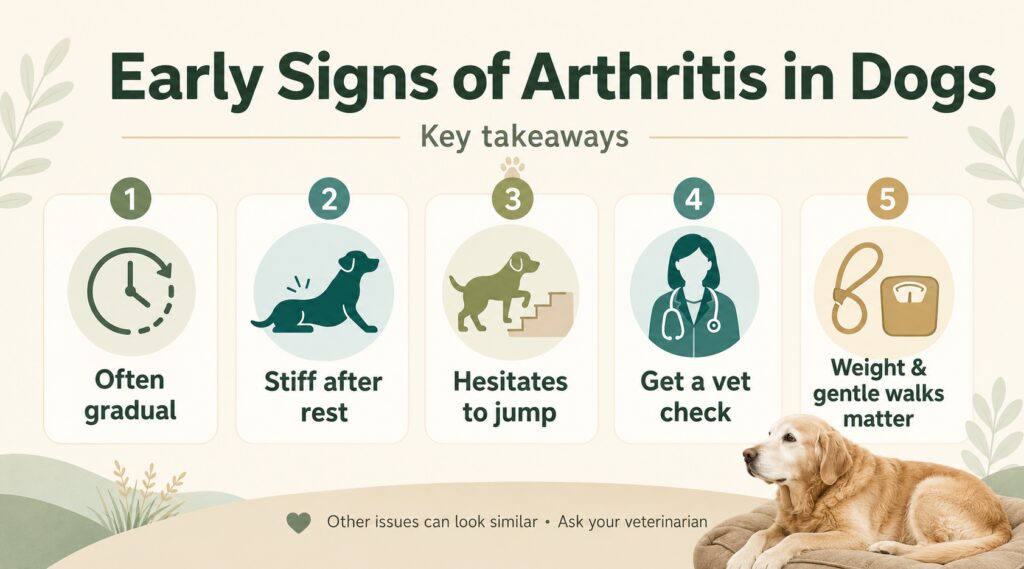
Early signs of arthritis in dogs often show up as subtle changes rather than dramatic limping. Stiffness after rest, slower movement, hesitation with stairs or jumping, shorter walks, and changes in mood or posture can all be indicators. If these signs persist, a veterinary exam is the safest next step.[1][2][3]
Trust Signal
By Superfood Science Writing Team | Reviewed by Dr. Kelly Hood, DVM | Last Updated: 06/12/2026
Superfood Science has produced organic and natural functional foods for humans and pets for over 20 years, specializing in clean-label formulations and evidence-based nutrition.
Key Takeaways
- Early arthritis signs are often quiet and gradual, not dramatic.[1][2]
- Stiffness after rest, slower movement, and reluctance to jump are common early clues.[1][2][3]
- Not every mobility change means arthritis. Injury, neurologic issues, paw pain, and other conditions can look similar.[2][3]
- Early veterinary assessment can help clarify the cause and guide safer next steps.[1][2]
- Weight control, regular low-impact movement, and consistency usually matter more than chasing quick fixes.[2][4]
Why early arthritis is easy to miss
Dogs often adapt before owners realize something has changed.
A dog may still walk, go outside, and still happily wag its tail, but take longer to get up or hesitate before jumping into the car. Because those changes develop gradually, many owners assume the dog is “just slowing down.”
That is exactly why early signs are worth noticing. Osteoarthritis is common in dogs, especially with age, previous injury, excess weight, or orthopedic stress. Earlier recognition may help owners and veterinarians manage comfort more thoughtfully.[1][2][4]
What arthritis means in practical terms
Arthritis, often called osteoarthritis in dogs, refers to long-term joint degeneration and inflammation that can reduce comfort and normal movement over time.[1][3]
The hips, knees, elbows, shoulders, and spine are all common locations. But the signs do not look identical in every dog. Some dogs show stiffness. Some show decreased interaction. Some show behavior change before obvious lameness.
Common early signs of arthritis in dogs
Stiffness after resting
A dog may look especially stiff when getting up after sleep, then loosen up after moving for a few minutes. That “warming up” pattern is one of the most common early owner observations.[1][2]
Slower movement or hesitation
Many dogs with early joint discomfort do not stop moving. They simply move more cautiously.
You may notice:
- taking longer to stand up
- hesitating before stairs
- pausing before jumping onto furniture or into the car
- turning more carefully
Shorter walks or less interest in play
A dog that used to want a longer walk may now slow down, lag behind, or seem ready to head home sooner.
That does not automatically prove arthritis, but it is a clue worth taking seriously when it becomes a pattern.[2]
Subtle gait or posture changes
Some dogs shorten their stride, shift weight differently, or carry themselves more stiffly.
These changes can be mild enough that owners do not think of them as “lameness,” but they still matter.
Behavior changes
Pain in dogs often shows up through behavior rather than vocalization.
Some dogs become quieter, more irritable, less social, or less tolerant of touch around certain body areas.[2][3]
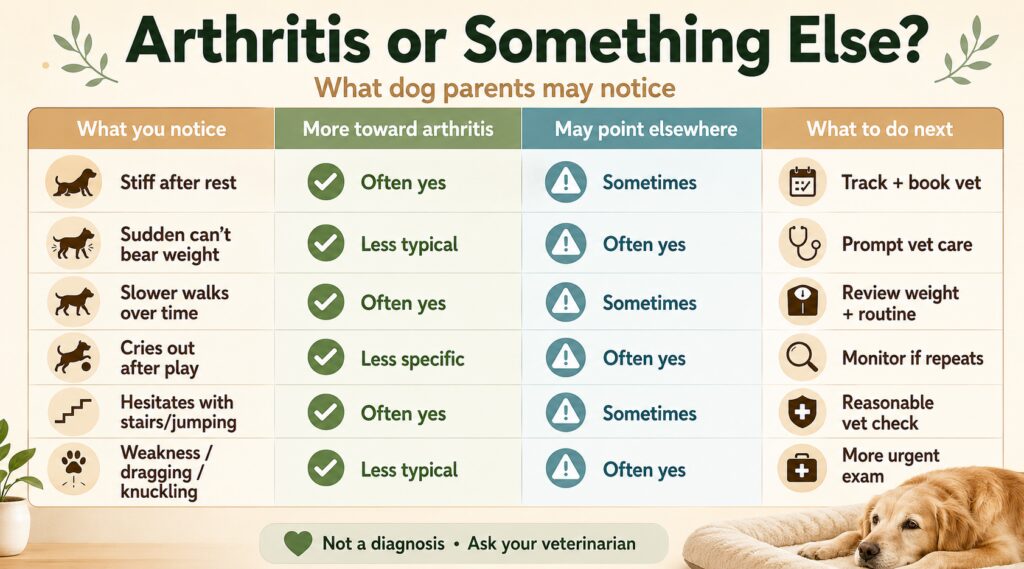
Decision table: what may point more toward arthritis and what may point elsewhere
| What you notice | More consistent with early arthritis | May suggest another issue too | What to do next |
| Stiff after rest, then loosens up | Often yes[1][2] | Sometimes | Track pattern and book a vet exam |
| Sudden non-weight-bearing lameness | Less typical | Often yes | Seek prompt veterinary evaluation |
| Slower walks over weeks or months | Often yes[1][2] | Sometimes | Review weight, movement, and history |
| Crying out once after rough play | Less specific | Often yes | Monitor closely and call vet if it repeats |
| Reluctance to jump, stairs harder | Often yes[1][2][3] | Sometimes | Veterinary assessment is reasonable |
| Weakness, dragging, or knuckling | Less typical | Often yes | Consider more urgent evaluation |
The point is not to diagnose arthritis based on a single sign. It is important to notice patterns early enough that the dog does not have to struggle silently.
What stronger evidence supports
Veterinary sources consistently note that osteoarthritis in dogs is common and that early signs can be subtle.[1][2][3]
The stronger support in this topic is for:
- recognizing gradual mobility and behavior changes as potentially meaningful[1][2]
- using veterinary examination and history to sort arthritis from other causes[2][3]
- focusing on multimodal management rather than one magic fix[2][4]
- treating body condition as an important part of joint stress and long-term comfort[2][4]
What early-stage owners often overlook
Many dog parents wait for a clear limp.
But by the time limping is obvious, the dog may already have been compensating for quite a while.
That is why the quieter clues matter:
- taking longer to stand
- sleeping more after activity
- choosing less slick surfaces or routes
- no longer wanting to jump
- seeming “less playful” without another obvious reason
These do not prove arthritis, but together they form the kind of picture that deserves attention.[1][2] Keeping a log or list of these changes may help see a pattern over time. Also, taking a video of concerning pet mobility issues and behavior can help your vet determine a cause and next steps for your pet’s comfort.
Weight and joint stress: why this matters so much
Even mild excess body weight can add mechanical stress to joints over time.[2][4]
This is one reason weight-conscious feeding and treat management matter in arthritis conversations. Joint support is not just about supplements or mobility products. It is also about not giving the joints more work than they need to carry.
That is not glamorous advice, but it is one of the most practical.
How Superfood Science Treat Options Fit This Topic

This section is educational brand positioning, not proof that any Superfood Science product treats arthritis, pain, or joint disease.
When a dog is showing early signs of mobility changes, the main priorities are veterinary assessment, weight management, a steady routine, and sensible daily management. Treats can still fit that picture, but they should fit it carefully.
Organic Turkey Dog Treats
For dog parents trying to keep a cleaner-label, more intentional reward routine, Superfood Science Organic Turkey Dog Treats may fit well when the goal is smaller, thoughtful rewards rather than constant snacking.
This line also includes beta-glucan-rich Agaricus blazei mushrooms — an ingredient researched for its immune-modulating properties. The beta-glucans in Agaricus blazei have been studied for their role in supporting normal immune function and helping maintain a balanced inflammatory response, both of which contribute to everyday joint wellness and overall comfort as dogs age. In a treat formulation, that contribution is best understood as ingredient-level functional support, not a treatment or preventive for any diagnosed condition.
Organic Chicken Dog Treats
For dogs that tolerate chicken well, Superfood Science Organic Chicken Dog Treats may fit a structured, portion-aware training or reward routine.
This recipe also features two well-recognized functional superfood ingredients — turmeric, valued for its natural anti-inflammatory properties, and flaxseed, a plant-based source of omega-3 fatty acids that may support joint health over time. Both are excellent additions to a clean-label formulation, and their inclusion gives this recipe a meaningful functional story while keeping the positioning honest: these are supportive superfood ingredients in a treat, not a medical treatment for arthritis.
Plant-Based Protein Dog Treats
For owners who want a different ingredient direction, Superfood Science Plant-Based Protein Dog Treats may offer another clean-label option to consider — and a particularly practical one for calorie-conscious rewarding as part of a joint-health routine.
At approximately 2.9 kcal per gram, this line sits at the lower end of treat calorie density — a meaningful advantage when excess body weight is adding mechanical stress to a dog’s joints. Chia and flaxseed are both omega-3-rich plant-based superfoods studied for their roles in supporting a normal inflammatory response and contributing to everyday joint wellness, while kelp adds trace minerals to the broader plant-based functional profile. The result is a treat that pairs low-calorie practicality with functional ingredient depth — a combination that fits naturally into a thoughtful, weight-aware feeding routine for dogs with early mobility concerns.
The strongest compliant brand position is this: Superfood Science offers dog parents cleaner-label treat options that fit into a thoughtful, mobility-supportive routine, but the bigger drivers are veterinary guidance, weight control, and sensible daily management.
Limitations and research gaps
There is good veterinary guidance on osteoarthritis recognition, body condition influence, and multimodal management.[1][2][3][4]
But not every dog with stiffness has arthritis, and not every early-stage case looks the same. Age, breed, body type, orthopedic history, fitness level, and pain expression all influence what owners see at home.
That is why home observations are valuable, but they still need veterinary interpretation.
Practitioner-Recommended Usage Guide
If you suspect early arthritis, start by observing patterns rather than making ten changes at once.
Notice when stiffness happens, how long it lasts, whether stairs are harder, whether the dog is walking less, and whether weight may be creeping up. A simple written log can be surprisingly useful during the veterinary visit.
Keep activity regular but moderate. Short, controlled walks are usually easier to evaluate than occasional high-impact bursts. Avoid sudden marathon outings.
Use treats more intentionally, not more generously. If the dog is moving less than before, the treat plan may also need to become more calorie-conscious.
Safety and when to call a vet
Call your veterinarian if your dog has persistent stiffness, repeated limping, reluctance to move, trouble rising, or clear changes in activity or temperament that suggest discomfort.[1][2][3]
Seek more urgent care if your dog cannot bear weight, has sudden severe lameness, cries out in pain, drags a limb, shows neurologic signs, or seems acutely injured.
Puppies and younger dogs with mobility changes should also be evaluated sooner, because developmental or orthopedic issues can mimic “arthritis-like” signs.
FAQs
What are the first signs of arthritis in dogs?
Common early signs include stiffness after rest, slower movement, reluctance to jump, shorter walks, and subtle behavior changes.[1][2]
How do I know if my dog has joint pain or is just getting older?
Aging and joint pain can look similar, which is why persistent changes in movement, posture, or comfort deserve veterinary review.[1][2][3]
At what age do dogs start getting arthritis?
Arthritis is more common in older dogs, but it can appear earlier depending on breed, body condition, injury history, and joint health.[1][3]
Should I still walk my dog if I suspect arthritis?
In many cases, controlled, moderate exercise remains useful, but intensity and duration may need adjustment. Ask your veterinarian what would be most beneficial for your dog.
Can treats affect a dog with arthritis?
Yes. Treats matter because excess calories can contribute to weight gain, which can put stress on joints over time.[2][4]
Conclusion
Early signs of arthritis in dogs are often quieter than owners expect.
A little stiffness, a little hesitation, or a little less enthusiasm may not seem dramatic, but together they can be meaningful.
That is why earlier attention matters. Not because every slow morning means arthritis, but because dogs are good at adapting and not very good at telling us when something hurts.
Explore More Dog Health Tips
- Signs Your Dog May Be Overweight
- How to Tell if Your Dog Is in Pain
- Natural Joint Support for Dogs
- Fish Oil and Joint Stiffness in Dogs
- When to Call a Vet for Limping
References
- American College of Veterinary Surgeons. Osteoarthritis in dogs. ACVS. https://www.acvs.org/small-animal/osteoarthritis
- American Animal Hospital Association. Mobility and osteoarthritis guidance. AAHA. https://www.aaha.org
- MSD Veterinary Manual. Osteoarthritis in dogs. MSD Veterinary Manual. https://www.msdvetmanual.com/musculoskeletal-system/lameness-in-dogs/osteoarthritis-in-dogs
- VCA Animal Hospitals. Overweight, obesity, and pain in dogs: overview. VCA. https://vcahospitals.com/know-your-pet/overweight-obesity-and-pain-in-dogs-overview
