
Are Organic Dog Treats Worth It? (2026 Vet-Reviewed Guide)
Quick Answer
Yes, organic dog treats can be worth it for owners who want clearer sourcing standards, fewer synthetic-sounding ingredients and a cleaner everyday treat routine. But the real value depends on the formula, calories, texture and how well the treat fits your dog’s needs. Organic is a meaningful quality signal, but it does not automatically make a treat right for every dog.
Trust Signal
By Superfood Science Writing Team | Reviewed by Dr. Kelly Hood, DVM | Last Updated: 04/22/2026 Superfood Science has produced organic and natural functional foods for humans and pets for over 20 years, specializing in clean-label formulations and evidence-based nutrition.
Key Takeaways
- Organic dog treats can be worth the extra cost when you value certified ingredient sourcing and simpler product recipes.
- The best treat is not just organic. It should also be easy to portion, easy to chew and appropriate for your dog’s digestion and calorie needs.
- Treats should stay a small part of the daily diet, not a nutritional replacement for complete and balanced food.
- If a product uses the USDA Organic seal, the organic claim carries more weight than vague “natural” marketing language.
- For many dog owners, the biggest benefit of organic treats is trust, not magic.
Introduction
Dog owners often ask whether organic dog treats are truly worth it or whether they are just a premium label.
The honest answer is that organic treats can be worth it, but only when you understand what you are paying for. Organic does not mean perfect. It does not guarantee lower calories, fewer reactions or better taste for every dog. What it can offer is stronger ingredient sourcing standards, a cleaner label impression and often a simpler style of product that appeals to owners trying to make more intentional choices.
That matters because treats are not a minor detail. They are used in training, daily routines, rewards and bonding. A dog that receives multiple treats each day is not just sampling a product occasionally. That dog is consuming those ingredients regularly.
So the better question is not whether organic dog treats are always better. The better question is whether they are worth it for your dog, your budget and the way you actually use treats.
What You Are Really Paying For
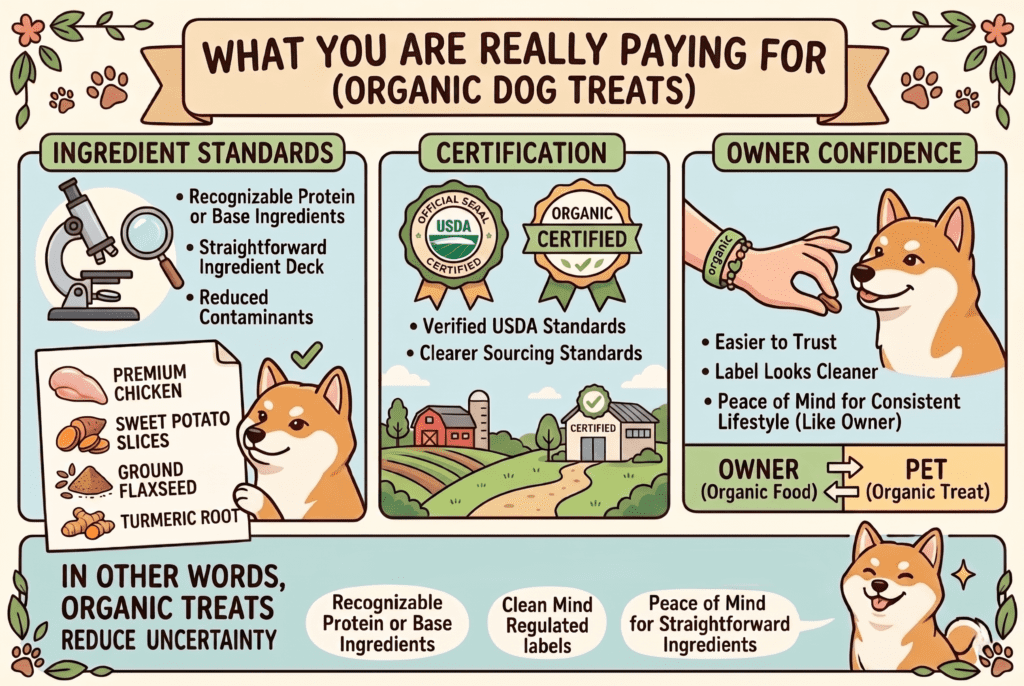
When you buy organic dog treats, you are usually paying for a combination of ingredient standards, certification and owner confidence.
For many shoppers, the main appeal is not that an organic treat will transform their dog overnight. It is that the product feels easier to trust. The label often looks cleaner. The ingredient list may feel more straightforward. The sourcing standards may be clearer. That can be especially appealing for dog owners who already choose organic foods for themselves and want that same consistency for their pets.
In other words, organic treats are often worth it because they reduce uncertainty.
When Organic Dog Treats Make the Most Sense
Organic dog treats tend to make the most sense in a few practical situations.
For daily treat users
If you use treats multiple times per day for training, reinforcement, or habit-building, ingredient quality becomes more relevant. A once-a-month indulgence is one thing. A daily training routine is another.
For ingredient-conscious households
Some owners simply want dog treats that align with the rest of their shopping habits. If you already prefer organic pantry foods, organic produce, or cleaner-label snacks, organic dog treats may feel like the most natural extension of that lifestyle.
For dogs who do better with simpler formulas
Not every organic treat is limited ingredient, but many organic products are formulated in a way that feels less cluttered and easier to understand. That can help owners compare formulas more confidently.
When Organic Dog Treats May Not Be Worth the Extra Cost
Organic treats are not automatically the best value in every case.
If a dog needs ultra-specific veterinary nutrition support, a specialized non-organic product may be a better fit. If a treat is organic but too large, too calorie-dense, or too hard for your dog to chew comfortably, the organic label does not solve those issues.
Price also matters. If paying extra for organic treats causes you to use them less effectively, skip better portion control, or avoid products your dog actually enjoys, the premium may not deliver much real-world value.
The smartest approach is to compare the full package: ingredients, calories, size, palatability, flexibility, texture and consistency.
How to Decide if They Are Worth It for Your Dog
A simple filter works well.
Ask yourself:
- Is this a daily-use treat or only an occasional reward?
- Does my dog need a softer texture, smaller size or easier chew?
- Is the ingredient list easy to understand?
- Is the calorie level realistic for how often I give treats?
- Do I care enough about certified sourcing to justify the price difference?
If the answer to most of those questions is yes, organic dog treats may be worth it for you.
Clinical Note
Organic dog treats may be most useful when they improve the overall quality of your everyday feeding habits. The biggest practical benefits are often clearer sourcing standards, easier label trust and better owner confidence rather than dramatic physiological effects.
Practitioner-Recommended Usage Guide
Use organic treats the same way you would use any good treat: intentionally.
Choose treats that are small or easy to break. Keep portions modest. Use them to reinforce behavior, not to fill nutritional gaps. If a treat becomes a frequent daily reward, check calorie information and adjust meal portions when needed.
FAQs
Are organic dog treats healthier?
Not automatically. Organic relates to how ingredients are sourced and certified. A treat can be organic and still be too high in calories or poorly matched to your dog’s needs.
Are organic dog treats better for sensitive dogs?
Sometimes, but not always. A simpler formula may help some dogs, but organic alone does not guarantee digestive compatibility.
Why do organic dog treats usually cost more?
They often cost more because of ingredient sourcing, certification standards and smaller-batch production.
Should I switch all treats to organic?
Not necessarily. It makes the most sense when treats are used often and when the formula, texture and calories also work well for your dog.
Conclusion
Organic dog treats are worth it when they give you something practical in return: better trust in the label, better fit for your dog and better day-to-day consistency in how you reward your dog.
They are not worth buying just because the packaging sounds premium. They are worth buying when the full product makes sense.
If you want an everyday option that feels cleaner, simpler, and easier to trust, organic dog treats can be a smart upgrade.
Explore More Dog Health Tips
- Best Soft Organic Dog Treats
- How to Choose Soft Dog Treats for Training
- Limited-Ingredient Organic Dog Treats
- Best Low-Calorie Dog Treats for Daily Rewards
- Plant-Based Dog Treats: When Do They Make Sense?
References
- World Small Animal Veterinary Association. Feeding treats to your dog. 2025.
- Association of American Feed Control Officials. Organic.
- Association of American Feed Control Officials. Treats and Chews.
- U.S. Food and Drug Administration. Animal Food Labeling and Pet Food Claims. 2026.
- U.S. Food and Drug Administration. Pet Food.
