
Organic Dog Treats with Natural Ingredients: What Actually Matters for Your Dog
Quick Answer
Organic dog treats made with natural ingredients can be a smart choice for dog parents who want cleaner sourcing, more recognizable ingredients and greater confidence in what they feed their dogs. Still, “organic” and “natural” work best when they are paired with practical label checks: ingredient transparency, calorie content, treat size, formula consistency and how the product fits within a complete and balanced diet. The best choice is not just a treat that sounds wholesome, but one that uses thoughtful ingredients and works well for your individual dog.[1][2][3][4]
Featured Snippet Block
Organic dog treats with natural ingredients can support a cleaner, more transparent treat routine when they are made with clearly identified ingredients, appropriate calories, practical treat size and a consistent formula your dog tolerates well.
Trust Signal
By Superfood Science Writing Team | Reviewed by Dr. Kelly Hood, DVM | Last Updated: 04/27/2026
Superfood Science has produced organic and natural functional foods for humans and pets for over 20 years, specializing in clean-label formulations and evidence-based nutrition.
This article follows the current dogs.superfoodscience.com workflow and uses conservative guidance from WSAVA, FDA, AAFCO consumer resources, Tufts Petfoodology and Merck Veterinary Manual. It is written to help American dog parents shop more intelligently without overclaiming health benefits that standard treat labels do not prove.[1][2][3][4][5]
Key Takeaways
- Organic and natural-ingredient dog treats can be a thoughtful upgrade for dog parents who value cleaner sourcing and recognizable ingredients.[1][2]
- Organic may be a meaningful sourcing preference, especially when combined with clear labeling, appropriate calories and a formula that fits your dog’s needs.[2][4]
- Natural ingredients are easiest to evaluate when the label is transparent: what is in the treat, how many calories each piece contains and how your dog actually tolerates it.[1][3]
- Treats should generally stay below about 10% of daily caloric intake to avoid overfeeding.[1][3]
- Dogs with persistent vomiting, diarrhea, weight loss, food sensitivity concerns or chronic itch need more than a marketing promise and may need veterinary evaluation.[4][5]
Introduction
Savvy pet parents should familiarize themselves with the components of label language to best serve their dog.
One package says “natural ingredients.” Another says “organic.” Another promises ancient grains, superfoods, human-grade sourcing or limited ingredients. On first glance, those words can make a treat seem healthier before you even turn the bag over.
But dog nutrition does not happen on the front panel.
What matters most is the full context: the actual ingredient panel, calorie density, treat size, feeding pattern and whether your dog does well on it. A beautiful ingredient list and heartfelt marketing story does not automatically translate into better digestion, healthier weight or safer daily use.
What “Natural Ingredients” Usually Means in Real Shopping Language
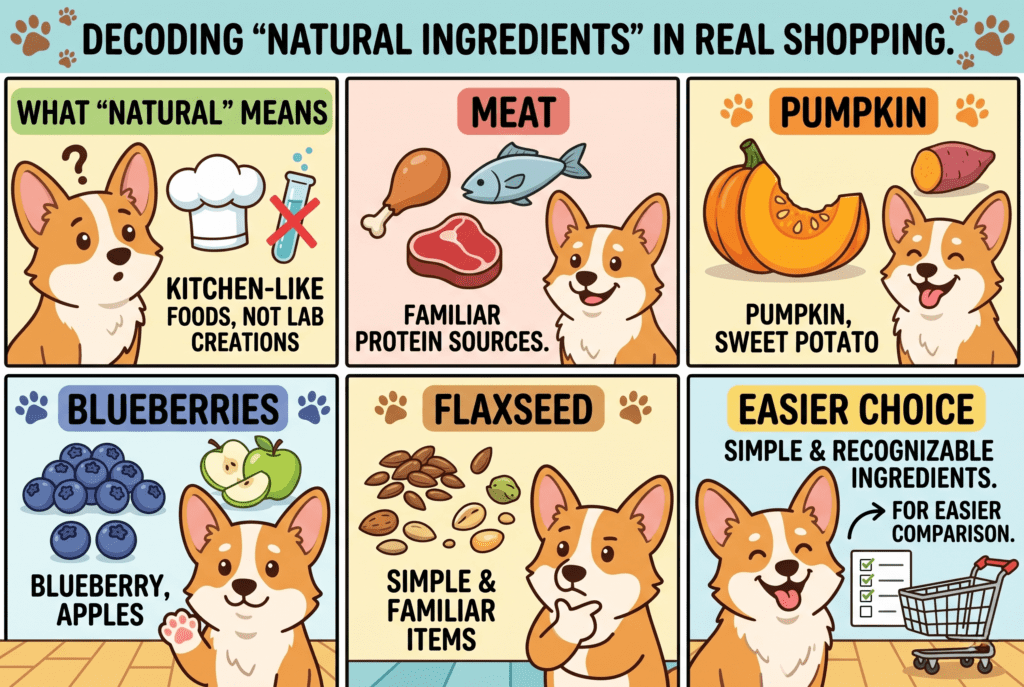
For most dog parents, “natural ingredients” suggests foods that sound closer to the kitchen than the lab.
That can include meat, sweet potato, pumpkin, kelp, apples, flaxseed, or other familiar-sounding items. There is nothing wrong with appreciating that. In fact, simple and recognizable ingredients can make comparison easier.
The catch
Recognizable does not necessarily mean lower calorie, lower fat, greater digestibility or safer for puppies or sensitive dogs.
A jerky-style treat made from recognizable ingredients can still be rich. A baked biscuit with “natural ingredients” can still be oversized. A label with five trendy botanicals can still create more variables than a simpler formula.
Where Organic Fits In
Organic certification can be a meaningful quality signal because it reflects how ingredients are sourced, handled, and labeled under applicable standards. For dog parents who prioritize cleaner sourcing and ingredient integrity, organic is a valuable starting point, especially when paired with the right treat size, calorie level, digestive fit, and long-term feeding routine.[2]
A helpful mindset
Think of organic as one attribute, not the final verdict.
It may matter to you for sourcing reasons. It should still compete with other equally important questions, like portion size, digestibility and whether the brand gives clear calorie information.
The Label Features That Matter More Than Buzzwords
Ingredient transparency
WSAVA nutrition guidance emphasizes transparency and practical assessment over front-of-package excitement.[1] If a company makes it hard to see the full ingredient list, that is not ideal.
Why transparency matters
A short, understandable list makes it easier to assess possible triggers, compare products and spot whether the treat is really as simple as the marketing suggests.
Calorie content
This is one of the most important and most ignored parts of treat shopping.
Treats can be nutritionally minor and still become metabolically major if they are fed too often. WSAVA and Tufts both emphasize that treats should generally stay at or below about 10% of daily calorie intake.[1][3]
Real-world example
A “clean” treat that is twice as calorie-dense as you expected may still work against your goals if your dog is training frequently or already carrying extra weight.
Treat size and breakability
American dog parents often use treats for reinforcement, not just for occasional reward. That changes the ideal format.
A large natural biscuit may sound wholesome, but it is less practical for training than a smaller treat that breaks cleanly into tiny pieces.
Formula consistency
Dogs with stable stomachs may tolerate variation well. Dogs with sensitive stomachs often do better when formulas are straightforward and consistent rather than rotating through many “natural” extras.[4][5]
Common Ways Natural-Ingredient Marketing Gets Overstated
“If I recognize it, it must be better”
Not always. Familiar-sounding ingredients can still be calorie-dense, fatty or present in combinations that do not suit your dog.
“Organic means gentle on the stomach”
Not necessarily. Digestive tolerance depends on the whole recipe and the individual dog, not just whether an ingredient was organically sourced.[2][4]
“Superfoods make it healthier”
This is where dog parents need to stay grounded. Small amounts of trendy plant ingredients do not automatically transform a treat into a health intervention.
“Natural” means I can feed more of it
This is one of the most common mistakes. A natural-ingredient treat still counts as a treat and should still fit within your dog’s overall daily calorie budget.[1][3]
What Dog Parents Should Ask Before Buying
Is the protein source clearly identified?
A clearly named protein can make a formula easier to understand than vague flavor-forward wording.
Is the treat small enough for the way I plan to use it?
This matters a lot for training and households that reward often.
Are calories listed clearly?
If not, you are shopping partly blind.
Does the ingredient list look simple or crowded?
A simpler formula list is not always better, but it is often easier to evaluate.
Has my dog done well with similar ingredients before?
This question is more valuable than general popularity or social-media hype.
Natural Ingredients and Sensitive Stomachs
This is the place where dog parents most often want certainty.
A dog with loose stool, gas or vomiting after treats can make anyone want the cleanest-sounding bag on the shelf. But the evidence-based answer is still practical rather than magical: many sensitive dogs do better with smaller amounts, simpler formulas and careful introduction rather than broad claims about “naturalness.”[4][5]
What helps more than label romance
- one new treat at a time
- tiny trial portions
- stable main diet
- tracking stool and appetite for several days
Practitioner-Recommended Usage Guide
For most dog parents, this is a smart way to use natural-ingredient or organic treats.
Step 1: Treat the label like data
Read ingredients, calories and feeding directions before looking at the front-of-bag story.
Step 2: Decide the use case
Are you using this for training, occasional reward or something in between? A good fit for one job may be a poor fit for another.
Step 3: Start smaller than you think you need
A conservative first trial gives you more information and less digestive risk.[3][4]
Step 4: Keep the main diet stable
Changing food and treats at the same time makes it harder to interpret any reaction.
Step 5: Watch the dog, not just the brand promise
Your dog’s stool quality, appetite, energy, skin comfort and weight trend matter more than inspirational packaging.
Safety
Do not assume that “natural ingredients” means unlimited safety.
Dogs with obesity, pancreatitis history, chronic GI symptoms, suspected food allergy or a pattern of treat-related loose stool deserve extra caution.[1][3][4][5]
Treats also should not crowd out the main diet. Too many extras can unbalance overall nutrition even when the ingredients sound wholesome.[3]
When to call a vet
Contact your veterinarian if a new treat is followed by repeated vomiting, persistent diarrhea, appetite loss, worsening itch, blood in stool or decreased energy.[4][5]
When to seek urgent care
Seek urgent help if your dog has severe vomiting, dehydration, collapse, marked abdominal pain or rapid decline after eating a new product.[4]
FAQ
Are organic dog treats healthier than natural dog treats?
Not automatically. Organic and natural describe different classifications, but neither label alone proves better nutrition, better digestion or a better fit for your dog.[1][2]
What matters more than the ingredient story?
Calorie content, treat size, ingredient transparency, formula consistency and your dog’s real-world tolerance usually matter more.[1][3][4]
Can natural-ingredient treats still cause stomach upset?
Yes. Even treats with recognizable ingredients can trigger loose stool, gas or vomiting in some dogs.[4][5]
Are natural-ingredient treats good for training?
They can be, but only if they are small enough or easy to break and low enough in calories for repeated use.[1][3]
Should I avoid long ingredient lists?
Not always, but longer lists can create more variables and may be harder to evaluate in dogs with food sensitivity concerns.
Conclusion
Natural-sounding ingredients can be part of a thoughtful dog treat choice, but they are not the whole story.
For dog parents who want something safer, smarter and more useful, the real question is not whether a treat sounds wholesome. It is whether the label is transparent, the calories are manageable and the dog actually thrives on it.
Explore More Dog Health Tips
- Top-Rated Organic Dog Treats: How to Choose Safely
- Are Organic Dog Treats Worth It in the Long Run?
- Organic Dog Treats by Size: 2026 Guide for Small to Large Dogs
- Homemade vs. Store-Bought Organic Dog Treats
- Organic Dog Treat Subscription Made Simple and Easy
References
[1] World Small Animal Veterinary Association. What are treats? Feeding treats to your dog. https://wsava.org/wp-content/uploads/2024/06/Feeding-treats-to-your-dog-v2.pdf
[2] U.S. Food and Drug Administration. Pet food. https://www.fda.gov/animal-veterinary/animal-foods-feeds/pet-food
[3] Tufts Cummings Petfoodology. Treat options for dogs and cats without unbalancing their diet. https://vetnutrition.tufts.edu/2021/12/treat-options-for-dogs-and-cats-without-unbalancing-their-diet/
[4] Merck Veterinary Manual. Disorders of the stomach and intestines in dogs. https://www.msdvetmanual.com/dog-owners/digestive-disorders-of-dogs/disorders-of-the-stomach-and-intestines-in-dogs
[5] Merck Veterinary Manual. Food allergy in dogs and cats. https://www.msdvetmanual.com/dog-owners/immune-disorders-of-dogs-and-cats/food-allergy-in-dogs-and-cats
