
Chicken Allergy in Dogs vs Food Sensitivity: How to Tell the Difference | Vet-Reviewed Guide

Quick Answer
Chicken allergy in dogs and chicken sensitivity are not always the same thing. A true food allergy involves an immune reaction to a dietary ingredient, while sensitivity or intolerance may cause digestive upset or other signs without the same mechanism. The most reliable way to tell the difference is a structured elimination-challenge diet trial under veterinary guidance.1234
Trust Signal
By Superfood Science Writing Team | Reviewed by Dr. Kelly Hood, DVM | Last Updated: 06/05/2026
Superfood Science has produced organic and natural functional foods for humans and pets for over 20 years, specializing in clean-label formulations and evidence-based nutrition.
Key Takeaways
- A dog that seems to do poorly with chicken does not necessarily mean chicken allergy in dogs is the cause.12
- Food allergy and food sensitivity can look similar at home, especially when itching, ear flare-ups, vomiting, or loose stool appear after meals or treats.123
- The most reliable diagnostic approach is a strict elimination-challenge diet trial, not internet guesswork or non-validated at-home testing.234
- Chicken is a common ingredient in dog foods and treats, so frequent exposure may be one reason it becomes a common suspect in food-reaction discussions.14
- If symptoms are ongoing, random switching of dog treats is usually less useful than a more controlled veterinary plan.23
Introduction
Dog parents often use the word allergy when what they really mean is, “My dog does not seem to do well with this food.”
That is understandable.
A dog gets itchy after chicken treats, develops loose stool, or has recurring ear issues. Then the obvious question becomes whether chicken allergy in dogs is the problem.
The challenge is that two different situations can look very similar at home.
A dog may have a true food allergy. Or the dog may simply have a food sensitivity, ingredient intolerance, richness issue, or overfeeding problem that is not a classic immune allergy response.
That is why the most useful question is not, “Is my dog allergic to chicken?” It is, “What is the most reliable way to tell whether chicken is truly the culprit?“
What Chicken Allergy in Dogs Means
A food allergy is generally understood as an adverse reaction to food with an immune component.14
MSD Veterinary Manual notes that commonly reported food allergens in dogs include beef, dairy products, chicken, wheat, and lamb.1 The inciting factor is most often the main protein source. That does not mean every dog reacts to chicken. It means chicken is a reasonable ingredient to question when a dog has a repeatable pattern involving itch, ears, skin, or digestive signs that seems connected to food.12
What Food Sensitivity or Intolerance Means
Food sensitivity is often used in looser terms.
Usually, owners notice that a dog seems to have loose stools, gas, vomiting, or indigestion after certain foods or treats. That is important to note; however, it is not necessarily proof of a classic food allergy.
A dog may react to formula richness, fat level, portion size, ingredient complexity, or abrupt treat changes without having a true immune-mediated allergy.23
Why Chicken Comes Up So Often
Chicken is both common and, therefore, commonly questioned.
It is included in many dog foods, training treats, chewable supplements, and flavored products. Because dogs are exposed to it so often, owners are more likely to notice and blame it when a food-related pattern seems possible.
There is also a useful biological reason to explain this cautiously. Immune reactions can only happen to ingredients the dog has actually been exposed to. So when a protein is fed frequently over time, it naturally becomes a more common suspect in food-reaction discussions. That does not prove chicken is bad or uniquely problematic. It simply helps explain why repeated exposure makes chicken a familiar target when owners are trying to connect symptoms to food.14
Comparison Table: Chicken Allergy in Dogs vs Food Sensitivity
The point is not that one category matters more than the other. It is that the safest way to separate them is through a structured process rather than assumptions.
| Feature | True Food Allergy | Food Sensitivity / Intolerance |
| Mechanism | Immune-mediated reaction to a specific dietary protein | Non-immune adverse reaction — may involve richness, fat, or intolerance |
| Common signs | Itching, ear flare-ups, skin changes, sometimes GI upset | Loose stool, gas, vomiting, inconsistent digestion |
| Diagnosis | Structured elimination-challenge diet trial under vet guidance | Often managed with dietary simplification; full trial if signs persist |
| Reliable testing | Elimination-challenge trial only; blood/saliva tests not validated | No single validated test; process of elimination most useful |
| Next step | Veterinary-guided elimination trial with hydrolyzed or novel protein diet | Simplify diet, reduce treat frequency, monitor response |
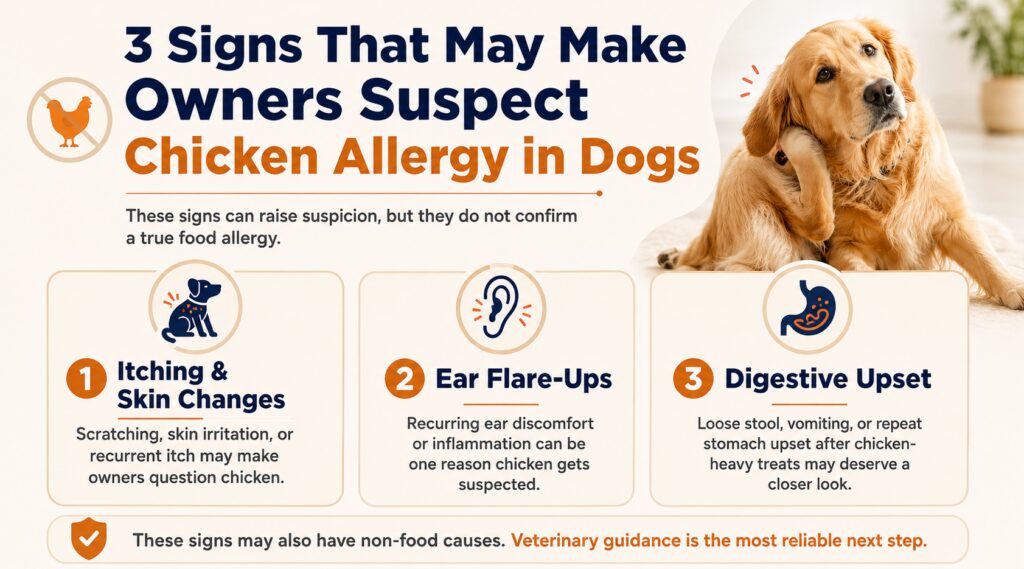
3 Signs That May Make Owners Suspect Chicken Allergy in Dogs
Several signs commonly lead owners to question chicken as an ingredient — but none of these signs alone confirms a true food allergy. Each one may also reflect environmental triggers, infections, or other non-food causes.124
Itching and Skin Changes
Food-related skin reactions can show up as pruritus, recurrent skin irritation, or ear flare-ups.14 But itching is not specific to food. Environmental allergy, flea allergy, secondary infection, and other skin disorders can look similar.
Ear Flare-Ups
Recurring ear inflammation is one of the patterns owners often notice during food-allergy workups. But it is still not specific enough to confirm chicken as the main culprit.
Digestive Upset
Loose stool, vomiting, or repeated stomach upset after chicken-heavy treats may make chicken worth questioning. That still does not prove a true allergy. It only tells you the ingredient or formula deserves a closer look.23
The Only Reliable Way to Tell Whether It Is Chicken Allergy in Dogs: Elimination-Challenge Diet Trial
The elimination-challenge diet trial is the only veterinary-endorsed method for confirming a true food allergy — not a casual treat swap, a short home experiment, or an online allergy checklist.234
VCA explains that the only reliable way to determine a true food allergy is through an elimination-challenge diet trial.23 MSD Veterinary Manual gives similar guidance, noting that diagnosis requires feeding a limited-ingredient or hydrolyzed diet and monitoring whether the signs resolve, followed by challenge testing when appropriate.4
That means the answer does not come from a casual treat switch, a one-week internet experiment, or a quick online checklist. It comes from a controlled feeding process.
A Casual Home Switch Is Not the Same as a True Veterinary Elimination Trial
A casual treat switch is not the same as a formal veterinary elimination-challenge diet trial, and confusing the two is one of the most common mistakes owners make during food-reaction investigations.234
A home switch might mean replacing chicken treats with turkey treats and seeing whether there is a noticeable reduction in clinical signs. That can sometimes be a useful observation, but it is not the same thing as a real diagnostic elimination trial.
A strict veterinary elimination trial is much more comprehensive. It often requires a prescription hydrolyzed diet or a carefully selected limited-ingredient diet, with extra foods or treats usually prohibited unless the veterinarian specifically approves them.234
So if you are trying to confirm a food allergy, a few better-looking weeks after swapping treats does not definitively answer the question.
Why Random Switching Usually Makes Things Harder
One of the biggest mistakes owners make is changing too many things at once.
They remove chicken, add turkey, change the main food, start supplements, switch treats, and adjust toppers all in the same week. If the dog improves, nobody really knows what helped.
This is why structured trials matter — they reduce noise and are systematic. A good diagnostic process is less exciting than guessing, but much more useful.2356
What Stronger Evidence Supports, and What It Does Not
The stronger support in this topic is for:
- recognizing that food allergy and food sensitivity are not always the same thing124
- using elimination-challenge trials to confirm food allergy234
- avoiding reliance on unproven food-allergy tests2
What the evidence does not strongly support is the assumption that any itching or loose stool after chicken necessarily proves a chicken allergy. That leap is common, but it is not the same as a diagnosis.
How Superfood Science Treat Options Fit This Topic
Superfood Science offers multiple clean-label treat options that may fit different points in a dog’s food-reaction journey — always alongside veterinary guidance, never as a replacement for it.567
If a dog is actively itchy, repeatedly vomiting, having chronic diarrhea, or already undergoing a formal food-allergy workup, the answer is not to keep testing random treats just because they are natural or organic. Ongoing symptoms still require veterinary guidance and a more controlled plan.
Organic Turkey Dog Treats
If chicken is the ingredient being questioned for suspected chicken allergy in dogs, Superfood Science Organic Turkey Dog Treats are often a sensible first option to consider. The strongest compliant claim is not that turkey resolves the allergy. It is that a simpler turkey-based, natural-and-organic treat may be a more logical next trial when owners want to move away from chicken while keeping the ingredient story cleaner.
This recipe can also be discussed through its more intentional formulation approach, including beta-glucan-rich Agaricus mushrooms. In a dog treat, that ingredient is best understood as part of the recipe’s broader functional ingredient profile, not as a medical treatment.
Organic Chicken Dog Treats
Not every dog who eats chicken has a problem with chicken. For dogs that tolerate chicken well, Superfood Science Organic Chicken Dog Treats can still fit a clean-label routine.
This line can also be positioned through ingredients such as turmeric and flaxseed as part of a more intentional formulation story. The stronger message is not ‘always abandon chicken.’ It is ‘keep chicken where it clearly works, and change direction where it does not.’
Plant-Based Protein Dog Treats
For some owners, a different ingredient direction sounds more appealing during a reset phase. In those cases, Superfood Science Plant-Based Protein Dog Treats may offer another clean-label option to consider once the dog is stable and normal treat use is appropriate.7
This product line brings in ingredients such as kelp, chia, and flaxseed as part of its plant-based functional ingredient profile. That may appeal to ingredient-conscious families who want a different formulation direction while still respecting tolerance and portion control.
The strongest compliant brand position is this: Superfood Science offers more than one thoughtful, natural-and-organic treat path, but individual tolerance and veterinary guidance still come first when it comes to food sensitivities and nutrition.
Limitations and Research Gaps
There is strong veterinary guidance around how food allergy should be diagnosed and how unreliable shortcut testing can be.124
But real-world dog cases are still messy. Classic signs such as itching or loose stool can come from many causes. Dogs can react to formula richness, not just a named protein. And owners often use the word “allergy” differently from how veterinarians use it.
That is why even a careful, evidence-based article cannot confirm chicken allergy in dogs at home — only a structured veterinary process can do that.
Practitioner-Recommended Usage Guide
If you suspect chicken allergy in dogs, avoid making several changes at once.
Write down the main signs you are seeing — especially itching, ear issues, vomiting, stool changes, and timing after meals or treats. Then speak with your veterinarian about whether the pattern sounds more like a true food allergy or a broader GI tolerance issue.124
If a controlled reintroduction phase is appropriate later, use one simple treat direction at a time. For many owners, that means trialing a turkey-based or other clearly different protein option in small amounts rather than mixing several new products.56
If your veterinarian is running a formal food-allergy elimination trial, follow that plan strictly and do not assume that an over-the-counter treat swap counts as the same thing.234
Safety and When to Call a Vet
Call your veterinarian sooner rather than later if your dog has chronic itching, repeated ear flare-ups, vomiting, ongoing diarrhea, weight loss, poor appetite, or symptoms that keep recurring around food changes.124
Seek more urgent care if your dog has facial swelling, trouble breathing, collapse, severe vomiting, black or bloody stool, or marked lethargy.
If your dog is already on a prescription diet or in the middle of an elimination trial, do not add treats casually without veterinary guidance.237
For puppies and small dogs, also choose treat sizes and textures carefully. Choking risk is a separate safety issue and can complicate an already confusing food-reaction picture.
FAQs
Is chicken a common food allergen in dogs?
Yes. Chicken is one of the more commonly reported food allergens in dogs, although not every dog reacts to it.1
How can I tell if it is chicken allergy in dogs or just sensitivity?
The only reliable way to confirm a true food allergy is through a structured elimination-challenge diet trial under veterinary guidance.234
Are blood or saliva tests accurate for dog food allergies?
No. These tests are not considered reliable for confirming food allergy in dogs.2
If my dog gets itchy after chicken treats, should I switch to turkey?
Turkey may be a reasonable next trial if chicken seems suspicious, but one switch alone does not confirm that chicken was the true cause. Veterinary guidance is the most reliable path forward.
Can natural or organic dog treats still cause reactions?
Yes. Better ingredient positioning does not override individual tolerance. Any treat still has to match the dog’s needs and history.
Conclusion
Chicken allergy in dogs and chicken sensitivity are not always the same thing, even though they can look similar at home.
That is why the safest path is not guessing harder. It is simplifying the routine, using veterinary guidance, and relying on a structured elimination-challenge process when true food allergy is on the table.
And once the dog is stable, a cleaner-label treat routine built around more intentional options — including turkey, chicken, or plant-based Superfood Science treats depending on the dog — can make much more sense than continuing to experiment randomly.
Explore More Dog Health Tips
- Turkey vs. Chicken: Which Protein Is Better for Your Dog’s Treats?
- Best Organic Dog Treats Made in the USA: A Vet-Safe Guide for Dog Parents
- Organic Dog Treats with Natural Ingredients: What Actually Matters
- Top-Rated Organic Dog Treats: A Guide to Safety
- Organic Dog Treat Subscription Options: Why Superfood Science Makes Sense
References
1. MSD Veterinary Manual. Cutaneous food allergy in animals. MSD Veterinary Manual. https://www.msdvetmanual.com/integumentary-system/food-allergy/cutaneous-food-allergy-in-animals
2. VCA Animal Hospitals. Implementing an elimination-challenge diet trial: dog. VCA. https://vcahospitals.com/know-your-pet/implementing-an-elimination-challenge-diet-trial-dog
3. VCA Animal Hospitals. Food allergies in dogs. VCA. https://vcahospitals.com/know-your-pet/food-allergies-in-dogs
4. MSD Veterinary Manual. Allergies in dogs. MSD Veterinary Manual. https://www.msdvetmanual.com/dog-owners/skin-disorders-of-dogs/allergies-in-dogs
5. World Small Animal Veterinary Association. Global nutrition guidelines. WSAVA. https://wsava.org/global-guidelines/global-nutrition-guidelines/
6. American Animal Hospital Association. 2021 AAHA nutrition and weight management guidelines for dogs and cats. AAHA. https://www.aaha.org/resources/2021-aaha-nutrition-and-weight-management-guidelines/home/
7. World Small Animal Veterinary Association. Feeding treats to your dog. WSAVA. https://wsava.org/wp-content/uploads/2025/11/WSAVA_GuidetoTreats_Dogs_251107.pdf
