
The Low-Calorie Trap: Why Some “Diet” Dog Treats May Be Junk Food (2026 Evidence-Based Guide)

Quick Answer
Many dog treats labeled low calorie lower calories by relying more on refined carbohydrates and bulk ingredients rather than lean, satisfying protein. That can still be legally compliant, but it may reduce satiety, limit training value, and make portion control harder. For smarter weight management, look beyond front-of-bag claims and prioritize named protein, small treat size, and predictable calories per piece.
By Superfood Science Writing Team | Reviewed by Dr. Kelly Hood, DVM | Last Updated: 4/7/2026 Superfood Science has produced organic and natural functional foods for humans and pets for over 20 years, specializing in clean-label formulations and evidence-based nutrition.
Key Takeaways
- “Low calorie” does not automatically mean high quality.
- Some diet treats cut calories by increasing refined starch intake and reducing protein and fat.
- Calories per treat often matter more than calories per kilogram for daily training.
- Small, protein-forward treats usually offer better reward value and portion control.
- Reading the ingredient panel is often more useful than trusting the front label.
Why “Low Calorie” Can Be Misleading
Pet parents often reach for labels such as low-calorie, lite, or weight management when trying to help a dog maintain a healthy body condition. That is understandable, especially because excess weight remains common in companion dogs. But these claims describe calorie density, not ingredient quality or training usefulness.
A treat can be lower in calories while still depending heavily on refined carbohydrate ingredients, flavor enhancers, or low-cost fillers. In practice, the more important question is not just how few calories are printed on the package, but how much satisfaction, reward value, and portion control each calorie provides.[1][2]
What “Low Calorie” Should Mean to Dog Owners
For most pet parents, a useful low-calorie treat should do three things well:
Support Portion Control
The treat should be small enough, or easy enough to break, that it fits into daily training without quickly exhausting a dog’s calorie budget.
Deliver Reliable Reward Value
If a treat is too bland or unsatisfying, owners may end up giving more pieces to get the same behavioral response.
Add Nutritional Value, Not Just Bulk
Ideally, the calories come from clearly identified, useful ingredients such as named animal protein rather than mostly refined starches.
How Manufacturers Lower Calorie Density
There are two common ways manufacturers make a treat look lighter on paper.
Path 1: Protein-Forward Formulation
This approach uses lean, moisture-containing, named proteins along with moderate fiber and careful portion sizing. The goal is to keep treats satisfying while controlling calories.
Path 2: Carbohydrate Dilution
This approach lowers fat and protein, then increases bulk with refined flours, starches, meals, or fibers. The calorie count may look attractive, but the treat may provide less satiety and lower training efficiency.
Both approaches can be legal. Only one is more likely to support consistent weight management and practical day-to-day use.
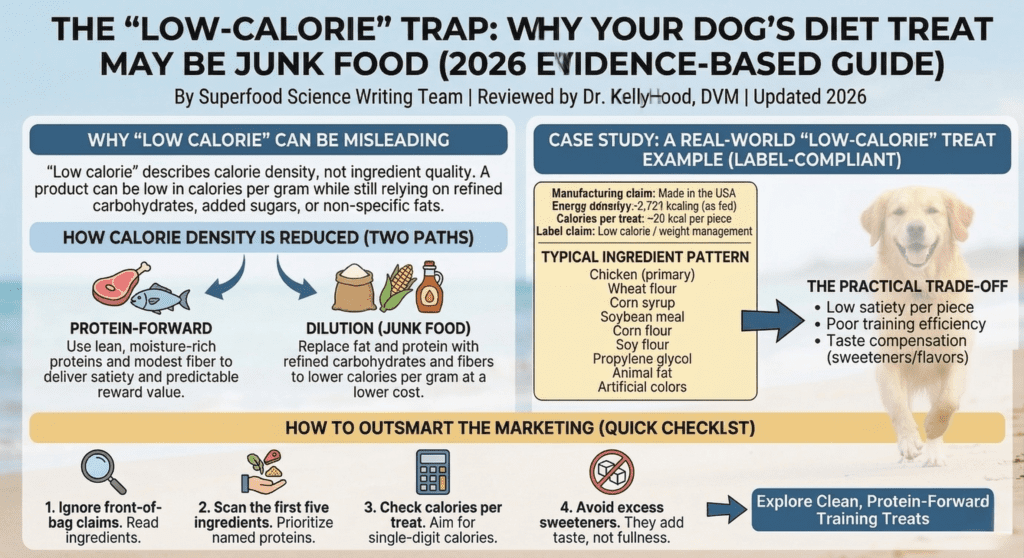
Case Study: A Label-Compliant “Low-Calorie” Pattern
To illustrate how this works, consider a representative example based on publicly available U.S. dog treat label patterns.
Label Snapshot
- Made in the USA claim
- Approximate energy density: 2,721 kcal/kg as fed
- Approximate calories per treat: 20 kcal
- Marketing language: low calorie or weight management
Typical Ingredient Pattern
- Chicken as the first ingredient by pre-processing weight
- Wheat flour
- Corn syrup
- Soybean meal
- Corn flour
- Soy flour
- Propylene glycol
- Animal fat preserved with BHA or BHT
- Artificial colors
Why This Can Still Qualify as Low-Calorie
From a regulatory perspective, the calorie density may indeed be lower than richer biscuits or meat-heavy treats. But that does not mean the formulation is especially nutrient-dense or helpful for training.
The Practical Trade-Off
A pattern like this may create several real-world problems:
Lower Satiety Per Piece
A treat built more around refined carbohydrate bulk may not feel as rewarding or satisfying as a protein-forward option.
Harder Portion Control
If one piece contains around 15 to 20 calories, even a few rewards can consume a meaningful share of a small dog’s daily discretionary calories.
Compensation Through Flavoring
When fat and protein are reduced, manufacturers may lean more heavily on sweeteners, flavor systems, or texture agents to maintain palatability.
This is why label compliance is not the same thing as nutritional strategy.
A Closer Look at the Ingredient List
Many mass-market diet treats follow a familiar pattern: multiple refined grains or plant meals appear high in the ingredient list, while truly meaningful protein density is limited.
What This May Mean Nutritionally
Lower Satisfaction Per Calorie
Protein generally contributes more to satiety than refined carbohydrate-heavy formulas.[1][2]
Less Efficient Training
If the reward is not highly motivating, pet parents often use more of it.
More Marketing Than Meaning
Claims such as low calorie, made in the USA, or weight control may distract from a less impressive ingredient panel.
It is important to be fair here: not all fiber is bad, and not all carbohydrate ingredients are inherently poor quality. The bigger concern is when refined carbohydrate dilution becomes the main strategy.
Sugar, Glycemic Response, and Satiety
Dogs can digest carbohydrates well, but research suggests that dietary composition influences post-meal glucose and insulin responses. Protein-rich and fat-containing meals tend to slow gastric emptying and may provide greater satiety than rapidly digestible, carbohydrate-heavy formulas.[2][3]
That does not mean a single lower-quality treat is automatically harmful. It does mean some so-called diet treats may feel less filling and less useful during repetitive reward-based training.
Why Calories Per Treat Matter More Than the Headline Claim
For actual weight management, the calorie count per treat is often more important than broad marketing language.
Why This Matters in Real Life
- Small dogs may only have a modest daily treat allowance.
- A single 15 to 20-calorie treat can use a large share of that allowance.
- Treats in the single-digit calorie range are easier to use for repetition and reinforcement.
Consistency is what makes training and healthy body weight easier to sustain. Owners often do better with a small, breakable, protein-forward reward than with a larger “diet” treat that looks healthier than it functions.
Ingredient Claims That Can Distract Buyers
“Made in the USA”
For many pet owners, Made in the USA is not just a patriotic claim. It can function as a practical risk-screening signal because some of the pet industry’s most widely discussed safety problems have involved imported products or imported ingredients. For example, the FDA’s 2017 recall of certain rawhide chews traced the issue to manufacturing facilities in Mexico and Colombia that used a chemical processing aid not approved in the U.S. for rawhide chews, with reported complaints including unpleasant odor, diarrhea, and vomiting. Earlier, FDA investigations into jerky treats and the 2007 melamine crisis drew intense attention to pet treats and ingredient sources linked to China.[6][7][8]
That history helps explain why some shoppers give extra weight to domestic manufacturing claims. Still, the claim should be interpreted carefully. Country of manufacture does not guarantee nutritional quality. A domestically made treat can still rely on refined carbohydrates, added sugars, artificial colors, vague fats, or weak portion design. In other words, origin may help inform trust, but it does not replace reading the ingredient panel and calorie count.
Preservatives and Humectants
Some treats use approved preservatives or moisture-keeping ingredients to extend shelf life. While these may be legal, many pet parents prefer a cleaner ingredient deck when suitable alternatives exist.
What to Look for Instead
Rather than chasing the lowest number on the front of the package, look for traits that support both health and practicality.
Better Low-Calorie Treat Criteria
- Named protein high on the ingredient list
- Minimal added sugars
- Clear ingredient transparency
- Small size or easy breakability
- Single-digit calories per piece when possible
- Good palatability without relying on artificial color or excessive sweeteners
Practical Comparison
| Feature | Carbohydrate-Diluted “Diet” Treat | Protein-Forward Mini Treat |
| Primary volume source | Refined grains and meals | Lean named protein |
| Reward value | Often moderate | Often stronger |
| Calories per piece | Often 15–20 | Often about 5–6 |
| Training utility | Fewer repetitions | More repetitions |
| Satiety per calorie | Often lower | Often higher |
| Ingredient transparency | Sometimes weaker | Often clearer |
How to Outsmart Low-Calorie Marketing
1. Ignore the Front First
Turn the package over before making a judgment.
2. Read the First Five Ingredients
Look for clearly named proteins and watch for stacks of flour, starch, syrup, and vague fats.
3. Check Calories Per Piece
This is one of the fastest ways to judge whether a treat is actually practical for training.
4. Think in Repetitions
A good training treat should allow multiple rewards without quickly overshooting the daily calorie budget.
5. Prioritize Nutrient Density
A lower-calorie treat is more useful when the calories come from meaningful ingredients.
Veterinary Note
If your dog is overweight, treat strategy matters, but the biggest drivers of progress are still total daily calorie intake, consistent portioning, activity level, and regular reassessment of body condition. Treats should support the plan, not quietly sabotage it.[4]
Frequently Asked Questions
Are low-calorie dog treats always healthier?
No. Some are well designed, but others lower calories mainly by adding refined starches, plant meals, or other bulk ingredients. A lower number on the label does not automatically mean better nutrition.
What is the best calorie range for training treats?
Many owners do best with very small treats in the single-digit calorie range, especially for repeated rewards during training. The right number depends on your dog’s size, diet, and daily calorie budget.
Is protein more important than the low-calorie claim?
In many cases, yes. Protein-forward treats often provide better satiety and stronger reward value than treats that simply dilute calories with carbohydrate-heavy fillers.[1][2]
Can a treat be made in the USA and still be low quality?
Yes. Manufacturing location does not determine nutrient density, ingredient quality, or training usefulness.
Are all carbohydrate ingredients bad in dog treats?
No. Carbohydrates are not automatically bad, and some fibers can be useful. The concern is when refined carbohydrate dilution becomes the main reason a product appears diet-friendly.
Explore More Dog Health Tips
- Best Low-Calorie Dog Treats for Weight Management
- Healthy Dog Treats for Training: What to Look For
- Are Soft Dog Treats Better for Senior Dogs?
- Best Organic Dog Treats for Everyday Rewards
Final Takeaway
The smartest way to evaluate a low-calorie dog treat is to ask a better question: What is making it low-calorie? If the answer is mostly refined-carbohydrate dilution, the treat may be less satisfying, less effective for training, and less helpful for long-term weight control. In many cases, a small, breakable, protein-forward treat is the more practical choice.
References
[1] Case, L. P., Daristotle, L., Hayek, M. G., & Raasch, M. F. (2011). Canine and feline nutrition (3rd ed.). Mosby.
[2] Zentek, J., et al. (2013). Dietary carbohydrates and glycemic response in dogs. Journal of Animal Physiology and Animal Nutrition, 97(6), 1131–1140.
[3] de Oliveira, L. D., et al. (2008). Effects of dietary protein and carbohydrate sources on nutrient digestibility and postprandial glucose in dogs. The Journal of Nutrition, 138(2), 274S–277S.
[4] WSAVA Global Nutrition Committee. (2011). Nutritional assessment guidelines.
[5] Association of American Feed Control Officials. Model regulations for pet food and specialty pet food.
[6] U.S. Food and Drug Administration. (2017). United Pet Group voluntary recalls multiple brands of rawhide chew products for dogs due to possible chemical contamination.
[7] U.S. Food and Drug Administration. (2017). United Pet Group expands voluntary recall of multiple brands of rawhide chew products for dogs to also include private label brands due to possible chemical contamination.
[8] U.S. Food and Drug Administration. FDA investigates animal illnesses linked to jerky pet treats; see also FDA summaries of the 2007 melamine-related pet food investigation involving ingredients imported from China.
