
Homemade vs. Store-Bought Organic Dog Treats: Which Is Better for Your Dog in 2026?

Quick Answer
For most dog parents in 2026, high-quality store-bought organic dog treats are the better everyday choice because they are more consistent in calories, texture, shelf stability, and portion control. Homemade treats can still be useful when you want ingredient transparency or need to avoid specific allergens, but they require more care to prepare safely and are usually best used occasionally rather than as a daily training treat.
Trust Signal
By Superfood Science Writing Team | Reviewed by Dr. Kelly Hood, DVM | Last Updated: 04/06/2026
Superfood Science has produced organic and natural functional foods for humans and pets for over 20 years, specializing in clean-label formulations and evidence-based nutrition.
Key Takeaways
- Store-bought organic dog treats are usually the best option for daily training because they offer more consistent size, calories, and texture.
- Homemade dog treats provide strong ingredient transparency, but nutrition, shelf life, and portion control are harder to manage.
- Dogs with food sensitivities may benefit from carefully selected homemade recipes, especially when guided by a veterinarian.
- Treats should stay under 10% of your dog’s daily calories, whether they are homemade or store-bought.
- The best organic dog treats are simple, clearly labeled, easy to break, and gentle enough for regular use.
Why This Comparison Matters
Many dog parents are trying to choose between homemade and store-bought organic dog treats for the same reason: they want cleaner ingredients and safer daily rewards. Homemade treats feel more personal and transparent, while store-bought organic treats offer convenience and predictable nutrition.
The problem is that “homemade” does not automatically mean better, and “store-bought” does not automatically mean low quality. The better choice depends on your dog’s needs, how often you use treats, and whether consistency matters for training, weight management, and digestion.
Homemade Dog Treats: Pros and Cons
Benefits of Homemade Dog Treats
Homemade dog treats let you control every ingredient. That can be helpful when your dog has confirmed food sensitivities, when you want to avoid certain additives, or when you simply prefer to make occasional treats at home.
Common advantages include full ingredient transparency, flexibility to avoid known allergens, the ability to choose fresh, simple ingredients, and the personal satisfaction of preparing treats yourself.
Limitations of Homemade Dog Treats
Homemade dog treats can still cause problems if not carefully planned. Even simple recipes may vary in calories, moisture, protein, and texture from batch to batch.
Common drawbacks include inconsistent calorie and protein content, shorter shelf life, higher risk of spoilage, less reliable portion control, and a greater chance of ingredient or preparation errors.
Veterinary research has shown that home-prepared diets often fail to deliver consistent nutrient levels when they are not professionally formulated. While treats are not complete meals, the same principle still matters. A homemade treat that seems healthy can still be too calorie-dense, too large, or nutritionally uneven for frequent use.[1]
Store-Bought Organic Dog Treats: Pros and Cons
Benefits of High-Quality Store-Bought Organic Treats
Well-made organic dog treats are designed for repeatable use. That matters when you use treats during training, for daily rewards, or for dogs who need careful calorie management.
Key benefits include more consistent calories per piece, more predictable protein and texture, better shelf stability, easier storage and portability, and better sizing for training and portion control.
When treats are used often, consistency becomes a health and behavioral advantage, not just a convenience.[2]
Potential Downsides of Store-Bought Treats
Not all store-bought treats are equally good. Some products may still include ingredients that dog parents would rather avoid.
Watch for excess starch fillers, added sugars or syrups, vague meat or flavor descriptions, oversized pieces that are harder to portion, and hard textures that may not suit puppies, seniors, or small dogs.
That is why label reading still matters, even for organic products.
Homemade vs. Store-Bought Organic Dog Treats: Side-by-Side Comparison
Ingredient Control
Homemade treats offer the highest direct control because you select every ingredient yourself. Reputable store-bought organic treats can still provide strong ingredient transparency if the label is clear and specific.
Nutritional Consistency
Store-bought organic treats usually win here. They are typically made to deliver more repeatable calorie density, texture, and feeding experience.
Shelf Life
Homemade treats are more perishable and often need refrigeration or freezing. Store-bought treats are usually easier to store and use over time.
Training Convenience
Store-bought mini treats or soft sticks are usually better for training because they are uniform, easier to break, and less messy.
Food Safety
Homemade treats carry a higher food safety risk if they are undercooked, stored too long, or made in large batches without proper handling.
Quick Comparison Table
| Factor | Homemade Treats | Store-Bought Organic Treats |
| Ingredient Control | Very high | High with reputable brands |
| Nutritional Consistency | Variable | More consistent |
| Shelf Life | Short | Longer |
| Training Use | Less convenient | Better optimized |
| Portion Control | Variable | Easier |
| Food Safety Risk | Higher | Lower |
Which Option Is Better for Training?
Training works best when rewards are small, fast, and repeatable. Homemade treats are often softer in an uneven way, too crumbly, or too large unless the recipe is specifically designed for training.
Store-bought organic dog treats are usually better for training because they are more likely to offer uniform size, better breakability, cleaner handling, more accurate calorie control, and safer chewing for repeated rewards.
For dogs that receive many treats in one session, these details matter more than most owners expect.
A Vet-Smart Homemade Treat Recipe for Occasional Use
Simple Turkey and Pumpkin Soft Training Treats
For dog parents who enjoy making treats at home, this is a practical recipe built around digestibility, moderate protein, and easy portioning.
Ingredients
1 cup cooked plain ground turkey, 1/2 cup pure pumpkin puree, 1 large egg, and 1/2 cup oat flour or finely ground oats.
Why These Ingredients Work
Turkey: Lean, digestible protein that many dogs tolerate well[2].
Pumpkin: Adds fiber and moisture for stool quality and texture.
Egg: Helps bind the mixture and supports protein quality.
Oats: Provide structure and gentle carbohydrates.
Preparation
- Preheat oven to 350°F (175°C).
- Mix all ingredients until a soft dough forms.
- Spread thinly, about 1/4 inch thick, on a parchment-lined baking sheet.
- Bake for 20 to 25 minutes until set but still soft.
- Cool completely and cut into very small training-size pieces.
Storage and Safety
Refrigerate for up to 3 days, freeze extra portions for up to 1 month, and discard the treats if they develop odor, mold, or visible moisture issues.
Important Feeding Note
These treats are not nutritionally complete. Use them only as occasional rewards, and keep all treats combined to no more than 10% of your dog’s daily caloric intake.
When Homemade Treats Make the Most Sense
Homemade treats may be a reasonable choice when your dog has confirmed food allergies or sensitivities, when you want tighter ingredient control, when a veterinarian has reviewed the recipe for your dog, and when treats are used occasionally rather than many times per day.
When Store-Bought Organic Treats Are Usually the Better Choice
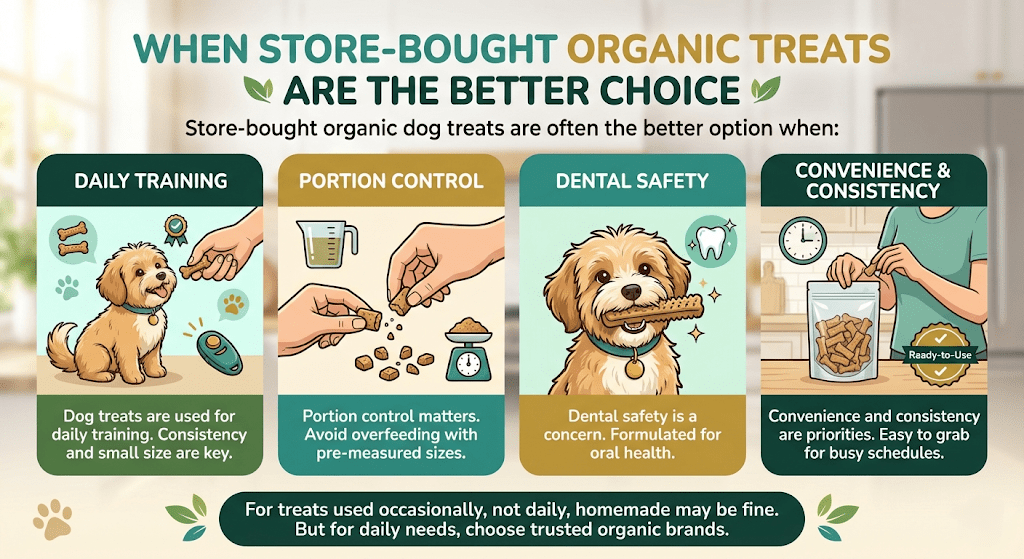
Store-bought organic dog treats are usually the stronger option when you use treats every day, do regular training sessions, want better calorie consistency, need convenience and shelf stability, or have a dog that does best with soft, breakable, predictable treats.
Vet Note
The healthiest treat is not always the one that sounds the most natural. The best choice is the one your dog tolerates well, fits your feeding routine, and can be used consistently without adding unnecessary calories or digestive surprises.
How to Choose a Better Organic Dog Treat
When comparing store-bought options, look for clearly named ingredients, simple limited formulas, predictable calorie content per treat, a soft or semi-soft texture, easy breakability for training, and an appropriate size for your dog’s age and chewing ability.
FAQs
Are homemade dog treats healthier than store-bought treats?
Not automatically. Homemade treats can offer cleaner ingredient control, but they may also be less consistent in calories, texture, and nutrient balance if they are not carefully formulated.[1]
Are organic store-bought dog treats safe for puppies and seniors?
They can be easy to chew and used in moderation, as long as the treats are appropriately sized. Softer textures are often better for younger and older dogs.
Can I use both homemade and store-bought treats?
Yes. Many dog parents use store-bought treats for daily training and keep homemade treats for occasional rewards.
Are homemade treats cheaper?
Sometimes, but not always. Cost depends on the ingredients, storage needs, and how much time you spend preparing them.
What matters most when choosing between the two?
Think about consistency, digestibility, calorie control, convenience, and whether your dog has any special dietary needs.
Final Verdict
If you want the most practical everyday option, store-bought organic dog treats are usually the better choice. They are easier to portion, easier to store, and more consistent for daily training and routine use.
If you enjoy preparing treats at home and your dog has specific needs, homemade treats can still play a role. The smartest approach for many households is a balanced one: use well-made organic store-bought treats for daily rewards and keep homemade treats as an occasional extra.
Recommended Clean Treat Option
When comparing products, look for organic dog treats that are clearly labeled, easy to break into smaller pieces, calorie-consistent, soft enough for daily use, and made with simple ingredients.
Explore Clean Organic Dog Treat Options
Explore More Vet-Reviewed Dog Health Articles
- Best Organic Dog Treats for Sensitive Stomachs
- Are Plant-Based Dog Treats Good for Dogs?
- Low-Calorie Dog Treats for Training and Weight Management
- Soft Organic Dog Treats for Puppies and Seniors
References
[1] Larsen, J. A., & Fascetti, A. J. (2014). Nutrition of dogs fed home-prepared diets. Journal of the American Veterinary Medical Association, 245(3), 283–291.
[2] Case, L. P., Daristotle, L., Hayek, M. G., & Raasch, M. F. (2011). Canine and feline nutrition (3rd ed.). Mosby.
