
Turkey vs Chicken Dog Treats for Sensitive Stomachs: Which Is Easier to Digest?

Quick Answer
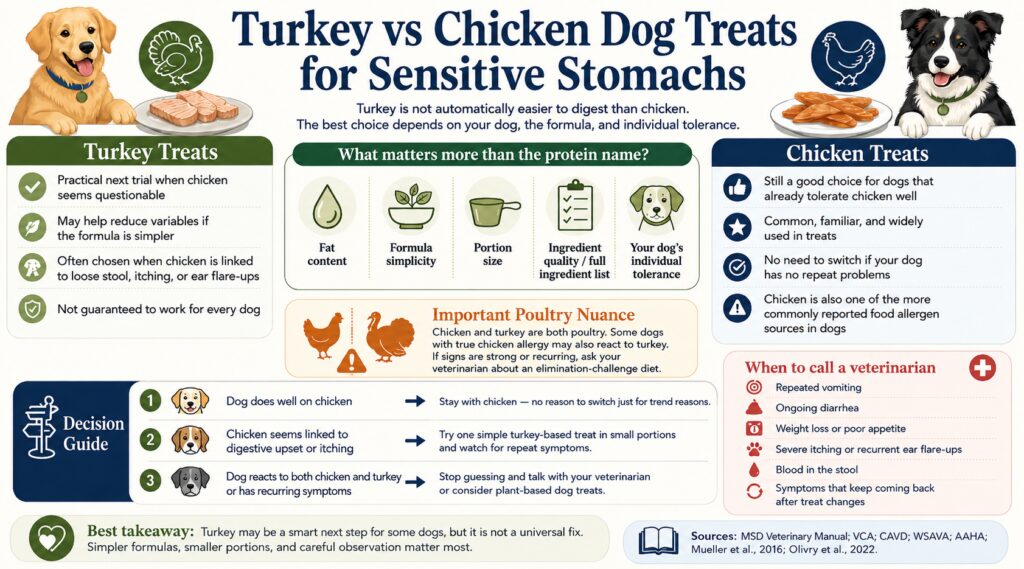
Turkey is not necessarily easier to digest than chicken for every dog. Either protein may work well when the treat is appropriately portioned and the formula is simple. But if chicken repeatedly seems linked to loose stool, itching, or ear flare-ups, a turkey-based treat may be a practical next trial.
Trust Signal
By Superfood Science Writing Team | Reviewed by Dr. Kelly Hood, DVM | Last Updated: 05/19/2026
Superfood Science has produced organic and natural functional foods for humans and pets for over 20 years, specializing in clean-label formulations and evidence-based nutrition.
This article uses conservative, vet-safe language and separates supportive treat-selection guidance from veterinary diagnosis or treatment.
Key Takeaways
- Turkey is not universally easier to digest than chicken, but it can be a useful alternative for some dogs that seem to do poorly with chicken.
- Chicken is a common ingredient in dog foods and treats, and it is also one of the more commonly reported food allergens in dogs.
- A “sensitive stomach” is not always a true food allergy. Fat content, portion size, formula complexity, and abrupt treat changes may matter just as much.
- Because chicken and turkey are both poultry, some dogs with true chicken allergy may still react to turkey.
- Natural and organic turkey treats may be a smart choice for ingredient-conscious families when they are clearly labeled, properly portioned, and matched to the dog’s individual tolerance.
Why This Question Matters
This is one of those dog-parent questions that sounds simple but usually is not.
A dog gets loose stool after treats. Or starts itching more on a chicken-heavy routine. Or seems fine on one product but not another. Then the question becomes: should I switch to turkey?
That is a practical question, and it deserves a practical answer.
The strongest evidence-based answer is not that turkey is magically gentler than chicken for every dog. It is that the easier-to-digest treat is usually the one your dog actually tolerates well, and that depends on more than the protein source alone.[3][5][6]
Still, there is a reason turkey comes up so often in sensitive-dog conversations. Chicken is one of the more commonly reported food allergens in dogs, so a turkey-based treat may sometimes be a logical next step when chicken-heavy products keep raising concerns.[1][2][8]
“Sensitive Stomach” Is Not the Same as “Chicken Allergy”
Dog parents often use the phrase “sensitive stomach” to describe a cluster of overlapping signs, ranging from gas and vomiting to acute loose stool shortly after a new treat is introduced.
These clinical signs do not automatically point to one protein.
A dog may react to fat content, ingredient complexity, portion size, multiple proteins in one product, abrupt food changes, or simply getting too many treats. That is why safer advice focuses on the entire formulation and the individual dog, not just whether the front of the bag says turkey or chicken.[2][3][5][6]
A true food allergy is different from a short-term digestive upset. MSD Veterinary Manual describes food-induced hypersensitivity reactions as exaggerated immune responses to the diet, and it notes that clinical signs may include itching, recurrent skin or ear issues, and sometimes gastrointestinal signs.[1] The only reliable way to confirm a food allergy is a structured elimination diet followed by a controlled challenge, not guesswork from one treat reaction.[1][3][4]
Why Chicken Comes Up So Often in Food-Reaction Discussions
This part matters.
MSD Veterinary Manual notes that commonly reported food allergens in dogs include beef, dairy products, chicken, wheat, and lamb.[1] A peer-reviewed review of adverse food reactions in dogs and cats also found that beef, dairy products, chicken, and wheat were among the most commonly reported food allergen sources in dogs.[8]
That does not mean every dog reacts to chicken.
It means that when a dog has a repeatable pattern of itching, ear flare-ups, loose stool, or vomiting associated with chicken-heavy foods or treats, chicken becomes a reasonable ingredient to question rather than ignore.[1][2][3][8]
Why Is Chicken Such a Common Ingredient in Dog Foods and Treats?
Palatability is a big part of the answer, but it is not the only reason.
Chicken is extremely common in dog foods and treats because it works well from both a pet-food formulation standpoint and a dog-acceptance standpoint. Many dogs like the taste and aroma of chicken, which makes it practical for kibble coatings, soft treats, dehydrated treats, jerky-style products, and many other formulas.
Chicken is also widely available in the food supply. That helps manufacturers source it more consistently than some niche proteins. Cost matters too. Chicken is often more economical than many novel proteins, which makes it easier to use in mainstream pet foods and treats.
There is also a dog-parent side to the story. Chicken feels familiar. Many owners recognize it, trust it, and are comfortable buying it.
The tradeoff is exposure. Because chicken is used so often, dogs are exposed to it more often than many other proteins. This is one reason it comes up so frequently in food sensitivity and food allergy conversations. The issue is not necessarily that chicken is uniquely bad or reactive. Sometimes it is simply the protein dogs encounter the most.[1][2][8]
Is Turkey Easier to Digest Than Chicken?
The honest answer is: not inherently, not in every dog, and not based on protein source alone.
WSAVA’s nutrition guidance emphasizes individualized feeding decisions.[5] Digestibility and tolerance are shaped by more than the named meat. Processing method, fat content, moisture level, ingredient complexity, treat size, calorie density, and the dog’s own gastrointestinal history all matter.[5][6][7]
So if a dog does better on turkey treats, the reason may be:
- the dog handles turkey better than chicken.[5][6][7]
- the turkey treat is simpler.[5][6][7]
- the turkey treat is lower in fat.[5][6][7]
- the dog was reacting to another ingredient in the chicken formula.[5][6][7]
- the portion size of the turkey treat is easier to manage.[5][6][7]
That is why dog parents should avoid assuming that turkey automatically means gentle and chicken automatically means bad.
Important Poultry Nuance: Chicken and Turkey Can Overlap
Turkey can be a smart trial option when chicken seems questionable, but it is not the same as choosing an entirely unrelated novel protein.
Chicken and turkey are both poultry. From an allergy perspective, proteins from related animal species may share enough similarity that cross-reactivity is possible in some dogs. A 2022 veterinary dermatology analysis described a high theoretical risk of cross-reactivity among some food-source allergens, although the clinical relevance can vary and should not be over-interpreted for every dog.[9]
That means a dog with a true chicken allergy may do well with turkey, but it may also react to turkey or other poultry-derived ingredients. For a dog with strong or recurring signs, a veterinarian-guided elimination diet may be more appropriate than simply switching from chicken to turkey.[1][3][4][9]
Decision Table: When Turkey May Make More Sense Than Chicken
| Situation | Chicken Treat Trial | Turkey Treat Trial | Practical Takeaway |
| Dog has always done well on chicken | Often reasonable to continue | Optional, not necessary | No need to switch just for trend reasons. |
| Dog gets loose stool after rich or mixed chicken treats | May still be possible, but formula needs review | Often worth trialing | Simpler turkey may reduce variables. |
| Dog has repeated itching or ear flare-ups with chicken-heavy products | Less ideal as the first retry | Often more practical | Turkey may be a better next elimination-style step, but poultry cross-reactivity is still possible.[1][3][4][9] |
| Dog is prone to fat sensitivity | Depends on the product | Depends on the product | Fat content may matter more than protein name.[5][6][7] |
| Dog has suspected true food allergy | Do not keep guessing casually | Use only with caution | A structured elimination-challenge diet is more reliable than random treat trials.[1][3][4] |
| Owner wants a cleaner-label treat trial | Possible if the label is simple | Often easier to frame as a fresh trial | Simpler, more transparent formulas help reduce variables. |
The point is not that turkey always wins. It is that turkey may be the better trial option when chicken has become a repeated concern, especially for dog parents who want a cleaner-label treat with fewer variables.
When Chicken May Still Be Perfectly Fine
Many dogs do very well on chicken.
If your dog eats chicken-based treats with normal stool, normal skin, and no repeatable problems, there is no evidence-based reason to switch simply because turkey sounds gentler or trendier online.
Chicken is common because many dogs tolerate it well. The problem is not chicken itself. The problem is assuming every dog responds to it the same way.
Why Fat Content and Formula Simplicity Matter So Much
For some dogs, the real issue is not turkey versus chicken. It is richness.
AAHA’s nutrition and weight-management guidance emphasizes individualized feeding and calorie awareness, and WSAVA’s treat guidance warns that treats can quietly contribute excess calories and nutritional imbalance when owners are not paying attention.[6][7]
In practical terms, rich treats may trigger digestive upset in some dogs even when the main protein itself is not the true problem.
This matters even more in dogs with pancreatitis history, obesity risk, repeated gastrointestinal flare-ups, or poor tolerance for rich snacks. In those dogs, a lower-fat, simpler treat often makes more sense than a highly indulgent one, regardless of whether it is made with chicken or turkey.[3][6][7]
How Superfood Science Treat Options Fit This Topic
This is where brand positioning matters, but it still has to stay compliant.
If a dog is actively having diarrhea, vomiting, or major gastrointestinal instability, the answer is not to keep trialing treats just because they are natural or organic. Ongoing symptoms still require attention to individual tolerance and veterinary guidance.
But once the dog is stable and a treat trial is appropriate, Superfood Science can be clearly positioned across three clean-label treat directions.
Organic Turkey Dog Treats
When chicken seems to be tied to recurrent digestive upset, itching, or ear flare-ups, Superfood Science Organic Turkey Dog Treats are the most natural first fit for this topic.
The value is not that turkey is guaranteed to be easier for every dog. The value is that a turkey-based, natural and organic treat may be a logical next trial for dog parents who want to move away from chicken while keeping the routine cleaner and simpler.
Organic Chicken Dog Treats
Not every sensitive-stomach conversation should become anti-chicken.
Many dogs do very well on chicken. For dogs that tolerate chicken well and do not show repeat digestive or skin concerns, Superfood Science Organic Chicken Dog Treats can still fit the healthier-treat conversation as a clean-label, natural-and-organic option.
The better message is not that chicken is bad. It is that chicken should be judged by the individual dog’s response, not by internet fear alone.
Plant-Based Protein Dog Treats
For some owners, a completely different ingredient direction may be appealing, especially when they want to reduce variables or rotate away from the most common animal proteins.
In those cases, Superfood Science Plant-Based Protein Dog Treats can be positioned as another natural, cleaner-label option to consider.
That does not mean plant-based treats are automatically better for every dog with a sensitive stomach. It means they may offer a different protein approach for owners who want more variety in how they manage their dog’s treat routine, as long as the dog tolerates them well.
The Strongest Compliant Brand Position
Superfood Science offers three practical clean-label treat directions for dog parents: organic turkey for dogs where chicken may be the problem, organic chicken for dogs that do well on chicken, and plant-based protein treats for owners who want a different ingredient direction.
The goal is not to claim that any one product cures digestive issues. The goal is to help dog parents choose a more intentional treat routine built around tolerance, portion control, and simpler ingredients.
What Stronger Evidence Supports, and What It Does Not
The stronger support for this topic is the recognition that chicken is one of the more commonly reported food allergens in dogs.
There is also strong support for individualized feeding decisions rather than one-size-fits-all rules.
Veterinary references also support using elimination-style logic when food reactions are suspected rather than random guessing.
Finally, WSAVA and AAHA guidance support keeping treats a modest part of total daily calories and choosing them carefully.
What the evidence does not strongly support is the sweeping claim that turkey is universally easier to digest than chicken in all dogs.
That is why the most defensible conclusion is this: turkey may be the better option for some sensitive dogs, especially when chicken seems to be part of the problem, but digestibility is still formula-specific and dog-specific.
Limitations and Research Gaps
There is good veterinary guidance around food allergy, elimination trials, label interpretation, and calorie management.[1][3][4][5][6][7]
There is much less direct head-to-head evidence proving that turkey treats are inherently easier to digest than chicken treats across the general dog population.
There is also an important real-world limitation: owners often use the phrase “sensitive stomach” to describe several different problems at once. Loose stool, food intolerance, fat sensitivity, overeating, food allergy, and abrupt treat changes can look similar at home even when they are not the same issue.
This ambiguity makes it difficult to isolate one protein as the universal answer. The better approach is to look at the dog’s pattern, the full ingredient list, the treat portion, and whether symptoms repeat after exposure.
Suggested Care Guide
The following guidance is intended for supportive wellness care and is not a substitute for professional veterinary diagnosis or medical treatment.
If your dog is doing well on chicken, there is usually no need to switch simply because turkey sounds gentler on paper.
If chicken seems tied to a repeat pattern of digestive upset, itching, or ear flare-ups, simplify the routine. Choose one turkey-based treat, use small portions, and avoid introducing several new foods at once.
Watch stool quality, vomiting, gas, appetite, itching, ear comfort, and overall behavior over several days. If symptoms continue or worsen, move from treat experimentation to veterinary evaluation.
For owners who want a cleaner-label turkey option after that kind of screening, Superfood Science Organic Turkey Dog Treats are the kind of product that makes practical sense to consider first.
Safety: When to Call a Veterinarian
Call your veterinarian sooner rather than later if your dog has repeated vomiting, ongoing diarrhea, poor appetite, weight loss, blood in the stool, severe itching, recurrent ear flare-ups, lethargy, or symptoms that keep returning after treat changes.[1][2][3]
Seek more immediate care if your dog has severe vomiting, collapse, marked weakness, abdominal pain, or trouble breathing.
If your dog is already on a prescription diet, has a known food allergy, or has a history of pancreatitis, do not make major treat changes casually without veterinary guidance.
FAQ
Is turkey easier to digest than chicken for dogs?
Not necessarily. Some dogs may do better with turkey, especially if chicken seems to trigger problems, but digestibility depends on the whole formula and the individual dog.[1][3][5]
Is chicken a common food allergen for dogs?
Yes. Chicken is one of the more commonly reported food allergen sources in dogs, along with ingredients such as beef, dairy products, wheat, and lamb.[1][2][8]
Are turkey dog treats better for sensitive stomachs?
They may be better for some dogs, especially when chicken seems problematic. But the best treat is still the one your dog actually tolerates well, regardless of protein source.
Can a dog with chicken sensitivity also react to turkey?
Yes, it is possible. Chicken and turkey are both poultry, and related food proteins may share enough similarity for cross-reactivity in some dogs. Dogs with stronger or recurring signs should be evaluated with veterinary guidance rather than random treat switching.[1][3][4][9]
How do I know if my dog has a food allergy or just a sensitive stomach?
The only reliable way to determine a true food allergy is through a structured elimination-challenge diet trial, not guesswork alone.[1][3][4]
What kind of treat should I try first if chicken seems to upset my dog?
A simpler turkey-based treat with a clear ingredient story and moderate calorie load is often a sensible first trial. However, because chicken and turkey are both poultry, a dog with broader poultry sensitivity may need a different novel protein or a veterinarian-guided elimination plan.
Conclusion
Turkey versus chicken is not really a contest with one universal winner.
For some dogs, chicken is completely fine. For others, turkey may make more sense, especially when chicken seems tied to repeat digestive or skin concerns.
That is why the best answer is not hype. It is fewer variables, better screening, smaller portions, and a more intentional treat routine.
When dog parents want to move in a cleaner-label direction, Superfood Science’s organic turkey dog treats, organic chicken dog treats, and plant-based protein dog treats give them more than one thoughtful path forward.
The smarter next step depends on the dog: turkey when chicken seems questionable, chicken when it is clearly tolerated, and plant-based protein treats when the owner wants a different ingredient direction without drifting into exaggerated claims.
Explore More Dog Health Tips
- Turkey vs. Chicken: Which Protein Is Better for Your Dog’s Treats?
- Best Treats for Dogs with Chicken Allergies
- Limited-Ingredient Organic Dog Treats
- Top-Rated Organic Dog Treats: A Guide to Safety
- Organic Dog Treats with Natural Ingredients: What Actually Matters
- Organic Dog Treat Subscription Options: Why Superfood Science Makes Sense
References
[1] MSD Veterinary Manual. (n.d.). Cutaneous food allergy in animals. MSD Veterinary Manual. https://www.msdvetmanual.com/integumentary-system/food-allergy/cutaneous-food-allergy-in-animals Accessed May 19, 2026.
[2] MSD Veterinary Manual. (n.d.). Nutrition in disease management in small animals. MSD Veterinary Manual. https://www.msdvetmanual.com/management-and-nutrition/nutrition-small-animals/nutrition-in-disease-management-in-small-animals Accessed May 19, 2026.
[3] VCA Animal Hospitals. (n.d.). Implementing an elimination-challenge diet trial: Dog. VCA. https://vcahospitals.com/know-your-pet/implementing-an-elimination-challenge-diet-trial-dog Accessed May 19, 2026.
[4] Canadian Academy of Veterinary Dermatology. (n.d.). Food allergies and elimination diets in dogs. CAVD. https://www.cavd.ca/images/CAVD_Illustrated_Diet_Trial_Handout_for_Dogs.pdf Accessed May 19, 2026.
[5] World Small Animal Veterinary Association. (n.d.). Global nutrition guidelines. WSAVA. https://wsava.org/global-guidelines/global-nutrition-guidelines/ Accessed May 19, 2026.
[6] American Animal Hospital Association. (2021). 2021 AAHA nutrition and weight management guidelines for dogs and cats. AAHA. https://www.aaha.org/resources/2021-aaha-nutrition-and-weight-management-guidelines/home/ Accessed May 19, 2026.
[7] World Small Animal Veterinary Association. (2025). Feeding treats to your dog. WSAVA. https://wsava.org/wp-content/uploads/2025/11/WSAVA_GuidetoTreats_Dogs_251107.pdf Accessed May 19, 2026.
[8] Mueller, R. S., Olivry, T., & Prélaud, P. (2016). Critically appraised topic on adverse food reactions of companion animals (2): Common food allergen sources in dogs and cats. BMC Veterinary Research, 12, 9. https://doi.org/10.1186/s12917-016-0633-8
[9] Olivry, T., Bexley, J., Mueller, R. S., & Prélaud, P. (2022). Evaluation of the theoretical risk of cross-reactivity among recently identified food allergens for dogs. Veterinary Dermatology, 33(6), 523-e143. https://doi.org/10.1111/vde.13082
