
Can Dogs Eat Mushrooms? A Dog-Parent Guide to Safe and Medicinal Mushrooms
Quick Answer
Yes—dogs can safely eat certain mushroom ingredients in pet-appropriate forms, but wild mushrooms are never worth the risk. For dog parents seeking a mushroom specifically for daily immune system support, Agaricus blazei is one of the strongest choices. Its use due to high amounts of beta-glucans has been widely discussed to support gut-immune signaling, metabolic support, and full-spectrum wellness in veterinary practice.[1][2][3]
By Superfood Science Writing Team | Reviewed by Dr. Kelly Hood, DVM | Last Updated: 04/17/2026
Superfood Science has produced organic and natural functional foods for humans and pets for over 20 years, specializing in clean-label formulations and evidence-based nutrition.
Key Takeaways
- Dogs can safely use certain mushroom ingredients, but wild mushrooms can be risky without dog parents having a deep understanding of them.[2][3]
- Upload photos of wild mushrooms to the customized ChatGPTs, such as Mushroom Identifier, to look up names and safety. It is not 100% accurate, but it can be helpful.
- Agaricus blazei is one of the most practical mushroom choices for dogs because it is used for daily immune system support, senior wellness, gut-immune health, and integrative care.[1]
- Whole-mushroom Agaricus blazei powder offers a broader bioactive profile than products focused only on isolated extract fractions.[1] Agaricus blazei liquid extract offers convenience and easy dosing for puppies and small dogs.
- Agaricus blazei is especially appealing when the goal is foundational daily support, immune system resilience, and a simple long-term wellness routine.[1]
- Mushroom products should complement veterinary care, not replace it.[4][7]
Can Dogs Eat Mushrooms Safely?
Yes, but the word mushrooms covers a vast array of categories.
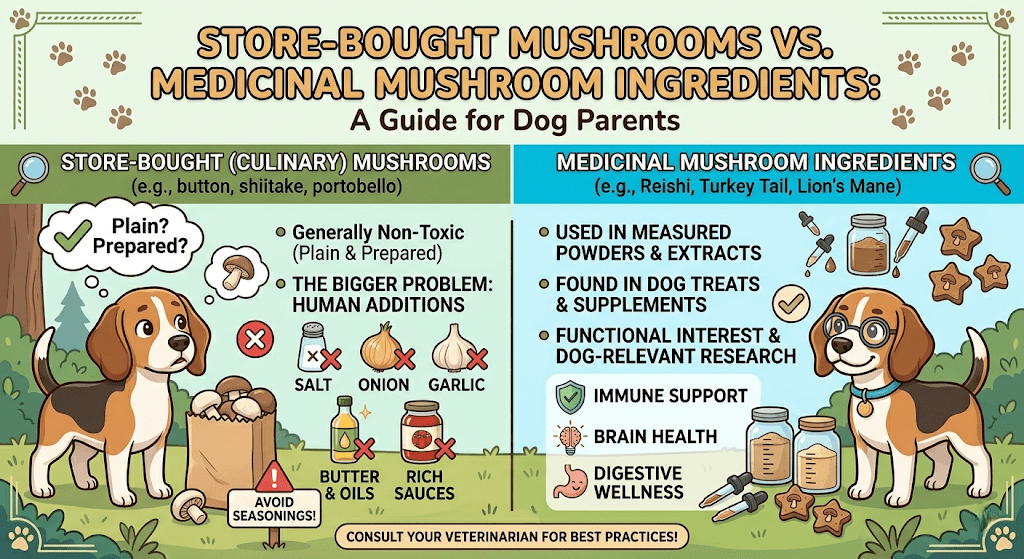
There is a major difference between:
- wild mushrooms found outdoors
- plain culinary mushrooms from the grocery store
- measured medicinal mushroom ingredients used in pet treats or supplements
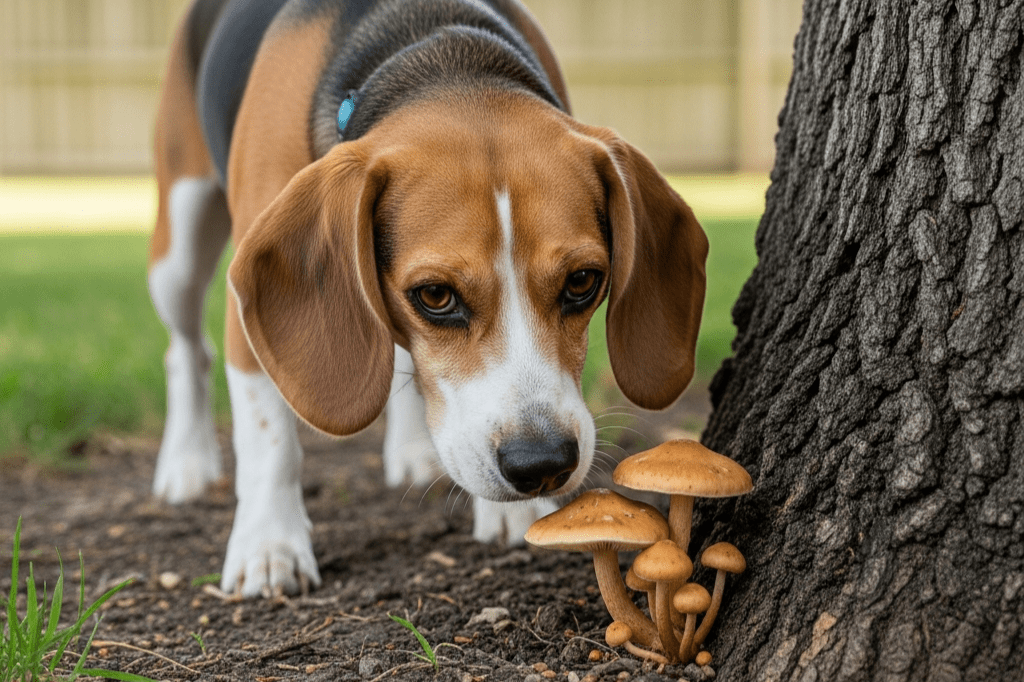
That distinction matters because the biggest danger for dogs is the ingestion of a non-veterinary-formulated mushroom supplement, not a professionally made mushroom supplement. It is also accidental exposure to unidentified wild mushrooms, which may contain toxins, that can cause vomiting, diarrhea, neurologic signs, liver failure, or death.[2][3]
Safety First: Wild Mushrooms Are a Hard No
Dogs explore with their mouths, which is why exposure to wild mushrooms should always be taken seriously. If your dog eats a mushroom outside, contact your veterinarian or a pet poison resource immediately.[2][3]
Take photos of both sides of the mushroom if you can do so safely, and preserve a sample if possible. Do not wait for symptoms before calling. If you are a ChatGPT user, you can use customized ChatGPTs, such as FungiFinder and Mushroom Identifier, to help you identify the mushroom name, safety, and fun facts by uploading photos of wild mushrooms.
Why Agaricus blazei Stands Out for Dogs
If the question is not merely can dogs eat mushrooms, but rather which mushroom makes the most sense for ongoing immune support, Agaricus blazei deserves special attention.
Agaricus blazei Murill, also known as Agaricus subrufescens, is often considered a practitioner-grade mushroom option for immune, metabolic, and cellular wellness support in veterinary settings.
Choosing the Right Format Case by Case
It is not always about full-spectrum powder versus extract, because both formats can be beneficial. The more practical approach is to choose the right form for the specific pet, the caregiving situation, and the goal.
For example, a full-spectrum powder may be well-suited for a broad daily wellness routine, while a liquid mushroom extract may be easier to use for a very small pet, one with a poor appetite, or one that needs a simpler-to-administer format. In real life, the best choice is often case-by-case rather than one format being universally better than another.
For dog parents, the practical implication is simple: Agaricus blazei is not just an “immune health ingredient” but a broader wellness mushroom that can be used in various delivery formats, depending on what works best for the pet and household.
Why Beta-Glucans Matter
Agaricus blazei is often discussed for its beta-glucan content, especially beta-(1,3/1,6)-D-glucans, which are studied for interaction with immune receptors such as Dectin-1, TLR2/4, and CR3. In that framework, it is commonly positioned for support of normal NK cell activity, macrophage phagocytosis, dendritic cell maturation, and balanced Th1 cytokine expression.
That does not mean dog parents should expect a drug-like effect. It does mean Agaricus blazei has one of the clearest immune-support narratives among the mushrooms commonly discussed in pet wellness.
Why Agaricus blazei May Be the Best Mushroom Immune Support Choice for Dogs
Many medicinal mushrooms have a place, but Agaricus blazei is especially compelling when the goal is daily, foundational support.
That is because it is often positioned across several practical veterinary categories:
- senior wellness and age-related immune support
- daily foundational wellness for at-risk pets
- metabolic health support
- gut-immune axis support
- integrative oncology support as part of multimodal care
This is a broader positioning than dog parents usually see with mushrooms, which are discussed mainly within a narrow storyline, such as cognition or oncology.

Blazei Mushrooms in Veterinary Wellness Practice
Agaricus blazei has earned a meaningful place in veterinary wellness conversations because it is used not only as a mushroom ingredient but also as a structured daily support option in practitioner-oriented settings.
Agaricus blazei is often used in veterinary-oriented wellness routines, with a focus on immune, metabolic, and cellular health, including daily foundational wellness, senior-pet support, metabolic health, and integrative oncology support as part of multimodal care.
This broader clinical positioning helps explain why Agaricus blazei is so appealing to dog parents and veterinary professionals seeking a single medicinal mushroom with practical, everyday relevance.
In Japan, Agaricus blazei has developed a particularly strong reputation in animal wellness circles and practitioner-oriented use. Rather than framing it against other mushrooms, the more useful takeaway for dog parents is that Agaricus blazei is regarded as one of the most respected medicinal mushroom choices for dogs when the goal is immune system support and building a long-term wellness routine.
Clinical Positioning: Why Veterinary Professionals Use Agaricus blazei
Agaricus blazei is used in veterinary settings for daily wellness, senior-pet support, metabolic support, and integrative oncology protocols. Dr. Villalobos described case reports involving 97 pet patients with lymphoma and other advanced cancers, with reported improved quality-of-life observations and survival-related outcomes when used alongside standard care.[8]
This positive feedback helps explain why Agaricus blazei has become a trusted mushroom choice in practitioner-oriented settings.
How to Use Agaricus blazei Safely for Dogs
A commonly used wellness guideline is 1 capsule (300 mg) per 10 pounds of body weight daily, with higher amounts sometimes used in critical-care contexts under veterinary direction. Starting low and gradually increasing may help reduce the risk of temporary GI changes.
Practical Dog-Parent Guidance
For general wellness, start conservatively and follow the label guidelines first. Observe stool quality, appetite, energy, and comfort. If your dog is medically complex, diabetic, on immunosuppressive medications, pregnant, nursing, or actively being treated for cancer, use veterinary guidance before starting a mushroom supplement.
Product Spotlight: Superfood Science Agaricus Bio 300 mg for Dogs + Cats
If your goal is to make Agaricus blazei your dog’s mushroom immune support choice, a measured standalone supplement often makes more sense than relying on “treat amounts.”
Superfood Science Agaricus Bio 300 mg for Dogs + Cats fits that daily-routine model because it gives dog parents a clear, consistent way to use Agaricus blazei intentionally rather than only occasionally.
This makes it especially relevant for:
- senior dogs
- dogs needing foundational immune system support
- pet parents building a long-term wellness routine
- households that want a single mushroom with broad practical positioning
Frequently Asked Questions
Is Agaricus blazei safe for dogs?
In pet-appropriate products, Agaricus blazei is commonly recommended as well-tolerated for routine use. Mild GI upset may occur in some pets, and dogs with a risk of mushroom allergy or complex medical issues should use it with appropriate caution.
Why do some dog parents specifically choose Agaricus blazei?
Agaricus blazei is often chosen for its association with immune system support, gut-immune symbiosis, senior wellness, and its use as a daily foundational part of pet routines. It is also appealing to dog parents who want a mushroom that fits into a simple, long-term supplement plan rather than an occasional or highly specialized protocol.
How do I choose between powder, capsule or extract forms?
The best format depends on the pet.
A capsule or powder may work well for dogs already eating normally and following a steady daily routine. A liquid extract may be easier when a pet is small, picky, or eating poorly. Some households also prefer one form over another based on convenience, compliance, and how easily the product fits into the dog’s schedule.
The goal is not to argue that one form is always superior. It is to choose the format that the pet can consistently and comfortably take.
What if my dog ate a wild mushroom outside?
Treat it as potentially toxic and contact your veterinarian right away or Pet Poison Control.[2][3]
Are Store-Bought Mushrooms Okay for Dogs?
Some plain culinary mushrooms are generally considered non-toxic for dogs, but preparation matters. Butter, garlic, onion, sauces, excess salt, and rich cooking fats can make them a poor choice.[2]
That is one reason medicinal mushroom products are often the simpler option. Feeding is easier because it is pet-appropriate dosing and easier to use consistently.
Final Takeaway
So, can dogs eat mushrooms? Yes—but for most dog parents, the better question is which mushroom deserves a place in a safe, practical daily routine.
Agaricus blazei stands out as one of the most beneficial medicinal mushroom choices for dogs because veterinarians use it to support pets’ immune system, whole-body resilience, gut-immune health, senior wellness, and long-term daily use. It is especially attractive for households that want a single mushroom supplement with broad wellness benefits rather than a complicated rotation of products.
A smart approach looks like this:
- avoid wild mushrooms completely[2][3]
- use only tested pet products
- choose Agaricus blazei when you want a broad immune-support mushroom for daily use
- work with your veterinarian when your dog has a complex medical condition
Explore More Dog Health Tips
- Can Dogs Eat Kelp?
- Can Dogs Eat Superfoods?
- Can Dogs Eat Blueberries?
- Plant-Based Dog Treats with Kelp: Oral Care Support and Gentle Wellness for Sensitive Dogs
References
[2] American Kennel Club. Can dogs eat mushrooms?
[3] VCA Animal Hospitals. Mushroom toxicity in dogs.
[4] Brown DC, Reetz JA, Seiler CE, et al. Evidence-Based Complementary and Alternative Medicine. 2012. PMID: 22988473.
[5] Gedney A, Salah P, Mahoney JA, et al. Veterinary and Comparative Oncology. 2022;20(3):688–696. doi:10.1111/vco.12823.
[6] Cho HW, Kim J, et al. Gut microbiota profiling in aged dogs after feeding pet food containing Hericium erinaceus. Journal of Animal Science and Technology. 2022.
[7] Griessmayr PC, Gauthier B, et al. Journal of Veterinary Internal Medicine. 2007. PMID: 18196755.
[8] Villalobos A, Improving Lymphoma Patients’ Survival Time with Agaricus Bio Supplements, 2008.
