
What Are Superfoods? And When Do They Become Hidden Hazards for Pets?

Quick Answer
A “superfood” is not a scientific category. It is a popular label for foods that are nutrient-dense and rich in bioactive compounds such as polyphenols, carotenoids, fiber, omega-3 fatty acids, or beta-glucans. For people, superfoods may support healthy dietary patterns when used consistently. For dogs and cats, however, some human superfoods can be unsafe or even toxic. This guide explains both the human nutrition science and a practical pet safety framework.
By Superfood Science Writing Team | Reviewed by Dr. Kelly Hood, DVM | Last Updated: 04/15/2026
Superfood Science has produced organic and natural functional foods for humans and pets for over 20 years, specializing in clean-label formulations and evidence-based nutrition.
Key Takeaways
- “Superfood” is a marketing term, not a formal scientific classification. However, superfoods represent a category of functional nutrition characterized by exceptional nutrient density.
- The value of a superfood depends more on regular dietary patterns than on one-time use.
- Evidence-informed examples for humans include matcha, blueberries, omega-3s, avocado, turmeric, kelp, and certain functional mushrooms.
- Some human superfoods can be dangerous for pets, especially matcha, green tea, grapes, raisins, and xylitol-containing products.
- In pet households, the safest approach is to separate human wellness trends from pet feeding decisions.
Why This Topic Matters
The term “superfood” is everywhere. It appears on powders, snacks, beverages, supplements, and social media posts. But in evidence-based nutrition, no food is automatically “super” on its own. What matters more is whether that food contributes to a balanced routine that a person can maintain over time.
That distinction becomes even more important in homes with dogs or cats. A food that fits a healthy human dietary pattern may still be inappropriate for pets because their metabolism, body size, and sensitivity to toxins differ from ours.
This article is designed to do two things at once:
- Explain why certain foods are called superfoods in human nutrition.
- Help dog and cat owners avoid preventable feeding mistakes.
What Is a Superfood?
A superfood is best understood as a popular label for foods that are both nutrient-dense and rich in bioactive compounds that are being studied for their health-supporting effects.[1] These foods may provide vitamins, minerals, fiber, fatty acids, or plant compounds that support normal physiology when included in an overall healthy diet.
In practice, foods labeled as superfoods often share several features:
- High nutrient density relative to calories
- Presence of studied bioactive compounds
- Potential to support healthy dietary patterns
- Strong public interest tied to wellness claims
The most useful way to think about superfoods is this: they are not magic foods. They are foods with interesting nutrition profiles that may support health when used appropriately and consistently.
What Nutrition Science Actually Looks For
Many foods marketed as superfoods are studied because they contain one or more of the following:
Polyphenols and carotenoids
These plant compounds are studied for antioxidant activity and support of healthy inflammatory balance.[2] They are found in foods such as berries, green tea, colorful vegetables, and certain herbs and spices.
Dietary fiber
Fiber helps support gut function, satiety, and cardiometabolic health patterns.[3] It also contributes to microbiome-related dietary quality.
Healthy fats
Monounsaturated fats and marine omega-3s are studied for cardiovascular and structural roles in the body.[11,14] They can also affect nutrient absorption and meal satisfaction.
Beta-glucans and other functional polysaccharides
Certain mushrooms and plant foods contain beta-glucans or related compounds that are being studied for their immune and metabolic effects.[19]
7 Evidence-Informed Superfoods for People
1) Matcha Green Tea: Catechins Plus Calm Focus
Matcha is powdered green tea made from shade-grown Camellia sinensis. Because the powdered leaf is consumed directly, matcha can deliver concentrated levels of compounds such as catechins, caffeine, and L-theanine in some contexts.[4]
What the evidence supports
Matcha is rich in catechins, caffeine, and L-theanine.[4] In controlled trials, the combination of L-theanine and caffeine has been shown to influence attention and alertness measures.[5] Matcha and green tea extract have also been associated with increased fat oxidation during moderate activity in human studies, but those findings should not be overstated as proof of meaningful weight-loss effects.[6,7]
Practical note for pet households
Matcha and green tea are not pet-safe wellness foods. Their caffeine content can be toxic to dogs and cats.[21–23]
2) Turmeric: Curcumin and Healthy Inflammatory Balance
Turmeric contains curcumin, a polyphenol studied for antioxidant and inflammation-modulating properties. Human evidence varies by formulation and dose, and many studies use enhanced-bioavailability versions rather than plain turmeric powder.[8]
What the evidence supports
Curcumin is widely studied in humans, with mixed but promising findings across inflammatory and metabolic outcomes depending on the study design and formulation used.[8] Bioavailability matters, which is why many human supplements include absorption enhancers such as piperine.[8]
Practical note for pet households
Turmeric itself can sound familiar to pet owners because it is used in some animal products. But that does not mean every human turmeric supplement is pet appropriate. Many human formulas are much more concentrated and may contain piperine, a black pepper extract that can increase nutrient bioavailability, or other add-ins that can affect how the body handles certain compounds or medications. A safer rule is to choose a pet-specific turmeric product or check with your veterinarian first. [27–29]
Internal link opportunity: Curcumin Bioavailability in Humans vs. Pets
3) Blueberries: Anthocyanins for Vascular and Cognitive Support
Blueberries are rich in anthocyanins, compounds that have been studied for vascular and cognition-related outcomes.
What the evidence supports
Higher anthocyanin intake has been associated with a lower risk of myocardial infarction in observational studies, but this association does not prove causation.[9] In a randomized trial involving older adults, blueberry supplementation improved certain cognitive measures.[10]
Practical note for pet households
Plain blueberries are generally considered a safer occasional treat for dogs and, in some cases, cats when introduced gradually and served in moderation.[38] Serve them plain and raw. Do not offer blueberries prepared with sweeteners, syrups, chocolate, xylitol, or baked ingredients that may be unsafe for pets.
4) Avocado: Healthy Fats and Nutrient Absorption
Avocado provides monounsaturated fats and fiber and may support nutrient absorption when eaten with vegetables.
What the evidence supports
Reviews suggest avocado fits well into heart-supportive dietary patterns.[11] Human studies also show that adding avocado or avocado oil can significantly improve carotenoid absorption from foods such as salad and salsa.[12] Some trials suggest avocado-containing meals may improve satiety, although calorie differences matter.[13]
Practical note for pet households
Avocado is a mixed category for pets. The flesh may be tolerated in tiny amounts by some dogs, but the pit, skin, and leaves should be avoided due to choking, obstruction, and toxicosis concerns.[35,36] If any avocado is offered, it should be plain flesh only and only in very small amounts.
5) Omega-3 Fish Oil: Product and Dose Matter
Omega-3 fatty acids such as EPA and DHA are essential fats. Their benefits depend on the goal, dose, and product quality.
What the evidence supports
The American Heart Association has summarized the triglyceride-lowering effects of prescription-strength omega-3s in appropriate patients.[14] At the same time, the STRENGTH trial found no significant reduction in major cardiovascular events with a high-dose EPA+DHA formulation versus corn oil in a high-risk population.[15] DHA has shown benefits in some age-related cognitive decline research, while other populations show mixed results, so claims should be made with caution.[16]
Practical note for pet households
Fish oil is useful for pets when dosed by body weight and used with veterinary guidance.[31,32] Avoid assuming that a human softgel or flavored product is appropriate for dogs or cats.
6) Kelp and Sea Vegetables: Real Benefits, Real Guardrails
Kelp is a natural source of iodine, but iodine content varies substantially across seaweed products. That matters because excess iodine intake can contribute to thyroid issues in susceptible people.[17,18]
What the evidence supports
Studies of commercially available seaweed and macroalgae products show wide iodine variability and potential risk of excess intake.[17] Excess iodine exposure has also been linked to thyroid issues in susceptible individuals.[18]
Practical note for pet households
Kelp-based products for pets should not be improvised from human supplements. Because dogs and cats are smaller and more vulnerable to overdosing, iodine-containing products should be used only with veterinary guidance. Or, use kelp products for pets in accordance with feeding directions.
7) Medicinal Mushrooms: Beta-Glucans and Emerging Evidence
The mushroom category includes both culinary mushrooms and medicinal mushrooms such as Agaricus blazei, Lion’s Mane, Turkey Tail, Cordyceps, and Maitake. Beta-glucans are widely studied, but human outcomes vary by species, extraction method, and preparation.[19]
What the evidence supports
Reviews emphasize biologic plausibility and emerging human research, while also noting that findings on mushroom polysaccharides and beta-glucans still need confirmation in larger human trials.[19] Lion’s Mane (Hericium erinaceus) improved cognitive test scores during supplementation in a small placebo-controlled human study, with scores declining after discontinuation.[20]
Practical note for pet households
Some mushroom extracts, including Agaricus blazei and Turkey Tail, are used in integrative veterinary settings.[37] Interest in Agaricus blazei pet supplements is also established in Japan through veterinary and pet-industry channels, but product quality and species-specific use still matter.[39]
Check out the best-selling Agaricus blazei for Dogs and Cats.
Which Human Superfoods Are Safe for Dogs and Cats?
Dogs and cats metabolize foods differently from humans. A food that supports a human dietary pattern may still cause an emergency in a pet. Use this traffic-light framework as quick guidance, then check with your veterinarian when your pet has a medical condition, is very small, is elderly, or takes medication.
Red Light Foods: Strictly Avoid
Matcha and Green Tea
Dogs and cats are significantly more sensitive to caffeine than humans. Caffeine exposure can cause dangerous cardiac and neurologic stimulation, including hyperactivity, abnormal heart rhythm, tremors, and seizures.[21–23] Concentrated matcha powder is especially risky for small breeds because a relatively small amount may deliver a meaningful stimulant dose.
Grapes and Raisins
Grapes and raisins can cause acute kidney injury in dogs, and there is no reliable safe dose.[24] Current veterinary evidence suggests tartaric acid and potassium bitartrate are likely toxic contributors, which helps explain why toxicity can be unpredictable between grape types and exposures.[25,26]
Xylitol
Xylitol can cause rapid, profound hypoglycemia in dogs and has also been associated with acute liver injury.[33,34] It may be found not only in gum and candy, but also in some supplements, chewables, and wellness products marketed to people.
Clinical Note for Small Dogs
In small dogs, xylitol-related hypoglycemia can develop quickly after exposure. Early signs may include vomiting, weakness, tremors, collapse, or seizures. Because the onset may be rapid, suspected ingestion should be treated as an urgent veterinary situation.
Yellow Light Foods: Proceed With Caution
Turmeric Supplements, Especially With Piperine
Food-level turmeric may be tolerated in small amounts, but human turmeric or curcumin supplements are concentrated and often include piperine to increase absorption.[8] Piperine has been shown to inhibit glucuronidation pathways in laboratory models and may alter drug metabolism, posing a real risk of interactions in pets taking medications.[27,28] It also increases curcumin bioavailability in pharmacokinetic work.[29]
Bottom line: Do not give turmeric plus piperine supplements to pets unless a veterinarian approves.
Spinach
Spinach is not inherently toxic, but it is high in oxalates. Veterinary guidance for dogs with calcium oxalate bladder stones recommends avoiding high-oxalate foods, including spinach, in susceptible pets.[30]
Fish Oil
Fish oil can be useful for pets when dosed correctly, but more is not always better. Excess amounts may contribute to gastrointestinal upset and other issues.[31] A classic study in healthy cats did not find significant changes in bleeding time or platelet aggregation with EPA and DHA supplementation, but high-dose caution still applies, especially around surgery or when medications are involved.[32]
Also avoid sweetened or flavored human products that may contain xylitol or other unsuitable additives.[33,34]
Green Light Foods: Safer Options in Moderation
Blueberries
Plain, raw blueberries are commonly considered a safer occasional treat for dogs and sometimes cats when served in small amounts and introduced gradually.[38] Offer them plain only. Avoid preparations with sugar, syrups, chocolate, baked ingredients, or sweeteners.
Avocado Flesh Only, With Caution
Avocado toxicosis is species-dependent and involves plant parts, including leaves, pit, seed, and skin, as well as the compound persin.[35,36] For dogs and cats, the pit is also a major choking and obstruction hazard. If avocado is offered at all, only a tiny amount of plain flesh should be used, and many pet owners may prefer to avoid it entirely.
Medicinal Mushrooms With Veterinary Guidance
Some mushroom extracts, such as Agaricus blazei, Turkey Tail, and Maitake, are used in integrative veterinary settings. In a notable study at the University of Pennsylvania, Turkey Tail polysaccharopeptide was associated with delayed metastasis and improved survival in dogs with naturally occurring hemangiosarcoma.[37] These products are not substitutes for standard veterinary care, but they may have a role in a veterinarian-guided plan.
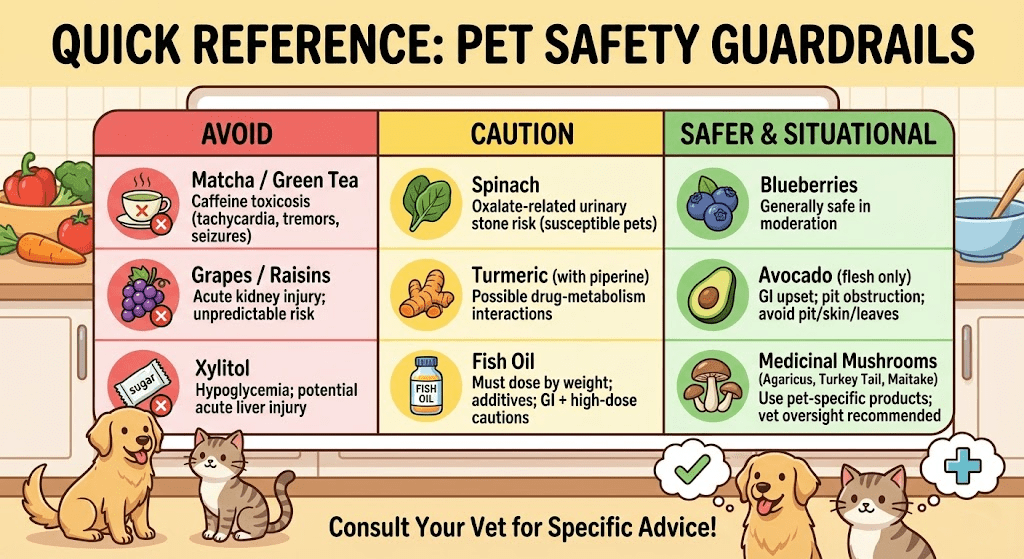
Pet Safety Guardrails
| Human “Superfood” | Pet Safety Status | Main Risk or Note |
| Matcha / green tea | Avoid | Caffeine toxicosis; may cause tachycardia, tremors, seizures |
| Grapes / raisins | Avoid | Acute kidney injury; unpredictable risk |
| Xylitol | Avoid | Rapid hypoglycemia; possible acute liver injury |
| Spinach | Caution | High oxalate burden in susceptible pets |
| Turmeric supplements with piperine | Caution | May interfere with medication metabolism |
| Fish oil | Caution | Must be dosed by weight; avoid unsuitable additives |
| Blueberries | Safer | Best served plain and in moderation |
| Avocado flesh only | Mixed | GI upset risk; pit, skin, and leaves should be avoided |
| Medicinal mushrooms | Situational | Use pet-specific products and veterinary oversight |
Final Perspective
For people, superfoods can be useful shorthand for foods with interesting nutrient and bioactive profiles. But the healthiest interpretation of the term is still practical, not magical. A superfood is only truly helpful when it fits into a consistent, balanced routine.
For pets, the stakes are different. Dogs and cats should not be treated as small humans when it comes to nutrition. Some foods that support human wellness can cause serious toxicity in pets. In mixed human-and-pet households, the safest rule is simple: keep human superfood trends separate from pet feeding choices unless your veterinarian says otherwise.
Frequently Asked Questions
What makes a food a superfood?
There is no formal scientific definition. The term usually refers to foods that are nutrient-dense and rich in compounds such as polyphenols, fiber, omega-3 fats, or beta-glucans that are being studied for health-supporting effects.[1–3,19]
Are superfoods proven to prevent disease?
No single food should be viewed that way until it is proven to have drug efficacy. Until then, dog parents can add superfoods-based pet products to nourish furry friends. Most evidence supports the role of overall dietary patterns, with individual foods contributing nutrients and bioactive compounds that may support normal physiology.
Can I give my dog my human turmeric supplement?
No. Human turmeric supplements often contain concentrated curcumin plus piperine, which may interfere with pet medication metabolism and may not be appropriate for dogs or cats.[27–29]
Are blueberries safe for dogs?
Usually yes, when they are plain, raw, and offered in small amounts.[38] Avoid blueberry products that contain sugar, chocolate, syrups, baked ingredients, or xylitol.
Is avocado safe for pets?
Avocado is not a simple yes-or-no food. Tiny amounts of plain flesh may be tolerated by some dogs, but the pit, skin, and leaves should be avoided; some owners may prefer to skip avocado entirely due to choking and GI concerns.[35,36]
Is matcha safe for pets?
No. Matcha contains caffeine, and dogs and cats are much more sensitive to caffeine than humans.[21–23]
Explore More Dog Health Tips
- Agaricus blazei for Dogs and Cats
- Can Dogs Eat Blueberries?
- Can Dogs Eat Seaweed?
- Turkey vs. Chicken: Which Protein Is Better for Your Dog’s Treats?
References
- Harvard T.H. Chan School of Public Health, The Nutrition Source. (n.d.). Superfoods or superhype? Retrieved March 4, 2026.
- Scalbert, A., Manach, C., Morand, C., Rémésy, C., & Jiménez, L. (2005). Dietary polyphenols and the prevention of diseases. Critical Reviews in Food Science and Nutrition, 45(4), 287–306.
- Anderson, J. W., Baird, P., Davis, R. H., Ferreri, S., Knudtson, M., Koraym, A., Waters, V., & Williams, C. L. (2009). Health benefits of dietary fiber. Nutrition Reviews, 67(4), 188–205.
- Kochman, J., Jakubczyk, K., Antoniewicz, J., Mruk, H., & Janda, K. (2020). Health benefits and chemical composition of matcha green tea: A review. Molecules, 25(23), 1–18.
- Haskell, C. F., Kennedy, D. O., Milne, A. L., Wesnes, K. A., & Scholey, A. B. (2008). The effects of L-theanine, caffeine and their combination on cognition and mood. Nutritional Neuroscience, 11(4), 193–198.
- Willems, M. E. T., Świerczek, A., Brown, R., et al. (2018). Matcha green tea drinks enhance fat oxidation during brisk walking in females. International Journal of Sport Nutrition and Exercise Metabolism, 28(5), 536–541.
- Venables, M. C., Hulston, C. J., Cox, H. R., & Jeukendrup, A. E. (2008). Green tea extract ingestion, fat oxidation, and glucose tolerance in healthy humans. The American Journal of Clinical Nutrition, 87(3), 778–784.
- Hewlings, S. J., & Kalman, D. S. (2017). Curcumin: A review of its effects on human health. Foods, 6(10), 92.
- Cassidy, A., Mukamal, K. J., Liu, L., Franz, M., Eliassen, A. H., & Rimm, E. B. (2013). High anthocyanin intake is associated with a reduced risk of myocardial infarction in young and middle-aged women. Circulation, 127(2), 188–196.
- Miller, M. G., Hamilton, D. A., Joseph, J. A., & Shukitt-Hale, B. (2018). Dietary blueberry improves cognition among older adults in a randomized, double-blind, placebo-controlled trial. European Journal of Nutrition, 57(3), 1169–1180.
- Dreher, M. L., & Davenport, A. J. (2013). Hass avocado composition and potential health effects. Critical Reviews in Food Science and Nutrition, 53(7), 738–750.
- Unlu, N. Z., Bohn, T., Clinton, S. K., & Schwartz, S. J. (2005). Carotenoid absorption from salad and salsa by humans is enhanced by the addition of avocado or avocado oil. The Journal of Nutrition, 135(3), 431–436.
- Wien, M., Haddad, E., Oda, K., & Sabaté, J. (2013). A randomized 3×3 crossover study to evaluate the effect of Hass avocado intake on post-ingestive satiety, glucose and insulin levels, and subsequent energy intake in overweight adults. Nutrition Journal, 12, 155.
- Skulas-Ray, A. C., Wilson, P. W. F., Harris, W. S., et al. (2019). Omega-3 fatty acids for the management of hypertriglyceridemia: A scientific statement from the American Heart Association. Circulation, 140, e673–e691.
- Nicholls, S. J., Lincoff, A. M., Garcia, M., et al. (2020). Effect of high-dose omega-3 fatty acids vs corn oil on major adverse cardiovascular events in patients at high cardiovascular risk (STRENGTH): A randomized clinical trial. JAMA, 324(22), 2268–2280.
- Yurko-Mauro, K., McCarthy, D., Rom, D., et al. (2010). Beneficial effects of docosahexaenoic acid on cognition in age-related cognitive decline. Alzheimer’s & Dementia, 6(6), 456–464.
- Aakre, I., Kjellevold, M., et al. (2021). Commercially available kelp and seaweed products—valuable iodine source or risk of excess intake? Food & Nutrition Research, 65.
- Leung, A. M., & Braverman, L. E. (2014). Consequences of excess iodine. Nature Reviews Endocrinology, 10(3), 136–142.
- Cerletti, C., Esposito, S., & Iacoviello, L. (2021). Edible mushrooms and beta-glucans: Impact on human health. Nutrients, 13(7), 2195.
- Mori, K., Inatomi, S., Ouchi, K., Azumi, Y., & Tuchida, T. (2009). Improving effects of the mushroom Hericium erinaceus on mild cognitive impairment: A double-blind placebo-controlled clinical trial. Phytotherapy Research, 23(3), 367–372.
- VCA Animal Hospitals. (n.d.). Caffeine toxicity in pets. Retrieved March 4, 2026.
- VetMed. (2023). Caffeine. Retrieved March 4, 2026.
- ASPCA Animal Poison Control Center. (n.d.). People foods to avoid feeding your pets. Retrieved March 4, 2026.
- Cornell University, Richard P. Riney Canine Health Center. (2025). Grape and raisin toxicity. Retrieved March 4, 2026.
- ASPCApro. (2022). Toxic component in grapes and raisins identified. Retrieved March 4, 2026.
- Wegenast, C. A., et al. (2022). Acute kidney injury in dogs following ingestion of cream of tartar or tamarinds and the connection to tartaric acid as the proposed toxic principle in grapes and raisins. Journal of Veterinary Emergency and Critical Care.
- Singh, J., Dubey, R. K., & Atal, C. K. (1986). Piperine-mediated inhibition of glucuronidation activity in isolated epithelial cells of the guinea-pig small intestine: Evidence that piperine lowers endogenous UDP-glucuronic acid content. Journal of Pharmacology and Experimental Therapeutics.
- Reen, R. K., et al. (1993). Impairment of UDP-glucose dehydrogenase and glucuronidation potentials by piperine in liver and intestine. Biochemical Pharmacology.
- Shoba, G., Joy, D., Joseph, T., Majeed, M., Rajendran, R., & Srinivas, P. S. (1998). Influence of piperine on the pharmacokinetics of curcumin in animals and human volunteers. Planta Medica, 64(4), 353–356.
- VCA Animal Hospitals. (n.d.). Calcium oxalate bladder stones in dogs. Retrieved March 4, 2026.
- Bauer, J. E. (2011). Therapeutic use of fish oils in companion animals. Journal of the American Veterinary Medical Association, 239(11), 1441–1451.
- Bright, J. M., Sullivan, P. S., Melton, S. L., Schneider, J. F., & McDonald, T. P. (1994). The effects of n-3 fatty acid supplementation on bleeding time, plasma fatty acid composition, and in vitro platelet aggregation in cats. Journal of Veterinary Internal Medicine, 8(4), 247–252.
- Merck Veterinary Manual. (n.d.). Xylitol toxicosis in dogs. Retrieved March 4, 2026.
- Dunayer, E. K., & Gwaltney-Brant, S. M. (2006). Acute hepatic failure and coagulopathy associated with xylitol ingestion in eight dogs. Journal of the American Veterinary Medical Association, 229(7), 1113–1117.
- Merck Veterinary Manual. (n.d.). Avocado (Persea spp) toxicosis in animals. Retrieved March 4, 2026.
- ASPCA. (2019). The scoop on avocado and your pets. Retrieved March 4, 2026.
- Brown, D. C., & Reetz, J. (2012). Single agent polysaccharopeptide delays metastases and improves survival in naturally occurring hemangiosarcoma. Evidence-Based Complementary and Alternative Medicine, 2012, 384301.
- VCA Animal Hospitals. (n.d.). Using food and treats for training dogs. Retrieved March 4, 2026.
- QIX Co., Ltd. (n.d.). Agaricus products for companion animals in Japan. Referenced as a trade-source anchor for veterinary market popularity in Japan.
