
Top-Rated Organic Dog Treats: How to Choose Safely Without Falling for the Hype

Quick Answer
“Top-rated” organic dog treats are not automatically the safest or healthiest choice. Reviews can be useful, but they do not replace label-reading, calorie awareness, ingredient transparency or your dog’s individual tolerance. For most dogs, the better treat is one that is appropriately sized, easy to portion, clearly labeled and used sparingly within a complete and balanced diet.[1][2][3][4]
Trust Signal
By Superfood Science Writing Team | Reviewed by Dr. Kelly Hood, DVM | Last Updated: 04/24/2026
Superfood Science has produced organic and natural functional foods for humans and pets for over 20 years, specializing in clean-label formulations and evidence-based nutrition.
This article uses conservative guidance from WSAVA, FDA, AAFCO consumer resources, Tufts Petfoodology and Merck Veterinary Manual. It is designed for real-world dog parents comparing highly rated products online while trying to avoid overpromising marketing and treat-related stomach or weight problems.[1][2][3][4][5]
Featured Snippet Block
Top-rated organic dog treats are not automatically the safest choice. The best way to compare them is to look past review averages and focus on ingredient transparency, calories per piece, portion size and whether the treat fits your dog’s stomach, age and daily calorie budget.
Key Takeaways
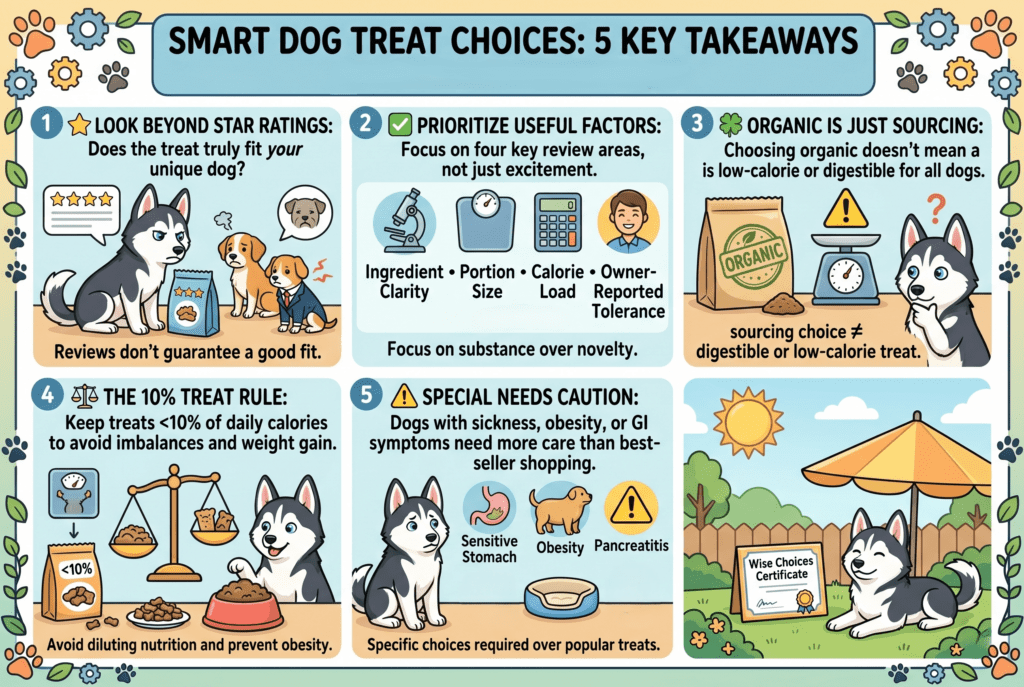
- A high star rating does not necessarily mean a treat is right for your dog.[1][2]
- The most useful review factors are ingredient clarity, portion size, calorie load and consistency of owner-reported tolerance, not just excitement or novelty.[1][3]
- Organic can be a sourcing preference, but it does not automatically make a treat low-calorie, highly digestible or safer for every dog.[2][4]
- Treats should generally remain below about 10% of a dog’s daily calories so they do not dilute nutritional balance or contribute to excess weight.[1][3]
- Dogs with sensitive stomachs, obesity, pancreatitis history or chronic GI symptoms need a more cautious approach than “best seller” shopping.[4][5]
Introduction
American dog parents are flooded with dog treat choices.
Every online marketplace seems to have a “top-rated” section. Every bag claims to be premium, natural, healthy or crafted with better ingredients. And when a product has thousands of five-star reviews, it is easy to assume the decision is almost made for you.
But dog treats are not shoes or coffee makers.
A treat that earns rave reviews from one family may still be a poor fit for a small dog, a senior dog, a puppy in training or a dog with a sensitive stomach. Or ultimately your dog. That is why the smartest way to use ratings is as one filter, not the final answer.
What “Top-Rated” Usually Means Online
Most rating systems reward popularity, convenience, price satisfaction, packaging and how excited dogs seem to be when they get the treat.
Those signals are not useless. Palatability matters. Value matters. Shipping experience matters. But they are not the same thing as digestive tolerance, calorie suitability or long-term feeding fit.
The Hidden Problem With Review Averages
Averages often flatten important details. A product can be “top-rated” overall while still being too large, too rich, too crumbly for training or too inconsistent for a dog with food sensitivities.
That is why dog parents need to read past the stars and into the substance.
The Four Questions Smart Dog Parents Should Ask First
1. What Is Actually in the Treat?
WSAVA and FDA guidance both support the importance of product transparency and truthful labeling.[1][2] Before a review score means anything, look at the ingredient panel.
What helps
A short, understandable ingredient list with clearly named ingredients is easier to evaluate.
What complicates things
A long list of “superfood” add-ins may sound impressive, but it can create more variables for dogs who do not tolerate change well.
2. How Many Calories Are in Each Piece?
This is one of the biggest blind spots in treat shopping.
Dog parents frequently compare ingredient style but never calculate how easy it is to overfeed the product. WSAVA and Tufts both emphasize that treats should usually stay around 10% or less of daily calories.[1][3]
Why This Matters So Much
A “healthy” treat can still become unhealthy if each piece is large and fed often.
3. What Size and Texture Is the Treat?
For training, tiny pieces or easy-to-break treats are usually more practical than oversized biscuits. For small dogs and puppies, large or hard treats can also be awkward or excessive.
Review the clue to notice
Look for owner comments about whether a treat breaks cleanly, crumbles excessively or turns into a calorie-heavy habit because each piece is too big.
4. How Did Dogs Actually Tolerate It?
This is where review-reading becomes more meaningful.
Instead of counting stars, scan for patterns. Are there repeated comments about diarrhea, vomiting, gas, poor tolerance or formula inconsistency? Or do owners repeatedly say the treat worked well for sensitive dogs when used in small amounts?
Owner reviews are not clinical trials, but repeated tolerance patterns can still be a useful context.
Where Organic Fits In
Organic can matter to some families as a sourcing preference.
That is reasonable. But it is important not to confuse an organic label with proof of better nutritional quality or easier digestion. FDA and AAFCO-related consumer resources focus on safety, labeling and appropriate use. They do not frame organic as a blanket health guarantee.[2][4]
A Practical Way to Think About It
Organic can be one “yes” on your checklist.
It should not replace questions about calories, portion size, ingredient simplicity or whether the treat fits your dog’s body and health history.
What High-Quality Reviews Actually Look Like
The most helpful reviews usually describe specific real-world experiences.
They mention dog size or age, whether the treat is used for training or occasional reward, whether the treat is easy to break, how the dog tolerated it and how many pieces the owner typically gives.
By contrast, vague reviews such as “my dog loved it” or “great product” tell you very little about whether the treat is safe or practical for your own dog.
When Top-Rated Treats Are Still the Wrong Choice
Sensitive Stomach Dogs
A top-selling treat may still be too rich or variable for a dog who gets loose stool after new foods.[5]
Overweight Dogs
High review volume does not cancel out calorie density. Dogs that need weight control often do better with very small, intentionally portioned treats.[1][3]
Puppies
Puppies have smaller caloric budgets and should still get most of their nutrition from a complete growth diet. A highly rated treat can still be too large, too frequent or too energy-dense for a puppy routine.[3]
Dogs on Elimination Diets or Special Diets
When a dog is being evaluated for food sensitivity or is on a tightly managed ingredient diet, “trying a top-rated treat” may work against the diagnostic goal.[5]
Practitioner-Recommended Usage Guide
If you are comparing highly rated organic dog treats, use this order of operations.
Step 1: Ignore the Star Rating at First
Start with the label, not the reviews.
Step 2: Check Calories per Piece
Ask whether the treat is realistically usable without exceeding a conservative daily treat limit.[1][3]
Step 3: Look at Size and Breakability
Training households usually benefits from smaller rewards. A small treat is still a treat.
Step 4: Read Negative Reviews Intelligently
Do not panic at one complaint. Look for repeated patterns involving GI upset, hard texture, oversized pieces or inconsistent batches.
Step 5: Trial Slowly
Introduce one new treat at a time and monitor stool, appetite, gas and itch flare-ups over several days.[5]
Safety
Treats should not replace meals or become a major calorie source.
Dogs with active vomiting, diarrhea, abdominal pain, significant food sensitivity, pancreatitis history or rapid weight change deserve extra caution before any new treat trial.[1][3][5]
When to Call a Vet
Call your veterinarian if a new treat is followed by repeated vomiting, persistent diarrhea, lethargy, appetite loss, blood in stool, ongoing poor stool quality or worsening itch.[5]
When to Get Urgent Care
Seek urgent veterinary help if your dog has severe vomiting, collapse, profound weakness, dehydration, repeated retching or rapidly worsening abdominal pain.[5]
FAQ
Are top-rated organic dog treats always safer?
No. Review popularity does not guarantee calorie appropriateness, digestibility or suitability for your specific dog.[1][2]
What matters more than reviews?
Ingredient transparency, calorie content, portion size and your dog’s tolerance usually matter more than simple star counts.[1][3][4]
Are highly rated treats good for training?
Only if they are small, easy to break and low enough in calories to use repeatedly without overfeeding.[1][3]
Can a top-rated treat still upset my dog’s stomach?
Yes. Even popular treats can trigger GI upset in individual dogs, especially if the recipe is rich or introduced too quickly.[5]
How should I test a new dog treat?
Start with a very small amount, keep the rest of the diet stable, and watch stool, appetite, gas and skin changes over several days.[3][5]
Conclusion
Top-rated organic dog treats can be worth considering, but they are not self-validating.
The safest, smartest choice for your dog is usually the one that checks practical boxes: transparent label, reasonable calories, manageable size and good tolerance in real life. Ratings can help you narrow the list. However, they should not do the thinking for you.
Explore More Dog Health Tips
- Organic Dog Treat Subscription Made Simple and Easy
- Are Organic Dog Treats Worth It in the Long Run?
- Organic Dog Treats by Size: 2026 Guide for Small to Large Dogs
- Homemade vs. Store-Bought Organic Dog Treats
- Plant-Based Dog Treats with Kelp for Sensitive Dogs
- Ultimate Guide to Choosing the Best Natural Dog Treats
References
- World Small Animal Veterinary Association. What are treats? Feeding treats to your dog. https://wsava.org/wp-content/uploads/2024/06/Feeding-treats-to-your-dog-v2.pdf
- U.S. Food and Drug Administration. Pet food. https://www.fda.gov/animal-veterinary/animal-foods-feeds/pet-food
- Tufts Cummings Petfoodology. Treat options for dogs and cats without unbalancing their diet. https://vetnutrition.tufts.edu/2021/12/treat-options-for-dogs-and-cats-without-unbalancing-their-diet/
- Association of American Feed Control Officials. Treats and chews. https://www.aafco.org/consumers/understanding-pet-food/treats-and-chews/
- Merck Veterinary Manual. Disorders of the stomach and intestines in dogs. https://www.msdvetmanual.com/dog-owners/digestive-disorders-of-dogs/disorders-of-the-stomach-and-intestines-in-dogs
