
Plant-Based Dog Treats with Kelp: Oral Care Support and Gentle Wellness for Sensitive Dogs

Quick Answer
If your dog reacts to common animal proteins, plant-based treats can help you keep rewards in the routine without depriving your pet or increasing exposure to unwanted food triggers. Among kelp ingredients, Ascophyllum nodosum has some of the strongest research supporting oral care in dogs. In controlled canine research, edible treats containing A. nodosum were associated with improvements in plaque and tartar measures when used daily.[4] For digestion and skin or coat support, the most accurate language is that kelp-containing treats may support overall wellness as part of a consistent routine, because results can vary by dog, dose, formulation, and total diet.[6][8]
By Superfood Science Writing Team | Reviewed by Dr. Kelly Hood, DVM | Last Updated: 04/08/2026
Superfood Science has produced organic and natural functional foods for humans and pets for over 20 years, specializing in clean-label formulations and evidence-based nutrition.
Key Takeaways
- Ascophyllum nodosum is one of the few seaweed ingredients with controlled canine evidence for oral care support in an edible treat format.[4]
- Research suggests its oral-care effects may involve changes in the oral environment, not just chewing action alone.[4][5]
- Brown seaweeds contain marine fibers and polyphenols, but nutrient composition can vary widely by species, harvest season, and sourcing location.[2][7]
- Research on digestive support in dogs is promising but still developing, so claims should remain conservative.[6][8]
- Because seaweeds can contribute iodine and may accumulate trace elements, feeding directions and quality sourcing matter.[1][3][7]
Why This Topic Matters for Sensitive Dogs
If you have a dog with a sensitive stomach or skin, you already know how quickly the wrong treat can disrupt progress. Some dogs develop itchiness, soft stools, or general discomfort after eating treats made with ingredients they do not tolerate well.
That is one reason many dog parents look for simpler reward options. A plant-based treat can be a practical choice when you are trying to avoid common animal proteins while keeping training and daily rewards consistent.
Some plant-based treats also include kelp. That matters because Ascophyllum nodosum, a brown seaweed commonly labeled as kelp, has one of the clearest evidence trails for a functional outcome in dogs: oral care support, as shown in clinical research using edible treats.[4]
This guide explains what A. nodosum is, what dog research suggests about oral care, what can be said responsibly about digestive and skin wellness, and how to use kelp-containing treats safely.
What is Ascophyllum nodosum?
Ascophyllum nodosum is a brown seaweed harvested from North Atlantic waters. Brown seaweeds are known for naturally occurring marine fibers such as alginate, laminaran, and fucoidan, along with polyphenols and minerals.[2][7]
These compounds are interesting because they may interact with the oral environment and gut microbiome differently than typical land-plant fibers.[2]
Why sourcing matters
Seaweed composition is not fixed. Even within the same species, nutrient and compound levels can shift depending on growing conditions, season, and harvest location.[7] That is why sourcing, testing, and quality control are especially important for kelp-based ingredients.
Oral Care: Where the Evidence Is Strongest
There are many dental chews on the market, but relatively few ingredients have controlled canine evidence behind them.
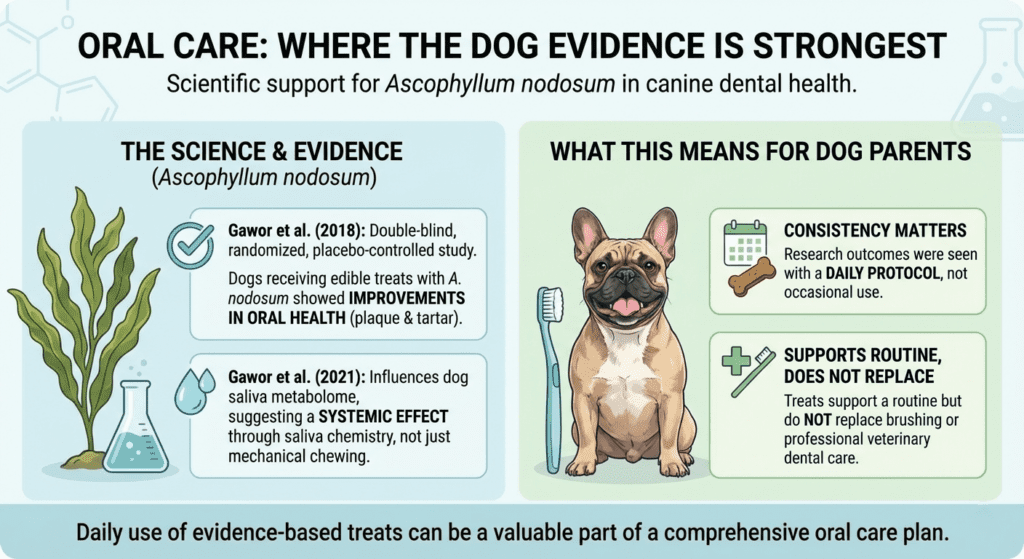
In a double-blind, randomized, placebo-controlled study, dogs receiving edible treats containing Ascophyllum nodosum showed improvements in oral health measures, including plaque and calculus outcomes, during the study period.[4]
Follow-up research also examined changes in dog saliva chemistry after supplementation, supporting the idea that the benefit may not come only from chewing texture. In other words, kelp may help support the oral environment in a way that goes beyond mechanical scraping alone.[5]
What this means in practice
- Consistency matters. The oral-care benefit was studied with daily use, not occasional use.[4]
- Kelp treats can support an oral-care routine, but they are not a replacement for brushing, appropriate chewing options, or veterinary dental care.
Digestive Support: What We Can Say Responsibly
Seaweed fibers are often described as prebiotic fibers because they may help support beneficial gut microbes and fermentation patterns.[2]
Dog-specific evidence is still emerging. One pilot study in dogs with chronic inflammatory enteropathy, a long-term digestive condition, evaluated Ascophyllum nodosum together with Bacillus subtilis C-3102 and supported the need for further study rather than broad conclusions for all dogs.[6] Another adult-dog study on supplemental seaweed extract evaluated loose stools, gut microbiota, and metabolite-related outcomes, but responses can vary by dog and formula.[8]
Safe takeaway for dog parents
Kelp-containing treats may support digestive comfort as part of a consistent routine, but outcomes depend on the individual dog, the amount fed, the rest of the diet, and the overall formulation.
Skin and Coat: Where Kelp Fits Best
Skin and coat changes are rarely explained by a single ingredient. They are influenced by the dog’s overall diet, essential fatty acid intake, micronutrient status, grooming routine, environment, and individual sensitivity.
That is why the most responsible way to discuss kelp and skin or coat support is not as a cure-all, but as one part of a cleaner, more consistent routine.
What is fair to say
- If your dog reacts to common animal proteins, a plant-based treat may help reduce exposure to ingredients your dog does not tolerate well.
- Kelp contains naturally occurring minerals and marine compounds that may support overall wellness, including skin and coat health, but results are individual and depend on the full diet.[2]
Clinical Note
If your dog has ongoing vomiting, diarrhea, blood in the stool, weight loss, severe itching, recurrent ear problems, or sudden noticeable breath changes, a treat change alone is not enough. Those patterns deserve veterinary evaluation and a structured plan. Treats can support a daily routine, but they should not replace diagnosis or care.
Safety and Responsible Use
Brown seaweeds can contribute iodine, and they can also accumulate trace elements depending on where and how they are grown.[7] That makes responsible dosing and quality sourcing important.
Example iodine math
If 10 pieces of 2 g treats provide about 650 mg of kelp, and that kelp contains about 300 to 750 ppm iodine, the kelp portion would provide roughly 0.195 to 0.488 mg iodine, or 195 to 488 mcg.
AAFCO lists iodine for adult dog maintenance at a minimum of 0.25 mg per 1000 kcal and a maximum of 2.75 mg per 1000 kcal.[1] For many 40 lb adult dogs eating roughly 900 to 1100 kcal per day, that treat example would usually be a meaningful addition but not typically near the daily maximum by itself, depending on the base diet and other iodine sources.
Practical guidance
- Follow feeding directions.
- Avoid stacking multiple kelp or iodine-containing products unless your veterinarian advises it.
- If your dog has a thyroid condition or is on an iodine-restricted plan, ask your veterinarian before adding kelp-containing treats.
- More is not automatically better.
Seaweeds may also accumulate metals from seawater, which is why supplier testing and ingredient quality control matter.[3]
Where Superfood Science Plant-Based Dog Treats with Kelp Fit
Superfood Science Plant-Based Dog Treats with Kelp Mini Sticks are best suited for dog parents who want a plant-based reward option, a simpler ingredient routine, and a functional ingredient with meaningful scientific backing, especially for oral care support.
Simple daily-use idea
Use them as training rewards or as a small daily wellness treat. If oral care is your top priority, pair them with the basics: brushing when tolerated, appropriate chew options, and regular veterinary dental checkups.
Seaweed Types at a Glance
| Seaweed group | Examples | Common nutrition highlights | Safe wording for dog parents |
| Brown algae | Ascophyllum nodosum, Saccharina latissima | Marine fibers such as alginate, laminaran, and fucoidan; polyphenols; often higher iodine | May support the oral environment and digestive comfort as part of a routine; sourcing and iodine intake matter |
| Red algae | Palmaria palmata, Chondrus crispus | Often higher protein; different polysaccharides | Useful in broader nutrition discussions, but not the main oral-care evidence base here |
| Green algae | Ulva species | Marine fibers such as alginate, laminaran, and fucoidan; polyphenols; often have higher iodine | More general nutrition interest; less targeted to A. nodosum oral-care research |
This table is a high-level summary and does not guarantee outcomes for every dog. Species, processing, dose, and individual response all matter.
Frequently Asked Questions
Are plant-based treats truly hypoallergenic?
No treat is universally hypoallergenic. However, plant-based treats can reduce exposure to common animal proteins that some dogs do not tolerate well.
What is the most evidence-backed benefit of Ascophyllum nodosum in dogs?
The clearest dog-specific evidence is for oral care support, including plaque and tartar-related outcomes, when used in edible treat form as part of a daily protocol.[4]
Will kelp treats fix bad breath on their own?
Not always. Bad breath can have several causes. Treats may support a routine, but the best results usually come from combining daily oral-care habits with veterinary dental evaluation when needed.
Can kelp treats support digestion?
They may support a healthier gut environment over time, but results vary by dog and formula. If digestive symptoms continue, talk with your veterinarian.[6][8]
Can kelp treats help skin and coat?
They may support overall wellness as part of a consistent routine, especially if the treat helps you avoid common trigger ingredients. Outcomes depend on the whole diet and the individual dog.
Is iodine from kelp a concern?
It can be if your dog is getting iodine from multiple sources or has a thyroid condition. Follow feeding directions and talk with your veterinarian if thyroid health is a concern.[1]
How many calories does a typical 40 lb dog eat per day?
Many adult 40 lb dogs consume roughly 900 to 1100 kcal per day, depending on age, activity level, and body condition.
Can I use kelp treats during an elimination diet?
Often, treats are restricted during elimination trials. Check with your veterinarian before adding any treat during a diet trial.
Conclusion
If your dog is sensitive to common animal proteins, a plant-based treat can be a practical way to keep rewards consistent while reducing exposure to ingredients that may not agree with your dog.
If oral care support is also a priority, Ascophyllum nodosum stands out because it has controlled canine evidence in an edible treat format.[4] Digestive and skin-related benefits should still be described conservatively as supportive, routine-based, and individual-dependent.
Explore More Dog Health Tips
- Superfood Science Plant-Based Dog Treats with Kelp (Mini Sticks)
- Oral care routine tips for dog parents
- How to choose treats for dogs with protein sensitivities
- Gentle digestion support tips for sensitive dogs
References
- Association of American Feed Control Officials (AAFCO). (2023). AAFCO dog and cat food nutrient profiles.
- Čmiková, N., Kowalczewski, P. Ł., Kmiecik, D., Tomczak, A., Drożdżyńska, A., Ślachciński, M., Szala, Ł., Matić, S., Marković, T., Popović, S., Baskic, D., & Kačániová, M. (2024). Seaweed nutritional value and bioactive properties: Insights from Ascophyllum nodosum, Palmaria palmata, and Chondrus crispus. Life, 14(11), 1522. https://doi.org/10.3390/life14111522
- Deemy, M., & Benjamin, L. (2019). CVM CY15–17 report on heavy metals in animal food. U.S. Food and Drug Administration.
- Gawor, J., Jank, M., Jodkowska, K., Klim, E., & Svensson, U. K. (2018). Effects of edible treats containing Ascophyllum nodosum on the oral health of dogs: A double-blind, randomized, placebo-controlled single-center study. Frontiers in Veterinary Science, 5, 168. https://doi.org/10.3389/fvets.2018.00168
- Gawor, J. P., Wilczak, J., Svensson, U. K., & Jank, M. (2021). Influence of dietary supplementation with a powder containing Ascophyllum nodosum algae on dog saliva metabolome. Frontiers in Veterinary Science, 8, 681951. https://doi.org/10.3389/fvets.2021.681951
- Isidori, M., Rueca, F., Massacci, F. R., Diaferia, M., Giontella, A., Caldin, M., Furlanello, T., Corbee, R. J., Mannucci, G., Pezzotti, G., & Trabalza-Marinucci, M. (2021). The use of Ascophyllum nodosum and Bacillus subtilis C-3102 in the management of canine chronic inflammatory enteropathy: A pilot study. Animals, 11(12), 3417. https://doi.org/10.3390/ani11123417
- Samarasinghe, M. B., van der Heide, M. E., Weisbjerg, M. R., Sehested, J., Sloth, J. J., Bruhn, A., Vestergaard, M., Nørgaard, J. V., & Hernández-Castellano, L. E. (2021). A descriptive chemical analysis of seaweeds, Ulva sp., Saccharina latissima and Ascophyllum nodosum harvested from Danish and Icelandic waters. Animal Feed Science and Technology, 278, 115005. https://doi.org/10.1016/j.anifeedsci.2021.115005
- Zhang, M., Mo, R., Qu, Y., Li, M., Wang, H., Liu, P., Liu, T., & Wu, Y. (2025). Effects of supplemental seaweed extract on antioxidant properties, loose stools, gut microbiota, and its metabolite composition in adult dogs. Journal of Animal Science, 103, skaf149. https://doi.org/10.1093/jas/skaf149
