
What Are Beta-Glucans in Mushrooms for Dogs? Why Dog Parents Hear About Them

Quick Answer
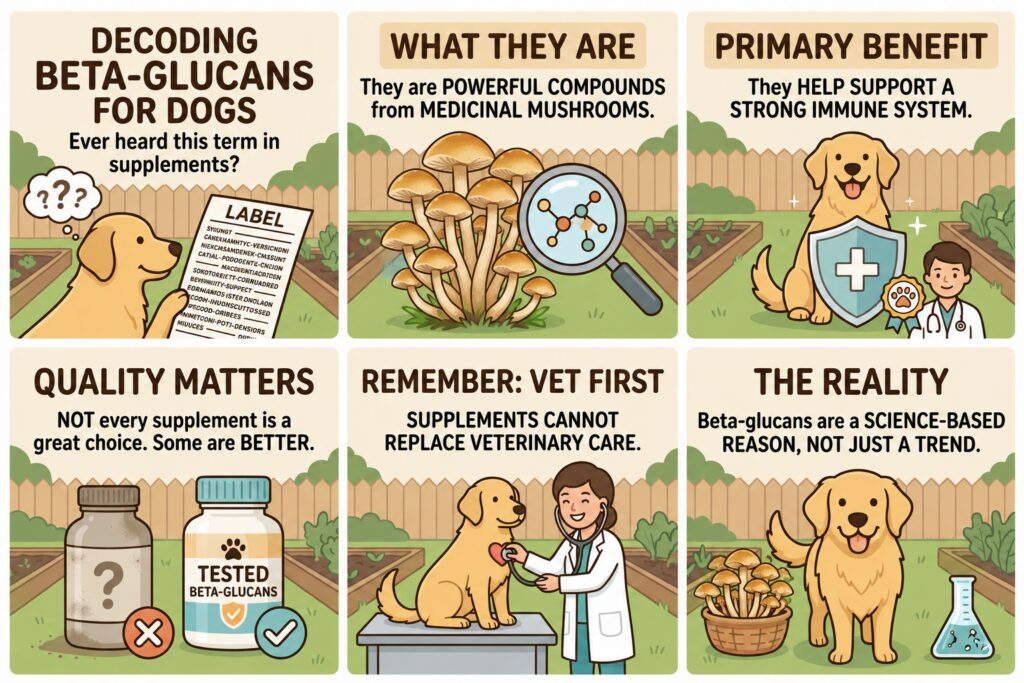
Beta-glucans are natural compounds found in certain mushrooms. They are one of the main reasons medicinal mushrooms are discussed in dog wellness conversations because they interact with immune-related pathways and may support normal immune function as part of a broader wellness routine.[1–3] They are not a cure, and they do not replace veterinary care, but they are one of the strongest science-based reasons dog parents look into mushroom supplements in the first place.
By Superfood Science Writing Team | Reviewed by Dr. Kelly Hood, DVM | Last Updated: 05/11/2026
Superfood Science has produced organic and natural functional foods for humans and pets for over 20 years, specializing in clean-label formulations and evidence-based nutrition.
This article uses conservative, evidence-based language. It separates early or mechanism-based research from stronger practical guidance and avoids disease-treatment claims.
Key Takeaways
- Beta-glucans are one of the main natural compounds that make medicinal mushrooms relevant in dog wellness discussions.[1–3]
- They are part of the broader polysaccharide family in mushrooms, which helps explain why Agaricus blazei gets so much attention.[7–9]
- The most accurate way to describe beta-glucans is that they may support normal immune function as part of a broader wellness routine, not that they treat disease.[1–5]
- A clearly labeled mushroom product with a named source and practical feeding format is easier for dog parents to evaluate than a vague “immune blend.”[4–6]
Why Dog Parents Keep Hearing About Beta-Glucans
Dog parents hear plenty of supplement language that sounds impressive but explains very little. “Beta-glucans” can sound like one more technical buzzword, but in this case, the term is worth understanding.
If medicinal mushrooms come up in a conversation about dogs, beta-glucans are often a big reason why. They are among the better-known natural compounds in mushrooms, and they are central to why mushrooms are discussed in immune-support products and wellness routines.[1–3]
That does not mean every mushroom supplement is automatically high quality. It does not mean a supplement can replace veterinary diagnosis or treatment. It does mean beta-glucans are more than a trendy label term. They are one of the clearest science-based reasons mushroom supplements get attention in the first place.
What Beta-Glucans Are in Plain English
Beta-glucans are natural compounds made of linked sugar units. In practical terms, they are structural parts of certain mushrooms.[1–3]
For dog parents, the chemistry is not the important part. What matters is why they keep showing up in product education and supplement conversations. Researchers study beta-glucans because they interact with immune-related pathways, which is why they are often discussed in wellness contexts.[1–3]
The simplest takeaway is this: beta-glucans are one of the most important reasons a mushroom supplement may be worth discussing at all.
Beta-Glucans and Mushroom Polysaccharides
Beta-glucans are part of the mushroom’s broader polysaccharide family.[7–9]
That sounds technical, but the practical explanation is simple. If you think of mushroom polysaccharides as a larger category, beta-glucans are one of the most important compounds within that category. This is one reason Agaricus blazei is discussed so often in conversations about mushroom support for dogs.[7–9]
This distinction matters because it helps dog parents understand why one mushroom may be emphasized over another and why a named mushroom source often tells a clearer ingredient story than a vague multi-ingredient blend.
Why Agaricus blazei Gets So Much Attention
Not all mushroom products tell a clear ingredient story. Agaricus blazei usually does.
This mushroom gets attention because its polysaccharide fraction, including beta-glucans and related compounds, is one of the main reasons researchers and supplement brands focus on it.[7–9] That does not mean every product is equally strong or equally well formulated. It does mean Agaricus blazei is one of the easier mushrooms to explain clearly to dog parents.
For a reader trying to make sense of labels, this is helpful. Instead of hearing abstract language about “mushroom immune support,” they can understand that certain mushrooms are studied in part because of their polysaccharide content, including beta-glucans.[7–9]
Why Beta-Glucans Deserve Clearer Framing
A cautious tone is appropriate in pet health writing, but over-cautious wording can confuse readers when a compound is clearly central to the topic.
A more helpful way to frame beta-glucans is this: they are one of the main reasons medicinal mushrooms are discussed for dogs at all.[1–3] That does not require exaggerated claims. It simply gives readers a more useful explanation of why this ingredient category keeps coming up.
This kind of framing improves both trust and readability. Dog parents do not need hype. They need a direct explanation that connects the ingredient, the research interest, and the practical role in a dog’s wellness routine.
What This Means for Mushroom Supplement Selection
Dog parents usually are not shopping for an abstract science term. They are looking for a clear explanation of why a product’s ingredient story makes sense.
A focused mushroom supplement built around a clearly named source can be easier to evaluate than a generic blend with no clear mushroom identity. Clear labeling, practical serving format, and realistic expectations often matter as much as the scientific term on the front of the label.[4–6]
Format matters too. A supplement is only useful if a household can use it consistently. Capsules that can be opened and mixed into food may be easier for some homes than larger scoops or harder chew formats, especially for small dogs or picky eaters.
What the Stronger Evidence Supports
| Practical Point | What Dog Parents Can Understand | Why It Matters |
| Beta-glucans are a major reason medicinal mushrooms are discussed in dog wellness. | This is one of the clearest takeaways from the broader mushroom and beta-glucan literature.[1–3] | It explains why the ingredient category appears in immune-support conversations. |
| Agaricus blazei polysaccharides are part of that story. | It explains why the ingredient category appears in conversations about immune support. | It gives dog parents a clearer ingredient story than vague “mushroom blend” language. |
| Product clarity still matters. | Even when the science is promising, dog parents still need a product that is clearly labeled, easy to feed, and appropriate for the individual pet.[4–6] | It keeps the conversation practical and responsible. |
Where the Evidence Is Still Limited
This is the part that keeps the article balanced.
Not every beta-glucan source is identical. Not every mushroom supplement is standardized the same way. And not every lab or mechanism-based finding translates into a visible, everyday change a dog parent will notice at home.[1–3,7–9]
That is why the best message is not “beta-glucans do everything.” The better message is that beta-glucans are one of the strongest science-based reasons medicinal mushrooms are discussed for dogs, and Agaricus blazei is one of the clearer mushrooms through which to explain that story.
What Dog Parents Should Look For
A named mushroom source
A product built around a clearly named mushroom is usually easier to evaluate than a vague immune blend.
Easy feeding
If your dog is small, picky, or already on a stable routine, a simple feeding format is often more realistic.
Clear labeling
Dog parents should be able to tell what the product is, who it is for, and how it is meant to be used.
Realistic goals
A supplement should support a routine, not carry all the expectations.
Practitioner-Recommended Usage Guide
Step 1: Start with the right expectation
Think of beta-glucans as one of the strongest reasons to consider a mushroom supplement for immune support, not as a cure-all.
Step 2: Keep the rest of the routine stable
Do not change food, treats, and supplements all at once when trying something new.
Step 3: Choose a product you can use consistently
If the format feels impractical, it is less likely to become part of a stable routine.
Step 4: Watch your dog closely
After starting a new supplement, monitor appetite, stool quality, vomiting, itching, and general comfort level over several days.
Step 5: Involve your veterinarian when symptoms are part of the picture
Supplements make more sense when they support good care, not when they delay needed care.
Safety and When to Call a Vet
Beta-glucan-containing mushroom supplements should still be introduced thoughtfully and gradually. Natural does not always mean risk-free, and immune-support language should never distract from real veterinary red flags.
Call your veterinarian if your dog develops repeated vomiting, persistent diarrhea, poor appetite, lethargy, or a clear decline after starting any new supplement.
Seek urgent care if your dog has severe vomiting, collapse, marked weakness, inability to keep water down, or significant abdominal pain.
Frequently Asked Questions
Why do dog supplements talk about beta-glucans so much?
Because beta-glucans are one of the main natural compounds that make medicinal mushrooms relevant to immune-support conversations.[1–3]
Are beta-glucans the same thing as mushroom polysaccharides?
Not exactly. Beta-glucans are one important type of mushroom polysaccharides.[7–9]
Why should dog parents care about Agaricus blazei polysaccharides too?
Because beta-glucans are part of the bigger Agaricus blazei story, which helps explain why this mushroom gets so much attention.[7–9]
Does Agaricus blazei make more sense than a generic mushroom blend?
Often yes. A named mushroom source usually gives dog parents clearer ingredient information and makes the product easier to evaluate.
Are beta-glucans enough if my dog seems sick?
No. If your dog has ongoing symptoms such as vomiting, diarrhea, weight loss, poor appetite, or a major behavior change, veterinary care comes first.[4–5]
Conclusion
For a dog-parent audience, the best message is simple.
Beta-glucans are among the key natural compounds that make medicinal mushrooms worth attention. They are a major reason Agaricus blazei is discussed so often in immune-support conversations.[1–3,7–9]
That does not mean dog parents need hype. It means they deserve a clear explanation. The clearest explanation is that beta-glucans are one of the strongest science-based reasons to care about mushroom supplements for dogs, while Agaricus blazei polysaccharides help tell the broader story behind that interest.
Explore More Dog Health Tips
- Can Dogs Eat Mushrooms? A Dog-Parent Guide to Safe and Smart Choices
- What Are Superfoods? Hidden Hazards for Dogs and Cats
- Organic Dog Treats with Natural Ingredients: What Actually Matters for Your Dog
- Organic Dog Treats Made in the USA for Health
- Homemade vs. Store-Bought Organic Dog Treats
Clinical Note
Mushroom compounds such as beta-glucans are best understood as part of a wellness-support conversation, not as a replacement for diagnosis or treatment. When a dog has active symptoms, unexplained weight loss, or declining energy, supplementation should follow veterinary evaluation rather than delay it.
References
- Amaral, A. R., Risolia, L. W., Rentas, M. F., Marchi, P. H., Balieiro, J. C. C., Vendramini, T. H. A., & Brunetto, M. A. (2024). Translating human and animal model studies to dogs’ and cats’ veterinary care: Beta-glucans application for skin disease, osteoarthritis, and inflammatory bowel disease management. Microorganisms, 12(6), 1071. https://doi.org/10.3390/microorganisms12061071
- de Souza Theodoro, S., et al. (2024). β-glucans from Euglena gracilis or Saccharomyces cerevisiae: Effects on immunity and inflammatory parameters in dogs. PLOS ONE, 19(6), e0304833. https://doi.org/10.1371/journal.pone.0304833
- Vetvicka, V., & Vetvickova, J. (2007). Physiological effects of different types of beta-glucan. Biomedical Papers, 151(2), 225–231. https://pubmed.ncbi.nlm.nih.gov/18345255/
- World Small Animal Veterinary Association. (n.d.). Global nutrition guidelines. https://wsava.org/global-guidelines/global-nutrition-guidelines/
- World Small Animal Veterinary Association. (2011). Nutritional assessment guidelines. https://wsava.org/wp-content/uploads/2020/01/WSAVA-Nutrition-Assessment-Guidelines-2011-JSAP.pdf
- Superfood Science. (n.d.). Agaricus Bio® immune support for dogs and cats product page. https://dogs.superfoodscience.com/
- Martins, P. R., et al. (2017). Agaricus brasiliensis polysaccharides stimulate human monocytes to capture Candida albicans, express toll-like receptors 2 and 4, and produce pro-inflammatory cytokines. Journal of Venomous Animals and Toxins including Tropical Diseases, 23, 25. https://pubmed.ncbi.nlm.nih.gov/28344593/
- Biedron, R., Tangen, J. M., Maresz, K., & Hetland, G. (2012). Agaricus blazei Murill: Immunomodulatory properties and health benefits. Functional Foods in Health and Disease, 2(11), 428–447. https://doi.org/10.31989/ffhd.v2i11.72
- Cheng, W., Di, F., Li, L., Pu, C., Wang, C., & Zhang, J. (2024). Anti-photodamage effect of Agaricus blazei Murill polysaccharide on UVB-damaged HaCaT cells. International Journal of Molecular Sciences, 25(9), 4676. https://doi.org/10.3390/ijms25094676
