
Chicken Allergy in Dogs vs. Food Sensitivity: How to Tell the Difference
Quick Answer
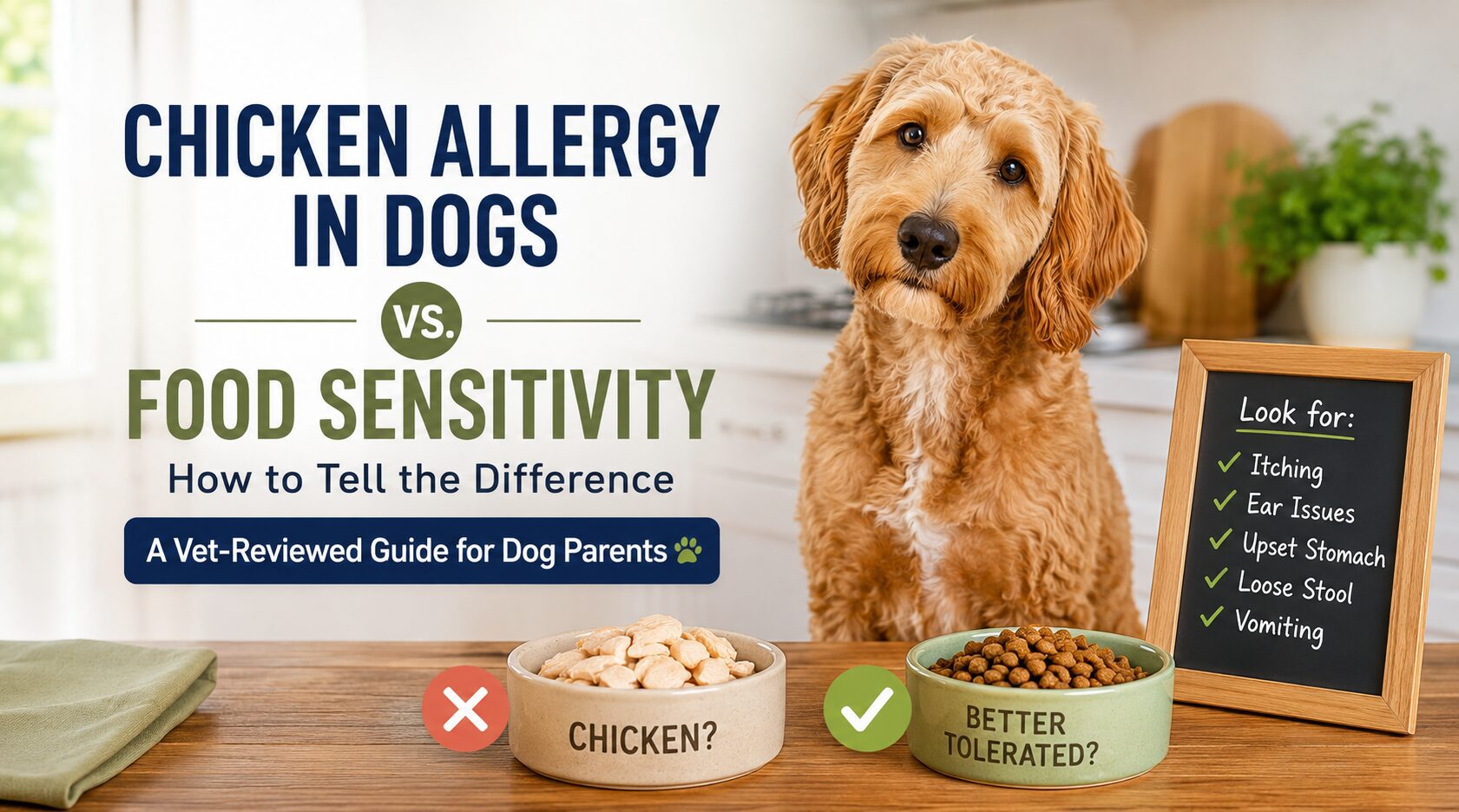
Chicken allergy in dogs and chicken sensitivity are not always the same thing. A true food allergy involves the immune system, whereas a food sensitivity or intolerance may present as digestive upset, stool changes, gas, or vomiting without the same immune mechanism. The most reliable way to confirm a true food allergy is a strict elimination-challenge diet trial under the guidance of a veterinarian.
Trust Signal
By Superfood Science Writing Team | Reviewed by Dr. Kelly Hood, DVM | Last Updated: 05/21/2026
Superfood Science has produced organic and natural functional foods for humans and pets for over 20 years, specializing in clean-label formulations and evidence-based nutrition.
Key Takeaways
- A dog that does poorly with chicken does not automatically have a true chicken allergy.
- Chicken allergy and chicken sensitivity can look similar at home, especially when itching, ear flare-ups, vomiting, or changes in stool appear after meals or treats.
- A true food allergy is an immune-mediated adverse reaction to a dietary ingredient.[1]
- Blood, saliva, and hair tests marketed for dog food allergy are not considered reliable for diagnosis.[2]
- A strict elimination-challenge diet trial is the most reliable way to evaluate a suspected food allergy.[1][2][3]
- Natural and organic treat options can support a cleaner routine after a dog is stable, but individual tolerance and veterinary guidance still come first.
Why This Question Confuses So Many Dog Parents
Dog parents often use the word “allergy” when what they really mean is, “My dog does not seem to do well with this food.”
That is understandable.
A dog may become itchy after chicken treats. Another dog may develop loose stool after a chicken-heavy snack. Another may have recurring ear flare-ups while eating a chicken-based diet. In each case, chicken becomes an obvious suspect.
The challenge is that two different situations can look similar at home: a true immune-mediated food allergy, or a non-allergic food sensitivity, intolerance, richness issue, formula issue, or treat-overload problem. The safer question is not simply, “Is my dog allergic to chicken?”
A better question is: “What is the most reliable way to tell whether chicken itself is truly the issue?”
What a True Chicken Allergy Means in Dogs
A food allergy is generally understood as an adverse food reaction with an immune component.[1] In practical terms, the dog’s immune system reacts abnormally to something in the food.
MSD Veterinary Manual describes food allergy as a hypersensitivity reaction to dietary components and lists beef, dairy products, chicken, and wheat among commonly reported food allergens in dogs.[1] This does not mean chicken is “bad” for dogs. It means chicken is one of several dietary proteins that can be involved in confirmed or suspected canine food allergy cases.
The Immune System “Why” Behind a True Allergy
Proteins are large, complex molecules. In a true food allergy, the immune system may misidentify a food protein as a harmful invader. That immune response can contribute to inflammatory signaling and skin-related signs such as pruritus, which is the medical term for itching.[1]
This is why a true food allergy is not the same as a food being “too rich” or a dog simply eating too much of a new treat. A true allergy involves the immune system. A tolerance problem may not.
What Food Sensitivity or Intolerance Means
“Food sensitivity” is a looser consumer term. It is often used when a dog seems to do poorly with a certain food or treat, but the mechanism may not be a true immune-mediated allergy.
A dog with a food sensitivity or intolerance may develop vomiting, gas, or changes in fecal consistency, such as loose stool. These signs still matter. However, they do not automatically prove a classical food allergy.
The Digestive “Why” Behind Sensitivity
A sensitivity or intolerance may involve the digestive tract more than the immune system. Some dogs may have trouble handling a product’s fat level, richness, portion size, mixed ingredients, fiber level, additives, or sudden change in diet. When the gut does not process a food smoothly, owners may see gas, stool changes, vomiting, or inconsistent digestion.
That reaction can be real and uncomfortable for the dog, but it is not automatically the same as a chicken allergy.
Why Chicken Comes Up So Often
Chicken is extremely common in dog foods and treats. That popularity matters for two reasons.
First, many dogs are exposed to chicken frequently. Second, chicken is one of the more commonly reported food allergens in dogs.[1] Because chicken appears in so many diets, it can become one of the first ingredients owners suspect when signs appear.
That does not make chicken inherently harmful. Many dogs tolerate chicken very well. The key is judging the individual dog’s response through a careful process, not fear or guesswork.
Chicken Allergy vs. Food Sensitivity in Dogs
| Question | Chicken Food Allergy | Chicken Sensitivity or Intolerance |
| Main mechanism | Immune-mediated adverse food reaction[1] | May be non-immune, tolerance-related, formula-related, or portion-related |
| Common home signs | Itching, skin flare-ups, ear issues, and sometimes GI signs[1] | Gas, vomiting, stool changes, or inconsistent digestion |
| Can it be confirmed by guessing? | No | No |
| Best way to evaluate | Strict elimination-challenge diet trial[1][2][3] | Careful diet review, simplification, and sometimes an elimination-style process |
| Are blood, saliva, or hair tests reliable? | No, not considered reliable for diagnosis[2][3] | No |
| Does switching to turkey prove chicken was the issue? | No | No |
The point is not that one category matters more than the other. The point is that the safest way to separate allergy from sensitivity is through a structured process.
Signs That May Make Owners Suspect Chicken Is the Problem
Itching and Skin Changes
Food allergy can show up as itching, skin inflammation, or recurrent skin issues.[1] However, itching is not specific to food. Environmental allergy, fleas, skin infection, and other dermatologic problems can look similar.
Ear Flare-Ups
Recurring ear inflammation is one pattern owners may notice during food-allergy workups. Still, ear problems alone are not specific enough to prove that chicken is the culprit.
Digestive Upset
Vomiting, gas, or repeat digestive instability after chicken-heavy treats may make chicken worth questioning. That still does not prove a true allergy. It only tells you that the ingredient, amount, or formula deserves a closer look.
The Only Reliable Way to Tell: Elimination-Challenge Diet Trial
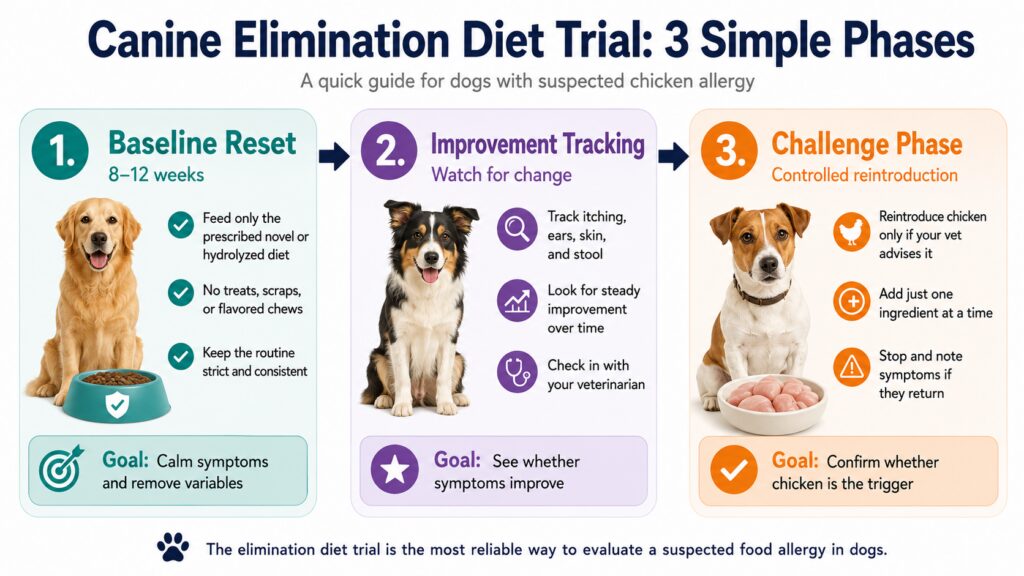
Veterinary guidance consistently points to an elimination-challenge diet trial as the most reliable way to evaluate suspected food allergy.[1][2][3]
In this process, the dog eats only the veterinarian-recommended diet for a set period. Depending on the case, that diet may be a hydrolyzed diet or a carefully selected novel-protein diet. If signs improve, the suspected ingredient may later be reintroduced in a controlled challenge phase to see whether signs return.
This is very different from casually switching treats for a few days.
Why Random Switching Often Confuses the Picture
One of the biggest mistakes dog parents make is changing too many things at once.
They remove chicken, add turkey, change the main food, introduce supplements, and switch treats all within a few days. If the dog improves, nobody really knows what caused the change. Was it removing chicken? Reducing fat? Feeding fewer treats? Changing the main diet? Removing another ingredient?
A structured trial reduces noise. It may feel slower than guessing, but it gives you and your veterinarian a clearer picture.
What the Evidence Supports – and What It Does Not
The stronger veterinary guidance supports three practical ideas.
First, food allergy and food sensitivity are not automatically the same thing.[1][2]
Second, elimination-challenge diet trials remain the most reliable way to evaluate suspected food allergy.[1][2][3]
Third, blood, saliva, and hair tests marketed for food allergy should not be relied on for diagnosis.[2][3]
What the evidence does not support is the casual assumption that any itching, ear issue, vomiting, or loose stool after chicken automatically proves a chicken allergy. That leap is common, but it is not the same as a diagnosis.
How Superfood Science Treat Options Fit This Topic
This is where treat choice matters, but it has to be handled carefully.
If a dog is actively itchy, repeatedly vomiting, experiencing ongoing diarrhea, or undergoing a formal food-allergy workup, the answer is not to keep introducing random treats just because they are natural or organic. Ongoing symptoms still require veterinary guidance and a controlled feeding plan.
However, once the dog is stable and a careful reintroduction of treats is reasonable, Superfood Science offers dog parents more than one thoughtful, clean-label option.
Superfood Science Organic Turkey Dog Treats
If chicken is the ingredient in question, Superfood Science Organic Turkey Dog Treats may be the most logical first option to discuss with your veterinarian. The goal of introducing an alternative protein option is not to treat or cure an allergy. Rather, a simpler turkey-based treat offers a cleaner ingredient profile when dog parents choose to transition away from chicken under veterinary guidance.
This is especially useful for dog parents who want a natural and organic option while they build a more intentional treat routine.
Superfood Science Organic Chicken Dog Treats
Not every dog who eats chicken has a problem with chicken. For dogs that tolerate chicken well, Superfood Science Organic Chicken Dog Treats can still fit a clean-label routine.
The better message is not “chicken is bad.” It is that chicken should be judged by the individual dog’s response, the overall diet, treat amount, and veterinary guidance when symptoms are present.
Superfood Science Plant-Based Protein Dog Treats
For some owners, a different protein direction may feel more comfortable during a reset phase or after a dog has shown difficulty with multiple animal proteins. In those cases, Superfood Science Plant-Based Protein Dog Treats may offer another clean-label option to consider once the dog is stable and veterinary guidance allows normal treat use again.
The strongest compliant brand position is simple: Superfood Science offers natural and organic treat options that may help dog parents build a more intentional routine, but individual tolerance and veterinary guidance still come first.
Suggested Usage Guide
If you suspect chicken is a problem, avoid making several changes at once. Sudden diet changes can make it harder to know whether the dog is reacting to chicken, treat richness, too many calories from treats, another ingredient, or a separate health issue.
Before changing the routine, write down what you are seeing. Include itching, ear issues, vomiting, stool changes, appetite changes, and timing after meals or treats. Then speak with your veterinarian about whether the pattern fits a food-allergy workup, a digestive tolerance issue, or another concern.
If your veterinarian says treat reintroduction is appropriate later, use a simple approach:
- Introduce one treat direction at a time.
- Use small portions and keep the rest of the diet stable.
- Track skin, ear, stool, and digestive changes for several days before making another change.
For many dog parents, that may mean trialing a turkey-based or clearly different protein option in small amounts rather than mixing several new products at once.
Safety and When to Call a Veterinarian
Call your veterinarian sooner rather than later if your dog has chronic itching, repeated ear flare-ups, vomiting, ongoing diarrhea, weight loss, poor appetite, or symptoms that keep recurring around food changes.[1][2]
Seek urgent veterinary care if your dog has facial swelling, trouble breathing, collapse, severe vomiting, black or bloody stool, or marked lethargy.
If your dog is already on a prescription diet or in the middle of an elimination trial, do not add treats casually without veterinary guidance.
Limitations and Research Gaps
There is strong veterinary guidance around how food allergy should be evaluated and why shortcut testing can be misleading.[1][2][3] However, real-world dog cases are still messy.
Itching can come from many causes. Digestive upset can reflect formula richness, abrupt change, portion size, infection, parasites, stress, or other medical concerns. Dogs may also react to a full formula rather than one named protein.
That is why even a well-informed article cannot diagnose a chicken allergy at home. The best next step is a veterinarian-guided process that matches your dog’s actual signs, diet history, and health status.
FAQ
Is chicken a common food allergen in dogs?
Yes. Chicken is one of the commonly reported food allergens in dogs, along with ingredients such as beef, dairy products, wheat, and lamb.[1] However, many dogs tolerate chicken well.
How can I tell if my dog has a chicken allergy or just sensitivity?
You usually cannot tell by guessing at home. A true food allergy is best evaluated through a strict elimination-challenge diet trial under veterinary guidance.[1][2][3]
Are blood, saliva, or hair tests accurate for dog food allergies?
These tests are not considered reliable for diagnosing food allergy in dogs. Veterinary sources recommend elimination-challenge diet trials instead.[2][3]
If my dog gets itchy after chicken treats, should I switch to turkey?
Turkey may be a reasonable alternative protein source for some dogs, but one switch alone does not prove chicken was the true cause. If itching is ongoing or recurring, speak with your veterinarian before making repeated diet changes.
Can natural or organic dog treats still cause reactions?
Yes. Cleaner ingredient positioning does not override individual tolerance. Any treat, including natural or organic treats, still needs to match the dog’s needs, diet history, and veterinary guidance.
Should I give treats during an elimination diet trial?
Only if your veterinarian specifically allows them and confirms they fit the trial. Extra treats, flavored medications, chews, table scraps, and supplements can interfere with the results of a strict elimination diet trial.
Conclusion
Chicken allergy and chicken sensitivity are not always the same thing, even though they can look similar at home.
The safest path is not more guesswork. It is simplifying the routine, tracking patterns carefully, using veterinary guidance, and relying on a structured elimination-challenge process when true food allergy is possible.
Once the dog is stable, a cleaner-label treat routine built around more intentional options – including turkey, chicken, or plant-based Superfood Science treats depending on the dog – can make far more sense than continuing to experiment randomly.
Explore More Dog Health Tips
- Turkey vs. Chicken: Which Protein Is Better for Your Dog’s Treats?
- Turkey vs. Chicken Dog Treats for Sensitive Stomachs
- Best Dog Treats for Chicken Allergies
- Limited-Ingredient Organic Dog Treats: Best for Sensitive Dogs
- Organic Dog Treats with Natural Ingredients: What Actually Matters
- Best Organic Dog Treats Made in the USA: A Vet-Safe Guide for Dog Parents
References
[1] MSD Veterinary Manual. (2025). Cutaneous food allergy in animals. Merck & Co., Inc. https://www.merckvetmanual.com/integumentary-system/food-allergy/cutaneous-food-allergy-in-animals
[2] VCA Animal Hospitals. (n.d.). Implementing an elimination-challenge diet trial: Dog. https://vcahospitals.com/know-your-pet/implementing-an-elimination-challenge-diet-trial-dog
[3] Mueller, R. S., Olivry, T., & Prélaud, P. (2016). Critically appraised topic on adverse food reactions of companion animals (2): Common food allergen sources in dogs and cats. BMC Veterinary Research, 12, 9. https://pmc.ncbi.nlm.nih.gov/articles/PMC4710035/
[4] WSAVA. (2025). Feeding treats to your dog. World Small Animal Veterinary Association. https://wsava.org/wp-content/uploads/2025/11/WSAVA_GuidetoTreats_Dogs_251107.pdf
[5] WSAVA. (n.d.). Global nutrition guidelines. World Small Animal Veterinary Association. https://wsava.org/global-guidelines/global-nutrition-guidelines/
