
Turkey vs Chicken Dog Treats for Puppies: Which Protein Makes More Sense?
Quick Answer
For most healthy puppies, either turkey or chicken can make sense if the treat is small, easy to chew, clearly labeled, and used in moderation. Chicken is not necessarily worse, and turkey is not necessarily gentler. The better choice usually depends on tolerance, portion size, ingredient simplicity, and whether the puppy has shown any recurring digestive or skin-related problems after ingesting a specific protein.123
Trust Signal
By Superfood Science Writing Team | Reviewed by Dr. Kelly Hood, DVM | Last Updated: 05/28/2026
Superfood Science has produced organic and natural functional foods for humans and pets for over 20 years, specializing in clean-label formulations and evidence-based nutrition.
Key Takeaways
- Puppies do not need a trendy protein. They need small, simple, appropriately portioned treats that fit a complete and balanced growth diet.12
- Turkey is not necessarily better than chicken for every puppy, but it may be a sensible alternative if chicken seems tied to repeated digestive or skin issues.23
- Treats should usually stay under about 10% of daily calories so they do not crowd out the puppy’s main food.14
- For training, morsel size and frequency often matter more than whether the front of the bag says organic, natural, or top-rated.
- If a puppy has repeated diarrhea, vomiting, poor growth, itching, or ear flare-ups, thoroughly investigate the ingredient list on the treat bag and seek guidance from a veterinary professional. 235
Introduction
Puppy treats can look deceptively simple.
A dog parent wants something small, healthy, and easy to use for training. Then the ingredient questions start.
Is turkey gentler than chicken?
Is chicken too common?
Should a puppy start with turkey just to be safe?
The most useful answer is more practical than trendy.
For most puppies, the better protein is not the one with the louder marketing. It is the one the puppy actually tolerates: a small, straightforward treat used in moderation alongside a complete and balanced growth diet.12
That means turkey can be a smart choice for some puppies, and chicken can be perfectly fine for others.
Why Puppies Need a Different Treat Protocol Than Adult Dogs
Puppies are not just small adult dogs.
They are growing quickly, often training frequently, and may receive many rewards in a short session. This changes the way treats should be chosen.
AAHA nutrition guidance emphasizes that treats and extras — snacks, rewards, and nibbles — should stay a relatively small part of the total diet, with the complete and balanced food doing the real nutritional work.4 WSAVA’s treat guidance says the same thing in simpler terms: treats should generally stay below about 10% of the dog’s daily calorie intake.1
That matters even more in puppies because frequent rewards can add up quickly.
A treat that seems tiny to a person may still become a meaningful calorie source when repeated dozens of times during training.
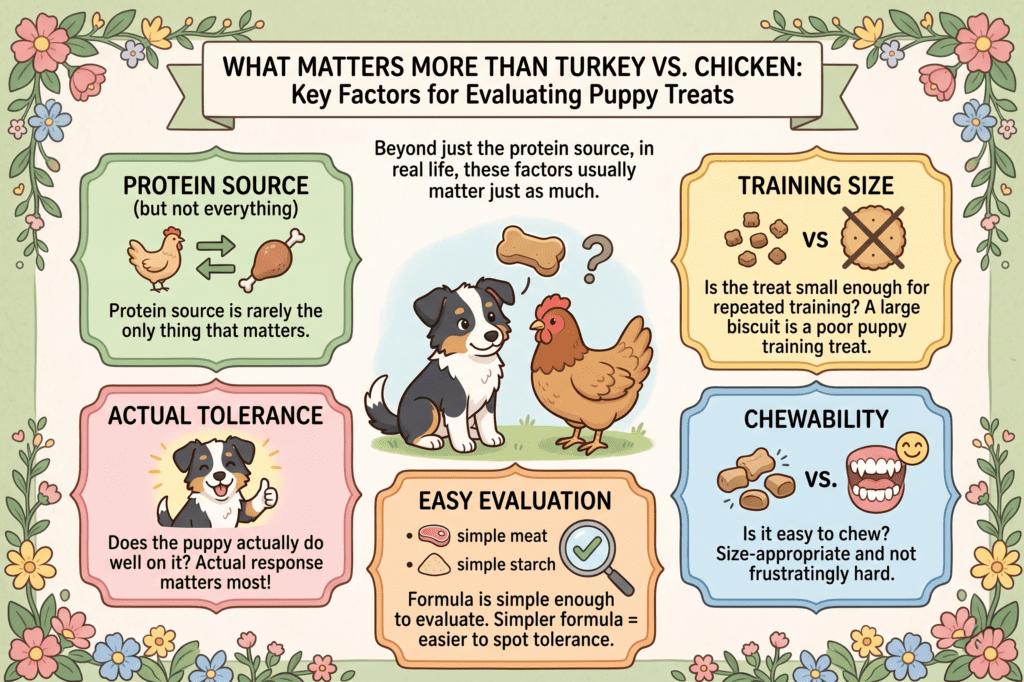
What Matters More Than Turkey Versus Chicken
Protein source matters, but it is rarely the only thing that matters.
In real life, these questions usually matter just as much:
- Is the treat small enough for repeated training? A large biscuit is usually a poor puppy training treat, even if the ingredient list sounds clean.
- Is the treat easy to chew? Puppies need a treat that is size-appropriate and not frustratingly hard.
- Is the formula simple enough to evaluate? A simpler formula can help dog parents more easily notice whether the puppy tolerates the treat well.
- Does the puppy actually do well on it? No label claim matters more than the puppy’s actual response.
Is Turkey Necessarily Better for Puppies?
No.
Turkey is not inherently superior for all puppies. If a puppy is already doing well on chicken treats, there is no evidence-based reason to switch just because turkey sounds gentler.23
But turkey can still be a very reasonable choice.
It may make more sense when:
- The owner wants a simpler trial away from chicken
- The puppy seems to do poorly with chicken-heavy treats
- The turkey treat has a cleaner ingredient story
- The goal is to reduce variables during a cautious treat reset
In other words, turkey is not necessarily better. It is sometimes the more logical next option.
When Chicken Still Makes Good Sense
Chicken remains one of the most common proteins in dog foods and treats for practical reasons. Many dogs like it, many tolerate it well, and it works across a range of product formats.
For a puppy with normal stool, normal skin, and no repeat problems after chicken treats, chicken can still be a completely reasonable option.
That is important because dog parents sometimes overthink this. A puppy does not need to abandon chicken just because chicken is commonly discussed in food-sensitivity conversations. It only makes sense to question the chicken when the puppy’s pattern shows clinical signs that point in that direction. 23
Comparison Table: Turkey vs Chicken Treats for Puppies
The point is not that one protein wins universally. The right choice depends on the puppy in front of you.
| Consideration | Turkey Treats | Chicken Treats |
| Protein novelty | Less commonly used — may help with controlled trials | Most common — familiar to many dogs |
| Tolerance | May suit puppies that seem to react to chicken | Fine for puppies with no chicken-related issues |
| Ingredient story | Often, simpler, cleaner-label options are available | Widely available in many formats and price points |
| Training use | Works well in small morsel formats | Works well in small morsel formats |
| When to prefer | Chicken seems tied to repeat digestive or skin signs | Puppy tolerates chicken well with no issues |
| Vet guidance needed? | Yes, if clinical signs persist despite switching | Yes, if clinical signs persist despite good tolerance |
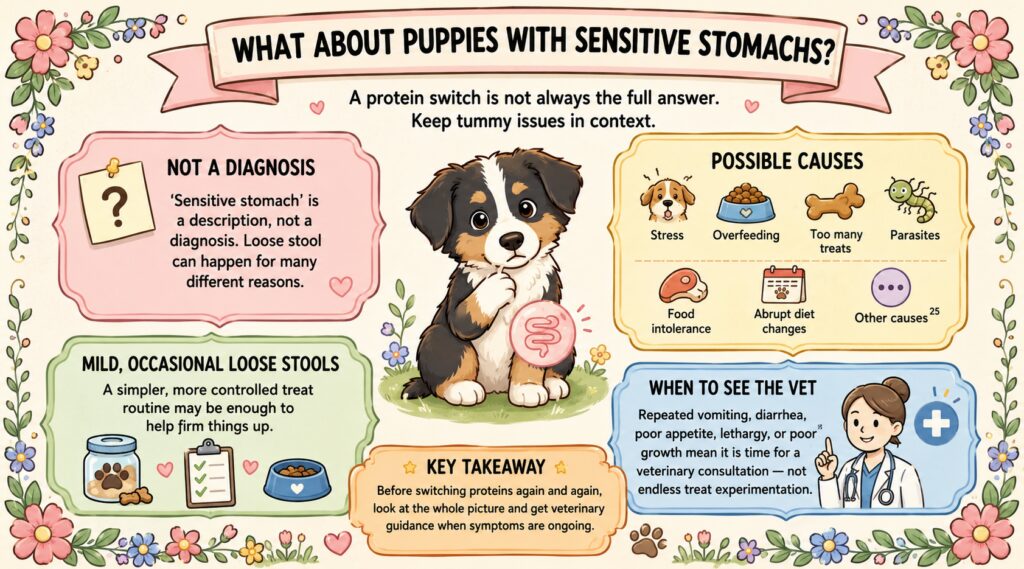
What About Puppies with Sensitive Stomachs?
This is where dog parents often want a shortcut.
“Sensitive stomach” is not a diagnosis — a puppy may have loose stool because of stress, overfeeding, treats, parasites, food intolerance, abrupt diet changes, or many other causes. 25
That is why a protein switch should be kept in context.
If a puppy has only mild, occasional loose stools, a simpler and more controlled treat routine may be enough to firm things up. If the puppy has repeated vomiting, diarrhea, poor appetite, lethargy, or poor growth, the next step is a veterinary consultation rather than endless experimentation with dog treats. 25
What Stronger Evidence Supports, and What It Does Not
The stronger support in this topic is for:
- keeping treats a modest part of the daily calorie load14
- using a complete and balanced growth diet as the nutritional foundation46
- watching the puppy’s real tolerance rather than buying based on hype12
- using a more controlled elimination-style approach when food reactions are suspected23
What the evidence does not strongly support is the blanket claim that turkey is always better than chicken for puppies. That statement is too broad for real-world nutrition.
How Superfood Science Treat Options Fit This Topic
A puppy treat should be chosen as a well-matched reward that fits the puppy’s size, training routine, calorie budget, and tolerance — not as a stand-in for a veterinary evaluation.
Organic Turkey Dog Treats
For puppies suspected of having a chicken food intolerance, Superfood Science Organic Turkey Dog Treats are the most natural first choice. They can be positioned as a cleaner-label turkey option for dog parents who want to trial a non-chicken protein option in a more intentional way.
This recipe can also be discussed through its broader functional-ingredient story, including beta-glucan-rich Agaricus mushrooms, which are often of interest in nutrition conversations due to research on mushroom polysaccharides. In a treat, though, their role should be understood as supportive and formulation-based, not as a medical treatment.
Organic Chicken Dog Treats
For puppies that clearly tolerate chicken well, Superfood Science Organic Chicken Dog Treats still fit naturally into a cleaner-label training routine. Chicken should not be treated like the enemy when the puppy is doing well on it.
This line can also be positioned through its more intentional ingredient profile, including turmeric and flaxseed, which support the product’s natural-and-organic formulation story without turning the treat into an overclaimed wellness product.
Plant-Based Protein Dog Treats
For some owners, a different ingredient direction sounds appealing. In those cases, Superfood Science Plant-Based Protein Dog Treats may offer another clean-label option to consider once the puppy is stable and normal treat use is appropriate.
This product line brings in ingredients such as kelp, chia, and flaxseed as part of its plant-based functional ingredient profile. That may appeal to ingredient-conscious families who want a more distinctive alternative while still keeping the conversation about treats grounded in tolerance and portion control.
The strongest compliant brand position is this: Superfood Science gives dog parents multiple clean-label puppy treat directions — turkey when chicken seems questionable, chicken when it is clearly tolerated, and plant-based protein treats when a different ingredient route makes more sense.
Limitations and Research Gaps
There is good guidance around calorie control, growth-diet priority, label reading, and food-allergy workups.1246
There is much less direct head-to-head evidence proving that turkey treats are inherently better than chicken treats across the board for all puppies.
There is also a real-world limitation in how owners use the phrase “sensitive stomach.” Loose stool, food intolerance, overeating, parasites, rapid diet change, and early food allergy workups can all look similar at home, even when they are not the same problem.
That is why a treat choice should be framed as a cautious feeding decision rather than a diagnosis. Always consult with your veterinarian before trying a variety of different treats — doing so helps narrow down the problem before you have a sick, miserable puppy.
Practitioner-Recommended Usage Guide
Start with the puppy’s actual situation, not the marketing language.
- If your puppy is doing well on a chicken treat, there is usually no need to switch just because turkey sounds gentler on paper.
- If chicken seems tied to repeat digestive or skin issues, simplify the routine. Trial one turkey-based treat in very small amounts, avoid changing several foods at the same time, and watch stool, itchiness, appetite, and behavior over several days.
- If your puppy has a history of loose stool, use smaller treat amounts and count training rewards honestly. If the puppy has recurrent GI symptoms, poor growth, or mixed skin and GI signs, move from casual experimentation to veterinary guidance.
Safety and When to Call a Vet
Call your veterinarian sooner rather than later if your puppy has repeated vomiting, ongoing diarrhea, poor appetite, low energy, weight loss, poor growth, black or bloody stool, dull hair coat, or a pattern of itching plus digestive upset.25
Seek urgent care if your puppy has severe lethargy, collapse, repeated inability to keep water down, abdominal pain, or breathing difficulty.
If your puppy is already on a prescription diet or in an elimination trial, do not add treats casually without veterinary guidance.23
FAQs
Are turkey treats better than chicken treats for puppies?
Not necessarily. Either can work well if the puppy tolerates it, the treat is small enough for training, and the total treat calories stay modest.12
Is turkey easier to digest than chicken for puppies?
Not as a universal rule. A puppy may do better on turkey if chicken seems problematic, but digestibility depends on the full formula and the individual puppy.23
Can puppies have organic dog treats?
Yes, if the treats are appropriately sized, used in moderation, and do not displace a complete and balanced growth diet.146
What kind of puppy treats work best for training?
Usually small, easy-to-chew, easy-to-portion treats that let you reward frequently without adding too many calories.14
Should I switch my puppy from chicken to turkey if they get loose stool?
Maybe, but do not assume protein is the only issue. Simpler feeding, smaller portions, and veterinary guidance may matter just as much. 25
Conclusion
Turkey versus chicken is not really a contest with one universal winner for puppies.
For some puppies, chicken is perfectly fine. For others, turkey may be the more practical next step when chicken seems questionable.
The smartest choice is usually the one that keeps the routine simple, the portions small, and the puppy stable.
And when dog parents want a cleaner-label direction, Superfood Science’s organic turkey, organic chicken, and plant-based protein treats give them more than one thoughtful path forward — as long as the choice is matched to the puppy rather than to marketing alone.
Explore More Dog Health Tips
- Turkey vs. Chicken: Which Protein Is Better for Your Dog’s Treats?
- Best Organic Dog Treats Made in the USA: A Vet-Safe Guide for Dog Parents
- Organic Dog Treats with Natural Ingredients: What Actually Matters
- Top-Rated Organic Dog Treats: A Guide to Safety
- Organic Dog Treat Subscription Options: Why Superfood Science Makes Sense
References
1. World Small Animal Veterinary Association. Feeding treats to your dog. WSAVA. https://wsava.org/wp-content/uploads/2025/11/WSAVA_GuidetoTreats_Dogs_251107.pdf
2. VCA Animal Hospitals. Food allergies in dogs. VCA. https://vcahospitals.com/know-your-pet/food-allergies-in-dogs
3. VCA Animal Hospitals. Implementing an elimination-challenge diet trial: dog. VCA. https://vcahospitals.com/know-your-pet/implementing-an-elimination-challenge-diet-trial-dog
4. American Animal Hospital Association. 2021 AAHA nutrition and weight management guidelines for dogs and cats. AAHA. https://www.aaha.org/resources/2021-aaha-nutrition-and-weight-management-guidelines/home/
5. Merck Veterinary Manual. Disorders of the stomach and intestines in dogs. Merck Veterinary Manual. https://www.merckvetmanual.com/dog-owners/digestive-disorders-of-dogs/disorders-of-the-stomach-and-intestines-in-dogs
6. Association of American Feed Control Officials. Selecting the right pet food. AAFCO. https://www.aafco.org/consumers/understanding-pet-food/selecting-the-right-pet-food/
