
Chicken-Free Dog Treats for Sensitive Dogs: Natural Options to Consider | Vet-Reviewed Guide
Quick Answer
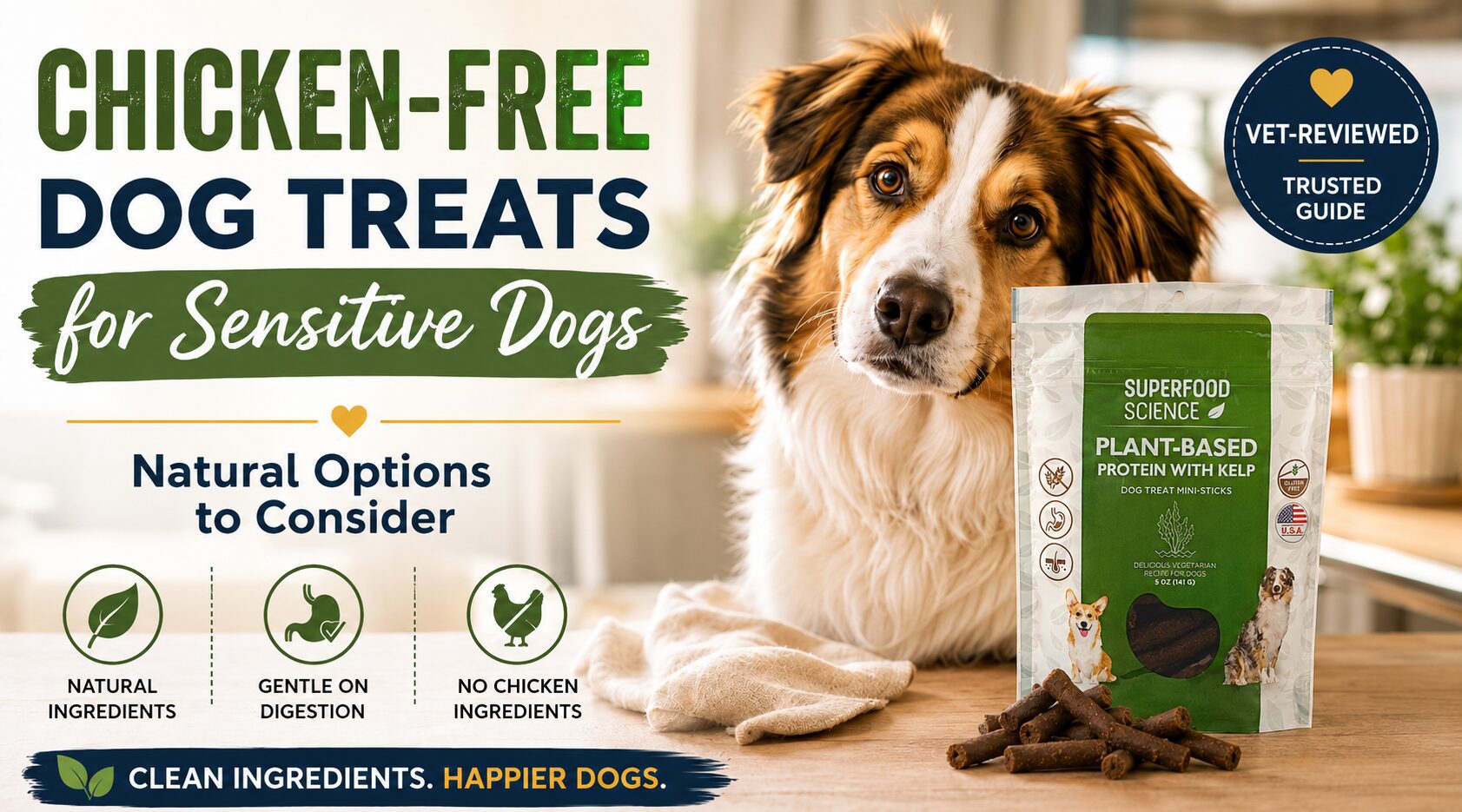
Chicken-free dog treats can be a smart option for sensitive dogs when chicken is a realistic concern, but they are not automatically better for every dog. The best choice is usually a clearly labeled, appropriately portioned treat that fits the dog’s symptom pattern, overall diet, and veterinary plan, especially when itching, vomiting, diarrhea, or ear flare-ups keep happening.[1][2][3]
Trust Signal
By Superfood Science Writing Team | Reviewed by Dr. Kelly Hood, DVM | Last Updated: 06/08/2026
Superfood Science has produced organic and natural functional foods for humans and pets for over 20 years, specializing in clean-label formulations and evidence-based nutrition.
Key Takeaways
- Chicken-free treats may help some dogs, but they do not diagnose a chicken allergy by themselves.[1][2][3]
- Sensitive dogs often do better with simpler formulas, smaller portions, and fewer diet changes at once.[2][4]
- Chicken is a common ingredient in dog treats and also one of the more commonly reported food allergens in dogs.[1][2]
- “Natural,” “organic,” and “limited ingredient” can be useful filters, but they do not guarantee tolerance.[4][5]
- Ongoing itching, vomiting, diarrhea, recurrent ear issues, or weight loss warrant veterinary guidance rather than endless experimentation with dog treats.[1][2][3]
Why do dog parents start looking for chicken-free treats?
This search usually starts with a pattern.
A dog gets itchy after certain treats. Or develops softer stool. Or has recurring ear flare-ups. Then, chicken becomes the obvious ingredient to question.
That is understandable.
Chicken is extremely common in dog foods and treats, so it is both widely fed and frequently suspected. MSD Veterinary Manual notes that chicken is one of the more commonly reported food allergens in dogs, along with beef, dairy, wheat, and lamb.[1]
Still, the fact that chicken is commonly suspected does not prove that it is the problem in every dog.
What “sensitive dog” can really mean
A dog described as “sensitive” may have several different issues.
Some dogs mainly show loose stools or vomiting. Some dogs mainly itch. Some have both digestive and skin signs. Others react more to richness, portion size, or repeated changes in dog treats than to a specific named protein.[2][3]
That is why a chicken-free label is only one piece of the puzzle.
The bigger question is whether the dog’s clinical signs are consistent with the dog treat.
When chicken-free treats may make more sense
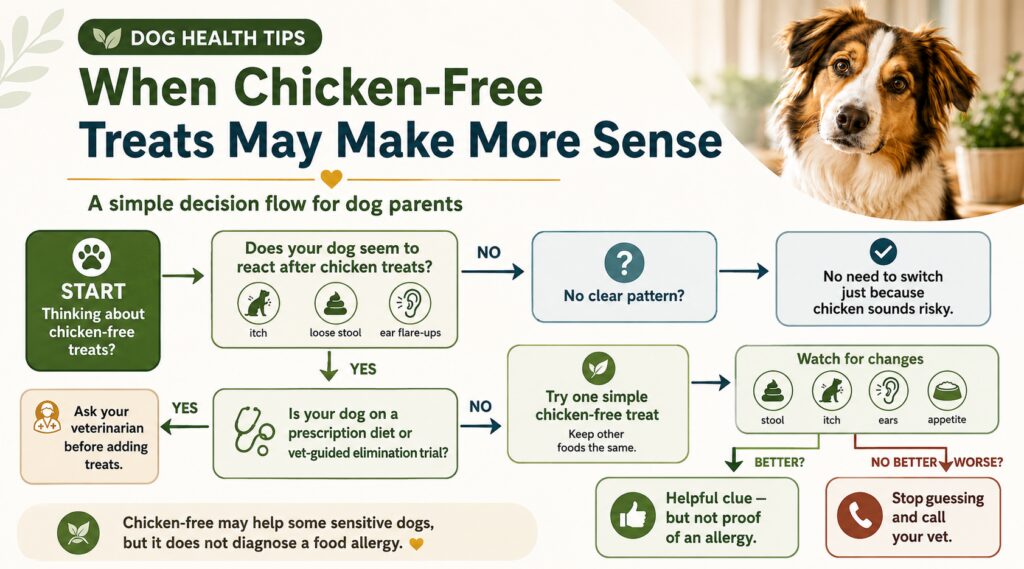
Chicken-free treats may be a reasonable next step when a dog shows a repeat pattern that seems tied to chicken-heavy foods or treats.
That pattern may include:
Itching or skin flare-ups
Food-related itch is possible, although itch can also come from fleas, environmental allergy, skin infection, or other skin diseases.[1][2]
Recurrent ear problems
Recurring ear issues sometimes show up during food-allergy workups, but they are not specific enough to prove food alone.
Digestive upset after certain treats
Loose stool, vomiting, gas, or inconsistent stool may make a treat formula worth questioning, even if the cause is not a true allergy.[2][3]
Decision table: when chicken-free is more useful and when it may not be
| Situation | Chicken-free treats may help | Chicken-free treats may not solve the issue | Practical takeaway |
| Dog has repeat itch or ear flare-ups after chicken treats | Yes, worth considering | Maybe not if environment or infection is the main driver | Use as a careful trial, not proof[1][2] |
| The dog gets loose stool after rich or mixed chicken treats | Yes, especially with a simpler formula | Maybe not if the real issue is fat level or portion size | Simpler treats reduce variables[2][4] |
| The dog has always tolerated chicken well | Usually no need to switch | Yes | Do not change just because chicken sounds risky |
| Only if the veterinarian approves | Maybe not if the environment or infection is the main driver | Yes, if added casually | Diagnosis needs a controlled plan[2][3] |
| Owner wants cleaner-label choices | Sometimes yes | Only if label choice replaces common sense | Keep calories, texture, and tolerance in view[4][5] |
The point is not that chicken-free always wins.
It is that chicken-free is most useful when it is part of a more intentional trial rather than a random shopping reaction.
What makes a chicken-free treat a better choice in practice
The strongest practical answer is not just “avoid chicken.”
It is “reduce variables.”
A simpler ingredient story
For many sensitive dogs, a simpler formula is easier to evaluate. A short, understandable ingredient list makes it easier to track what changed if a reaction happens.[4][5]
Moderate calories and fat
Treats that are rich, fatty, or oversized can create their own digestive trouble. That is one reason that calories and portion size matter as much as the protein story.[4][6]
One change at a time
If you are trying to see whether chicken is the issue, changing the treats, the main diet, the topper, and the supplements all at once usually makes the answer less clear.
Chicken-free is not the same as hypoallergenic
This distinction is important.
A retail chicken-free treat may be useful as a practical trial option, but it is not the same thing as a veterinary hypoallergenic diet.
VCA explains that the best way to diagnose a true food allergy is a structured elimination-challenge diet trial, not a casual switch to a different bag of treats.[2][3]
That is why owners should be careful about using chicken-free as if it were a diagnosis.
What stronger evidence supports
The stronger support in this topic is for:
- recognizing that chicken is one of the more commonly reported food allergens in dogs[1]
- understanding that food allergy and food sensitivity are not always the same thing[1][2][3]
- using a structured elimination-challenge process when true food allergy is suspected[2][3]
- keeping treats a small part of daily intake and avoiding overfeeding or chaotic switching[4][6]
What the evidence does not strongly support is the claim that every sensitive dog should automatically move to chicken-free treats.
That is too broad for how dogs actually present and respond.
How Superfood Science Treat Options Fit This Topic
This section is educational brand positioning, not proof that any Superfood Science product diagnoses or treats food-related disease.
If a dog is actively itchy, repeatedly vomiting, having chronic diarrhea, or undergoing a formal food-allergy workup, the answer is not to keep testing random treats just because they are natural or organic. Ongoing symptoms still require veterinary guidance and a more controlled plan.
Organic Turkey Dog Treats
For dogs where chicken is the ingredient under suspicion, Superfood Science Organic Turkey Dog Treats are the strongest natural fit for this topic. The most compliant claim is not that turkey treats address sensitivity. It is possible that a simpler turkey-based, natural-and-organic treat may be a more logical next trial when owners want to move away from chicken while keeping the ingredient story cleaner.
This recipe can also be discussed in terms of its more intentional formulation profile, including beta-glucan-rich Agaricus mushrooms. In a dog treat, that ingredient is best understood as supportive and formulation-based, not as a medical treatment.
Plant-Based Protein Dog Treats
For owners who want a completely chicken-free and poultry-free direction, Superfood Science Plant-Based Protein Dog Treats may offer another clean-label option to consider once the dog is stable and normal treat use is appropriate.
This line includes ingredients such as kelp, chia, and flaxseed as part of a plant-based functional ingredient profile. That may appeal to ingredient-conscious families who want a different formulation direction without drifting into disease claims.
Organic Chicken Dog Treats
This is the one Superfood Science line that is not the natural first fit for a dog actively avoiding chicken. But it still matters to make it clear that not every dog needs to avoid chicken. For dogs that tolerate chicken well, Superfood Science Organic Chicken Dog Treats may still fit a clean-label routine in other contexts.
That clarity matters because the goal is not to demonize chicken. The goal is to match the product to the dog.
Limitations and evidence gaps
There is strong veterinary guidance on food-allergy evaluation, dog-treat moderation, and the risks of casual guessing.[1][2][3][4][6]
There is much less direct evidence that chicken-free retail treats are universally better than chicken-based treats for every dog labeled “sensitive.”
That is partly because sensitive dogs are not one single group. Some are itchy. Some are gassy. Some are overfed. Some are truly allergic. Some are reacting to richness more than the named protein.
That is why the safest recommendation is still dog-specific.
Practitioner-Recommended Usage Guide
If chicken is under suspicion, simplify the routine first.
Choose one chicken-free treat direction, keep portions small, and avoid introducing several new products at once. Watch for stool quality, vomiting, itch, ear comfort, appetite, and overall behavior over several days.
If symptoms improve, that may be useful information, but it still does not prove a diagnosis. If symptoms keep recurring, move from casual dog-treat experimentation to a veterinary plan.
For owners who want a cleaner-label chicken-free option after that kind of screening, a turkey-based or plant-based Superfood Science treat may be the more practical next step.
Safety and when to call a vet
Call your veterinarian sooner rather than later if your dog has chronic itching, recurrent ear flare-ups, vomiting, persistent diarrhea, poor appetite, weight loss, or symptoms that repeatedly worsen with diet changes.[1][2][3]
Seek more urgent care if your dog has facial swelling, trouble breathing, collapse, severe vomiting, black or bloody stool, or marked lethargy.
If your dog is already on a prescription diet or in the middle of an elimination trial, do not add treats casually without veterinary guidance.
FAQs
Are chicken-free dog treats better for sensitive dogs?
Sometimes, but not automatically. They may be a smart trial option when chicken is a realistic concern, but the best treat still depends on the dog’s actual response.[1][2][3]
What are the best chicken-free dog treats for itchy dogs?
Usually, the most useful option is a simpler, clearly labeled treat used in a controlled way, not the most heavily marketed one.
Can a dog still react to turkey if I remove chicken?
Yes. Switching away from chicken may help some dogs, but turkey is not automatically perfect for every sensitive dog. Individual tolerance still matters.
Are limited-ingredient chicken-free treats hypoallergenic?
No. A limited-ingredient or chicken-free retail treat is not the same thing as a veterinary hypoallergenic diet.[2][3]
When should I stop experimenting with treats and call the vet?
If your dog has ongoing itch, vomiting, diarrhea, ear flare-ups, weight loss, or repeated relapses, it is time for veterinary guidance rather than more casual switching.[1][2][3]
Conclusion
Chicken-free treats can be a smart move for some sensitive dogs, but only when the decision is grounded in the dog’s actual pattern rather than guesswork.
The most useful approach is usually simpler formulas, smaller portions, fewer changes at once, and a lower threshold for calling the veterinarian when symptoms keep recurring.
That is also why cleaner-label Superfood Science options fit this topic well: they offer dog parents more than one practical approach without pretending that a treat alone is the diagnosis.
Explore More Dog Health Tips
- Chicken Allergy in Dogs vs Food Sensitivity Explained
- Turkey vs Chicken Dog Treats for Sensitive Stomachs
- Limited-Ingredient Organic Dog Treats: Best for Sensitive Dogs
- Top-Rated Organic Dog Treats: A Guide to Safety
- Best Organic Dog Treats Made in the USA: A Vet-Safe Guide for Dog Parents
References
- MSD Veterinary Manual. Cutaneous food allergy in animals. MSD Veterinary Manual. https://www.msdvetmanual.com/integumentary-system/food-allergy/cutaneous-food-allergy-in-animals
- VCA Animal Hospitals. Food allergies in dogs. VCA. https://vcahospitals.com/know-your-pet/food-allergies-in-dogs
- VCA Animal Hospitals. Implementing an elimination-challenge diet trial: dog. VCA. https://vcahospitals.com/know-your-pet/implementing-an-elimination-challenge-diet-trial-dog
- World Small Animal Veterinary Association. Guidelines on selecting pet foods. WSAVA. https://wsava.org/wp-content/uploads/2021/04/Selecting-a-pet-food-for-your-pet-updated-2021_WSAVA-Global-Nutrition-Toolkit.pdf
- U.S. Food and Drug Administration. Animal food labeling and pet food claims. FDA. https://www.fda.gov/animal-veterinary/animal-foods-feeds/animal-food-labeling-and-pet-food-claims
- American Animal Hospital Association. 2021 AAHA nutrition and weight management guidelines for dogs and cats. AAHA. https://www.aaha.org/resources/2021-aaha-nutrition-and-weight-management-guidelines/home/
