
Probiotics and Prebiotics for Dogs: What Dog Parents Should Know About Digestion, Gas, and Sensitive Stomachs
Quick Answer
Probiotics and prebiotics can both support gut health in dogs, but they work differently. Probiotics are live microorganisms, while prebiotics feed beneficial gut microbes already present. Some dogs may benefit from them during diet changes, mild digestive stress, or sensitive-stomach routines, but persistent symptoms need veterinary care.[1–4]
By Superfood Science Writing Team | Reviewed by Dr. Kelly Hood, DVM | Last Updated: 05/13/2026
Superfood Science has produced organic and natural functional foods for humans and pets for over 20 years, specializing in clean-label formulations and evidence-based nutrition.
This article follows the dogs.superfoodscience.com evidence-based workflow and uses conservative, vet-safe language. It provides stronger guidance on canine gut-health support from more limited or emerging evidence on specific ingredients and avoids disease-treatment claims.
Key Takeaways
- Probiotics and prebiotics both matter for gut health, but they are not the same thing.[1–4]
- Probiotic benefits are strain-specific. Some strains may support stool quality and digestive balance in dogs, but not every probiotic product works the same way.[2–3]
- Prebiotics help nourish beneficial gut bacteria. They may support short-chain fatty acid production, which helps feed colon cells and support gut lining health.[4–6]
- Agaricus blazei powder may have prebiotic-like relevance. Mushroom polysaccharides and dietary fibers can interact with the gut microbiota, but direct evidence in canines, specifically for Agaricus blazei, in this role remains limited.[5–7]
- Supplements are not a substitute for diagnosis. Repeated vomiting, persistent diarrhea, weight loss, poor appetite, or obvious decline should prompt veterinary evaluation.[2–4]
Why Dog Parents Hear About Probiotics More Than Prebiotics
Dog parents hear about probiotics all the time. Prebiotics come up a little less often, even though they belong in the same gut-health conversation.
That creates confusion. Some products highlight probiotics. Others focus on prebiotic fiber. Some use the phrase “gut support” without explaining what is actually inside. And some ingredients, like mushroom powders, are not always classified as prebiotics, even though their fibers and polysaccharides may play a similar supportive role.
The better question is not which claim sounds best. It is what probiotics and prebiotics actually do, and how dog parents should think about them in real life.
What Is the Difference Between Probiotics and Prebiotics for Dogs?
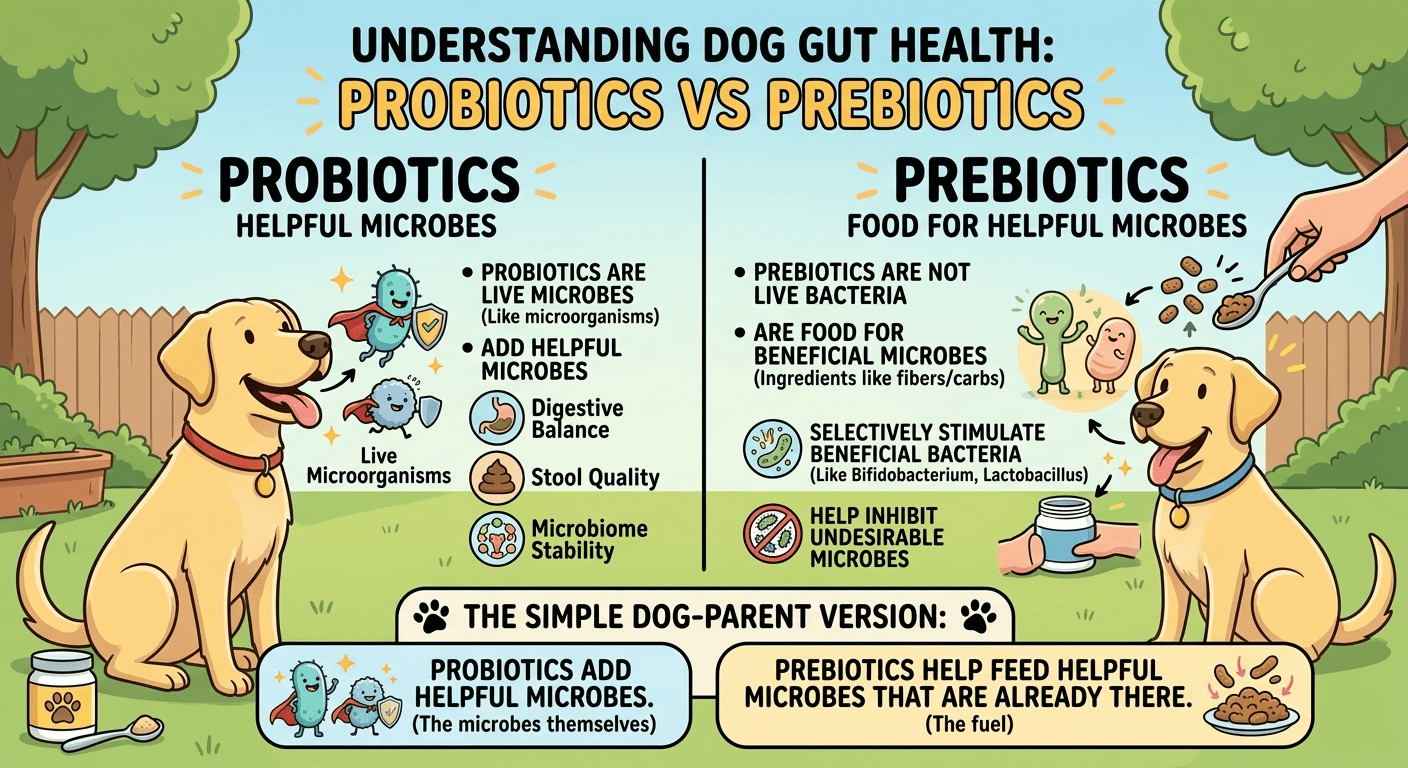
Probiotics and prebiotics support the gut in different ways.
| Gut-Support Category | What It Means | Simple Dog-Parent Translation |
| Probiotics | Live microorganisms that may provide a health benefit when given in adequate amounts.[1] | They add helpful microbes. |
| Prebiotics | Ingredients, often nondigestible carbohydrates or fibers, that beneficial microbes can use as fuel.[4] | They help feed helpful microbes already living in the gut. |
| Mushroom polysaccharides and fibers | Compounds found in some edible mushrooms that may interact with gut microbes and support microbiome balance.[5–7] | They may have prebiotic-like relevance, but the strength of evidence depends on the ingredient and species studied. |
Probiotics Are Live Microbes
Probiotics are live microorganisms that may provide a health benefit when given in adequate amounts.[1] In dogs, they are most often discussed in relation to digestive balance, stool quality, and microbiome stability.[2–3]
Prebiotics Are Food for Beneficial Microbes
Prebiotics are not live bacteria. They are ingredients, often nondigestible carbohydrates or fibers, that beneficial microbes can use as fuel. The Merck Veterinary Manual describes prebiotics as nondigestible food ingredients that selectively stimulate beneficial intestinal bacteria, such as Bifidobacterium and Lactobacillus, while also helping to inhibit undesirable microbes.[4]
The Simple Dog-Parent Version
Probiotics add helpful microbes. Prebiotics help feed helpful microbes already in the gut.
Why Both Matter in Gut Health
Dog parents often hear about probiotics more than prebiotics, but both can matter.
Gut balance is not just about adding beneficial bacteria. Sometimes the question is whether the gut environment is supportive enough for beneficial microbes to do well in the first place. That is one reason prebiotics matter.
When beneficial microbes ferment prebiotic ingredients, they can produce short-chain fatty acids, often called SCFAs.[4–6] These compounds help nourish the cells lining the colon and may help support the gut barrier, which is one reason they matter in digestive-health conversations.[4–6]

What the Stronger Dog Gut-Health Evidence Supports
There is stronger support for some gut-health ideas than for others.
Some Probiotics May Help in Digestive Situations
Current veterinary literature indicates that some probiotics may help maintain gut microbiota balance, improve stool quality, and address certain digestive disorders in dogs and cats, although not all strains have the same effects.[2–3]
Prebiotics Can Support Beneficial Gut Microbes
Merck’s nutrition guidance states that fermentable fibers can act as prebiotics in dogs and cats, supporting beneficial bacteria and contributing to short-chain fatty acid production.[4]
The Microbiome Matters
Canine gut-health reviews consistently reinforce that microbiota balance is relevant to digestive health, inflammation, and intestinal function, even if the best intervention varies case by case.[2–3]
Where the Evidence Is Still Limited
This is the part dog parents deserve to hear clearly.
Not Every Probiotic Works the Same Way
Strain matters, dose matters, and product quality matters. A product labeled probiotic is not automatically effective just because it uses that word.[2–3]
Not Every Prebiotic Ingredient Is Equally Studied in Dogs
Some prebiotic fibers have more direct evidence for pet nutrition than others. Some ingredients may have plausible or promising mechanisms without strong canine outcome data yet.[4–6]
Gut Support Is Not a Diagnosis
If a dog has a real underlying condition, probiotics and prebiotics may support care, but they do not replace the need to identify the cause.
Prebiotic-Like Relevance of Agaricus blazei Powder
This is where the mushroom angle fits naturally.
Agaricus blazei powder is not usually introduced to dog parents first as a prebiotic, but it makes sense to explain why it may have prebiotic-like relevance.
Why Mushroom Powders Can Have Prebiotic Potential
A 2023 review on mushroom dietary fiber and the gut microbiota states that mushroom dietary fibers can act as prebiotics by selectively supporting beneficial intestinal microorganisms.[5] A 2025 review on mushroom polysaccharides and GI modulation similarly emphasizes that edible mushroom polysaccharides can interact with the gut microbiota and help support intestinal barrier and gastrointestinal health, although evidence varies by mushroom type and study design.[6]
Why This Matters for Agaricus blazei
Agaricus blazei is rich in polysaccharides, including beta-glucan-containing fractions, which is one reason it is often discussed in broader wellness and immune-support conversations.[7]
For dog parents, the practical translation is this: Agaricus blazei powder may offer more than one kind of gut-support interest. It is not only part of the beta-glucan conversation. Its fiber and polysaccharide content may also have prebiotic-like effects, as these compounds can help nourish a healthier gut environment.
Species-First Reality Check
Direct canine evidence that Agaricus blazei powder specifically acts as a prebiotic in dogs remains limited. The current support comes more from the broader literature on mushroom fiber and mushroom polysaccharides, as well as the known composition of Agaricus blazei, than from dog trials focused on this exact question.[5–7]
That is why the safest wording is “prebiotic-like potential” or “prebiotic-like relevance,” not “Agaricus blazei is a proven prebiotic for dogs.”
Where Agaricus Bio Fits
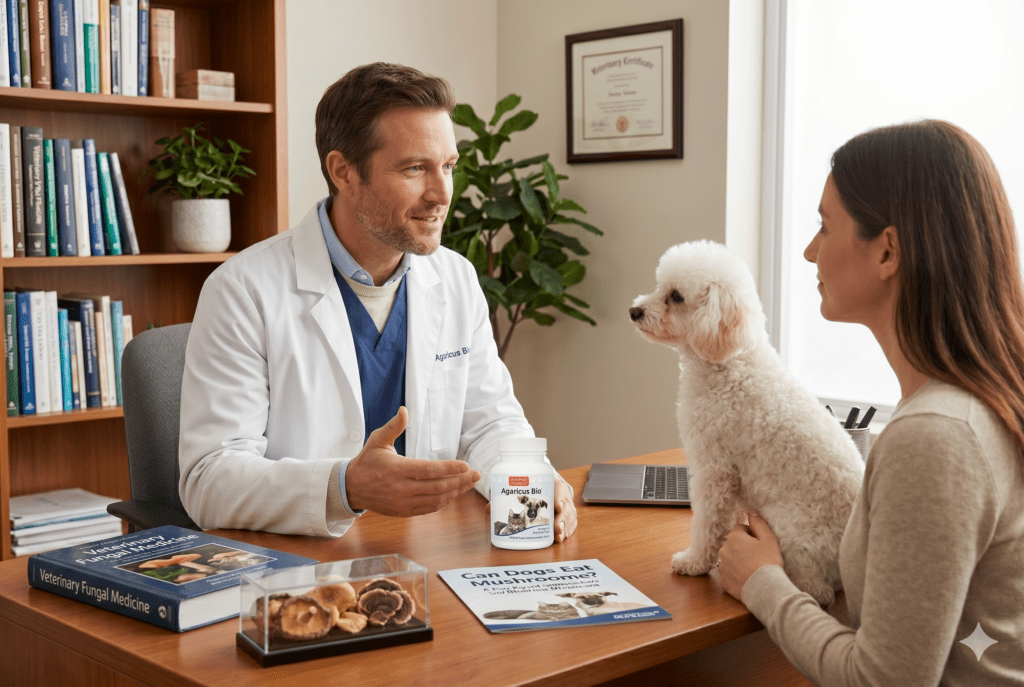
Superfood Science currently positions Agaricus Bio® Immune Support for Dogs and Cats as an organic Agaricus blazei powder capsule product for dogs and cats, with 300 mg capsules designed for small pets in an easy-to-feed pull-apart format.[8]
This product can be discussed not only through an immune-support lens, but also as part of a broader conversation about mushroom polysaccharides and possible prebiotic-style gut support.
Storage and Product Handling Matter More Than People Think
This is a useful practical point for dog parents.
Probiotic Storage Can Affect Viability
Because probiotics are live microorganisms, storage conditions matter. Heat, moisture, and time can affect viability depending on the product and strain.[1][9]
Always follow the label instructions. If a product says refrigerate, refrigerate it. If it says store in a cool, dry place, do not leave it in a hot car or steamy bathroom. A poorly stored probiotic may not perform the way the label suggests.
Prebiotics Are Usually Less Fragile Than Probiotics
Prebiotic fibers and polysaccharides are generally less sensitive than live probiotic organisms, which is another reason the probiotic-versus-prebiotic distinction matters in real life.
Which Dogs May Be the Best Fit for This Discussion?
| Dog Situation | Why Probiotic or Prebiotic Support May Come Up | Practical Caution |
| Mild digestive inconsistency | Occasional stool variability, gas, or sensitive stomach patterns may lead dog parents to ask about gut-support products. | Persistent, severe, or worsening symptoms need veterinary evaluation. |
| Diet transitions | Food changes can be a time when the gut ecosystem becomes more reactive. | Change one variable at a time so you can tell what your dog tolerates. |
| Senior dogs | Older dogs may have changing appetites, stool quality, medication routines, or sensitivity to diet changes, making digestive support a common wellness discussion.[2–4] | Seniors should be evaluated sooner if appetite drops, weight changes, or diarrhea persists. |
| Dogs with chronic skin or allergy conversations | Some veterinarians discuss the gut-skin connection in chronic allergic skin cases, especially when diet, stool quality, and immune balance are part of the bigger picture.[2–3] | Itching, chronic ear issues, hot spots, or recurring skin flares should be managed with veterinary guidance. |
| Dogs who need a simpler routine | A single, easy-to-feed product with a clear ingredient story can be more practical than layering multiple products at once. | More products do not always mean better results. |
What Dog Parents Should Look For
Clear labeling matters. Dog parents should be able to tell whether a product contains a probiotic, a prebiotic, or both, and what the active ingredients actually are.
Realistic positioning also matters. A product should be framed as support, not as a cure or a substitute for diagnosis.
Easy feeding is practical, not trivial. A gut-support product only helps if you can use it consistently.
A stable routine is also important. Trying one change at a time makes it easier to see what your dog actually responds to.
Practitioner-Recommended Usage Guide
Step 1: Decide What Question You Are Trying to Solve
Is the issue mild stool inconsistency, diet transition, gas, or broader daily gut support?
Step 2: Do Not Change Everything at Once
If you introduce a probiotic, prebiotic, new food, and new treats all at the same time, you will not know what actually helped.
Step 3: Start With One Product and One Realistic Goal
Keep the trial simple.
Step 4: Watch the Dog, Not Just the Label
Monitor stool quality, gas, appetite, vomiting, itching, and general comfort over several days.
Step 5: Involve Your Veterinarian Sooner if Symptoms Are Persistent or Escalating
This matters especially for puppies, seniors, dogs with chronic GI issues, and dogs with weight loss or poor appetite.
Safety and When to Call a Vet
Probiotics and prebiotics are often viewed as gentle, but gentle is not the same as always appropriate.
Call your veterinarian if your dog has repeated vomiting, persistent diarrhea, weight loss, low appetite, blood in stool, marked gas with discomfort, or a clear decline that continues despite supportive products.[2–4]
Seek urgent care if your dog has severe vomiting, collapse, marked weakness, inability to keep water down, significant abdominal pain, or rapid worsening.
Frequently Asked Questions
What is the difference between probiotics and prebiotics for dogs?
Probiotics are live microorganisms. Prebiotics are ingredients that help feed beneficial microbes already living in the gut.[1][4]
Is it okay to feed a dog yogurt with probiotics?
Sometimes, but not always. Plain, unsweetened yogurt may contain live cultures, but not every dog tolerates dairy well. Some dogs develop gas, loose stool, or digestive upset from yogurt itself, even if the product contains probiotics. Yogurt also is not a standardized probiotic supplement, so the amount and type of live cultures can vary. For dogs with sensitive stomachs, a dog-specific probiotic product is often easier to evaluate than yogurt.
What should dog parents know before giving a probiotic supplement to their dog?
Check whether the product clearly lists the strains, storage instructions, and intended use. Start one product at a time, keep the rest of the diet stable, and monitor stool quality, appetite, gas, vomiting, and overall comfort. Probiotics may support gut health in some dogs, but they do not replace veterinary care when symptoms are persistent, severe, or worsening.
Do probiotics help dogs with diarrhea?
Some probiotic strains may help support stool quality and digestive balance, but they do not replace a veterinary workup when diarrhea is severe, persistent, or accompanied by other signs.[2–3]
Are prebiotics good for dogs?
They can be. Prebiotics may support beneficial intestinal bacteria and gut balance, especially when used as part of a broader nutrition plan.[4]
Can Agaricus blazei powder act like a prebiotic for dogs?
It may have prebiotic-like potential because mushroom fibers and polysaccharides can interact with beneficial gut microbes, but direct canine evidence on Agaricus blazei specifically in this role is still limited.[5–7]
Is Agaricus Bio only about immune support?
Not necessarily. Because it is made from Agaricus blazei powder rich in polysaccharides and beta-glucans, it can also be discussed as part of a broader conversation about gut and microbiome support, as long as the claims remain conservative.[7–8]
When are supplements not enough for digestive issues?
When a dog has persistent diarrhea, recurrent vomiting, blood in the stool, poor appetite, weight loss, or an obvious decline, veterinary care should come first.[2–4]
Conclusion
For dog parents, the most useful gut-health takeaway is this: probiotics and prebiotics are not the same, but both can support digestion.
Probiotics may help by adding beneficial microbes. Prebiotics may help by feeding beneficial microbes that are already there.
And when it comes to mushroom ingredients, Agaricus blazei powder deserves a place in the prebiotic conversation too—not because it has been proven to solve every digestive problem, but because its polysaccharides and fiber-rich components may help support a healthier gut environment.
Explore More Dog Health Tips
- What Are Superfoods? Hidden Hazards for Dogs and Cats
- Organic Dog Treats Made in the USA for Health
- Organic Dog Treats with Natural Ingredients: What Actually Matters
- Turkey vs. Chicken: Which Protein Is Better for Your Dog’s Treats?
- Best Dog Treats for Chicken Allergies
- Limited-Ingredient Organic Dog Treats: Best for Sensitive Dogs
Clinical Note
Gut-support supplements can make sense as part of a thoughtful wellness routine, but persistent digestive signs deserve diagnosis before more layering of products. In dogs with repeated vomiting, chronic diarrhea, blood in stool, low appetite, or weight loss, the safer next step is veterinary evaluation rather than trial-and-error supplementation.
References
[1] FAO/WHO. (2001). Probiotics in Food: Health and Nutritional Properties and Guidelines for Evaluation. Food and Agriculture Organization of the United Nations and World Health Organization.
[2] Yang, Q., et al. (2023). Gut Probiotics and Health of Dogs and Cats: Benefits, Applications, and Underlying Mechanisms.
[3] Xia, J., et al. (2024). The Function of Probiotics and Prebiotics on Canine Intestinal Health.
[4] Merck Veterinary Manual. Modifying the Intestinal Microbiota in Animals.
[5] Yu, C., et al. (2023). The Effect of Mushroom Dietary Fiber on the Gut Microbiota.
[6] Liu, J., et al. (2025). Role of Mushroom Polysaccharides in Modulation of GI Health and Microbiota.
[7] Martins, P. R., et al. (2017). Agaricus brasiliensis polysaccharides stimulate human monocytes and are mainly attributed to β-glucans in the polysaccharide fraction.
[8] Superfood Science. Agaricus Bio® Immune Support for Dogs and Cats product page.
[9] National Center for Complementary and Integrative Health. Probiotics: What You Need to Know.
