
Trainer Dog Treats That Actually Work in Training

Quick Answer
The best trainer dog treats are usually tiny, quick to chew, clearly labeled, easy to count, and palatable. A great training treat keeps your dog engaged without slowing the session or quietly adding too many calories. For most dogs, the best choice depends on motivation, body size, reward frequency, and ingredient tolerance.[1][2][3]
Trust Signal
By Superfood Science Writing Team | Reviewed by Dr. Kelly Hood, DVM | Last Updated: 07/13/2026
Superfood Science has produced organic and natural functional foods for humans and pets for over 20 years, specializing in clean-label formulations and evidence-based nutrition.
Key Takeaways
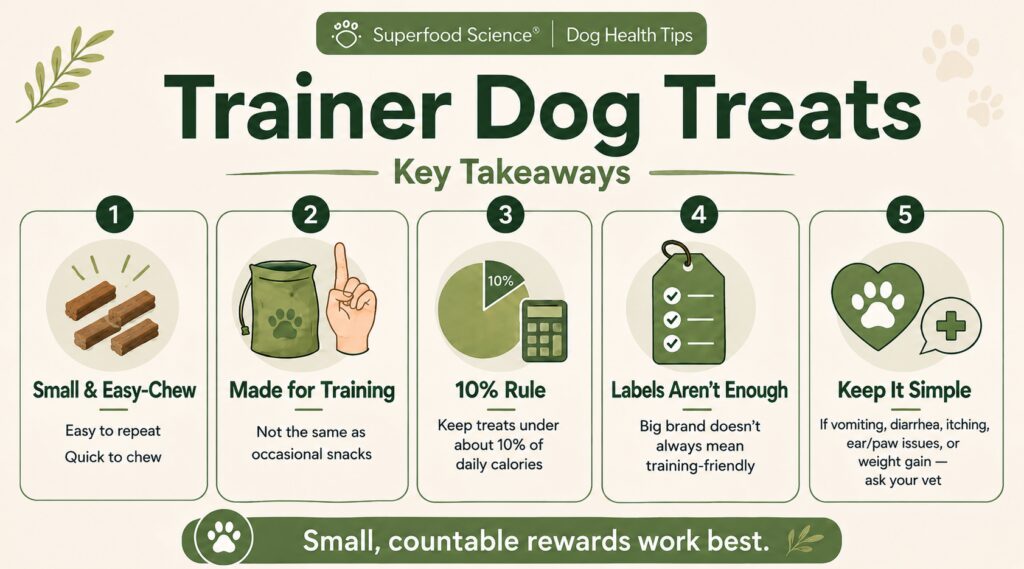
- Great trainer dog treats are usually small enough to use often and soft enough to chew quickly.[1][2]
- Treats that work well in training are not always the same treats that work well as occasional snacks.
- For most dogs, treats should stay under about 10% of daily calories, including training rewards.[1][3]
- “Natural,” “organic,” and “top-rated” can be helpful buying filters, but they do not automatically make a treat ideal for training.[2][4]
- Dogs with vomiting, diarrhea, itchy skin, paw or ear discomfort, or easy weight gain should be evaluated by a veterinarian; once a feeding plan is chosen, a simpler treat routine can make tolerance easier to track.[1][3][5]
Why trainer dog treats are a category of their own
A dog training treat has a different job from a casual reward.
A casual reward can be bigger, slower to chew, or more indulgent because it is only given once in a while. A trainer dog treat has to work repeatedly, often in a short period of time, without breaking the dog’s focus or quietly becoming a second meal.[1][2][3]
That is why the best training treat is usually not the most luxurious one. It is the one that fits the mechanics of real training.
What stronger evidence supports
The strongest support for this topic is to keep treats a modest part of total daily calories and ensure the main diet still provides the nutritional foundation.[1][3]
WSAVA advises that treats should generally make up less than 10% of a dog’s daily calorie intake.[1] AAHA’s nutrition and weight-management guidance supports individualized nutrition recommendations based on body condition, feeding history, activity level, and weight-management needs.[3]
For training, that means treat quality matters, but treat quantity matters just as much.
What makes a training treat actually useful
Small enough to repeat often
A dog should be able to take the reward and return attention to the task quickly. Oversized treats often interrupt timing and make calorie control harder.[1][2] Small soft dog training treats are typically the easiest fit here, since they can be eaten in a single bite without slowing the pace.
Quick to chew
A treat that takes too long to finish can derail a session. This matters even more in puppies, small dogs, and dogs learning new skills in distracting environments.[2] Choosing trainer treats for puppies with extra care around size and chew speed can make early sessions far less frustrating.
High enough value to matter
A treat still has to be worth working for. In a quiet house, a low-key reward may be fine. Around distractions, many dogs need something more motivating.[2] In those higher-distraction moments, high-value dog training treats are usually what keep a dog engaged.
Easy to count
If you cannot count it honestly, you cannot manage it honestly. Clear calorie information and easy portion control matter more than many owners realize.[1][4]
Tolerated by the dog
A training treat is a poor fit if it repeatedly coincides with loose stool, vomiting, gas, itching, appetite disruption, or weight gain. Those signs do not prove the treat is the cause, but they are good reasons to pause, simplify the routine, and ask your veterinarian for guidance or support when symptoms persist.[1][3][5]
The psychology of high-value rewards
A high-value treat is not defined by the label. It is defined by the dog’s response in that moment.
Dogs often make food choices based on a mix of smell, texture, novelty, and learned preferences. Research on canine food and food-odor preference suggests olfaction is an important part of the food-choice experience, while reward research also suggests some dogs may benefit from variety over longer training sessions.[6][7]
Practically, this means the “best” trainer dog treat may change by situation. Kibble may work in the kitchen. A softer, more aromatic, and more exciting reward may be needed at the park. The goal is not to make every reward richer; it is to match the reward value to the task’s difficulty while staying within the treat budget.
Decision table: what usually works better in real training
| Training need | More helpful choice | Less helpful choice | Why it matters |
| Frequent rewards | Tiny repeatable pieces | Large biscuits | Smaller rewards fit the training flow better and help limit calories.[1][2] |
| Fast-paced sessions | Quick-chew texture | Long-chew or crunchy distraction | Timing matters during learning.[2] |
| Weight-conscious dogs | Low-calorie, easy-to-count treat | Rich snack-style treat | Repetition adds calories quickly.[1][3] |
| Sensitive dogs | Simpler ingredient story and formulation | Highly rich or constantly changing formula | Fewer variables make tolerance easier to judge.[1][5] |
| Puppies or small dogs | Small morsel size | Oversized reward | Size and choking-hazard safety both matter.[1][2] |
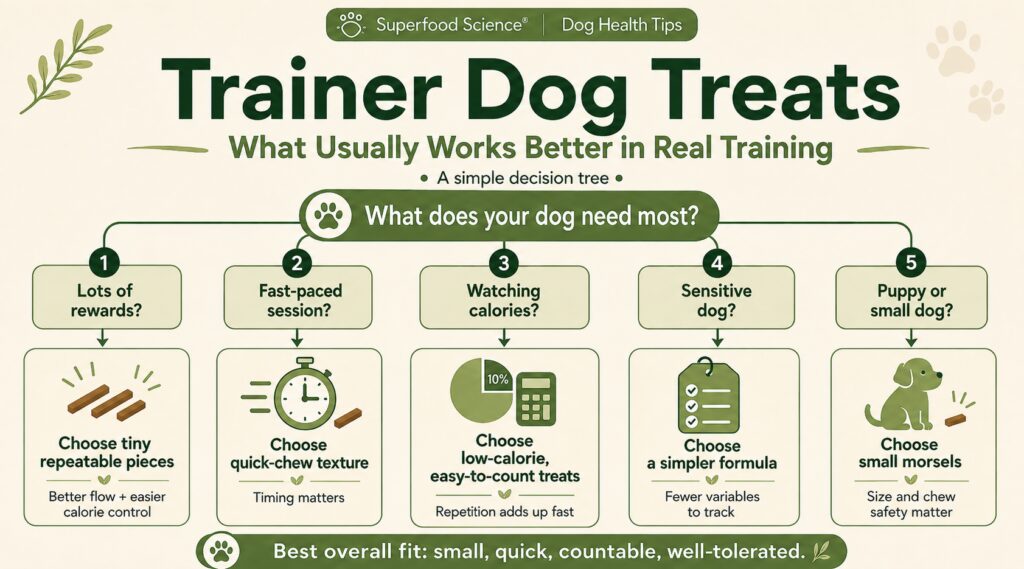
The point is not that one treat style fits every dog. The best training treats depend on the objectives for their use and the dog’s size.
Treat Budget Mini-Calculator: the 10% rule made practical
For most healthy adult dogs, a useful starting point is the 10% rule: treats should make up no more than about 10% of daily calories. This includes training treats, snacks, chews, table scraps, and foods used to give medication.[1]
Use this simple formula: Daily calories from food x 0.10 = maximum daily treat budget.
| Example dog | Daily food calories | 10% treat budget | What it means |
| Small dog | 400 kcal/day | 40 kcal/day | Even tiny treats need counting. |
| Medium dog | 800 kcal/day | 80 kcal/day | Twenty 4-kcal rewards may already use the full budget. |
| Large dog | 1,200 kcal/day | 120 kcal/day | Training treats still count, even when they look small. |
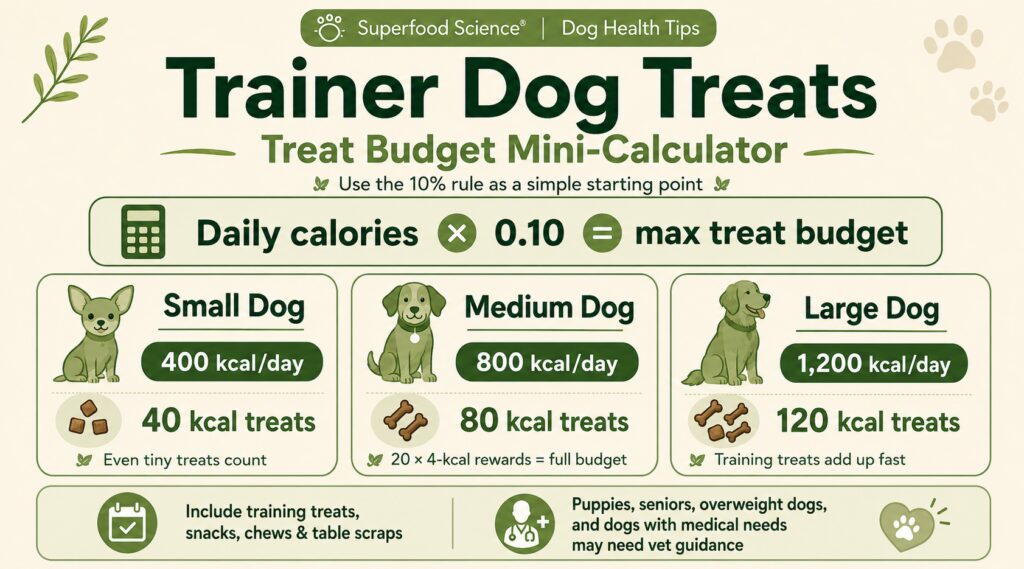
This is not a medical feeding prescription. Puppies, seniors, overweight dogs, athletic dogs, and dogs with medical conditions may need individualized guidance from a veterinary team.[1][3] Choosing low-calorie training treats for dogs makes it easier to stay within that 10% budget without cutting training short.
Why “top-rated” does not always mean best for training
A top-rated treat may be popular, tasty, and beautifully packaged, but still not be ideal for training.
Some are too large. Some are too rich. Some work fine as occasional rewards but are impractical for repeated use. Some are great for a large dog but awkward for a puppy or toy breed. That is why dog parents should judge trainer dog treats by function first and popularity second.[2] In short, the best trainer dog treats are chosen for how they perform in a session, not for their rating.
What about natural, organic, and made-in-the-USA treats?
These can all be reasonable preferences.
Many owners want natural or organic dog treats because they prefer a cleaner-label ingredient story. Others prioritize products made in the USA for sourcing or manufacturing reasons. Those filters can still matter. Many parents specifically search for natural trainer dog treats, hoping a cleaner ingredient list also means a better training fit.
But they are not the primary concern. The first question is whether the treat works for training: small, motivating, easy to chew, clearly labeled, and realistic to use often without overfeeding.[1][2][4]
When trainer dog treats need extra caution
Training frequency exposes formula problems quickly.
A treat that seems fine as a one-off snack may become a problem when given twenty times in a day. That matters more in dogs with occasional loose stool, vomiting after rich treats, suspected food sensitivity, itchy skin, paw or ear discomfort, obesity, or easy weight gain.[1][3][5]
Important nuance: recurring ear discomfort does not mean a treat is the cause. VCA notes that food allergies in dogs can involve itchy skin, paws, ears, vomiting, or diarrhea, and that proper diagnosis requires veterinary guidance and a controlled diet trial when a food allergy is suspected.[5] For everyday training, the safer takeaway is to avoid constant treat rotation and keep the reward routine simple enough that changes are easier to notice.
For dogs with digestive sensitivity, this related guide may help: Best Organic Dog Treats for Sensitive Stomachs.
How Superfood Science Treat Options Fit This Topic
For training, the main goal is simple: use a reward the dog enjoys, can chew quickly, and can fit into the day’s calorie budget without turning training into overfeeding.
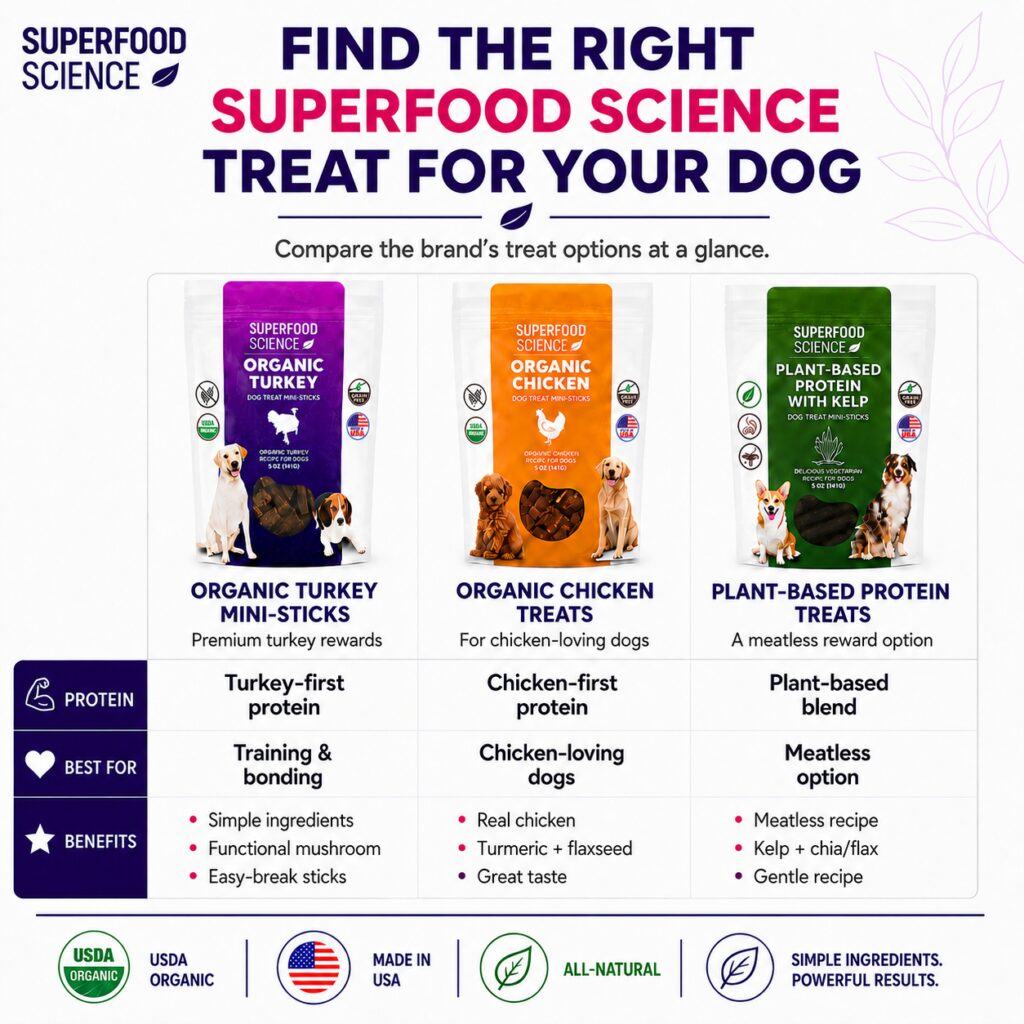
Dog parents who want to browse current Superfood Science dog treat options can visit the product page here: Shop Superfood Science Dog Treats. One of the features that Superfood Science dog treats offer is easily breakable mini-sticks for portion control.
Supportive care disclaimer for treat-related posts
Training treats can support a structured, ingredient-conscious routine, but they are not treatments for vomiting, diarrhea, food allergy, itchy skin, ear disease, obesity, or any other medical condition. If symptoms are persistent, recurrent, severe, or worsening, the treat plan should be discussed with a veterinarian.
Organic Turkey Dog Treats
For dog parents who want a cleaner-label, more intentional training reward, Superfood Science Organic Turkey Dog Treats may fit well when a turkey-based option makes sense for the dog.
This line includes beta-glucan-rich Agaricus mushrooms in its nutritional ingredient profile. That creates a distinctive wellness-formulation story while keeping the claim focused on ingredient choice, portion control, and individual tolerance rather than on medical improvement.
Organic Chicken Dog Treats
For dogs that tolerate chicken well, Superfood Science Organic Chicken Dog Treats may fit naturally into a structured training routine.
This line includes ingredients such as turmeric and flaxseed as part of an intentional clean-label formulation story. The compliant focus is nutritional positioning and training practicality, not the treatment of inflammation, itching, digestive disease, or any other condition.
Plant-Based Protein Dog Treats
For owners who prefer a different ingredient direction, Superfood Science Plant-Based Protein Dog Treats may offer a thoughtful alternative training treat.
This line includes ingredients such as kelp, chia, and flaxseed as part of a plant-based nutritional ingredient profile. That may appeal to ingredient-conscious families who want a different reward format while still focusing on treat size, calorie budget, and tolerance.
The strongest compliant brand position is this: Superfood Science gives dog parents cleaner-label treat options that may fit a more intentional training routine; however, the dog’s response, treat size, and total calorie load still matter most.
Limitations and research gaps
There is good veterinary guidance around treat calories, label evaluation, and the importance of keeping treats a small part of daily intake.[1][3][4]
There is much less direct research comparing commercial training treats head-to-head on learning outcomes, gastrointestinal tolerance, or long-term weight effects. Existing research on odor preference and reward variety provides useful background, but it should not be taken as proof that a single commercial treat format is best for every dog.[6][7]
That means the most defensible advice is practical rather than dramatic: choose tiny, countable, clearly labeled treats and pay attention to what your own dog actually tolerates well.
Suggested Usage Guide
Start by matching the treat to the training situation.
For short sessions at home, a lower-value but easy-to-count reward may be enough. For more intense training around distractions, offer something more motivating, but keep pieces small.
Count training rewards honestly. If your dog trains often, take those calories seriously instead of treating them like “free” extras. If needed, adjust meal portions modestly with veterinary guidance so the day’s total calories — meals plus treats — stay within your dog’s daily allotment.[1][3]
If your dog has digestive or skin sensitivity, choose one treat direction and keep the rest of the routine steady long enough to judge tolerance clearly. For a deeper buying framework, see Superfood Science’s guide to organic dog treats with natural ingredients.
Safety and when to call a vet
Call your veterinarian if your dog develops repeated vomiting, chronic diarrhea, weight gain, poor appetite, recurrent itching, paw licking, ear discomfort, or symptoms that seem tied to frequent treat use.[3][5]
Seek urgent care if your dog has choking, repeated inability to keep water down, breathing difficulty, collapse, black or bloody stool, or suspected toxin exposure.
Use extra caution with puppies, toy breeds, senior dogs, and fast gulpers. Morsel size and chew safety matter as much as ingredients.[1][2]
FAQs
What are trainer dog treats?
Trainer dog treats are small, easy-to-use rewards designed for repeated reinforcement during training sessions. They are usually chosen for speed, motivation, portion control, and ease of counting rather than indulgence alone.[1][2] Many dog parents simply call these dog trainer treats, since their whole purpose is built around the training session itself.
What makes a treat good for dog training?
A good training treat is usually small, motivating, quick to chew, and easy to count within the dog’s calorie budget. The best choice also depends on the dog’s size, training environment, and individual tolerance.[1][2][3]
Are natural dog treats better for training?
Not necessarily. Natural or organic positioning may matter to owners, but for training the biggest factors are size, chew speed, palatability, calorie load, and tolerance.[1][2][4] That holds true even for organic training treats for dogs — the ingredient story matters less than how the treat performs in the moment.
Can trainer treats cause diarrhea?
Yes, rich treats, too many treats, or abrupt ingredient changes can contribute to digestive upset in some dogs. Diarrhea can also have many other causes, so persistent or severe symptoms should be discussed with a veterinarian.[5]
How many training treats can I give my dog per day?
That depends on your dog’s size, total calorie needs, and the calories in each treat. In general, treats should stay under about 10% of daily calories, including training rewards.[1][3]
Should dogs with itchy skin or ear problems avoid training treats?
Not every itchy or ear-prone dog needs to avoid treats, but recurring symptoms deserve veterinary guidance. A simpler, consistent treat routine can make diet variables easier to track while your veterinarian helps assess the bigger picture.[1][5]
Explore More Dog Health Tips
- Best Organic Dog Treats for Sensitive Stomachs
- Best Organic Dog Treats Made in the USA: A Vet-Safe Guide for Dog Parents
- Organic Dog Treats with Natural Ingredients: What Actually Matters
- Top-Rated Organic Dog Treats: A Guide to Safety
- Organic Dog Treat Subscription Options: Why Superfood Science Makes Sense
References
1. World Small Animal Veterinary Association. (2025). Feeding treats to your dog. https://wsava.org/wp-content/uploads/2025/11/WSAVA_GuidetoTreats_Dogs_251107.pdf
2. Gibeault, S. (2025, November 26). The right treats make the best rewards: How to choose. American Kennel Club. https://www.akc.org/expert-advice/training/dog-training-treats/
3. Cline, M. G., Burns, K. M., Coe, J. B., Downing, R., Durzi, T., Murphy, M., & Parker, V. (2021). 2021 AAHA nutrition and weight management guidelines for dogs and cats. Journal of the American Animal Hospital Association, 57(4), 153–178. https://doi.org/10.5326/JAAHA-MS-7232
4. World Small Animal Veterinary Association Global Nutrition Committee. (2021, March 10). WSAVA Global Nutrition Committee: Guidelines on selecting pet foods. https://wsava.org/wp-content/uploads/2021/04/Selecting-a-pet-food-for-your-pet-updated-2021_WSAVA-Global-Nutrition-Toolkit.pdf
5. Llera, R., Barnette, C., & Ward, E. (2022). Food allergies in dogs. VCA Animal Hospitals. https://vcahospitals.com/know-your-pet/food-allergies-in-dogs
6. Hall, N. J., Péron, F., Cambou, S., Callejon, L., & Wynne, C. D. L. (2017). Food and food-odor preferences in dogs: A pilot study. Chemical Senses, 42(4), 361–370. https://doi.org/10.1093/chemse/bjx016
7. Bremhorst, A., Bütler, S., Würbel, H., & Riemer, S. (2018). Incentive motivation in pet dogs: Preference for constant vs. varied food rewards. Scientific Reports, 8, Article 9756. https://doi.org/10.1038/s41598-018-28079-5
