
How Often Should My Dog Have a Wellness Check? 2026 Vet-Reviewed Guide
Quick Answer:
Most healthy adult dogs should have a wellness check at least once a year. Puppies usually need visits every 3 to 4 weeks during the early vaccine and development period, while many senior dogs and dogs with chronic health concerns benefit from exams every 6 months or more often. The right schedule depends on life stage, breed size, health history, home observations, and your veterinarian’s guidance.[1–5]
By Superfood Science Writing Team | Reviewed by Dr. Kelly Hood, DVM | Last Updated: 05/12/2026
Superfood Science has produced organic and natural functional foods for humans and pets for over 20 years, specializing in clean-label formulations and evidence-based nutrition.
This article follows the dogs.superfoodscience.com evidence-based workflow and uses conservative, vet-safe language. It focuses on preventive care, early detection, and practical timing for wellness checks rather than disease-treatment claims.
Not veterinary advice: This article is for general dog wellness education only and does not replace diagnosis, treatment, or individualized recommendations from your veterinarian. It is dog-specific and should not be generalized to cats, whose life-stage timing, disease patterns, and preventive-care needs may differ.
Key Takeaways
- Adult dogs: Most healthy adult dogs need at least one wellness check per year, and some dogs benefit from more frequent visits.[1][2]
- Puppies: Puppies need repeated early visits because growth, vaccines, parasite control, and development change quickly.[1]
- Senior dogs: Senior dogs often benefit from checkups every 6 months because age-related problems can appear gradually and may be easier to catch early.[1][3][4]
- Breed size matters: Large and giant breeds may enter their senior years earlier than small breeds, which can affect when more frequent vet visits make sense.[1]
- Wellness checks are broader than vaccines: They often include a physical exam, body condition review, dental assessment, parasite screening, and a discussion of behavior, diet, supplements, and possible lab testing.[2][4][5]
Why Wellness Checks Matter Even When Your Dog Seems Fine
Many dog parents think about veterinary care in two categories: routine vaccine visits and appointments for when something is clearly wrong.
That leaves out one of the most useful forms of veterinary care your dog can get: the wellness check.
A wellness check is the visit you schedule before there is an obvious problem. That matters because many health issues in dogs build slowly. Weight gain, dental disease, early mobility decline, heart changes, kidney or liver-related lab changes, and subtle behavior shifts often do not begin with an emergency.
They begin quietly.[2][3][5]
That is why the better question is not only whether your dog needs routine checkups. It is how often your dog should have them.
What Is a Wellness Check for Dogs?
A wellness check is a preventive-care visit for a dog who appears healthy or mostly healthy.
VCA describes it as a general health assessment and physical examination that may also include screening tests such as blood work, urinalysis, or stool testing when appropriate.[4][5]
In practice, the value of the visit is not just what your veterinarian finds that day. It is also the trend line of findings the visit creates over time.
When a clinic has your dog’s weight history, exam findings, dental notes, and prior screening results, small changes are easier to catch earlier. That can matter with non-purposeful weight gain or loss, dental changes, early arthritis or mobility issues, increased thirst, behavior changes, or trending organ-related lab changes.[2][3][5]
For example, blood work may help your veterinarian evaluate patterns related to red and white blood cells, liver enzymes, kidney values, blood sugar, electrolytes, and other markers. Urinalysis may help show how concentrated the urine is and whether there are signs that your veterinarian wants to investigate further, such as protein, glucose, blood, crystals, or indicators of infection.[4][5]
These tests do not diagnose every problem on their own. They give your veterinarian more context than a visual exam alone.
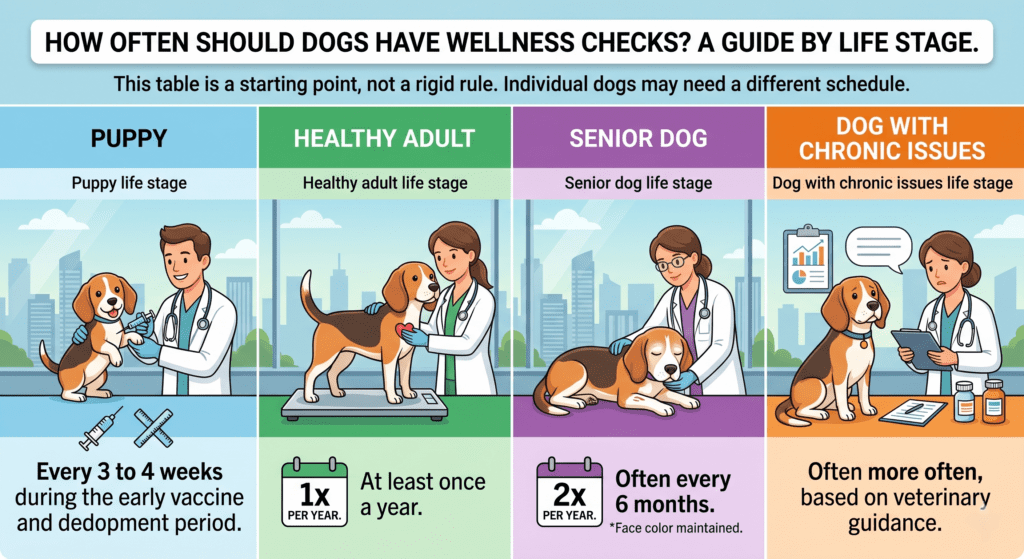
How Often Should Dogs Have Wellness Checks?
A practical way to think about wellness-check timing is by life stage.
| Dog Life Stage | Typical Wellness-Check Rhythm |
| Puppy | Every 3 to 4 weeks during the early vaccine and development period, usually from about 6 to 8 weeks until roughly 4 to 5 months old.[1] |
| Healthy adult | At least once a year, often ages 1 through 6-ish depending on breed, size, health history, and risk factors.[1][2] |
| Senior dog | Often, every 6 months, commonly around ages 8 to 10 and up, or earlier for large and giant breeds.[1][4] |
| At least once a year, often ages 1 through 6-ish, depending on breed, size, health history, and risk factors.[1][2] | Often, more frequently, based on veterinary guidance, medication monitoring needs, symptoms, and lab trends.[2][4][5] |
This table is a starting point, not a rigid rule. Individual dogs may need a different schedule.
Puppies
Puppies need the most frequent routine visits.
AAHA’s life-stage guidance notes that most puppies should begin veterinary care around 6 to 8 weeks of age and then return every 3 to 4 weeks until they are roughly 4 to 5 months old.[1]
That schedule supports vaccination timing, parasite prevention, growth monitoring, and early development questions.
These visits matter for more than vaccines. They are also when veterinarians often help owners with feeding amount, body condition, stool concerns, teething, handling, socialization, and common puppy behavior questions.[1][2]
Because puppies change so fast, waiting too long between visits can mean missing a problem that would have been easier to manage early.
Healthy Adult Dogs
For most healthy adult dogs, the practical baseline is at least once a year.[1][2]
That yearly interval is better understood as the minimum preventive standard for a dog who is doing well. Healthy adult dogs can still develop gradual changes in weight, teeth, mobility, skin, appetite, or drinking patterns that owners may not notice right away.[2][3][5]
A yearly visit also gives you a regular checkpoint to review your diet, treats, supplements, exercise, and any subtle home observations you may not be sure are important.
Senior Dogs
Senior dogs often benefit from wellness exams every 6 months rather than every 12 months.[1][3][4]
This recommendation is practical rather than alarming. Older dogs are more likely to develop changes in kidney function, dental disease, mobility, muscle condition, body weight, appetite, thirst, or behavior over shorter time frames.
A six-month interval gives veterinarians more opportunities to catch those shifts before they become harder to manage.[1][4][5]
That does not mean every senior dog is sick. It means aging changes often move faster than owners realize, and a shorter preventive-care interval can be more beneficial.
Why Breed Size Can Change the Timing
This is a useful nuance that many generic pet articles miss.
Large and giant breeds often enter their senior years earlier than smaller breeds. AAHA’s current dog life-stage guide notes that a giant-breed dog may be considered senior at around 6 years of age, while a small-breed dog may not reach that stage until around 8 to 10 years.[1]
That matters because “senior” is not just a birthday label. It affects how the body may change with age and how soon more frequent monitoring may make sense or be more beneficial.
A big dog slowing down at 6 may deserve the same kind of preventive attention that a small dog might not need until several years later.
Dogs That May Need More Frequent Checkups at Any Age
Life stage is not the only factor.
Some younger adult dogs also need more frequent visits because of their medical history or risk profile. This includes dogs with chronic skin disease, obesity, gastrointestinal sensitivity, heart disease, endocrine problems, long-term medications, dental disease, or ongoing mobility concerns.[2][4][5]
In those dogs, the right schedule is individualized. The goal is not to follow a rigid calendar. Biannual visits can be beneficial because they give your veterinarian a clearer way to monitor progress and changes over time.
What Happens at a Dog Wellness Visit?
A good wellness check is broader than a quick look-over.
Depending on your dog’s age and health status, the visit may include discussion of body weight, body condition, food and treats, dental health, stool quality, drinking habits, urination, parasite prevention, exercise, mobility, sleep, behavior, and any changes you have noticed at home.[2][4][5]
Your veterinarian may also recommend screening tests such as fecal checks, blood work, and urinalysis. Those are not automatically needed at every visit for every dog, but they are often more relevant as dogs age or when home observations suggest a possible change or new development.[4][5]
What the Evidence Supports
There is strong veterinary consensus behind life-stage-based preventive care and regular exams.[1][2][3][4][5]
The best-supported practical guidance is that puppies need repeated early visits as they grow and their immune systems develop; healthy adults should usually be seen at least yearly; and many senior dogs benefit from wellness care every 6 months.[1][2][4]
There is also strong practical support for the idea that preventive visits improve early detection. That does not mean a wellness check prevents every problem. It means it improves the odds that subtle changes are noticed sooner rather than later.[2][3][5]
Where the Schedule Becomes More Individualized
Not every dog fits neatly into one category.
Breed, size, body condition, geography, parasite exposure, chronic conditions, medications, and owner observations all affect the practical schedule. A dog with recurring ear infections, unexplained weight loss, or early mobility issues may need a very different recheck plan from a young, healthy adult dog with no ongoing concerns.
That is why annual and twice-yearly guidance is best understood as a starting framework rather than a rule that overrides everything else.
Limitations and Research Gaps
Preventive-care schedules are supported by clinical guidance, consensus documents, and long-standing veterinary practice, but there is not one single visit frequency that fits every dog.[1][2][3]
It is also important to be honest about the evidence base. There is no large body of randomized controlled trials directly comparing six-month versus twelve-month wellness schedules across breeds, sizes, and life stages to demonstrate that a single universal schedule is best in every case.
Much of the practical guidance is based on preventive-care principles, disease-detection logic, and veterinary consensus rather than direct head-to-head scheduling trials.
That does not make the guidance weak. It just means it should be applied thoughtfully.
A routine wellness exam also does not guarantee that a dog will remain healthy between visits. Some problems still emerge quickly, which is why home observation remains essential.
Clinical Note: What to Bring to a Wellness Check
Owners can make a wellness visit much more useful by bringing a few practical details.
If your dog has a subtle limp, cough, odd nighttime behavior, or unusual gait, a short phone video can be extremely helpful. This is one of the simplest ways to show your veterinary team what you see at home.
A photo of your food bag, treat label, supplement container, or stool changes can also save time and improve the conversation.
If you have noticed changes in drinking, urination, appetite, or energy, writing them down before the appointment makes it easier to explain the pattern clearly.
The goal is not to arrive with a perfect record. It is simple to help your veterinarian see what you see at home, because your dog cannot talk and tell the vet where it hurts.
Practitioner-Recommended Usage Guide
Start by matching the visit schedule to your dog’s life stage. Puppies usually need frequent early visits. Healthy adults usually need yearly care. Senior dogs often do better with exams every 6 months.[1][2][4]
Before each visit, make a short list of anything that has changed since the last exam. Things to consider include appetite, water intake, stool quality, urination, activity level, coughing, sleep, mobility, weight, and behavior.
Remember that you live with your dog and your veterinarian does not, so your observations are equally important during these visits.
During the appointment, ask what should be monitored before the next visit. A good wellness check should not only tell you how your dog looks today. It should also help you know what to watch for next.
How Superfood Science Treat Options Fit This Topic
Wellness checks are a good time to talk with your veterinarian about your dog’s everyday nutrition routine, including treats.
Treats may seem like a small part of the day, but they can affect calorie intake, training consistency, stool quality, chewing comfort, and exposure to ingredients. For dogs with weight concerns, digestive sensitivity, dental issues, food intolerance questions, or chronic health conditions, it is especially helpful to bring the treat label or a photo of the product to the visit.
Superfood Science organic and natural dog treats are positioned for dog parents who value clean-label ingredients, practical portioning, and transparent product choices. They are not a substitute for veterinary care, and they are not intended to diagnose, treat, cure, or prevent disease. Used thoughtfully, they can be part of a broader wellness conversation about what your dog eats every day.
A practical question to ask at the wellness visit is: “Do these treats fit my dog’s current body condition, health history, and daily calorie plan?”
Safety: When Not to Wait for the Next Routine Check
A wellness check is preventive care. It is not the same as urgent or emergency care.
Call your veterinarian sooner rather than waiting for the next routine visit if your dog develops repeated vomiting, persistent diarrhea, loss of appetite, weight loss, limping, excessive thirst, difficulty urinating, coughing, unusual tiredness, or a noticeable change in behavior.[2][4][5]
Seek urgent or emergency care if your dog has trouble breathing, collapse, seizures, uncontrolled vomiting or diarrhea, abdominal swelling, pale or blue gums, severe pain, or possible toxin exposure.
FAQ
How often should a healthy dog have a wellness check?
Most healthy adult dogs should have a wellness check at least once a year.[1][2]
Do senior dogs need checkups every 6 months?
Often yes. Many senior dogs benefit from twice-yearly visits because age-related changes can appear gradually and may be easier to catch early.[1][4]
How often should puppies go to the vet?
Most puppies should start around 6 to 8 weeks of age and then return every 3 to 4 weeks until around 4 to 5 months old.[1]
Is a wellness exam just for vaccines?
No. Wellness exams usually include a physical exam, body condition review, a discussion of diet and behavior, a dental assessment, and sometimes lab testing or parasite screening.[2][4][5]
Does breed size change when a dog should be monitored more often?
Yes, it can. Large and giant breeds often reach their senior years earlier than small breeds, which may make earlier twice-yearly monitoring more beneficial.[1]
What if my dog seems healthy and never gets sick?
That is still a good reason to keep up wellness care. Many problems are easier to catch on preventive visits than through symptoms alone, and some pets are good at masking subtle changes.[2][3][5]
Does this wellness-check schedule apply to cats, too?
No. This article is written for dogs. Cats have different life-stage timing, health risks, and preventive-care considerations, so cat parents should follow feline-specific veterinary guidance.
Conclusion
For most dog parents, the practical answer is straightforward.
Puppies need frequent early visits. Healthy adult dogs need at least yearly wellness checks. Senior dogs and dogs with chronic health concerns often benefit from exams every 6 months or a schedule recommended by their veterinarian.
The value of a wellness check is not that it guarantees perfect health. It gives you and your veterinarian a better chance of catching small changes before they become bigger problems.
Explore More Dog Health Tips
- Signs Your Dog May Be Sick: Early Red Flags and When to Call a Vet
- Top-Rated Organic Dog Treats: How to Choose Safely
- Homemade vs. Store-Bought Organic Dog Treats
- Best Organic Dog Treats Made in the USA: A Vet-Safe Guide for Dog Parents
- Organic Dog Treats with Natural Ingredients: What Actually Matters
References
[1] American Animal Hospital Association. (2025). How Often Should My Dog Go to the Vet? A Dog Life Stage Guide. https://www.aaha.org/resources/how-often-should-my-dog-go-to-the-vet-a-dog-life-stage-guide/
[2] AAHA/AVMA. (2011). Canine Preventive Healthcare Guidelines. https://www.aaha.org/wp-content/uploads/globalassets/02-guidelines/preventive-healthcare/caninepreventiveguidelines_ppph.pdf
[3] World Small Animal Veterinary Association. (2025). Principles of Wellness. https://wsava.org/wp-content/uploads/2025/06/Principles-of-Wellness-FINAL.pdf
[4] VCA Animal Hospitals. Wellness Examination in Dogs. https://vcahospitals.com/know-your-pet/wellness-examination-in-dogs
[5] VCA Animal Hospitals. Wellness Testing for Dogs. https://vcahospitals.com/know-your-pet/wellness-testing-for-dogs
