
Signs Your Dog May Be Overweight: Dog Parent Body Check Guide | DVM-Reviewed
Quick Answer
A dog may be overweight if the ribs are hard to feel, the waist is less visible from above, the abdominal tuck disappears, or your dog tires more easily during normal activity. Mild weight gain can creep up slowly, so body condition scoring and regular weight checks are usually more useful than eyeballing alone.
Trust Signal
By Superfood Science Writing Team | Reviewed by Dr. Kelly Hood, DVM | Last Updated: 05/18/2026
Superfood Science has produced organic and natural functional foods for humans and pets for over 20 years, specializing in clean-label formulations and evidence-based nutrition.
This article follows the dogs.superfoodscience.com evidence-based workflow and uses conservative, vet-safe language. It focuses on early recognition, nutrition basics, treat habits, and practical next steps rather than disease-treatment claims.
Key Takeaways
- Many dogs become overweight gradually, so small changes in body shape matter.[1][2]
- You should usually be able to feel the ribs beneath a slight layer of fat and see a waist from above.[1][2][4]
- Extra treats, free feeding, and underestimated portions are common reasons weight creeps up.[2][5]
- Being overweight is not just a cosmetic issue. Extra body fat can affect mobility, comfort, inflammation, and long-term health.[2][6][8][9]
- If you suspect your dog is carrying extra weight, the safest next step is a veterinary weight and body condition check rather than guessing at home.[1][2]
Why Early Weight Clues Matter
A lot of dog parents do not notice weight gain right away.
That is not because they do not care. It is because the change is usually gradual.
The dog still looks cute. The appetite still looks good. The extra treats still feel small. Then one day the waistline is harder to see, walks seem a little slower, and the dog feels heavier when picked up.
Being a little overweight can seem harmless, but weight gain in dogs is easier to notice early than to reverse later. In real life, one of the biggest drivers is not always the main food bowl. It is often the quiet extras: oversized portions, frequent snacks, and well-meaning treats that add up over time.[2][5]
That is why this topic matters for everyday dog parents.
Why Body Condition Matters More Than the Number on the Scale
The scale matters, but body condition is often more useful.
AAHA’s nutrition and weight management guidance emphasizes that dogs should be assessed with a body condition score, not just body weight, because the same number on the scale can mean different things in different dogs.[2] WSAVA also encourages routine body-condition assessment as part of nutrition care.[1]
That matters because some owners focus only on pounds. What really helps at home is learning what a healthy shape looks and feels like.
What a Healthy Body Shape Usually Looks Like
A healthy dog usually has ribs that are easy to feel with only a slight fat layer over them. From above, the waist should still be visible. From the side, the abdomen should tuck upward rather than looking straight, blocky, or rectangular.[1][2][4]
VCA employs a useful comparison for ribs: in a dog with a healthy condition, the ribs should feel more like the back of your hand than the fleshy palm.[4] That is not a diagnostic tool, but it can help owners distinguish between normal padding and excessive fat coverage.
Body Condition Check: Healthy Shape vs. Overweight Clues
| Assessment Area | Ideal Condition, Often Around 4–5/9 | Overweight Clues, Often Around 6–7/9 |
| Ribcage feel | Ribs are easy to feel with a light fat covering; the rib area feels closer to the back of your hand. | Ribs are hard to locate or require noticeable downward pressure under a thicker fat layer. |
| Top-down view | A visible waist narrows behind the ribs, creating a gentle hourglass shape. | The waist flattens out, creating a straighter, blockier, or oval shape. |
| Side profile | The abdomen tucks upward from the ribcage toward the hind legs. | The belly line looks flatter, lower, or sagging instead of tucked. |
| Daily movement | Normal walks, stairs, and play fit your dog’s usual energy level. | Your dog tires faster, avoids stairs, slows on walks, or seems less eager to play. |
| Collar or harness fit | Collar and harness fit remain stable when adjusted correctly. | A harness or collar that used to fit comfortably may feel tighter because body volume has changed. This is a body-shape clue, not a cause of weight gain. |
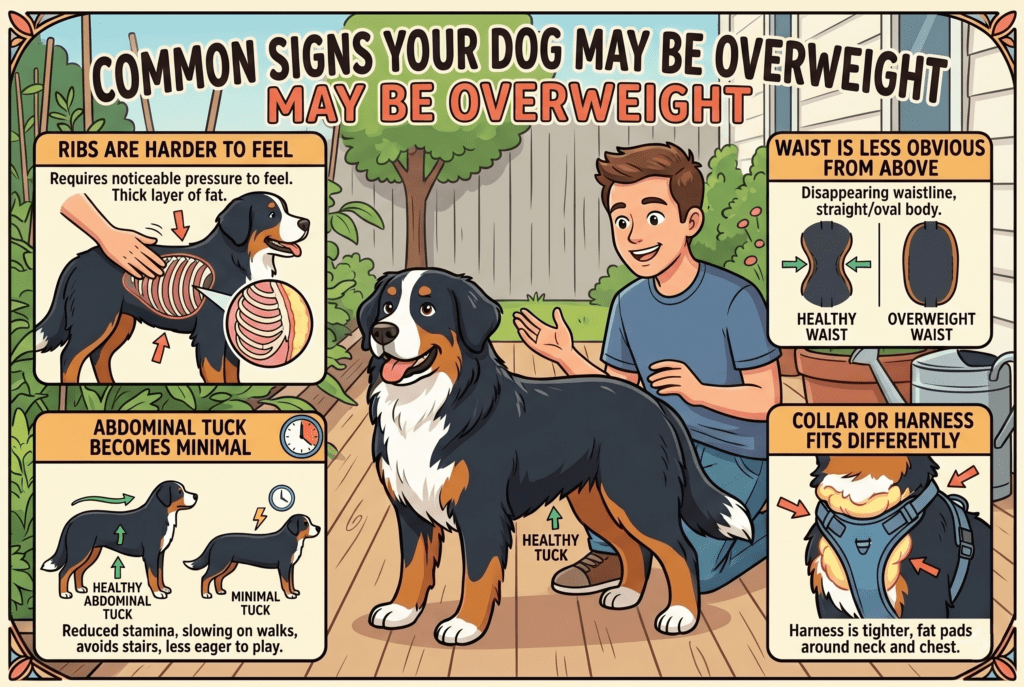
Common Signs Your Dog May Be Overweight
The Ribs Are Harder to Feel
This is one of the simplest clues.
If you have to press noticeably to feel the ribs, or they feel buried under a thicker layer of fat, your dog may be carrying extra weight.[2][4]
The Waist Is Less Obvious From Above
In many dogs, early weight gain shows up first as a disappearing waistline. The body begins to look straighter or ovaler from above instead of gently narrowing behind the ribs.[1][2][4]
The Abdominal Tuck Becomes Minimal
From the side, many healthy dogs have a visible upward tuck from the ribcage toward the belly. When that tuck flattens or disappears, extra weight may be part of the picture.[1][2]
Your Dog Tires More Easily
Reduced stamina is not always due to weight, but extra body weight can make ordinary activities feel harder. Some dogs start slowing on walks, avoid stairs, or seem less eager to play.[2][6]
The Collar or Harness Fits Differently
Sometimes owners notice the neck, chest, or shoulder area changes before they notice the waist. A harness that used to fit comfortably may become tighter, or fat pads may seem more obvious around the neck and chest.[4]
This should be understood as a mechanical marker of body volume change, not as a sign that the collar or harness caused metabolic weight gain.
Why Dogs Become Overweight So Easily
This is where dog parents often need the most honest answer.
Most of the time, the problem is not one dramatic mistake. It is an accumulation.
Extra Treats Add Up Fast
AAHA recommends that treats and extras should generally make up no more than about 10% of the day’s calories.[2] WSAVA gives similar practical guidance for treat feeding.[5]
That rule matters because many owners underestimate treat calories, especially in small dogs. A few rewards here and there can quietly become a meaningful part of the day’s caloric intake.
Free Feeding Can Make Portion Control Harder
WSAVA notes that free feeding is only appropriate in pets that can maintain an ideal body weight on that system.[7] Many dogs do not self-regulate well enough for that to work over time.
Portions Often Drift Upward
Scoops get rounded. Household members double-treat. The dog gets a snack for being cute. These are normal human habits, but they can lead to a real calorie surplus over time.
Lack of Exercise Can Quietly Lower Daily Energy Burn
House dogs can gain weight more easily when their daily routine becomes too sedentary. This is especially common when dogs spend most of the day indoors, take only short potty walks, or lose regular playtime as their owners get busy.
Peer-reviewed research supports the connection between lower activity and overweight status. In a large UK dog-owner survey, overweight dogs were reported to exercise less frequently and for shorter periods than dogs not reported to be overweight.[11] Another study found that pet dogs were more likely than sport dogs to be over-fat, and the authors emphasized that feeding should match the dog’s level of physical activity.[12]
Exercise should not be viewed as a free pass for extra treats. It works best when paired with measured meals, smarter reward portions, and regular body-condition checks.[2][5][12]
How Much Exercise Do Dogs Need?
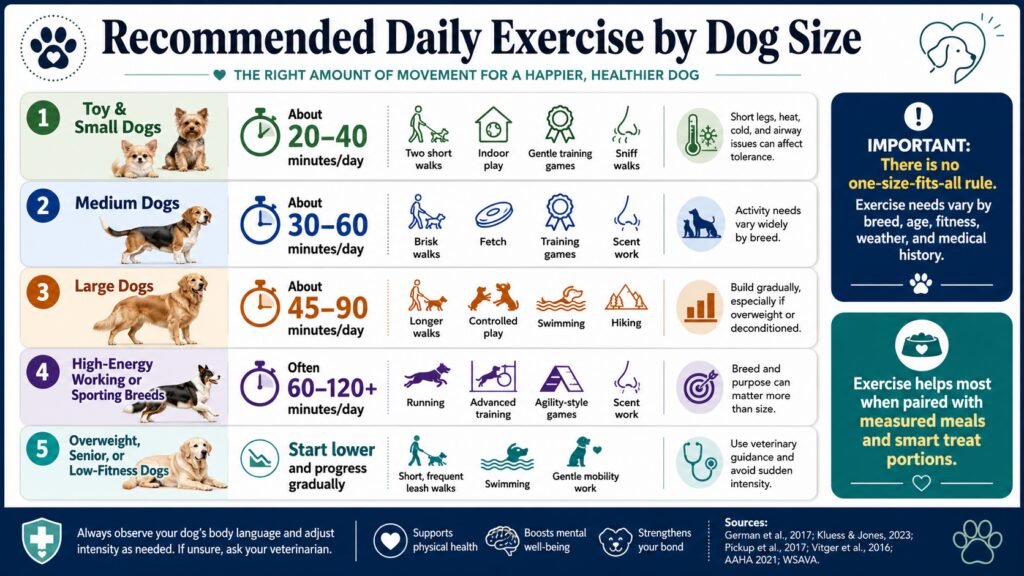
There is no single peer-reviewed rule stating that every small, medium, or large dog needs the exact same number of minutes. Breed, age, fitness level, joint comfort, weather, medical history, and training background all matter.[13]
Still, dog parents need a practical starting point. The ranges below are best understood as general daily targets for healthy adult dogs, not prescriptions for puppies, seniors, brachycephalic breeds, injured dogs, or dogs with heart, respiratory, orthopedic, or endocrine disease.
| Dog Size / Type | Practical Daily Exercise Starting Range | What That Can Look Like | Important Notes |
| Toy and small dogs | About 20–40 minutes per day | Two short walks, indoor play, gentle training games, sniff walks | Small dogs still need movement, but short legs, heat, cold, and airway issues can change tolerance. |
| Medium dogs | About 30–60 minutes per day | Brisk walks, fetch, training games, hill-free hikes, scent work | Many healthy adult dogs fall into this range, but energy level varies widely by breed. |
| Large dogs | About 45–90 minutes per day | Longer walks, controlled play, swimming, hiking, structured training | Build gradually, especially if the dog is overweight or deconditioned. Protect joints and avoid sudden high-impact exercise. |
| High-energy working or sporting breeds | Often 60–120+ minutes per day, depending on conditioning | Running, agility-style games, field work, hiking, advanced training, scent work | Breed and purpose can matter more than size. Some medium sporting breeds need more activity than some large companion breeds.[13] |
| Overweight, senior, or low-fitness dogs | Start lower and progress gradually with veterinary guidance | Short, frequent leash walks, swimming, slow hill-free walking, gentle mobility work | Do not suddenly increase intensity. Controlled exercise can help preserve lean mass during weight management, but the plan should match the dog’s health status.[14] |
A useful real-world benchmark is that, in a peer-reviewed U.S. study, many owners reported walking their dogs daily for about 15–45 minutes per session.[12] That does not prove this is the perfect amount for every dog, but it gives owners a realistic reference point. If a dog is gaining weight despite daily walks, the next step is not simply “walk more.” It is to reassess calories, treat size, activity intensity, and body condition together.
Why Extra Weight Matters
Being overweight is not just about appearance.
Merck Veterinary Manual defines dogs 10% to 20% above ideal body weight as overweight and dogs over 20% above ideal as obese.[6] Merck also notes that obesity is the most common nutritional health problem in dogs and cats.[6]
Extra weight can affect movement, joint comfort, heat tolerance, and daily energy. VCA notes that excess fat can contribute to inflammation and may worsen pain associated with degenerative joint disease.[8]
There is also a biological reason extra weight can matter. White adipose tissue is not simply passive storage. It functions as an active endocrine tissue, releasing adipokines and other signaling molecules involved in inflammation and metabolic stress.[9][10] That does not mean every overweight dog is suffering dramatically, nor that a home body check replaces veterinary care. It means early recognition and gentle correction are worth taking seriously.
Natural and Organic Treats Still Need Portion Control
This is an important place to be clear.
Natural and organic dog treats can be a better direction for many dog parents who want cleaner-label options and more ingredient transparency. But even a higher-quality treat can contribute to excess calories if portions are not controlled.[2][5]
That is why the healthiest treat is not just the one with the nicest ingredients. It is the one that also fits the dog’s calorie budget.
For dog parents who want a cleaner-label option while staying mindful of portion control, Superfood Science natural and organic dog treats can make sense as part of a more intentional treat routine. The benefit is not that a natural or organic treat cancels out calories. The benefit is that it can give owners a simpler, more transparent option when they are trying to build better daily habits.
How Superfood Science Treat Options Fit This Topic
Superfood Science treats are best positioned as part of a thoughtful daily reward plan, not as unlimited extras.
For dogs who do well with poultry, the USDA Organic turkey and chicken mini-stick treats may fit a clean-label reward routine when portions are kept small. For dogs with poultry sensitivity or households seeking a meat-free option, the natural, plant-based kelp mini-sticks may be a practical alternative.
The most weight-conscious approach is to break treats into smaller pieces, use them as meaningful rewards, and count them toward the day’s total treat allowance. For many dogs, small pieces given consistently are more useful than large treats given casually.
What Stronger Evidence Supports
The strongest support in this topic is for regular body condition scoring, individualized nutrition planning, treat-calorie awareness, and early intervention when weight gain is noticed.[1][2][5]
There is also strong support for the idea that overweight and obesity matter clinically, not cosmetically.[2][6][8][9]
The more limited area is trying to identify overweight status from one visual clue alone. Coat type, breed, muscle mass, and body conformation can make visual judgment harder. That is why hands-on rib checks and veterinary body-condition scoring are more reliable than guesswork.[1][2][4]
Breed and Body-Type Differences Matter
Not every dog should look the same.
Merck notes that ideal body fat and body condition can differ by breed and body type. For example, sighthounds naturally carry less body fat than many other breeds, while some breeds may look broader even at an appropriate body condition.[6]
That is one reason comparing your dog to another dog at the park is usually less helpful than using body condition scoring and veterinary guidance.
Limitations and Research Gaps
There is strong clinical guidance around body condition scoring and calorie management, but body-fat distribution and ideal appearance can vary by breed, coat, and conformation.[1][2][6]
There is also no single visual rule that works perfectly for every dog at home. A fluffy coat, heavy muscling, or unusual body shape can make mild excess weight harder to spot without hands-on assessment.
That is why owners should treat home screening as a useful first step, not a final diagnosis.
Suggested Care Guide
The following guidance is supportive care, not a substitute for veterinary diagnosis or treatment.
Start with a hands-on rib check and a top-down look at the waist. Do this regularly, not only when you already suspect a problem.[1][2][4]
If your dog seems a little heavier, do not panic or slash food randomly. First, measure meals more carefully, count treat calories more honestly, and schedule a veterinary weight and body-condition check.
If treats are part of daily life, shift toward smaller, simpler rewards and use them more strategically. This is where cleaner-label natural or organic treats may fit well, especially if you are trying to be more intentional about what goes into the daily routine.
Safety: When to Call Your Veterinarian
Call your veterinarian if your dog has rapid weight gain, weight gain with increased thirst, trouble breathing, major exercise intolerance, sudden reluctance to move, or weight change that does not make sense based on feeding alone.
Seek more timely veterinary input if your dog is already dealing with arthritis, endocrine disease, heart disease, or major mobility changes, because excess weight may worsen overall comfort and function.[2][6][8]
Do not put a dog on a severe or improvised weight-loss plan without veterinary guidance, especially puppies, seniors, or dogs with known medical issues.
FAQ
How can I tell if my dog is overweight?
Your dog may be overweight if the ribs are hard to feel, the waist is less visible from above, and the abdominal tuck looks smaller or disappears.[1][2][4]
What is a healthy body condition score for a dog?
On a 9-point scale, a score around 4 to 5 out of 9 is usually considered ideal for many dogs.[1][2][4]
Are treats one of the main reasons dogs gain weight?
Often, yes. Extra treats, table scraps, and people food can add calories quickly, especially when owners underestimate portions.[2][5]
Can natural or organic dog treats still make a dog overweight?
Yes. Better ingredients do not cancel out calories. Portion size still matters, even with natural or organic treats.[2][5]
Should I switch foods if my dog looks overweight?
Maybe, but do not guess. Start with a veterinary weight and body-condition check so the diet plan matches your dog’s actual needs.[1][2]
How often should I check my dog’s body condition at home?
A quick rib, waist, and tuck check every few weeks can help you notice gradual changes earlier. Use home checks as a screening habit, not as a replacement for routine veterinary exams.[1][2]
Conclusion
A dog does not have to look dramatically heavy to be carrying extra weight.
In many cases, the first clues are quieter: ribs that are harder to feel, a waist that fades, a little less stamina, or treats that have quietly become part of the main calorie budget.
That is why early recognition matters.
It is also why a smarter treat routine matters. If dog parents want a healthier direction, the goal is not just fewer treats. It is better choices, better portions, and a more intentional feeding plan overall.
Explore More Dog Health Tips
- How to Choose a Healthy Dog Treat
- Best Low-Calorie Dog Treats
- Organic vs. Natural Dog Treats: What’s the Difference?
- Are Organic Dog Treats Worth It in the Long Run?
- How Often Should My Dog Have a Wellness Checkup?
- Signs Your Dog May Be Sick
References
[1] World Small Animal Veterinary Association. (n.d.). Global nutrition guidelines. WSAVA. https://wsava.org/global-guidelines/global-nutrition-guidelines/ Accessed May 18, 2026.
[2] American Animal Hospital Association. (2021). 2021 AAHA nutrition and weight management guidelines for dogs and cats. AAHA. https://www.aaha.org/resources/2021-aaha-nutrition-and-weight-management-guidelines/home/ Accessed May 18, 2026.
[3] American Animal Hospital Association. (2021). Canine body condition score chart. AAHA. https://www.aaha.org/wp-content/uploads/globalassets/02-guidelines/2021-nutrition-and-weight-management/resourcepdfs/nutritiongl_bcs.pdf Accessed May 18, 2026.
[4] VCA Animal Hospitals. (n.d.). Body condition scores. VCA. https://vcahospitals.com/know-your-pet/body-condition-scores Accessed May 18, 2026.
[5] World Small Animal Veterinary Association. (2025). Feeding treats to your dog. WSAVA. https://wsava.org/wp-content/uploads/2025/11/WSAVA_GuidetoTreats_Dogs_251107.pdf Accessed May 18, 2026.
[6] Merck Veterinary Manual. (n.d.). Nutrition in disease management in small animals. Merck Veterinary Manual. https://www.merckvetmanual.com/management-and-nutrition/nutrition-small-animals/nutrition-in-disease-management-in-small-animals Accessed May 18, 2026.
[7] World Small Animal Veterinary Association. (2018). Frequently asked questions and myths. WSAVA. https://wsava.org/wp-content/uploads/2020/01/Frequently-Asked-Questions-and-Myths.pdf Accessed May 18, 2026.
[8] VCA Animal Hospitals. (n.d.). Overweight, obesity, and pain in dogs: Overview. VCA. https://vcahospitals.com/know-your-pet/overweight-obesity-and-pain-in-dogs-overview Accessed May 18, 2026.
[9] German, A. J. (2010). Obesity, its associated disorders and the role of inflammatory adipokines in companion animals. The Veterinary Journal, 185(1), 4–9. https://doi.org/10.1016/j.tvjl.2010.04.004
[10] Wakshlag, J. J., Struble, A. M., Levine, C. B., Bushey, J. J., Laflamme, D. P., & Long, G. M. (2011). The effects of weight loss on adipokines and markers of inflammation in dogs. British Journal of Nutrition, 106(S1), S11–S14. https://doi.org/10.1017/S0007114511000545
[11] German, A. J., Blackwell, E., Evans, M., & Westgarth, C. (2017). Overweight dogs exercise less frequently and for shorter periods: Results of a large online survey of dog owners from the UK. Journal of Nutritional Science, 6, e11. https://doi.org/10.1017/jns.2017.6
[12] Kluess, H. A., & Jones, R. L. (2023). A comparison of owner perceived and measured body condition, feeding and exercise in sport and pet dogs. Frontiers in Veterinary Science, 10, 1211996. https://doi.org/10.3389/fvets.2023.1211996
[13] Pickup, E., German, A. J., Blackwell, E., Evans, M., & Westgarth, C. (2017). Variation in activity levels amongst dogs of different breeds: Results of a large online survey of dog owners from the UK. Journal of Nutritional Science, 6, e10. https://doi.org/10.1017/jns.2017.5
[14] Vitger, A. D., Stallknecht, B. M., Nielsen, D. H., & Bjornvad, C. R. (2016). Integration of a physical training program in a weight loss plan for overweight pet dogs. Journal of the American Veterinary Medical Association, 248(2), 174–182. https://doi.org/10.2460/javma.248.2.174
