
Are Turkey Dog Treats Better Than Chicken for Dogs With Itching? | Vet-Reviewed Guide
Quick Answer
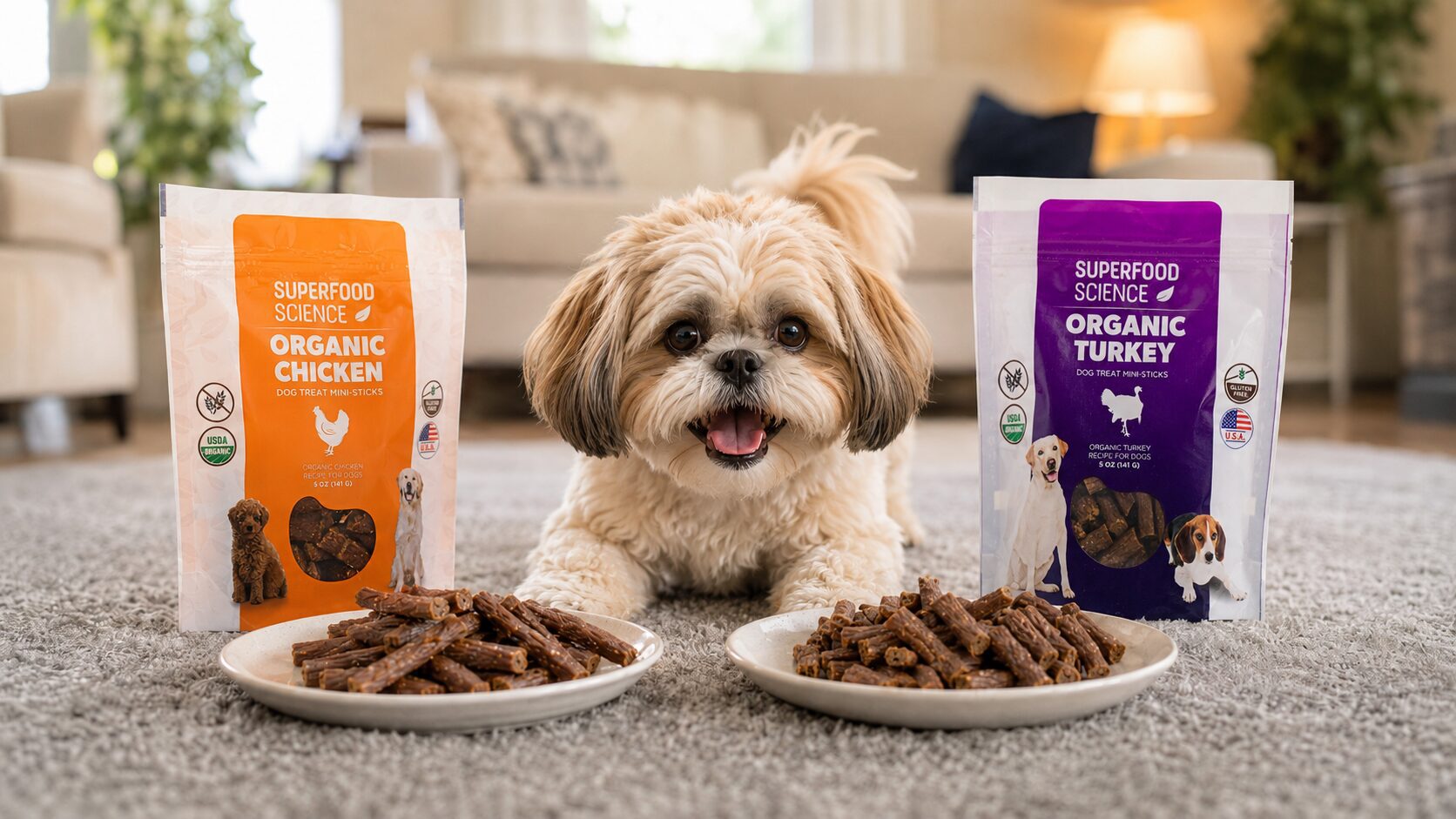
Turkey dog treats may be a smarter choice for some itchy dogs, especially when chicken seems linked to repeat flare-ups. But turkey is not automatically better for every dog with itching. Look for recurring patterns, rule out common non-food causes, and avoid assuming that a single protein change alone provides the answer.
Trust Signal
By Superfood Science Writing Team | Reviewed by Dr. Kelly Hood, DVM | Last Updated: 05/26/2026
Superfood Science has produced organic and natural functional foods for humans and pets for over 20 years, specializing in clean-label formulations and evidence-based nutrition.
Key Takeaways
- Turkey treats are not a universal fix for itchy dogs, but they may be a practical trial option when chicken is suspected as the culprit.
- Chicken is one of the more commonly reported food allergens in dogs, which is why it often comes up in conversations about itch-related diets.
- Itching is often caused by non-food factors such as environmental allergies, fleas, infections, or skin barrier problems rather than food alone.
- A cleaner-label turkey treat may help reduce variables, but it does not diagnose a food allergy on its own.
- Superfood Science’s organic turkey, organic chicken, and plant-based protein treats may each be tolerated differently, depending on the dog’s individual needs and veterinary guidance.
Introduction: Why Dog Parents Ask About Turkey vs. Chicken
Dog parents often make this connection quickly because the pattern feels obvious at home: the dog starts itching, chicken treats are part of the daily routine, and turkey sounds like a gentler alternative.
That makes the question understandable: are turkey dog treats better than chicken for dogs with itching?
The safest answer is more nuanced than “yes” or “no.” Turkey may be a better choice for some dogs, especially when chicken seems linked to repeat flare-ups. At the same time, itching in dogs has many possible causes, and food is only one part of the bigger picture.[2][4]
That is why this topic needs both practical logic and veterinary caution. A treat change can be useful, but it should not replace careful observation or a proper veterinary workup when symptoms are ongoing.

Why Itching in Dogs Is Not Automatically a Food Problem
Itching is common in dogs, but food is not always the main reason.
The MSD Veterinary Manual explains that dogs may itch due to food allergies, environmental allergens, fleas, skin infections, and other dermatologic causes.[2][4]
That matters because a dog who scratches more after chicken treats may truly be reacting to the protein source in the food. However, this same dog may also have seasonal allergies, secondary yeast overgrowth, flea exposure, skin barrier problems, or another unrelated issue occurring at the same time.
Before an owner concludes “chicken is the problem,” it helps to ask whether the itching pattern is repeatable and specific.
- Did the itching happen more than once after chicken-heavy treats?
- Did it improve when chicken was removed?
- Did it return when chicken was reintroduced? Those pattern questions matter more than one isolated bad day.
Why Chicken Is Often Under Suspicion
Chicken is often under suspicion for two practical reasons.
First, it is an extremely common ingredient in dog foods and treats. Second, it is also one of the more commonly reported food allergens in dogs.[1][2]
That does not mean chicken is bad for all dogs. Many dogs tolerate chicken well.
It means that when an owner suspects a food-related itch pattern, chicken often becomes the first ingredient they question because it is both common in the diet and commonly discussed in veterinary food-allergy conversations.
Are Turkey Dog Treats Better for Itchy Dogs?
The honest answer is: sometimes, but not necessarily.
A turkey-based treat may be the better option when itching seems to flare after chicken-heavy treats, the dog has a repeat pattern, the turkey product is simpler and easier to evaluate, and the owner wants to reduce variables during a careful food trial.
A turkey treat is less useful if it is just another heavily flavored, rich, multi-protein product with a different packaging label. Formula simplicity matters just as much as protein choice.[3][5]
Comparison Table: When Turkey May Make More Sense for Itchy Dogs
The following matrix is intended to provide guidance on supportive care for routine dog treat selection and is not a substitute for veterinary diagnosis or treatment.
| Situation | Chicken Treat Approach | Turkey Treat Approach | Practical Takeaway |
| Dog has always tolerated chicken well | Often reasonable to continue | Optional, not necessary | No reason to switch just for trend value |
| Itching repeatedly worsens with chicken-heavy treats | Less ideal to keep retrying | Often more logical | Turkey may be a cleaner next step |
| Dog has mixed skin and GI signs after treats | Formula needs review | Often easier to simplify | Turkey may reduce variables |
| Owner wants a cleaner-label trial | Possible if formula is simple | Often easier to frame as a fresh trial | Simpler turkey products may help clarity |
| No clear food pattern at all | Switching may not answer much | Switching may not answer much | Itching may be unrelated to protein choice |
The point is not that turkey always wins. It is that turkey may be the more practical trial option when chicken is the ingredient under suspicion.
What Stronger Evidence Supports
The stronger support for this topic includes recognizing that chicken is one of the most commonly reported food allergens in dogs, avoiding casual assumptions, using repeated patterns to guide next steps, and considering elimination-challenge diet trials when a true food allergy is suspected.[1][2][3][6]
The evidence also supports the understanding that itching has many non-food causes and often requires a broader workup.[2][4]
What the evidence does not strongly support is the sweeping claim that turkey dog treats are simply better than chicken for every itchy dog. That is too broad a claim for a symptom that can have several causes.
How a True Food-Allergy Workup Differs From Casual Treat Switching
This is an important distinction.
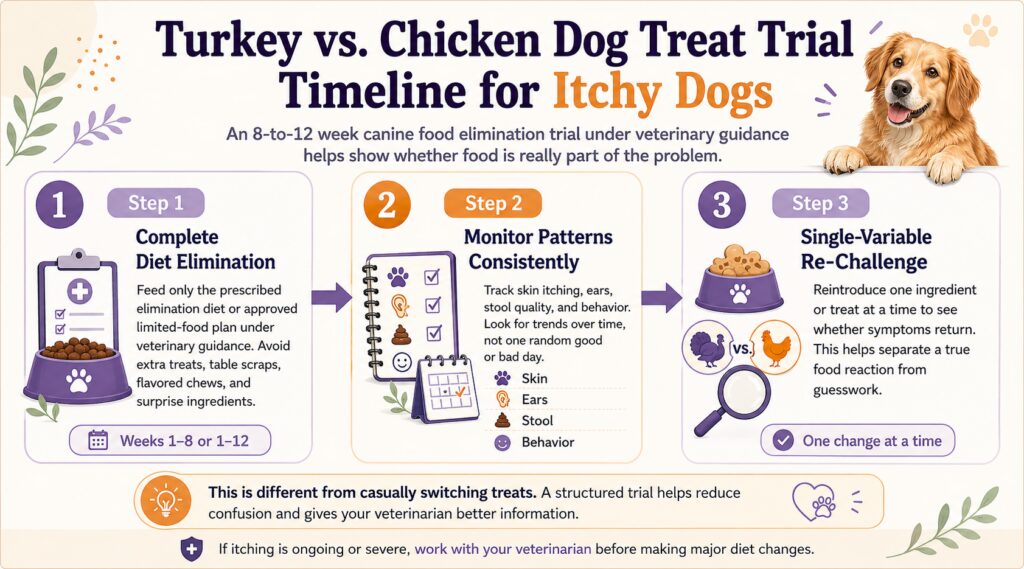
If a dog has chronic itching, recurrent ear flare-ups, skin inflammation, or a mixed pattern of digestive and skin signs, the most reliable way to evaluate for a food allergy is through a structured elimination-challenge diet trial.[3][6]
That is not the same thing as swapping one bag of treats for another and assuming the answer is now clear.
A turkey treat trial may still be useful in a practical, real-world sense. It may help an owner see whether a simpler non-chicken option is better tolerated by the dog. But by itself, it does not prove a diagnosis.
Clinical Note: Poultry Proteins Can Still Overlap
Turkey and chicken are different proteins, but they are both poultry. Some dogs that do poorly with one poultry protein may also do poorly with another, while other dogs may tolerate turkey even if chicken seems questionable.
This clinical overlap can happen because the immune system recognizes protein structures, including smaller binding regions called epitopes. Because chicken and turkey are closely related poultry proteins, some of their muscle proteins may share similar amino acid patterns. In a dog whose immune system is already sensitized to chicken proteins, turkey may occasionally be mistaken for a similar target.
That does not mean every chicken-sensitive dog will react to turkey. It means turkey should be tested carefully rather than assumed to be automatically safe. If symptoms are chronic, severe, or confusing, a veterinarian can help determine whether a formal elimination diet is more appropriate than continued treat experimentation.[3][6]
Why Formula Simplicity Still Matters More Than Hype
If a dog may be reacting to chicken, the smartest next treat is usually not the most exciting one. It is usually the one with fewer moving parts.
That means less ingredient clutter, moderate calories, and a more straightforward label story. Even the best protein switch can be obscured if the new treat is rich, highly processed, mixed with multiple proteins, or fed too generously.
This is one reason a natural-and-organic turkey treat can be a smarter comparison point than a generic heavily mixed alternative. Not because organic treats cure itching, but because a cleaner-label trial may reduce noise and make the dog’s response easier to interpret.
How Superfood Science Treat Options Fit This Topic
Brand positioning matters here, but it has to stay compliant and dog-centered.
If a dog is actively itchy, uncomfortable, or under evaluation for allergies, the answer is not to keep trying different treats endlessly just because they are natural or organic. Ongoing symptoms still require individual awareness of tolerance and veterinary guidance.
But once a careful treat trial is appropriate, Superfood Science offers three practical directions.
Organic Turkey Dog Treats
For itchy dogs where chicken is under suspicion, Superfood Science Organic Turkey Dog Treats are the strongest natural option. The compliant claim is not that turkey treats cause itching. It is that a turkey-based, natural-and-organic treat may be the more logical next step when owners want to move away from chicken while keeping the ingredient story cleaner and simpler.
Organic Chicken Dog Treats
Chicken should not be treated like the enemy in every dog.
For dogs that tolerate chicken well and do not show a repeat itch pattern around it, Superfood Science Organic Chicken Dog Treats can still fit a cleaner-label routine. The stronger brand message is not “always abandon chicken.” It is “keep chicken where it clearly works, and change direction where it does not.”
Plant-Based Protein Dog Treats
For some owners, a different ingredient direction may feel easier during a reset phase. In those cases, Superfood Science Plant-Based Protein Dog Treats may offer another natural, cleaner-label path to consider once the dog is stable and normal treat use is appropriate.
The strongest brand position is this: Superfood Science gives dog parents more than one thoughtful treat direction — turkey when chicken seems questionable, chicken when it is clearly tolerated, and plant-based protein treats when a different ingredient strategy feels more appropriate.
Suggested Usage Guide
If your dog is clearly doing fine on chicken, there is no evidence-based reason to switch just because turkey sounds better online.
If chicken seems linked to repeat itching or ear flare-ups, simplify the routine. Use one turkey-based treat in small amounts and avoid adding multiple new products at the same time.
Watch for patterns, not one-off moments. Are the ears less irritated? Is the itching less frequent? Is stool quality consistent, and are there no concerning changes in behavior?
If the dog continues to have chronic symptoms or the pattern is unclear, move from casual experimenting to a veterinary conversation about a proper food-allergy workup.
Safety and When to Call a Vet
Call your veterinarian sooner rather than later if your dog has chronic itching, recurrent ear infections, red or inflamed skin, vomiting, diarrhea, poor appetite, or symptoms that repeatedly flare around diet changes.[1][2][3]
Seek more immediate care if the dog has facial swelling, difficulty breathing, collapse, severe vomiting, black or bloody stool, or marked lethargy.
If your dog is already on a prescription elimination diet or has known pancreatitis, inflammatory bowel disease, or chronic skin disease, do not make major treat changes casually without veterinary guidance.
Limitations and Research Gaps
There is good veterinary guidance around food allergy, elimination trials, and common causes of itch in dogs.[1][2][3][4]
There is much less direct head-to-head evidence proving that turkey treats are inherently better than chicken treats for itching across all dogs.
There is also a real-world limitation in owner interpretation. Many people use the word “allergy” whenever a dog scratches more, even though itching can come from fleas, the environment, infection, skin-barrier issues, grooming products, or several causes at once.
That is why any treat decision should be framed as a cautious trial, not a certainty.
FAQs
Are turkey dog treats better than chicken for itchy dogs?
Sometimes, especially when chicken seems linked to repeated flare-ups. But turkey is not automatically better for every itchy dog.[1][2]
Is chicken a common food allergen for dogs?
Yes. Chicken is one of the more commonly reported food allergens in dogs.[1][2]
If my dog itches after chicken treats, should I switch to turkey?
Turkey may be a reasonable next trial if chicken seems suspicious, but that switch alone does not prove a true food allergy. If itching is ongoing, recurring, or severe, talk with your veterinarian.
Can a food allergy cause both itching and stomach upset in dogs?
Yes. Some dogs with food-related reactions show both skin and digestive signs.[2][3]
Are natural or organic dog treats less likely to cause itching?
Not necessarily. Better ingredient positioning does not override individual tolerance. The dog’s response still matters most.
What should I do if my dog reacts to both chicken and turkey?
Stop guessing and speak with your veterinarian. Because chicken and turkey are both poultry, some dogs may need a more structured elimination diet or a different protein strategy. A plant-based treat may be considered only when it fits the dog’s overall diet plan and veterinary guidance.
Conclusion
Turkey dog treats may be a better option for some itchy dogs, especially when chicken has been suspected as a trigger for the onset of clinical signs.
But the best answer is not a steadfast rule.
It is better screening, fewer variables, cleaner trials, and a more intentional treat routine.
And when dog parents want to move in a more natural-and-organic direction, Superfood Science’s turkey, chicken, and plant-based protein treats give them more than one practical path forward — as long as the choice is matched to the dog rather than to marketing alone.
Explore More Dog Health Tips
- Turkey vs. Chicken Dog Treats for Sensitive Stomachs
- Organic Dog Treats Made in the USA for Health
- Organic Dog Treats with Natural Ingredients Benefits
- Top-Rated Organic Dog Treats: A Guide to Safety
- Organic Dog Treat Subscription Made Simple and Easy
References
- MSD Veterinary Manual. (2026). Cutaneous food allergy in animals. MSD Veterinary Manual. https://www.msdvetmanual.com/integumentary-system/food-allergy/cutaneous-food-allergy-in-animals (Accessed May 26, 2026).
- MSD Veterinary Manual. (2026). Allergies in dogs. MSD Veterinary Manual. https://www.msdvetmanual.com/dog-owners/skin-disorders-of-dogs/allergies-in-dogs (Accessed May 26, 2026).
- VCA Animal Hospitals. (2026). Food allergies in dogs. VCA. https://vcahospitals.com/know-your-pet/food-allergies-in-dogs (Accessed May 26, 2026).
- Merck Veterinary Manual. (2026). Skin disorders of dogs overview. Merck Veterinary Manual. https://www.merckvetmanual.com/dog-owners/skin-disorders-of-dogs/overview-of-skin-disorders-of-dogs (Accessed May 26, 2026).
- World Small Animal Veterinary Association. (2026). Global nutrition guidelines. WSAVA. https://wsava.org/global-guidelines/global-nutrition-guidelines/ (Accessed May 26, 2026).
- VCA Animal Hospitals. (2026). Implementing an elimination-challenge diet trial: Dog. VCA. https://vcahospitals.com/know-your-pet/implementing-an-elimination-challenge-diet-trial-dog (Accessed May 26, 2026).
