
Best Low-Calorie Dog Treats for Weight-Conscious Dogs: A Vet-Reviewed Guide

Quick Answer
The best low-calorie dog treats for weight-conscious dogs are usually small, clearly labeled, easy to portion, and simple enough to fit into the dog’s total daily calorie budget. For most dogs, treats should stay under about 10% of daily calories, and weight control works best when treats, meals, and activity are managed together.[1][2]
Trust Signal
By Superfood Science Writing Team | Reviewed by Dr. Kelly Hood, DVM | Last Updated: 06/10/2026
Superfood Science has produced organic and natural functional foods for humans and pets for over 20 years, specializing in clean-label formulations and evidence-based nutrition.
Key Takeaways
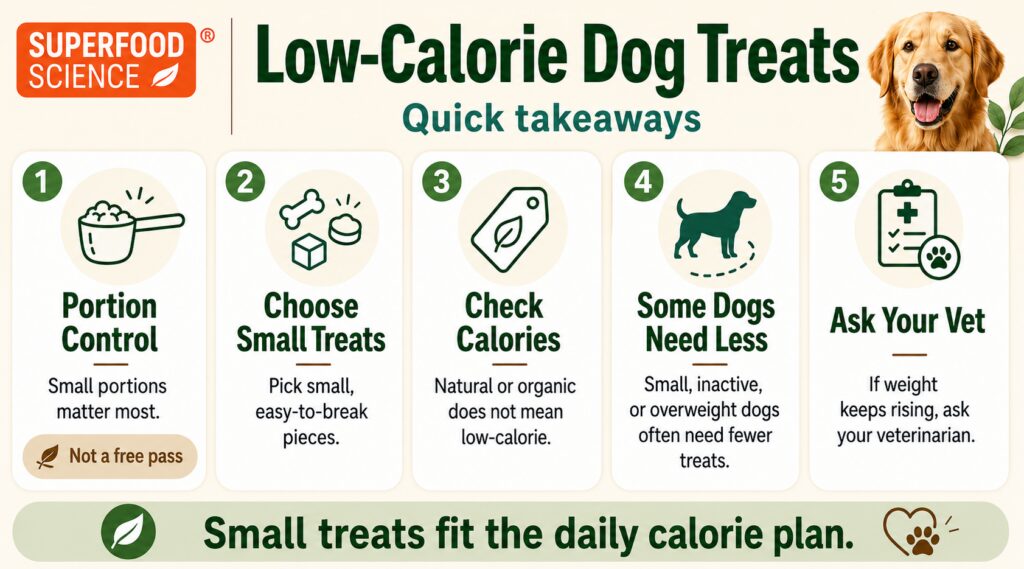
- Low-calorie dog treats help most when they are paired with portion control, not used as a free pass to over-treat.[1][2]
- The best choice is usually a small, easy-to-break treat with clear calorie information and a simple ingredient story.
- “Natural,” “organic,” and “made in the USA” can be useful buying filters, but they do not automatically make a treat weight-friendly.
- Dogs that are overweight, less active, or getting lots of training rewards often need much smaller treat portions than owners expect.[1][2]
- If your dog is gaining weight despite careful feeding, ask your veterinarian to review body condition, calories, treats, and possible medical factors.[2][5]
Why Low-Calorie Dog Treats Matter More Than Many Owners Realize
Weight gain in dogs rarely comes from meals alone.
Treats, table scraps, rawhide chews, dental sticks, and “just one more” rewards often add enough calories to shift body condition over time.[1][2]
That matters even more in small dogs, senior dogs, and dogs with lower activity levels. In those dogs, a few extra treats can represent a surprisingly large share of the daily calorie budget.[1][2]
This is why the best low-calorie dog treats for weight-conscious dogs are not defined by a slimming promise on the front of the bag. They are treats that align with the dog’s real feeding pattern, body condition, and metabolic state.
The Metabolic Math: Why 50 Extra Calories Can Matter
A dog’s calorie needs are tied to body size, life stage, activity level, neuter status, body condition, and medical history. Veterinary teams often begin calorie discussions with Resting Energy Requirement, or RER, which estimates the energy a dog needs at rest before adjustments are made for the individual dog.[2][6]
The common RER formula is 70 x body weight in kilograms to the 0.75 power. Using that estimate, a 10-lb dog has an RER of roughly 218 calories per day, while a 70-lb dog has an RER of roughly 870 calories per day. That does not mean every dog should eat exactly that amount; it shows why size changes the meaning of “just one treat.”[6]
For a 10-lb dog, 50 extra calories can equal about 23% of the estimated RER. For a 70-lb dog, the same 50 calories is closer to 6% of estimated RER. If treats are supposed to stay under about 10% of daily calories, a toy breed may have only a small treat budget, while a large dog has more room.[1][2][6]
The practical takeaway is simple: the smaller the dog, the more important it becomes to use tiny, countable, clearly labeled rewards.
What Stronger Evidence Supports
The strongest practical support in this topic is for calorie awareness, body-condition monitoring, and keeping treats as a small part of the day’s total intake.[1][2]
WSAVA advises that treats should generally make up less than 10% of a dog’s daily calorie intake, while the complete and balanced main diet should do the nutritional heavy lifting.[1] AAHA’s nutrition and weight-management guidance supports this same practical framework by emphasizing nutrition assessment, calorie planning, and body-condition monitoring.[2]
That means low-calorie dog treats are only helpful when they are actually counted into the full plan.
What Makes a Dog Treat “Low-Calorie” in Practice?
There is no single universal guideline that defines every low-calorie treat. What matters more is how the treat behaves in the real world, as it relates to your dog.
Small Size and Easy Portioning
A treat that can be broken into tiny pieces often works better than a larger biscuit, even if the ingredient list looks similar. A dog is still receiving a special reward from you, whether the treat is big or small, so smaller pieces can preserve the reward moment while reducing calorie load.
Clear Calorie Information
One of the most useful signs of a responsible treat is calorie transparency. Owners cannot manage what they cannot see, and WSAVA encourages dog parents to consider treats within the total daily intake.[1][3]
Appropriate Use Case
Training treats need a different standard than occasional reward treats. A training treat should usually be tiny, repeatable, and low enough in calories that ten or twenty rewards do not quickly become a second meal.[1][2]
The Satiety Factor: Why Fiber-Inclusive Formulas May Help
Satiety means the feeling of fullness after eating. In weight-conscious feeding plans, this matters because owners often worry that their dog will act hungry when treats are reduced.
Fiber-inclusive foods can add bulk and water-holding capacity with fewer digestible calories than fat-rich snacks. Soluble fibers can hold water and become more viscous in the GI tract, while some insoluble fibers add physical bulk. That extra volume can contribute to fullness signals, which is one reason fiber is often discussed in veterinary weight-management nutrition.[2][6]
Practically, this is why fiber-inclusive formulas may be useful for some weight-conscious dogs: they may help the dog feel less deprived while the owner keeps rewards smaller and countable. This is support for routine management, not proof that any treat blocks hunger or causes weight loss.[2]
For dog treats, this does not mean “high fiber” automatically makes a treat weight-friendly. It means ingredients such as flaxseed can be part of a more thoughtful formula story when the treat is still portioned carefully and counted into the day’s calories. Beta-glucan-rich Agaricus mushrooms can also be described as part of a functional ingredient profile, but they should not be framed as proof of weight loss or medical satiety effects in a treat.
Decision Table: What Usually Works Better for Weight-Conscious Dogs
| Treat feature | More helpful choice | Less helpful choice | Why it matters |
| Portion size | Tiny or easy-to-break pieces | Large biscuits or oversized chews | Smaller pieces help control calorie intake. |
| Calorie label | Clearly stated calorie breakdown | Hard-to-find or vague information | Weight control depends on counting accurately. |
| Daily use | Predictable training or reward portions | Random handfuls throughout the day | Repetition drives calorie overload. |
| Ingredient profile | Simple, easy-to-understand formula | Rich, indulgent, or highly variable products | Simpler products are easier to manage and evaluate. |
| Satiety support | Fiber-inclusive formula used in small portions | Fat-rich treat used freely | Fiber can support fullness, but calories still count. |
| Owner mindset | Treats counted into daily caloric intake | Treats treated as “free” extras | Weight gain often comes from uncounted extras. |
Why “Healthy-Sounding” Does Not Always Mean Lower-Calorie
This is where dog parents often get misled.
A treat can sound wholesome and still be too calorie-dense for frequent use. “Natural,” “organic,” “premium,” “gently baked,” and “made in the USA” may all sound appealing from a shopping standpoint, but none of those phrases automatically means the treat is low-calorie or weight-friendly.
That is why the back of the bag often matters more than the splashy front.
What to Look for on the Label
Calories First
Start with calories per treat or calories per kilogram. This tells you whether the product is actually practical for a weight-conscious routine.[1][3]
A Straightforward Ingredient Story
A shorter ingredient list is not automatically better, but a clear ingredient story can make it easier to understand what you are feeding and how often it makes sense to give it.
Company Transparency
WSAVA’s guidance on selecting pet foods emphasizes the value of company transparency and useful nutrition information rather than relying on marketing language alone.[3]
What About Puppies, Training, and Small Dogs?
These are the situations where low-calorie dog treats matter the most.
Training Puppies
Puppies may receive many rewards in a short session. The best puppy training treat is usually tiny, easy to chew, and modest enough in calories that it does not crowd out the growth diet.[1][2]
Small Dogs
Small dogs often have much less room for extra calories. A treat that seems minor for a large dog may represent a meaningful energy load in a toy breed.
Frequent Trainers
If your dog is rewarded often for recall, leash skills, or indoor manners, treat calorie math matters more than owners often realize.
A Practical Calorie Reminder for Dog Parents
The 10% rule is useful because it turns a vague idea into a practical boundary.[1][2]
If treats should stay below about 10% of daily calories, then the right low-calorie treat is the one that lets you stay comfortably inside that budget without feeling like you are starving the dog of rewards.
That often means:
- smaller pieces
- fewer “bonus” treats outside training
- more honest counting
- less reliance on large snack-style biscuits
How Superfood Science Treat Options Fit This Topic
This section is educational brand positioning, not proof that any Superfood Science product causes weight loss or treats obesity.
Weight-conscious dogs still need a complete nutrition plan, appropriate portions, regular exercise, and veterinary guidance when body condition drifts in the wrong direction.
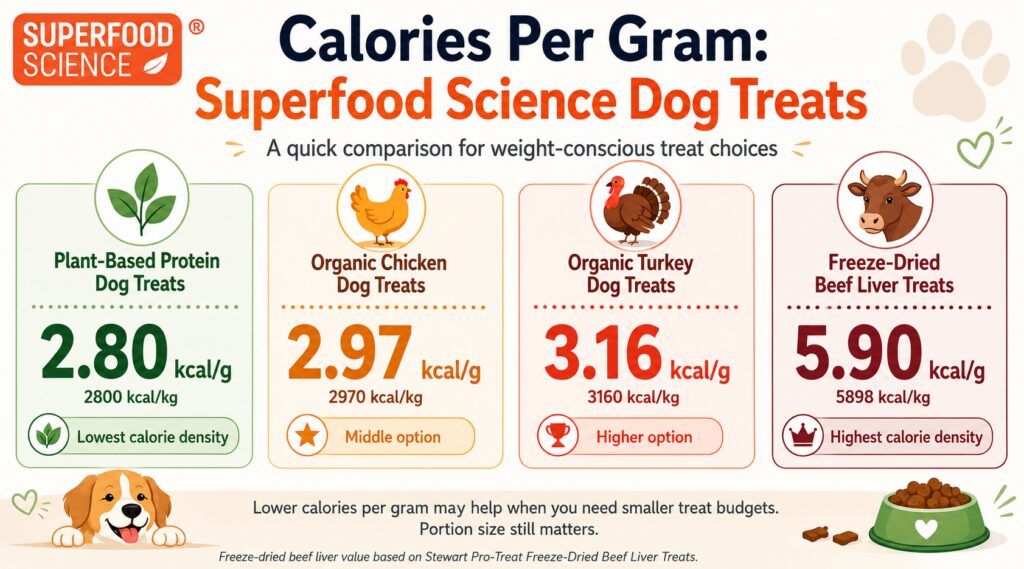
Organic Turkey Dog Treats
For dogs that need a more intentional, cleaner-label reward routine, Superfood Science Organic Turkey Dog Treats may fit well when owners want a protein-forward option that still feels more deliberate than a generic treat aisle choice.
Turkey can be positioned as a practical fit for owners who want a leaner-feeling daily reward story, especially when the goal is smaller, more thoughtful treat use rather than constant snacking.
This line also includes beta-glucan-rich Agaricus mushrooms as part of a broader functional ingredient profile. In a treat, though, that role should be understood as supportive and formulation-based, not as a medical treatment, satiety proof, or weight-loss claim.
Organic Chicken Dog Treats
For dogs that tolerate chicken well, Superfood Science Organic Chicken Dog Treats can still fit a cleaner-label routine, especially for training contexts where palatability matters.
This line also includes turmeric and flaxseed as part of a more intentional ingredient story. That helps support a natural-and-organic formulation philosophy without turning the treat into an overclaimed wellness product.
Plant-Based Protein Dog Treats
For some owners, Superfood Science Plant-Based Protein Dog Treats may feel especially attractive in a weight-conscious routine because they offer a different ingredient direction.
That does not mean plant-based automatically equals lower-calorie or a better fit for every dog. It means they may fit a more intentional treat strategy for ingredient-conscious families, especially when portion control still remains central.
The strongest compliant brand position is this: Superfood Science gives dog parents more than one cleaner-label option to build a smarter treat routine, but calories, portions, and the total diet still matter more than any one product story.
Limitations and Evidence Gaps
There is strong veterinary guidance on calorie control, body condition scoring, and the importance of moderation in treats.[1][2][5]
There is much less direct head-to-head clinical evidence proving that one commercial treat category is always best for weight-conscious dogs.
That is partly because dogs vary so much in size, life stage, activity, training use, medical history, and owner behavior. A treat that fits one dog beautifully may be a poor fit for another.
So the most defensible advice remains practical: choose smaller, countable, clearly labeled low-calorie dog treats and use them with more intention.
Suggested Usage Guide
The following guidance is supportive care, not a substitute for veterinary diagnosis or treatment.
Start by looking at your dog’s real treat pattern, not just the bag.
Count how many treats the dog gets in a normal day, including training rewards, family handouts, and extras outside formal sessions. Then compare that with the dog’s body condition and weight trend.
Choose low-calorie dog treats that are easy to portion and easy to count. Break larger treats into smaller pieces if appropriate. Keep the rest of the feeding plan steady so you can tell whether the routine is actually working.
If your dog is already overweight or weight gain is persistent, ask your veterinarian to review daily caloric intake, body condition score, and whether the dog’s treat routine is undermining progress.[2][5]
Safety and When to Call a Vet
Call your veterinarian if your dog is gaining weight despite careful feeding, seems less mobile, tires easily, has trouble rising, or has appetite changes that do not fit the feeding plan.[2][5]
Seek veterinary guidance before putting puppies, seniors, or dogs with chronic medical conditions on a restrictive feeding plan.
If your dog has pancreatitis risk, chronic GI disease, chronic itch, diabetes, or a prescription diet, do not assume any “healthy treat” label makes casual feeding automatically safe. Individual tolerance and medical context still matter.
FAQs
What are the best low-calorie dog treats?
Usually, the best choice is a small, clearly labeled treat that is easy to portion and easy to count within the dog’s daily calorie budget.[1][2]
Are natural dog treats automatically lower in calories?
No. Natural or organic positioning may matter to owners, but those labels do not automatically make a treat weight-friendly.
What dog treats are best for training when my dog needs weight control?
Tiny, low-calorie, easy-to-break training treats usually work best because they allow repeated rewards without adding too many calories.[1][2]
Can overweight dogs still have treats?
Yes, but the treats need to be counted carefully and kept to a small share of the daily calorie budget.[1][2][5]
Are plant-based dog treats better for weight-conscious dogs?
Not automatically. They may fit some dogs well, but the better question is whether the calories, portion size, and overall routine actually support weight control.
How many calories from treats can my dog have each day?
A common veterinary rule is to keep treats under about 10% of the dog’s daily calories, while the complete and balanced main diet provides most nutrition.[1][2]
Conclusion
The best low-calorie dog treats for weight-conscious dogs are rarely the ones with the loudest health claims.
The better choice is usually the one that is small, easy to count, clearly labeled, and simple enough to fit the dog’s actual feeding routine.
That is why weight-conscious treat decisions work best when they are built on portion control, body-condition awareness, and a little more honesty about how many rewards the dog is actually getting each day.
Explore More Dog Health Tips
- Signs Your Dog May Be Overweight
- Top-Rated Organic Dog Treats: A Guide to Safety
- Best Organic Dog Treats Made in the USA: A Vet-Safe Guide for Dog Parents
- Turkey vs. Chicken Dog Treats for Sensitive Stomachs
- Signs Your Dog May Be Sick: Common Symptoms
References
1. World Small Animal Veterinary Association. Feeding treats to your dog. WSAVA. https://wsava.org/wp-content/uploads/2025/11/WSAVA_GuidetoTreats_Dogs_251107.pdf
2. American Animal Hospital Association. 2021 AAHA nutrition and weight management guidelines for dogs and cats. AAHA. https://www.aaha.org/resources/2021-aaha-nutrition-and-weight-management-guidelines/home/
3. World Small Animal Veterinary Association. Guidelines on selecting pet foods. WSAVA. https://wsava.org/wp-content/uploads/2021/04/Selecting-a-pet-food-for-your-pet-updated-2021_WSAVA-Global-Nutrition-Toolkit.pdf
4. U.S. Food and Drug Administration. Animal food labeling and pet food claims. FDA. https://www.fda.gov/animal-veterinary/animal-foods-feeds/animal-food-labeling-and-pet-food-claims
5. VCA Animal Hospitals. Body condition scores. VCA. https://vcahospitals.com/know-your-pet/body-condition-scores
6. Merck Veterinary Manual. Nutritional requirements of small animals. Merck Veterinary Manual. https://www.merckvetmanual.com/management-and-nutrition/nutrition-small-animals/nutritional-requirements-of-small-animals
