
Dog Allergy Treat: What Makes a Treat Safer to Try?

Quick Answer
A better dog allergy treat is usually simple, clearly labeled, easy to portion, and chosen to reduce variables rather than add them. No over-the-counter treat can confirm a food allergy by itself. If itching, ear flare-ups, vomiting, or diarrhea are recurring, veterinary guidance is more useful than continued guesswork.[1][2][3]
Trust Signal
By Superfood Science Writing Team | Reviewed by Dr. Kelly Hood, DVM | Last Updated: 07/23/2026
Superfood Science has produced organic and natural functional foods for humans and pets for over 20 years, specializing in clean-label formulations and evidence-based nutrition.
Key Takeaways
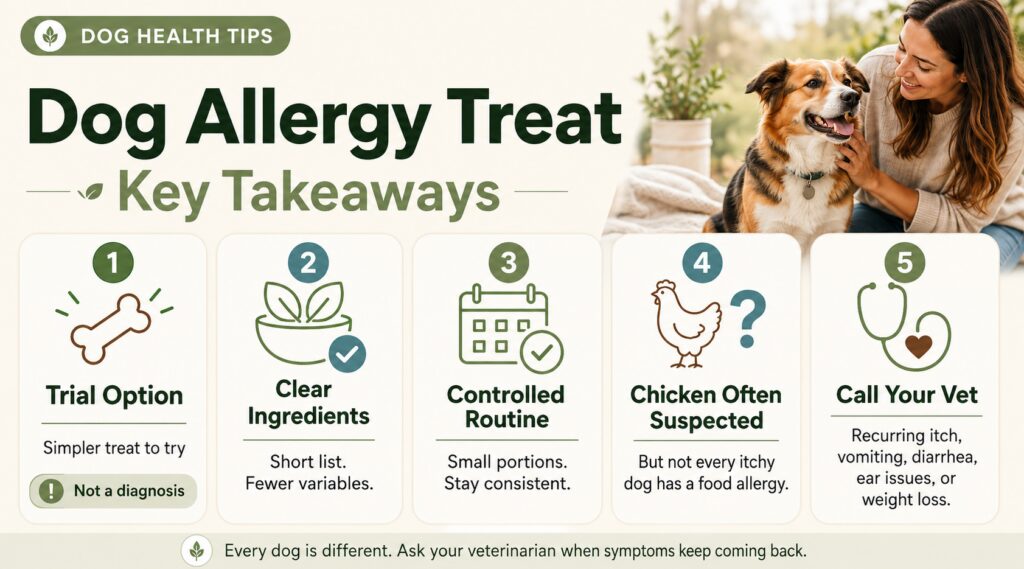
- A “dog allergy treat” is best thought of as a simpler trial option, not a diagnosis.[1][2]
- The most useful treats in this category usually have a clearer ingredient profile and a more controlled feeding routine.[2][4]
- Chicken is one of the more commonly reported food allergens in dogs, but not every itchy dog has a food allergy.[1][2]
- Food allergy, food sensitivity, and treat intolerance can look similar at home, which is exactly why they are so easy to confuse without veterinary testing.[1][2][3]
- Recurrent itching, vomiting, diarrhea, ear problems, or weight loss should prompt owners to seek veterinary evaluation sooner rather than later.[1][2][3]
Why dog parents look for a “dog allergy treat”
Most owners are not searching for a scientific term. They are searching for something safer to try.
Usually that search starts after a suspicious, repeatable pattern develops. A dog gets itchy after certain treats. Or recurrent soft stool keeps returning. Or ear flare-ups seem to appear around food changes. At that point, owners want a treat that feels less risky, is easier to understand, and is less likely to cause problems.
That is where the phrase “dog allergy treat” comes from.
The challenge is that opportunistic marketing language is not the same thing as a diagnosis.
What a dog allergy treat can and cannot do
A simpler treat may help reduce confusion.
It may give owners a cleaner way to test whether the dog seems to do better without a certain ingredient. It may also fit better into a more careful feeding routine.
But it cannot prove that the dog has a true food allergy.
VCA explains that the most reliable way to diagnose a food allergy is a structured elimination-challenge diet trial, not casual switching between retail products.[2][3]
That distinction matters because some dogs do better with a new treat for reasons that have nothing to do with a true immune response. The issue may be richness, portion size, ingredient complexity, or a non-food cause of itch or GI upset.
Why the ingredient story matters so much
When a dog is showing possible food-related symptoms, the safest next treat is often not the fanciest one.
It is usually the one with fewer moving parts.
That means:
A shorter ingredient list
A simpler list makes it easier to track what changed if symptoms improve or worsen.
One clear protein direction
A single main protein is often easier to evaluate than a highly mixed formula with multiple meat sources and fillers.
Moderate calories and richness
Even a treat with “good ingredients” can still cause trouble if it is too rich or fed too often.
Food allergy and food sensitivity are not always the same thing
Dog parents often use these terms interchangeably, as if they mean the same thing.
They do not always.
A true food allergy involves an immune-mediated response to something in the diet.[1][2] Food sensitivity or intolerance is often used more broadly to describe loose stool, vomiting, gas, or general digestive upset after certain foods or treats.[2][3]
That matters because a single concerned owner may actually be trying to solve two very different problems at once.
Why chicken often becomes the first suspect
Chicken is extremely common in dog foods and treats.
Thus, it is also one of the more commonly reported food allergens in dogs.[1]
That does not mean chicken is bad for every dog. Many dogs tolerate it well. It simply means chicken is often the first ingredient owners question when the timing, or the reaction after certain treats, seems suspicious.
This is one reason many owners searching for a “dog allergy treat” are searching for a chicken-free or simpler option.
Decision table: what usually makes a dog allergy treat more useful
| Treat feature | More helpful choice | Less helpful choice | Why it matters |
| Ingredient profile | Shorter, clearer formula | Long, highly mixed recipe | Easier to track tolerance[2][4] |
| Protein direction | One main protein source | Multi-protein confusion | Reduces variables |
| Daily use | Controlled portions | Random extras throughout the day | Repetition can blur the pattern |
| Diet context | Fits the full feeding plan | Added on top of many other changes | Too many changes reduce clarity |
| Diagnostic value | Used as part of a thoughtful routine | Treated as proof of allergy | Retail treats do not diagnose[2][3] |
The goal is not to find a cure-all treat.
The goal is to make the dog’s response easier to interpret.
What stronger evidence supports
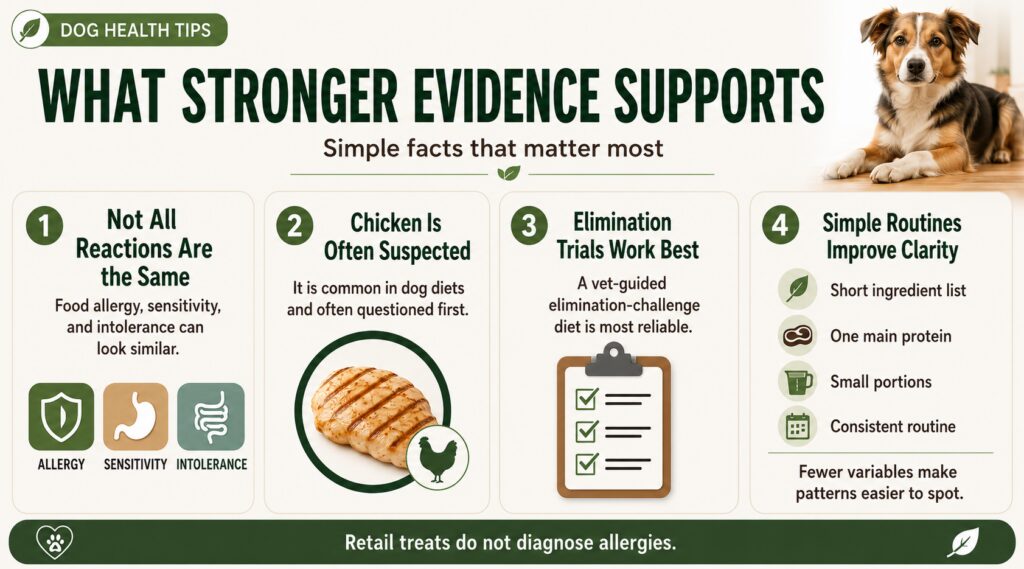
The strongest support in this topic is for:
- recognizing that food allergy and food sensitivity are not always the same thing[1][2][3]
- understanding that chicken is a common suspect because it is both common in the diet and commonly reported in allergy discussions[1]
- using structured elimination-challenge methods when true allergy is suspected[2][3]
- avoiding the assumption that a “better” treat automatically confirms the cause of clinical signs[2][3]
What the evidence does not strongly support is the idea that one retail treat category can reliably function as a diagnostic tool.
How Superfood Science Treat Options Fit This Topic
This section is educational brand positioning, not proof that any Superfood Science product diagnoses or treats food allergy.
If a dog is actively itchy, repeatedly vomiting, having chronic diarrhea, or undergoing a formal food-allergy workup, the answer is not to keep testing random treats just because they are natural or organic. Ongoing symptoms still require veterinary guidance and a more controlled plan.
Dog parents who want to browse current Superfood Science dog treat options can visit the product page here: Shop Superfood Science Dog Treats.
Organic Turkey Dog Treats
If chicken is the ingredient under suspicion, Superfood Science Organic Turkey Dog Treats are the strongest natural fit for this topic. The most compliant claim is not that turkey treats alleviate allergy concerns or symptoms. It is that a simpler turkey-based, natural-and-organic treat may be a more logical next step when owners want to move away from chicken while keeping the ingredient story cleaner.
This line also includes beta-glucan-rich Agaricus mushrooms as part of a broader functional ingredient profile. The beta-glucans in these mushrooms are studied for their role in supporting a healthy, normal immune response, which is why they earn a place on the label. That supports a more distinctive formulation story without turning the treat into a medical claim.
Organic Chicken Dog Treats
Not every dog needs to avoid chicken. For dogs that tolerate chicken well, Superfood Science Organic Chicken Dog Treats can still fit a clean-label routine.
This line includes turmeric, a source of the antioxidant compound curcumin, and flaxseed, which provides plant-based omega-3 fatty acids, as part of a more intentional formulation story. These two ingredients complement a lean poultry protein like chicken, supporting the brand’s natural-and-organic positioning without overstating what a treat can do.
Plant-Based Protein Dog Treats
For owners who want a different ingredient direction, Superfood Science Plant-Based Protein Dog Treats may offer another thoughtful option once the dog is stable and normal treat use is appropriate.
This line includes kelp, chia, and flaxseed as part of a broader plant-based functional ingredient profile, which may appeal to ingredient-conscious families who want a non-poultry option.
The strongest compliant brand position is this: Superfood Science gives dog parents more than one cleaner-label option to build a more intentional treat routine, but the dog’s response and the veterinary plan still matter more than any one product label.
Limitations and research gaps
There is good veterinary guidance around food-allergy evaluation, elimination trials, and the limitations of casual home guessing.[1][2][3]
There is much less direct head-to-head evidence proving that one retail “dog allergy treat” category is always better than another across all dogs.
That is partly because dogs with possible food-related symptoms are not all the same. Some mainly itch. Others mainly have GI signs. A few show both. And in certain dogs, the real trigger is richness or treat overload rather than a true allergic response.
That is why the safest advice is still dog-specific.
Practitioner-Recommended Usage Guide
If you are trying a more careful treat routine, simplify before you intensify.
Choose one treat direction, keep portions small, and avoid changing the food, treats, toppers, and supplements all at once. Watch for itchiness, ear comfort, stool quality, vomiting, appetite, and general behavior over several days.
If the pattern improves, that may be useful information, but it still does not prove a diagnosis. If symptoms keep returning, move from casual shopping decisions to a veterinary plan.
Safety and when to call a vet
Call your veterinarian sooner rather than later if your dog has chronic itchiness, repeated ear flare-ups, ongoing vomiting, persistent diarrhea, weight loss, poor appetite, or symptoms that keep recurring around diet changes.[1][2][3]
Seek more urgent care if your dog has facial swelling, trouble breathing, collapse, severe vomiting, black or bloody stool, or marked lethargy.
If your dog is already on a prescription diet or in the middle of an elimination trial, do not add treats casually without veterinary guidance.

FAQs
What is a dog allergy treat?
Usually it means a simpler retail treat owners use when they want to reduce possible trigger ingredients and make the feeding routine easier to interpret.
Can a dog allergy treat diagnose a food allergy?
No. A better-tolerated treat may be useful, but it does not confirm a food allergy by itself.[2][3]
What protein is often questioned first in itchy dogs?
Chicken is often questioned first because it is common in dog foods and also one of the more commonly reported food allergens in dogs.[1]
Are limited ingredient dog treats better for dogs with allergies?
Sometimes they are easier to trial because they reduce variables, but the best choice still depends on the dog’s actual response.[2][4]
When should I stop guessing and call the vet?
If your dog has recurring itchiness, vomiting, diarrhea, ear flare-ups, or ongoing symptoms despite treat changes, it is time for veterinary guidance rather than more trial and error.[1][2][3]
Conclusion
A dog allergy treat can be a useful idea if it helps owners simplify the routine and make better observations.
But the best result usually comes from clearer labels, smaller portions, fewer variables, and a lower threshold for calling the veterinarian when the dog’s symptoms stop looking occasional and start looking persistent.
Explore More Dog Health Tips
- Turkey vs. Chicken: Which Protein Is Better for Your Dog’s Treats?
- Best Organic Dog Treats Made in the USA: A Vet-Safe Guide for Dog Parents
- Organic Dog Treats with Natural Ingredients: What Actually Matters
- Top-Rated Organic Dog Treats: A Guide to Safety
- Organic Dog Treat Subscription Options: Why Superfood Science Makes Sense
References
- MSD Veterinary Manual. Cutaneous food allergy in animals. MSD Veterinary Manual. https://www.msdvetmanual.com/integumentary-system/food-allergy/cutaneous-food-allergy-in-animals
- VCA Animal Hospitals. Food allergies in dogs. VCA. https://vcahospitals.com/know-your-pet/food-allergies-in-dogs
- VCA Animal Hospitals. Implementing an elimination-challenge diet trial: dog. VCA. https://vcahospitals.com/know-your-pet/implementing-an-elimination-challenge-diet-trial-dog
- World Small Animal Veterinary Association. Guidelines on selecting pet foods. WSAVA. https://wsava.org/wp-content/uploads/2021/04/Selecting-a-pet-food-for-your-pet-updated-2021_WSAVA-Global-Nutrition-Toolkit.pdf
