
Best Puppy Training Treats: The 10% Rule Most Owners Break
Quick Answer
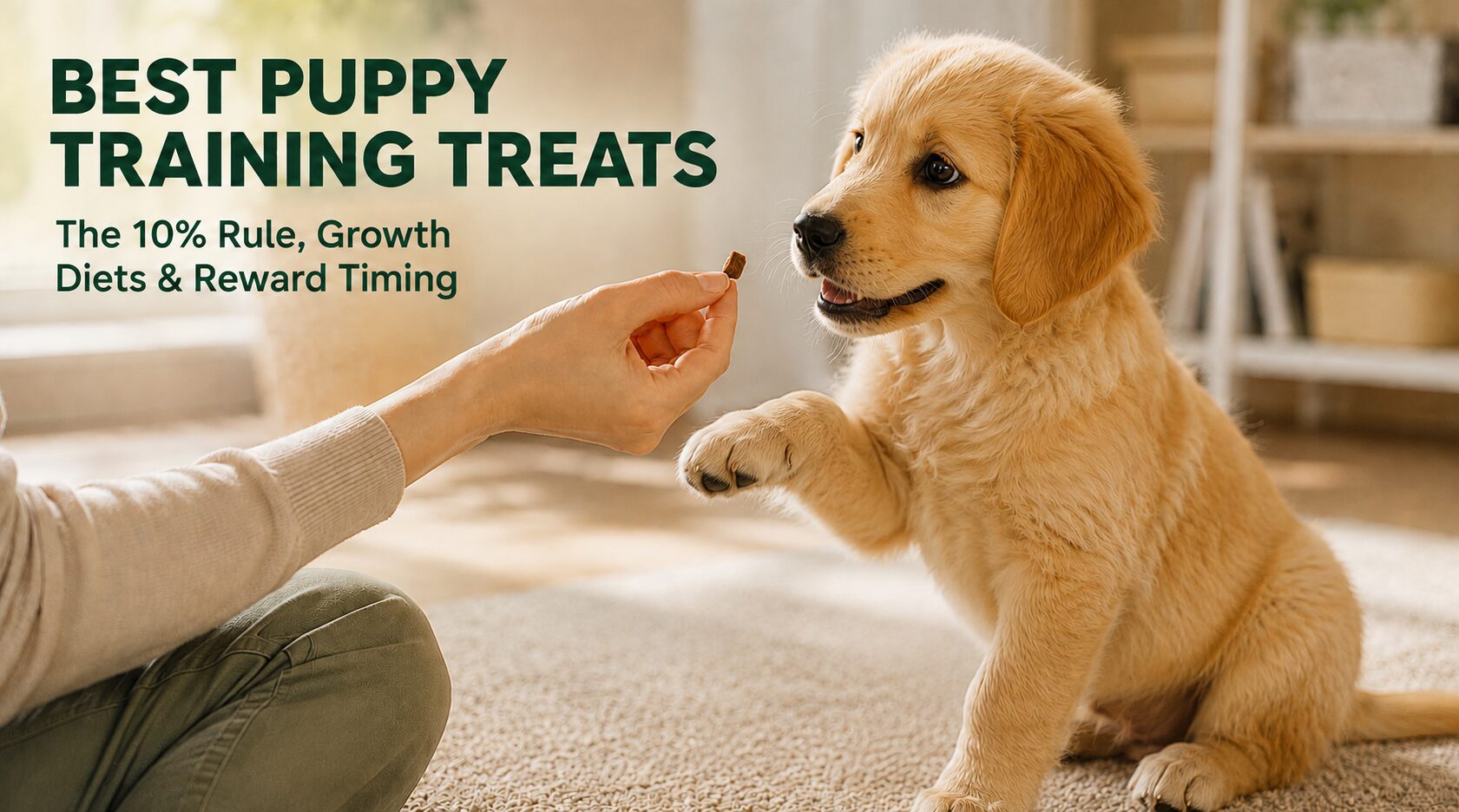
The best puppy training treats are tiny, semi-soft, easy to chew, and low enough in calories for repeated rewards. For puppies, the 10% treat rule is more than weight control: it protects the complete and balanced growth diet that should provide most daily nutrition.
Trust Signal
By Superfood Science Writing Team | Reviewed by Dr. Kelly Hood, DVM | Last Updated: 08/13/2026
Superfood Science has been producing organic and natural functional foods for humans and pets for over 20 years, specializing in clean-label formulations and evidence-based nutrition.
Key Takeaways
- Puppy training treats should be small enough to reward often without interrupting learning.
- The 10% treat ceiling is stricter for puppies because growth diets supply nutrients that snacks do not.
- Reward timing, treat value, and quick chewing matter because training depends on clear, immediate reinforcement.
- Functional ingredients such as beta-glucans, turmeric, flaxseed, chia, and kelp belong in supportive nutrition language, not treatment language.
- Repeated vomiting, diarrhea, poor growth, swelling, itching, choking, or appetite loss after treats should prompt a veterinarian call.
Why Puppy Training Treats Deserve More Thought Than Adult Dog Treats
Puppies are not just smaller adult dogs. They are growing bone, muscle, connective tissue, organs, immune capacity, and behavior patterns at the same time. That is why the best puppy training treat must do two jobs: keep learning fun and keep the main growth diet in control.
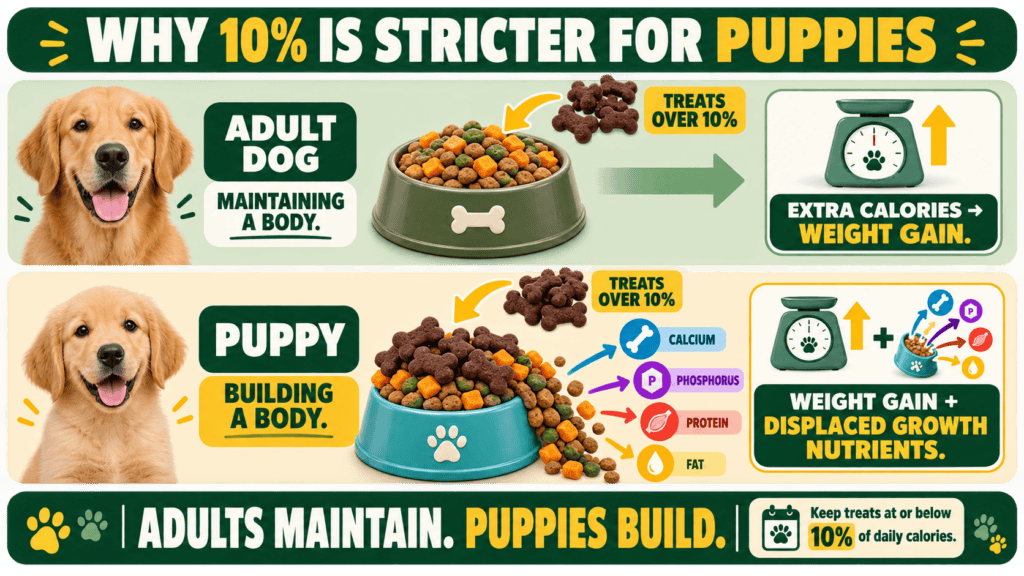
WSAVA and AAHA commonly use the same practical ceiling: treats and extras should generally stay at or below about 10% of daily calories. For adult dogs, that rule is often discussed as weight management. For puppies, it is also about nutrient balance. If treats crowd out puppy food, the puppy may get fewer growth-stage nutrients from the complete and balanced diet that should be doing the heavy nutritional work.^[1]^[4]
This is the central difference: an adult dog may be maintaining body condition, but a puppy is building a body. Training treats should be useful, countable, and motivating without turning reward-based learning into accidental overfeeding.^[2]^[3]^[7]
What Stronger Evidence Supports
The strongest evidence-based guidance in this topic is not that one commercial treat is universally “best.” The stronger guidance is that puppy treats should be limited, counted, introduced carefully, and used in a way that protects the puppy’s complete and balanced growth diet.^[1]^[2]^[3]^[4]
VCA’s puppy-feeding guidance explains that calories come from food plus treats and snacks, and it applies the 10% treat rule to puppies while reminding owners that calorie needs change as the puppy grows.^[2] Merck Veterinary Manual emphasizes complete and balanced growth diets and appropriate life-stage labeling, including large- and giant-breed puppy considerations.^[3]
For training mechanics, AVSAB’s humane dog training position statement supports reward-based training and evidence-based, humane reinforcement approaches.^[5] That matters here because the treat is not just a snack. It is a communication tool used to mark and reinforce behavior.
The Puppy Growth-Diet Rule: Why 10% Is a Harder Ceiling
For puppies, the 10% rule should be treated as a firm safety boundary, not a casual estimate. A puppy food labeled complete and balanced for growth is designed to provide the right relationship between calories, protein, fat, calcium, phosphorus, and other nutrients for that life stage.^[3]^[7]
When training rewards become too large or too frequent, two problems can happen at once. First, the puppy may exceed a sensible calorie budget. Second, treats may displace the puppy food that supplies the full nutrient profile. That displacement risk is why “just a few extra treats” matters more in a growing puppy than many owners expect.^[2]^[4]
The practical answer is not to stop training with food. It is to make rewards tiny, count them honestly, and use part of the puppy’s measured kibble for easy repetitions when that works.
How-To Box: Calculate a Puppy Training-Treat Budget
| How-To: Puppy Treat Budget Calculator |
| 1. Find your puppy’s estimated daily calories from the food label or your veterinarian. |
| 2. Multiply that number by 0.10 to estimate the maximum calories from all treats and extras. |
| 3. Divide the treat-calorie budget by the calories per treat or per gram. |
| 4. Cut treats smaller when your puppy needs many repetitions in one session. |
| 5. Recheck the number as your puppy grows, changes weight, or changes food. |
| Example: If a puppy’s daily target is 500 calories, the treat budget is about 50 calories. If one soft treat is 5 calories, that is only about 10 full treats for the day. Cutting each treat into four smaller pieces can create about 40 training rewards without changing the calorie total. |
What Makes a Puppy Training Treat Actually Useful?
A useful puppy training treat is not only healthy-looking on the label. It must be easy for the puppy to notice, chew, swallow, and mentally connect to the behavior being reinforced. Reward-based training works best when the reward arrives clearly and quickly enough for the puppy to understand what earned it.^[5]^[6]
That is why training treats are different from casual snacks. A big biscuit may be fine as an occasional chew-style reward, but it often slows down a training session. A tiny, semi-soft morsel can keep the puppy engaged and ready for the next repetition.
Training-Day Action Items
- Pinch or cut a semi-soft treat into pea-sized or smaller pieces before the session starts.
- Use the lowest-value reward that still works in the current setting; save higher-value treats for harder distractions.
- Keep treats in your hand or pouch so the reward can arrive quickly after the desired behavior.
- Use part of the measured kibble ration for easy repetitions when your puppy is motivated enough.
- Stop and reassess if your puppy gulps, coughs, loses focus, or develops digestive upset after repeated rewards.
Tiny Size
Tiny pieces help protect the calorie budget and keep the training rhythm clean. A puppy should be able to take the reward, swallow comfortably, and return attention to the handler within seconds. Oversized rewards slow the session and make the 10% rule harder to manage.^[1]^[2]^[6]
Semi-Soft or Quick-Chew Texture
A semi-soft or quick-chew texture often works well for puppy training because it reduces long chewing breaks. This does not mean every crunchy treat is wrong; it means fast-paced training usually benefits from rewards that do not interrupt timing.
High Enough Value to Matter
The best reward depends on the environment. Kibble may work in a quiet kitchen. Around other dogs, new smells, visitors, or outdoor distractions, many puppies need a more valuable reward to stay engaged. The goal is to use the lowest-value reward that still works, then save higher-value treats for harder settings.^[5]^[6]
Clear Label and Calorie Information
A treat is easier to use safely when the label gives practical calorie information and a clear ingredient story. Owners cannot manage a training budget if they do not know how calorie-dense the reward is.^[1]^[4]^[7]
Individual Tolerance
The best treat on paper is still the wrong treat if a puppy repeatedly develops loose stool, vomiting, gas, itching, swelling, or appetite disruption after eating it. Puppy digestion is still adapting, so new treats should be introduced gradually and monitored carefully.^[2]^[8]
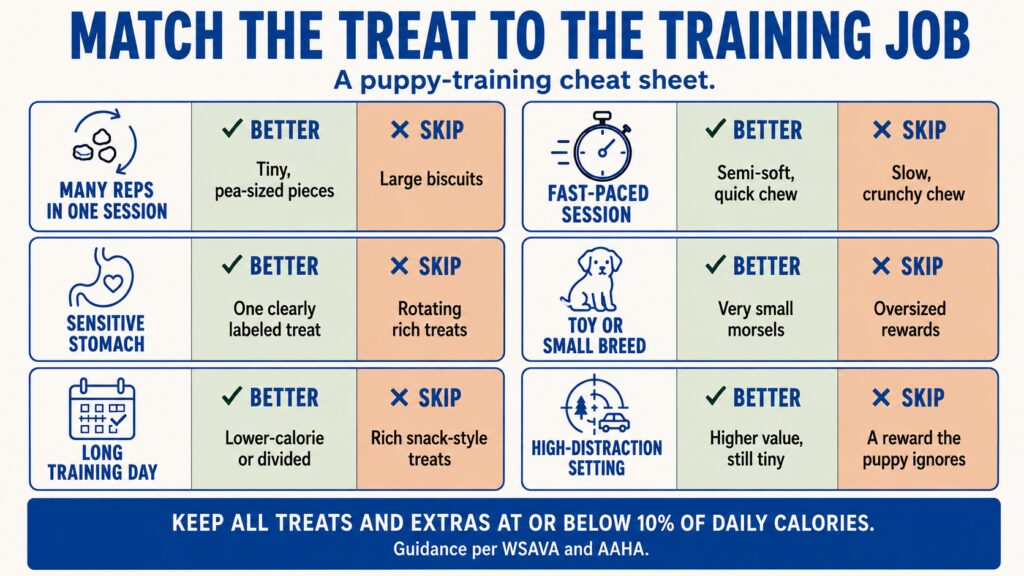
Decision Table: Match the Treat to the Training Job
The following guidance is supportive care, not a substitute for veterinary diagnosis or treatment.
| Training need | More helpful choice | Less helpful choice | Why it matters |
| Frequent rewards | Tiny repeatable pieces | Large biscuits | Small pieces protect timing and calorie control.^[1]^[2] |
| Fast-paced sessions | Semi-soft, quick-chew texture | Slow chewing reward | Clear timing helps the puppy connect the behavior and reward.^[5]^[6] |
| Sensitive stomach puppy | One clearly labeled treat direction | Constantly rotating rich treats | Fewer variables make tolerance easier to judge.^[2]^[8] |
| Small or toy breeds | Very small morsels | Oversized rewards | Size, chewing comfort, and swallow safety all matter. |
| Long training day | Lower-calorie or divided rewards | Rich snack-style treats | Calories can add up before the owner notices.^[1]^[4] |
| High-distraction setting | More motivating but still tiny reward | A reward the puppy ignores | Reward value should match the difficulty of the environment.^[5]^[6] |
The Nutrition Immunology Gap Most Puppy Treat Guides Miss
Puppies go through rapid immune development while their gut, microbiome, and environmental exposure are changing. Maternal antibody protection also wanes over time, which is one reason veterinarians use carefully timed vaccination schedules. Treats do not replace vaccination, veterinary care, or a complete puppy diet, but ingredient choices can still be discussed through a supportive nutrition lens.
One example is beta-glucans, a family of polysaccharides found in sources such as yeast and mushrooms. In immune biology, beta-glucans can interact with innate immune cells, including macrophages. Canine research has shown that beta-glucans can induce trained-immunity-like responses in dog macrophages in experimental settings, which helps explain why beta-glucans are often discussed as immunomodulatory ingredients rather than simple “immune boosters.”^[9]
The compliant takeaway is modest but meaningful: beta-glucan-containing ingredients may support normal immune health as part of a broader diet and wellness routine. They should not be described as preventing infections, replacing vaccines, treating immune disease, or guaranteeing better puppy health.
Why “Immunomodulatory” Is Better Than “Immune Boosting”
“Boosting” can imply a stronger immune response is always better. That is not how immune balance works. A more precise phrase is “may support normal immune function” or “may support immune health.” Beta-glucans are better discussed as ingredients that interact with innate immune pathways, including macrophage signaling, rather than as medical treatments.^[9]
What About the Developing Microbiome?
The following guidance is supportive care, not a substitute for veterinary diagnosis or treatment.
A puppy’s digestive tract is still adapting to food, training rewards, environment, and routine. Sudden treat changes can make it harder to tell whether loose stool is from food, stress, parasites, infection, or another cause. This is why gradual introduction and a steady treat routine are more useful than chasing a new “best” treat every few days.^[2]^[8]
Why Cleaner-Label Features Can Be a Real Advantage
Many dog parents look for organic, all-natural, grain-free, non-GMO, and made-in-the-USA treats because they want fewer surprises in a puppy’s routine. These features can be meaningful quality filters when they are paired with practical training design: small morsel size, quick chewability, manageable calories, and clear tolerance tracking.
Cleaner-label language should not be stretched into a medical promise. Organic or natural treats are not automatically better for every puppy, and grain-free is not a universal requirement. The stronger point is that ingredient-conscious owners may prefer a clearer, more intentional treat routine while still letting the main puppy food provide complete growth nutrition.^[7]
When Puppy Treats Need Extra Caution
Training exposes formula problems quickly because puppies may receive many rewards in a short time. A treat that seems fine once can become too rich when given repeatedly. Use extra caution if your puppy has loose stool after new foods, vomiting after rich treats, recent diet changes, itching or swelling after certain proteins, poor appetite, inconsistent growth, or a history of gulping food.
In those cases, keep the treat routine simple and ask your veterinarian before experimenting broadly. Puppies can dehydrate faster than adult dogs when vomiting or diarrhea is significant, and poor growth should never be handled as a treat-selection problem alone.^[2]^[8]
How Superfood Science Treat Options Fit This Topic
For puppy training, the goal is practical: choose a reward the puppy likes, can chew quickly, and can fit into the day’s calorie budget without disrupting the growth diet.
Superfood Science’s semi-soft, organic, all-natural, grain-free, non-GMO, made-in-the-USA treat positioning may fit ingredient-conscious dog parents who want a more intentional puppy reward routine. Puppy size, treat size, individual tolerance, and total calories still matter most.
Organic Turkey Dog Treats
Superfood Science Organic Turkey Dog Treats may fit dog parents who want a turkey-based, semi-soft reward that can be divided into smaller pieces for training. The formula includes Agaricus mushroom ingredients that contain beta-glucan polysaccharides. From a supportive-care standpoint, beta-glucans may support normal immune health through innate immune pathways, including macrophage interaction, but this should not be framed as infection prevention or treatment.^[9]
Organic Chicken Dog Treats
Superfood Science Organic Chicken Dog Treats may fit puppies that already tolerate chicken well. The semi-soft format is useful for training flow, and ingredients such as turmeric and flaxseed contribute a more intentional functional-ingredient story. Keep the claim conservative: these ingredients may support a wellness-focused routine, but the treat should not be described as treating inflammation, allergies, digestive disease, or skin problems.
Plant-Based Protein Dog Treats
Superfood Science Plant-Based Protein Dog Treats may fit owners who want a different reward direction from poultry-based options. Ingredients such as kelp, chia, and flaxseed add a plant-forward functional profile. For puppies, the practical question remains the same: can the treat be made tiny, tolerated well, and counted within the 10% treat budget?
Dog parents who want to browse current options can visit: Shop Superfood Science Dog Treats
Suggested Usage Guide
Start by matching the treat to the training situation. At home, use tiny pieces or part of the puppy’s measured kibble when the puppy is motivated enough. Around bigger distractions, use a more motivating treat, but keep the pieces very small.
Count training rewards honestly. If your puppy trains often, do not treat those calories like free extras. If training is heavy on a given day, ask your veterinarian whether modest meal adjustments make sense for your puppy’s age, breed size, body condition, and growth pattern.^[2]^[3]
If your puppy has digestive or skin sensitivity, choose one treat direction and keep the rest of the routine steady long enough to judge tolerance clearly. Rotating several proteins and rich treats at once makes it harder to identify what helped or hurt.
Safety and When to Call a Vet
Call your veterinarian if your puppy develops repeated vomiting, chronic diarrhea, poor growth, weight loss, poor appetite, recurrent itchiness, facial swelling, or symptoms that seem tied to treats.^[2]^[8]
Seek urgent care if your puppy has choking, repeated inability to keep water down, breathing difficulty, collapse, black or bloody stool, a swollen face, or suspected toxin exposure.
Use extra caution with toy breeds, fast gulpers, and puppies with known food reactions. Morsel size and chew safety matter as much as ingredients.
Limitations and Research Gaps
There is strong veterinary guidance around calorie control, complete and balanced growth diets, label evaluation, and reward-based training.^[1]^[2]^[3]^[4]^[5]^[7] There is much less direct research comparing commercial puppy training treats head to head on learning outcomes, GI tolerance, immune development, or long-term weight effects.
That is why the safest advice is practical rather than dramatic: choose tiny, countable, clearly labeled treats; introduce them gradually; make sure most of your puppy’s daily calories still come from a complete puppy food made for growing dogs; and watch what your own puppy actually tolerates.
FAQs
What are the best puppy training treats?
The best puppy training treats are usually tiny, semi-soft, easy to chew, clearly labeled, and motivating enough for the training environment. They should fit within the 10% treat-calorie (daily) ceiling so the puppy’s complete and balanced growth diet remains the main source of nutrition.^[1]^[2]^[3]
How many treats can a puppy have in one day?
It depends on the puppy’s daily calorie needs and the calories in each treat. A practical veterinary rule is to keep treats and extras at or below about 10% of daily calories, with the remaining calories coming from a complete and balanced puppy food.^[1]^[2]^[4]
Can puppy training treats cause diarrhea?
Yes. Too many treats, rich treats, abrupt ingredient changes, or individual food sensitivity can contribute to loose stool in some puppies. Repeated diarrhea, vomiting, poor appetite, or poor growth should be discussed with a veterinarian.^[2]^[8]
Are organic puppy treats better for training?
Organic treats can be a meaningful quality filter for ingredient-conscious owners, but “organic” does not automatically make a treat the best training choice. Size, texture, calories, label clarity, and individual tolerance still matter most.^[7]
Should I use kibble or treats for puppy training?
Use the lowest-value reward that still works. Kibble may be enough in quiet settings and can help protect the calorie budget. In more distracting settings, tiny pieces of a higher-value treat may keep training clearer and more motivating.^[5]^[6]
Are beta-glucan ingredients good for puppies?
Beta-glucan ingredients may support normal immune health through innate immune pathways, including macrophage interaction, but they should not be framed as disease prevention or treatment. For puppies, they are best discussed as supportive nutrition within an overall balanced routine.^[9]
Explore More Dog Health Tips
- Limited-Ingredient Organic Dog Treats for Sensitive Dogs
- Best Organic Dog Treats Made in the USA
- Organic Dog Treats with Natural Ingredients
- Top-Rated Organic Dog Treats: How to Choose Safely
- Organic Dog Treat Subscription Options
- Best Training Dog Treats of 2026: Organic, Low-Calorie, and High-Value Mini-Sticks
- Best Dog Training Treats for Dogs Who Need Small, Frequent Rewards
- Trainer Dog Treats That Actually Work in Training
References
1. World Small Animal Veterinary Association. (2025). Feeding treats to your dog. WSAVA Global Nutrition Toolkit. Retrieved June 30, 2026, from https://wsava.org/wp-content/uploads/2025/11/WSAVA_GuidetoTreats_Dogs_251107.pdf
2. VCA Animal Hospitals. (n.d.). Feeding growing puppies. Retrieved June 30, 2026, from https://vcahospitals.com/know-your-pet/feeding-growing-puppies
3. Merck Veterinary Manual. (2023). Feeding practices in small animals. Retrieved June 30, 2026, from https://www.merckvetmanual.com/management-and-nutrition/nutrition-small-animals/feeding-practices-in-small-animals
4. American Animal Hospital Association. (2021). Prevention of obesity: 2021 AAHA nutrition and weight management guidelines. Retrieved June 30, 2026, from https://www.aaha.org/resources/2021-aaha-nutrition-and-weight-management-guidelines/prevention-of-obesity/
5. American Veterinary Society of Animal Behavior. (2021). AVSAB position statement on humane dog training. Retrieved June 30, 2026, from https://avsab.org/wp-content/uploads/2021/08/AVSAB-Humane-Dog-Training-Position-Statement-2021.pdf
6. VCA Animal Hospitals. (n.d.). Using food and treats for training dogs. Retrieved June 30, 2026, from https://vcahospitals.com/know-your-pet/using-food-and-treats-for-training-dogs
7. U.S. Food and Drug Administration. (2020). “Complete and balanced” pet food. Retrieved June 30, 2026, from https://www.fda.gov/animal-veterinary/animal-health-literacy/complete-and-balanced-pet-food
8. VCA Animal Hospitals. (n.d.). Food allergies in dogs. Retrieved June 30, 2026, from https://vcahospitals.com/know-your-pet/food-allergies-in-dogs
9. Paris, S., Chapat, L., Pasin, M., Lambiel, M., & Cox, E. (2020). Beta-glucan-induced trained immunity in dogs. Frontiers in Immunology, 11, Article 566893. https://doi.org/10.3389/fimmu.2020.566893
