
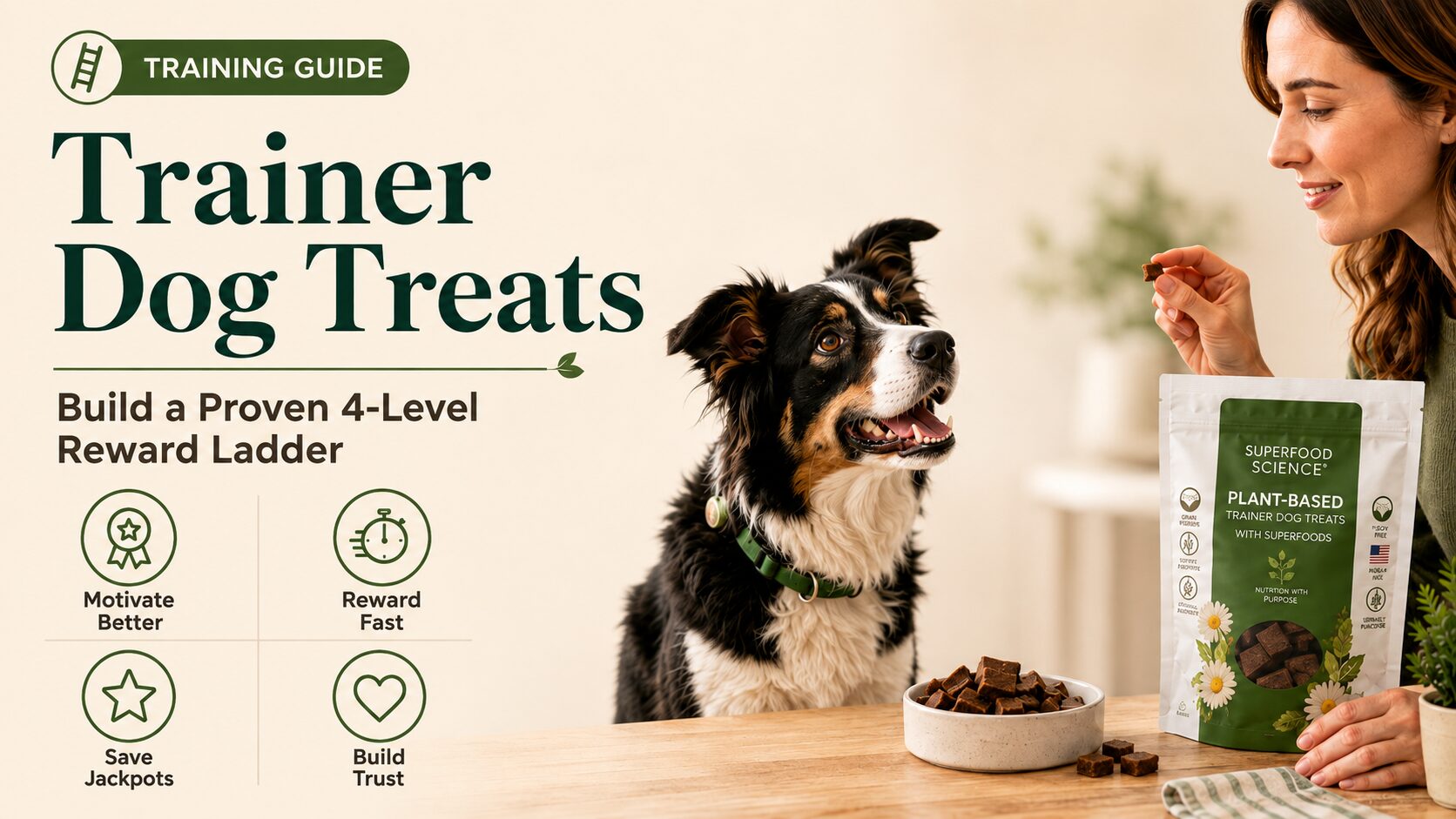
Trainer Dog Treats: Build a Proven 4-Level Reward Ladder
Quick Answer
Trainer dog treats perform best when their reward value matches the difficulty of the behavior. Build a dog training reward ladder: use everyday rewards for easy cues, more aromatic high-value rewards for distractions and recall, and a rare jackpot for exceptional responses. Keep pieces tiny, deliver them immediately, and count them toward the daily calorie plan.[1][2][3][4]
Trust Signal
By Superfood Science Writing Team | Reviewed by Dr. Kelly Hood, DVM | Last Updated: August 31, 2026
Veterinary review status: Pending.
Superfood Science has produced organic and natural functional foods for humans and pets for more than 20 years, with a focus on clean-label formulations and evidence-informed nutrition.
Key Takeaways
• Reward-based methods are recommended for dog training and behavior modification.[1]
• The best trainer dog treats are small, quick to eat, easy to deliver, and motivating enough for the current environment.[2][3][5]
• A reward value ladder helps owners save the most exciting treats for difficult behaviors, distractions, recall, and emotionally challenging situations.
• Treat timing matters: mark the correct behavior and deliver the reward immediately so the dog can connect the action with the subsequent outcome.[2][3]
• Treats should generally remain within about 10% of daily calories unless the veterinary team recommends a different plan.[4]
Why One Treat Does Not Work Equally Well Everywhere
A dog may happily work for a familiar reward in the kitchen and ignore the same reward near squirrels, visitors, traffic, or another dog, or any other distraction.
That does not mean the dog is stubborn. It often means the environment has become more interesting than the reward, the task is too difficult, or the dog is too excited, worried, or distracted to learn effectively.
AVSAB recommends reward-based methods for all dog training and behavior modification.[1] VCA likewise emphasizes that trainers should identify rewards the individual animal values and deliver them in a way that strengthens the desired behavior.[2][3]
A practical way to apply that guidance is to build a reward value ladder.
What Is a Reward Value Ladder?
A reward value ladder is a simple household system for ranking rewards from everyday to exceptional. It is not a rigid scientific scale. It is a practical tool that helps dog parents match the reward to the challenge.
The dog decides what is valuable. One dog may work eagerly for a plant-based semi-soft bite. Another may reserve maximum enthusiasm for turkey or chicken. Preferences can also change with hunger, location, stress, and recent meals.[2][3]
The Four-Level Trainer Dog Treat Ladder
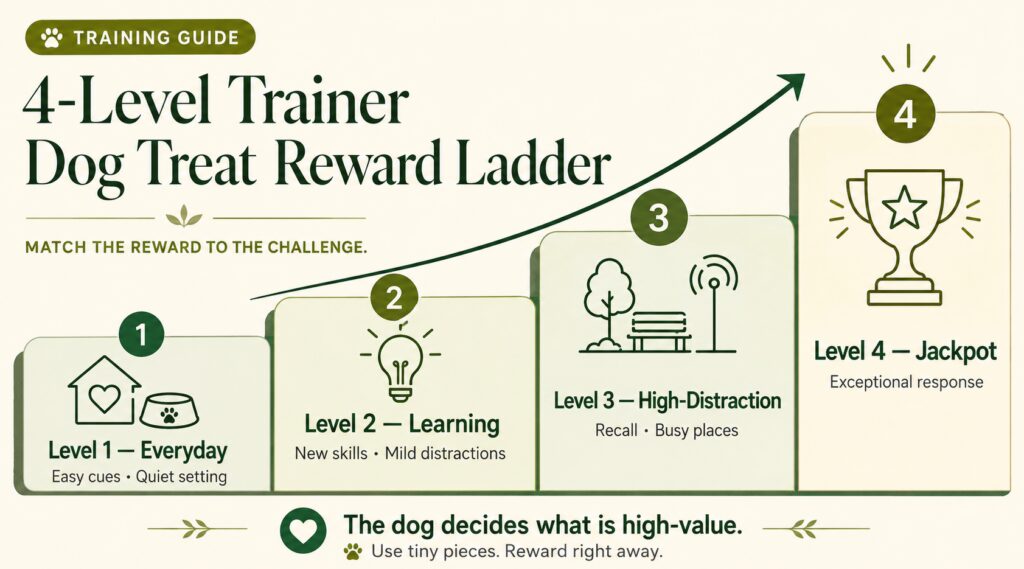
Level 1: Everyday Rewards
Use Level 1 for behaviors the dog already understands in quiet, familiar settings.
Examples include sitting in the kitchen, making eye contact before opening a door, or settling on a mat at home.
The reward should still be enjoyable, but it does not need to be the most exciting option in the house.
Level 2: Learning Rewards
Use Level 2 when teaching a new behavior, increasing duration, adding distance, or practicing in a mildly distracting setting.
These treats should be more motivating than the everyday reward and easy to deliver repeatedly without slowing the session.
Level 3: High-Distraction Rewards
Use Level 3 for recall, loose-leash walking near distractions, calm behavior around visitors, veterinary handling practice, or a new environment.
These situations require a reward that can compete with what is happening around the dog. Semi-soft treats with an enticing aroma and appealing texture can be especially useful because they are quick to eat and easy to repeat.
Level 4: Jackpot Rewards
A jackpot is a brief series of small rewards or a single, especially meaningful reward following an exceptional response.
Use it selectively. Examples include an immediate recall away from a major distraction, calm cooperation during a difficult handling exercise, or a breakthrough in a behavior plan.
A jackpot should feel special. If it happens after every routine sit, it loses its distinction.
Why Aroma Can Matter in Distracting Places
Dogs rely heavily on olfaction to gather information, make decisions, and learn. Research describes a highly specialized canine olfactory system, with receptor estimates varying by breed and commonly ranging from about 125 million to 300 million, compared with roughly 5 million in humans.[6]
In a busy park, training class, or veterinary setting, a noticeable aroma may help a reward stand out from competing sights and smells. Semi-soft trainer dog treats can also be broken into tiny pieces and swallowed quickly, which helps preserve training rhythm. However, aroma and texture do not guarantee better learning; the dog’s preference, comfort, timing, and distance from distractions still matter most.[2][3][6]
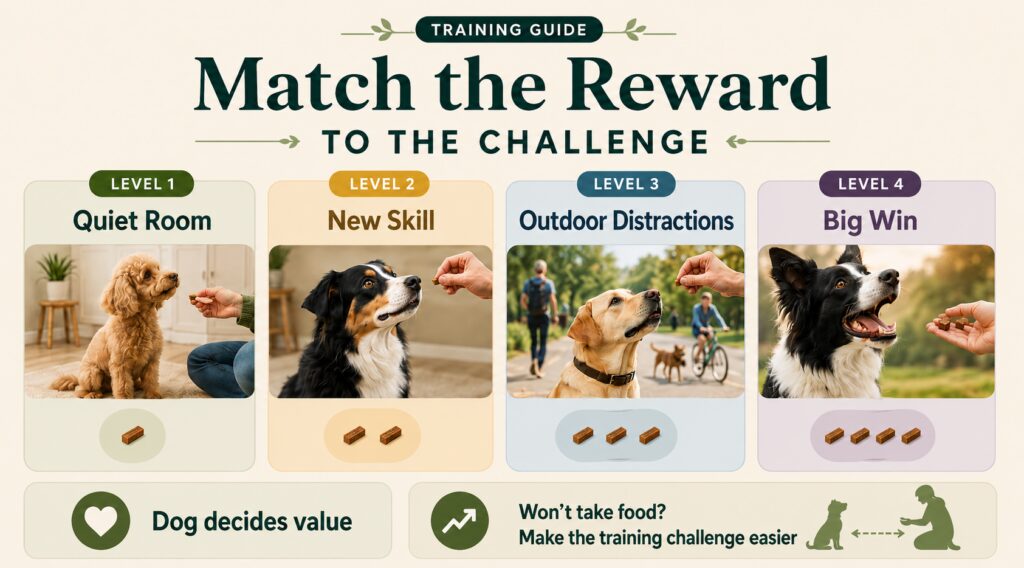
Decision Table: Match Reward Value to the Training Situation
The Five Mechanics That Make Trainer Dog Treats Work Better
Perfecting your delivery mechanics is just as important as choosing the right trainer dog treats.
1. Mark the Exact Behavior
Use a consistent marker such as “yes” or a clicker at the moment the dog performs the desired behavior. Then deliver the reward immediately.[2][3]
The marker tells the dog which action earned the treat.
2. Use Tiny Pieces
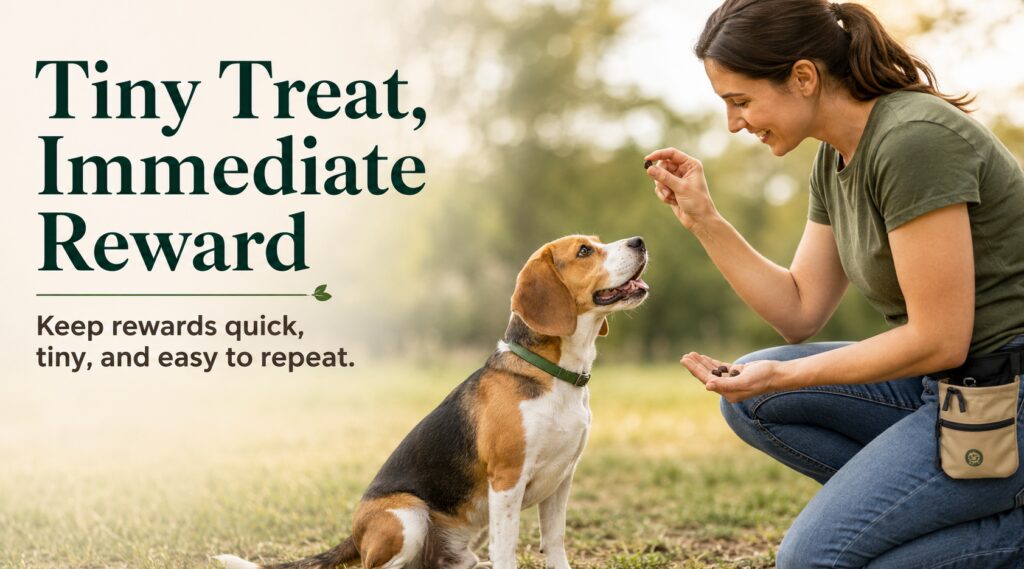
Training usually involves repetition. AAHA behavior guidance notes that treats should be palatable and small enough to allow multiple rewards without appreciable calorie intake.[5]
A tiny piece can reinforce the behavior just as effectively as a large snack when the reward is valuable to the dog.
3. Keep the Treat Easy to Deliver
Trainer dog treats should be easy to access, hold, and deliver without crumbling excessively or requiring a long chew. Semi-soft treats are well suited to this job because they can be portioned and eaten quickly.
4. Place the Reward Where You Want the Dog
Reward position influences the next repetition. Deliver near your leg for heel position, low on the mat for settling, or directly in front for a straight sit.
Good placement reduces the need to reposition the dog after every treat.
5. Reset Before the Next Repetition
After rewarding, give the dog a clear chance to reset. Short, clean repetitions are usually more useful than one long session in which attention fades.
How to Build Your Dog’s Personal Reward Ladder
Start with three or four safe rewards your dog already tolerates. Offer them in a quiet setting and observe enthusiasm, speed of response, and willingness to re-engage.
Then test the same options in a slightly more distracting environment. A reward that works indoors may move down the ladder outdoors.
Record the result. Your ladder may look like this:
• Level 1: ordinary meal kibble or a low-key treat
• Level 2: plant-based semi-soft treat
• Level 3: organic turkey or chicken semi-soft treat
• Level 4: several tiny pieces of the dog’s favorite option
That is only an example. The dog’s preferences determine the final order.
Calories Still Count During Training
WSAVA advises keeping treats to no more than about 10% of a healthy dog’s daily calorie intake.[4] Training can make this surprisingly difficult because thirty tiny rewards may not feel like much in the hand.
Use these practical controls:
• Break semi-soft treats into the smallest effective pieces.
• Pre-portion the session’s reward allowance before training starts.
• Use part of the dog’s measured daily food for easy repetitions when it is motivating enough.
• Reserve higher-value treats for more difficult work.
• Discuss meal adjustments with a veterinarian when a dog trains intensively, is very small, is overweight, or has medical needs.
The goal is not to minimize rewards. The goal is to reward generously in training while managing the total day intelligently.
What If the Dog Suddenly Stops Taking Treats?
A dog may refuse high-value trainer dog treats because it recently ate, the reward is not valuable enough, the environment is too distracting, or the dog is worried, overheated, nauseated, in pain, or unwell.
Do not assume refusal means disobedience.
Move to a quieter area, increase the distance from the distraction, lower the difficulty, and observe body language. If a normally food-motivated dog suddenly refuses food in multiple settings or shows other symptoms, contact a veterinarian.
How Superfood Science Treat Options Fit This Topic
Superfood Science dog treats are semi-soft, organic, all-natural, grain-free, non-GMO, and made in the USA. That combination makes them practical organic dog training treats for reward-based work: the semi-soft format supports quick delivery and portioning, while the cleaner-label features appeal to ingredient-conscious dog parents.
The turkey, chicken, and plant-based options also make it possible to build a reward ladder around the individual dog’s preferences without presenting one flavor as universally superior.
Browse Superfood Science Dog Treats
Organic Turkey Dog Treats
Superfood Science Organic Turkey Dog Treats may serve as an effective Level 2 or Level 3 reward for dogs that find turkey motivating. The semi-soft texture makes them practical for repeated delivery, and the organic, all-natural, grain-free, non-GMO, made-in-the-USA profile supports a more intentional training routine.
The Agaricus mushroom ingredient adds distinction to the brand’s functional-food formulation story without changing the treat’s primary job: rewarding the behavior you want to see again.
Organic Chicken Dog Treats
For dogs that strongly prefer chicken, Superfood Science Organic Chicken Dog Treats may become a high-value training option. They can be especially useful for new skills, recall, and distraction work when the dog already tolerates chicken well.
Their semi-soft format allows owners to use small pieces rather than oversized rewards.
Plant-Based Protein Dog Treats
Superfood Science Plant-Based Protein Dog Treats can provide a different reward profile for dogs and families who prefer a plant-based option. Kelp, chia, and flaxseed support the product’s ingredient story, while the semi-soft, grain-free format remains convenient for frequent training repetitions.
Some dogs may rank this as an everyday reward, while others may treat it as a high-value favorite. The dog decides.
The following guidance is supportive care and is intended for intermittent or supplemental reward-based training. It is not a substitute for professional veterinary diagnosis, treatment, or tailored nutritional therapy.
A 10-Minute Trainer Dog Treats Session Blueprint
Minutes 1-2: Easy Success
Begin with two or three behaviors the dog already knows. Use Level 1 or Level 2 rewards to create momentum.
Minutes 3-6: Teach One Small Step
Work on one criterion only: a longer stay, one step of loose-leash walking, or a new hand target. Mark and reward each successful approximation.
Minutes 7-8: Add a Mild Distraction
Make the task slightly harder, not dramatically harder. Increase reward value if needed.
Minutes 9-10: Finish With a Win
Return to an easier behavior, reward generously, and end while the dog still wants to participate.
Short sessions protect motivation and make it easier to manage calories.
Limitations and Research Gaps
No single commercial treat has been proven to create better learning outcomes for every dog. Reward effectiveness depends on the individual dog’s preference, timing, training skill, environment, emotional state, task difficulty, and reinforcement history.
The reward ladder is a practical framework, not a diagnostic or therapeutic protocol. Dogs with fear, aggression, guarding, panic, or complex behavior concerns may need help from a qualified reward-based trainer, certified behavior consultant, or veterinary behaviorist.
Suggested Usage Guide
1. Identify three safe rewards your dog already tolerates.
2. Rank them in a quiet environment, then re-test around mild distractions.
3. Use the lowest level that keeps the dog engaged and successful.
4. Increase reward value when task difficulty or environmental distraction rises.
5. Mark the correct behavior and deliver the reward immediately.[2][3]
6. Pre-portion treats and keep the total daily calorie plan in view.[4]
7. End the session before the dog becomes tired, frustrated, or disengaged.
Safety and When to Call a Vet or Behavior Professional
Use pieces appropriate for the dog’s size and chewing style. Supervise dogs that gulp, and avoid large pieces that may create a choking risk.
Stop using a treat that repeatedly causes vomiting, diarrhea, itching, facial swelling, or another adverse response. Seek urgent veterinary care for breathing difficulty, collapse, severe swelling, repeated vomiting, or rapidly worsening symptoms.
Contact a veterinarian when a normally food-motivated dog suddenly refuses rewards across settings, especially if appetite, energy, stool, movement, or behavior also changes.
Seek qualified behavior help when training involves aggression, severe fear, panic, resource guarding, or safety risk. AVSAB recommends reward-based approaches and advises against aversive methods.[1]
FAQs
What are trainer dog treats?
Trainer dog treats are small, quick-to-eat rewards used repeatedly to reinforce desired behavior. The best option is motivating, easy to deliver, portionable, and well tolerated.
Should trainer dog treats be soft?
They do not have to be, but semi-soft treats are highly practical because they are quick to chew, easy to portion, and less likely to interrupt the flow of a training session. Semi-soft training treats keep repetitions quick and clean.
How small should training treats be?
Use the smallest piece that still feels rewarding to the dog. For many dogs, a pea-sized or smaller piece is enough, but size should be adjusted for the individual dog: small dog training treats may need to be halved again for toy and small breeds.
What is a high-value dog treat?
A high-value treat is one that the individual dog prefers strongly enough to compete with the current distraction. The value is determined by the dog, not the label. High-value dog treats for training earn that status from the individual dog’s preference.
How many training treats can I give per day?
The number depends on the calories per piece and the dog’s daily needs. As a general guide, treats should remain within about 10% of daily calories unless the veterinary team advises otherwise.[4]
Why will my dog take treats at home but not outside?
The outdoor environment may be more rewarding, distracting, or stressful. Lower the difficulty, create more distance, use a higher-value reward, and watch the dog’s body language.
Explore More Dog Health Tips
• Best Organic Dog Treats Made in the USA
• Organic Dog Treats with Natural Ingredients: What Actually Matters
• Top-Rated Organic Dog Treats: How to Choose Safely
• Turkey vs. Chicken: Which Protein Is Better for Your Dog’s Treats?
• Organic Dog Treat Subscription Made Simple
References
1. American Veterinary Society of Animal Behavior. AVSAB Position Statement on Humane Dog Training. Published 2021. Accessed July 12, 2026. https://avsab.org/wp-content/uploads/2021/08/AVSAB-Humane-Dog-Training-Position-Statement-2021.pdf
2. VCA Animal Hospitals. Using Reinforcement and Rewards to Train Your Pet. Accessed July 12, 2026. https://vcahospitals.com/know-your-pet/using-reinforcement-and-rewards-to-train-your-pet
3. VCA Animal Hospitals. Using Predictable Rewards to Train Your Dog. Accessed July 12, 2026. https://vcahospitals.com/know-your-pet/using-predictable-rewards-to-train-your-dog
4. World Small Animal Veterinary Association Global Nutrition Committee. Feeding Treats to Your Dog. Published 2025. Accessed July 12, 2026. https://wsava.org/wp-content/uploads/2025/11/WSAVA_GuidetoTreats_Dogs_251107.pdf
5. American Animal Hospital Association. 2015 AAHA Canine and Feline Behavior Management Guidelines. Published 2015. Accessed July 12, 2026. https://www.aaha.org/wp-content/uploads/globalassets/02-guidelines/behavior-management/2015_aaha_canine_and_feline_behavior_management_guidelines_final.pdf
6. Kokocińska-Kusiak A, Woszczyło M, Zybala M, Maciocha J, Barłowska K, Dzięcioł M. Canine olfaction: physiology, behavior, and possibilities for practical applications. Animals (Basel). 2021;11(8):2463. doi:10.3390/ani11082463. Accessed July 12, 2026. https://pmc.ncbi.nlm.nih.gov/articles/PMC8388720/
