
Grain-Free Dog Food: Is It Better or Just Marketing?
Quick Answer
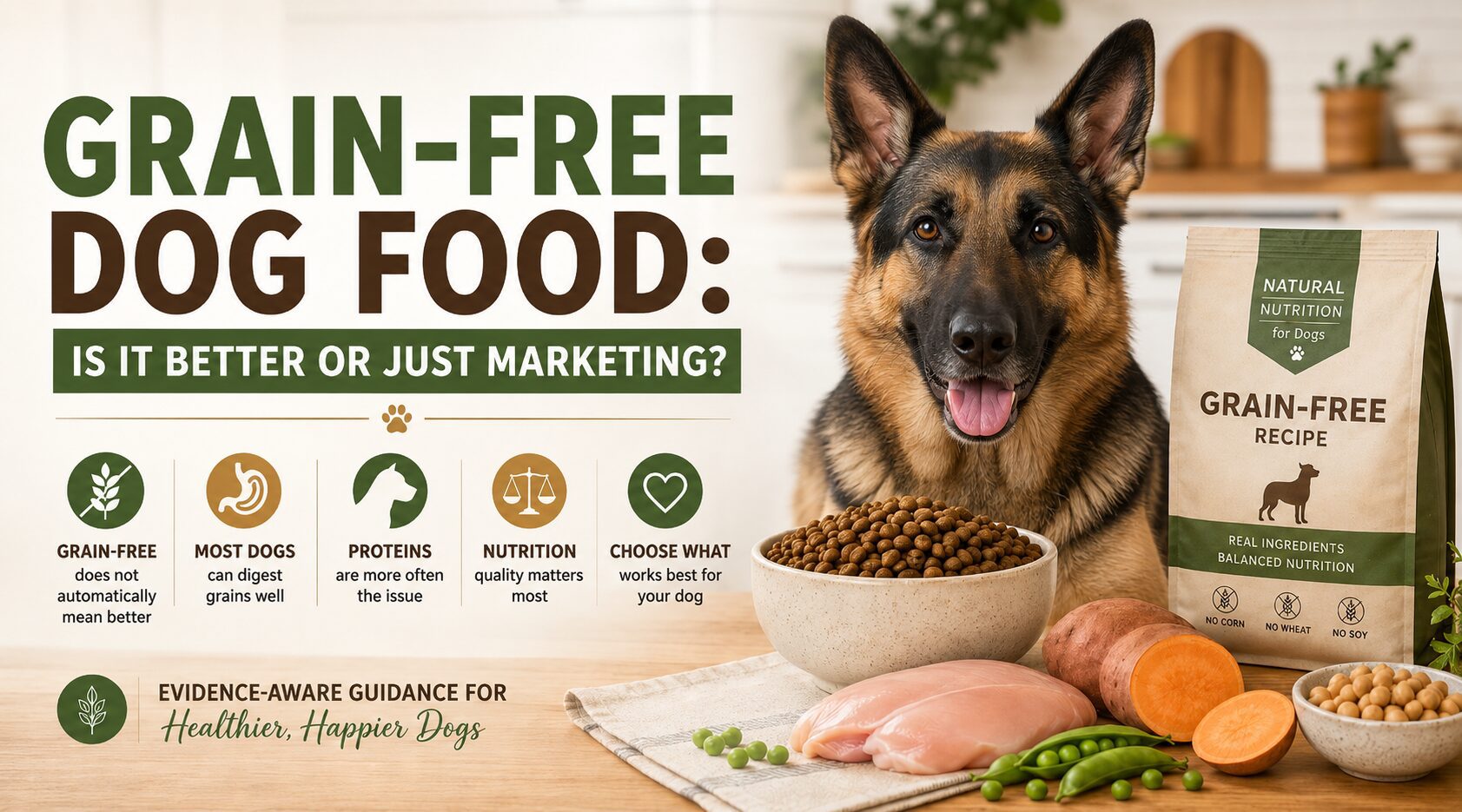
Grain-free dog food is not automatically better for every dog. Most healthy dogs can digest properly cooked grains well, and current evidence does not support grain-free diets as universally superior. The bigger questions are whether the diet is complete and balanced, whether your dog tolerates it well, and whether the formula fits your dog’s actual needs.[1][2]
Trust Signal
By Superfood Science Writing Team | Reviewed by Dr. Kelly Hood, DVM | Last Updated: 06/17/2026
Superfood Science has produced organic and natural functional foods for humans and pets for over 20 years, specializing in clean-label formulations and evidence-based nutrition.
Key Takeaways
- Grain-free does not automatically mean healthier, cleaner, or easier to digest.[1]
- Most dogs can digest properly cooked grains without trouble.[1][2]
- Food sensitivities in dogs are more often linked to proteins than grains, although individual dogs still vary.[2][3]
- Nutritional completeness, ingredient quality, company transparency, and real-world tolerance matter more than trend language.[1]
- Major diet changes should be made thoughtfully, especially in puppies, seniors, and dogs with chronic digestive or skin symptoms.[2][3]
Why grain-free has become so popular
Grain-free dog food rose alongside broader consumer interest in “ancestral,” “natural,” and “clean” eating patterns.
That trend made intuitive sense to many owners. If grains were being questioned in human nutrition, it felt natural to question them in pet food too.
The result was a wave of products positioned as:
- more natural
- easier to digest
- better for sensitive stomachs
- better for itching or skin issues
- closer to a dog’s “true” diet
Those claims are attractive, but they are not automatically supported just because they sound modern.
What grain-free actually means
Grain-free dog food removes ingredients such as wheat, corn, rice, oats, barley, or other grains.
That does not mean the food is low-carbohydrate, high-protein, or automatically superior.
In many grain-free formulas, grains are replaced with ingredients such as peas, lentils, chickpeas, potatoes, or tapioca. So the label tells you what is missing, but not necessarily what has improved.
Can dogs digest grains?
Yes, most dogs can digest properly cooked grains well.
Veterinary nutrition guidance does not support the idea that grains are inherently inappropriate for dogs.[1][2] In fact, grains may contribute digestible carbohydrate, fiber, and other nutrients depending on the formula and the dog’s needs.[1]
This is an important point because many owners hear “grain-free” and assume grains are the obvious problem ingredient.
For most healthy dogs, that is not how the evidence reads.
Are grains a common cause of food problems in dogs?
Sometimes, but less often than many owners assume.
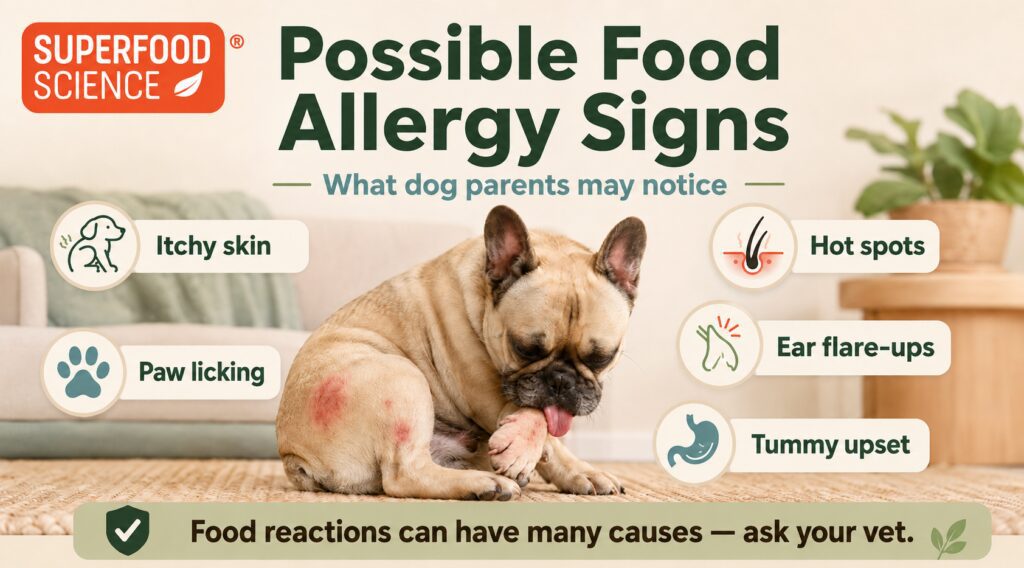
Food reactions in dogs are more commonly associated with food ingredients such as beef, dairy, chicken, wheat, or lamb than with the broad idea of “grains” as a category.[2][3]
That does not mean no dog ever reacts to grain-containing foods. It means grain is often blamed more quickly than the evidence justifies.
In practical terms, when a dog seems to react to a food, the issue may be the protein source, fat level, formula richness, ingredient complexity, or something entirely unrelated to food.
Decision table: when grain-free may matter and when it may not
| Situation | Grain-free may be worth discussing | Grain-free may not be the main answer | Practical takeaway |
| Dog is healthy and doing well on current food | Usually not necessary | Often yes | Do not switch just because a label sounds better |
| Dog has chronic GI or skin signs | Maybe, with veterinary input | Often yes | Evaluate the whole diet, not just grain content[2][3] |
| Owner wants a “cleaner” ingredient story | Possibly | Yes, if completeness is ignored | Label appeal should not outrank nutritional quality |
| Food allergy is suspected | Sometimes as part of a structured plan | Often yes | Protein choice and diagnostic process usually matter more[2][3] |
| Boutique marketing is the main reason for switching | No strong reason | Often yes | Marketing alone is not evidence |
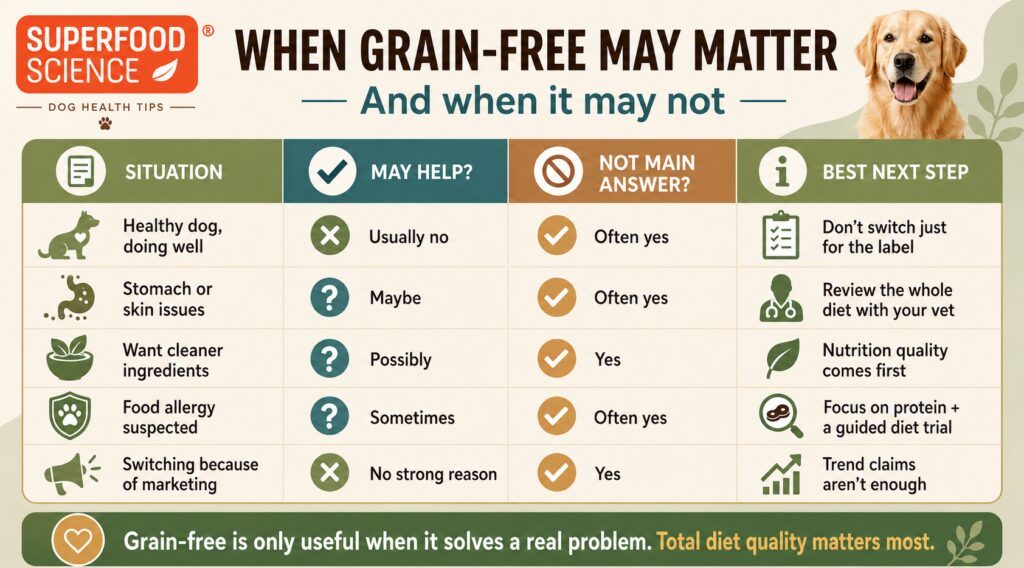
The point is not that grain-free is always bad or always good.
It is that grain-free is only useful when it solves a real problem rather than just sounding healthier.
What stronger evidence supports
The stronger veterinary guidance supports a few practical ideas.
First, overall diet quality matters more than one front-of-bag label.[1]
Second, pet owners should focus on complete and balanced nutrition, manufacturer transparency, including quality control, and whether the dog actually does well on the food.[1]
Third, food reactions should not be diagnosed casually. If a dog truly needs a diet trial, that process should be more controlled than just bouncing between trend-driven formulas.[2][3] Ideally, with the oversight of a veterinarian or nutritionist.
The grain-free and DCM question
This is the part many owners have heard about, but often only in fragments.
The U.S. Food and Drug Administration has investigated potential links between certain diets and canine dilated cardiomyopathy (DCM), especially some products marketed as grain-free or boutique diets.[4]
The situation is still evolving, and the FDA has not reduced it to a single villain ingredient. But the investigation is one reason veterinarians often encourage owners to think more carefully about nutritional adequacy and company quality rather than assuming grain-free equals better.
That does not mean every grain-free diet is harmful.
It does mean the category should be approached thoughtfully, not romantically. If your dog is doing fine on their current diet, there is generally no reason to switch — any change introduces its own risk without a clear benefit.
What matters more than the label
Nutritional completeness
A food should meet recognized nutritional standards and be appropriate for the dog’s life stage.[1][2]
Company transparency
WSAVA encourages owners to think about who formulates the food, whether the company provides useful nutritional information, and whether there is evidence of quality control and feeding competence.[1]
Real-world tolerance
How does your dog actually do on the food?
That includes stool quality, appetite, energy, skin comfort, body condition, and consistency over time.
Ingredient logic, not ingredient fear
A label should help owners think more clearly, not more fearfully.
What about grain-free treats?
This is where the conversation often overlaps with buying behavior.
Many owners are not just shopping for food. They are looking for grain-free dog food, grain-free treats, organic treats, natural treats, top-rated treats, or made-in-the-USA options.
Those preferences can be reasonable. But the same logic still applies: the best product is not automatically the one with the most fashionable claim. It is the one that fits the dog’s calorie budget, digestive tolerance, and overall routine.
How Superfood Science Treat Options Fit This Topic
This section is educational brand positioning, not proof that any Superfood Science product treats disease or proves grain-free superiority.
For dog parents who care about ingredient clarity and cleaner-label routines, the more useful conversation is often about treat fit, not about claiming that grain-free is always better.
Organic Turkey Dog Treats
For owners who want a more intentional, natural-and-organic reward option, Superfood Science Organic Turkey Dog Treats may fit well as part of a cleaner-label routine.
This line also includes beta-glucan-rich Agaricus mushrooms as part of a broader functional ingredient profile. In a treat, that ingredient is best understood as supportive and formulation-based, not as a medical treatment.
Organic Chicken Dog Treats
For dogs that tolerate chicken well, Superfood Science Organic Chicken Dog Treats may fit a straightforward, clean-label reward routine.
This line includes ingredients such as turmeric and flaxseed as part of a more intentional formulation story. That supports the product’s natural-and-organic positioning without making exaggerated health claims.
Plant-Based Protein Dog Treats
For owners who prefer a different ingredient direction, Superfood Science Plant-Based Protein Dog Treats may offer another thoughtful option.
This line includes ingredients such as kelp, chia, and flaxseed as part of a broader plant-based functional ingredient profile, which may appeal to ingredient-conscious families looking beyond standard meat-based formats.
Superfood Science offers dog parents cleaner-label treat choices that may fit a thoughtful routine, but the dog’s actual tolerance and overall feeding plan still matter more than trendy language. Superfood Science dog treats are grain-free, which may alleviate additional concerns for dog parents who want to give healthier, delicious treats.
Limitations and evidence gaps
There is good veterinary guidance around nutritional adequacy, food selection, and the need to avoid oversimplified diet claims.[1][2][4]
There is much less strong evidence supporting blanket statements such as “grain-free is healthier” or “grains are bad for dogs.”
There is also a real-world limitation in how owners use the phrase “sensitive stomach.” Dogs may react to richness, portion size, ingredient complexity, or another condition entirely, even when grain gets the blame first.
That is why a grain-free dog food decision should be framed as one part of a bigger nutrition picture.
Practitioner-Recommended Usage Guide
If your dog is doing well on a complete and balanced diet that includes grains, there is usually no evidence-based reason to switch just because grain-free sounds more natural or trendy.
If your dog has recurring digestive or skin symptoms, simplify your thinking before changing everything at once. Review the whole diet, including treats, toppers, table scraps, and recent changes. If a diet trial is needed, work with your veterinarian so the process is more controlled and less random.
If you choose a different food or treat direction, transition gradually and watch stool quality, appetite, activity, body condition, and skin comfort over time.
Safety and when to call a vet
Call your veterinarian if your dog has chronic diarrhea, repeated vomiting, ongoing itching, ear flare-ups, weight loss, poor appetite, or symptoms that keep recurring around food changes.[2][3]
Seek veterinary guidance before starting restrictive or homemade diets for puppies, senior dogs, or dogs with chronic disease.
If your dog has a suspected food allergy, chronic GI disease, heart disease, pancreatitis history, or a prescription diet, do not make major diet changes casually without veterinary input.
FAQs
Is grain-free dog food healthier?
Not necessarily. Most healthy dogs can digest grains well, and overall diet quality matters more than whether grains are present.[1][2]
Do dogs need grains?
Dogs do not have a nutritional requirement for grains specifically, but well-formulated diets with grains can still be healthy and complete.[1]
Can grain-free dog food help sensitive stomachs?
Sometimes a particular formula may fit a dog better, but improvement is not always because grains were removed. The full ingredient and calorie picture still matters.[2][3]
Is grain-free dog food linked to heart problems?
The FDA has investigated possible links between certain diets and canine dilated cardiomyopathy, and the research is still evolving.[4]
What matters most when choosing dog food?
Nutritional completeness, manufacturer transparency, real-world tolerance, and veterinary guidance matter more than trendy label language.[1]
Conclusion
Grain-free dog food is not automatically better, nor is it automatically just hype. The better question is whether the food makes sense for the dog in front of you. That means looking beyond the claim on the bag and paying more attention to formulation quality, company transparency, tolerance, and the bigger daily feeding routine.
Explore More Dog Health Tips
- Best Diet for Dogs: What Actually Matters
- How to Choose a Healthy Dog Treat
- Best Organic Dog Treats for Sensitive Stomachs
- Healthy Weight Management for Dogs
- Signs Your Dog May Be Sick
References
- World Small Animal Veterinary Association. Guidelines on selecting pet foods. WSAVA. https://wsava.org/wp-content/uploads/2021/04/Selecting-a-pet-food-for-your-pet-updated-2021_WSAVA-Global-Nutrition-Toolkit.pdf
- MSD Veterinary Manual. Food allergy in dogs. MSD Veterinary Manual. https://www.msdvetmanual.com/dog-owners/skin-disorders-of-dogs/allergies-in-dogs
- VCA Animal Hospitals. Food allergies in dogs. VCA. https://vcahospitals.com/know-your-pet/food-allergies-in-dogs
- U.S. Food and Drug Administration. FDA investigation into the potential link between certain diets and canine dilated cardiomyopathy. FDA. https://www.fda.gov/animal-veterinary/outbreaks-and-advisories/fda-investigation-potential-link-between-certain-diets-and-canine-dilated-cardiomyopathy
