
Pumpkin for Dog Diarrhea: Vet-Safe Guide for Dog Parents
Quick Answer
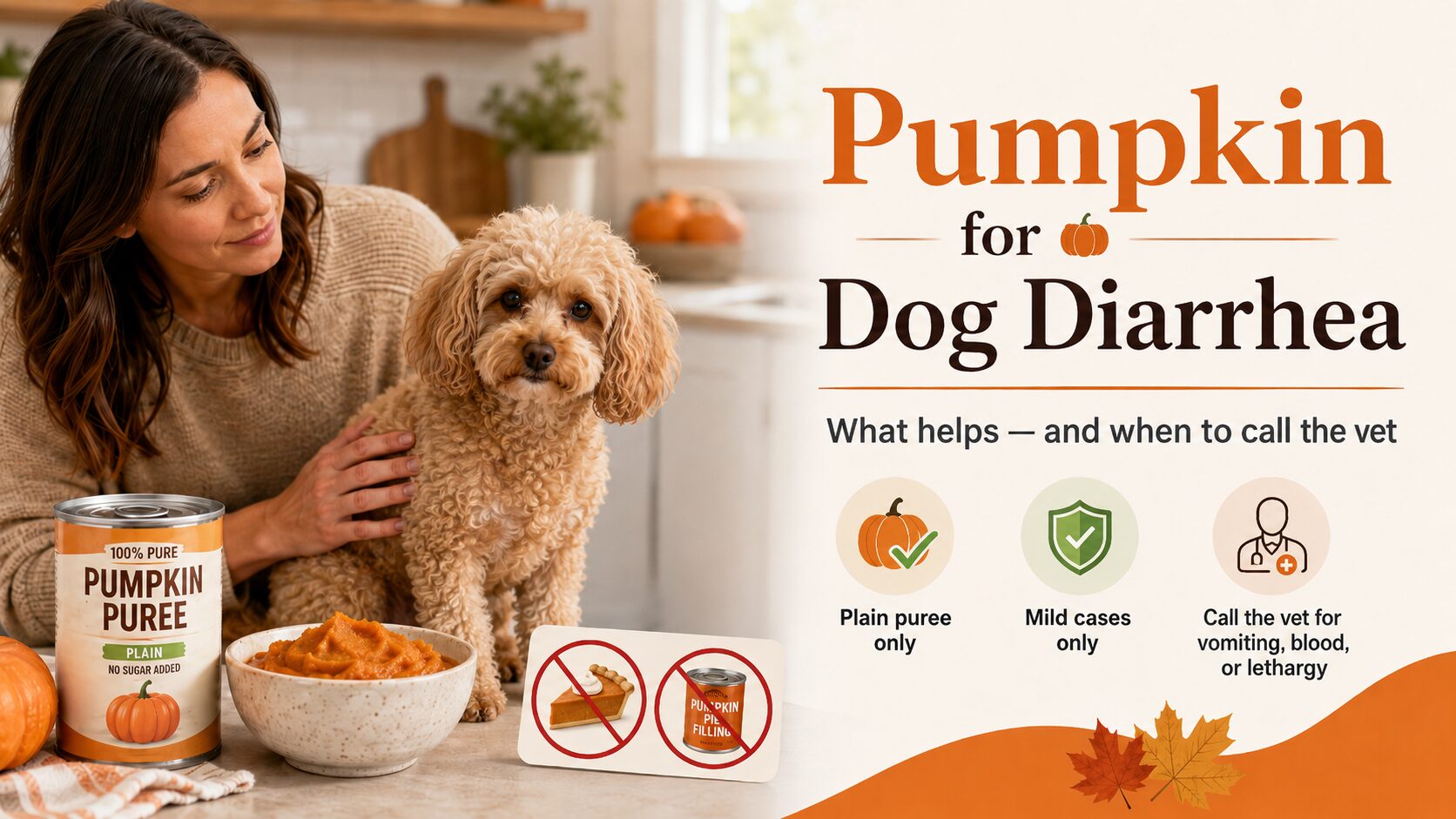
Pumpkin for dog diarrhea may help some dogs with mild, uncomplicated loose stool when it is plain, unsweetened 100% pumpkin puree. Its fiber can support stool consistency, but it is not a cure-all. Dogs with vomiting, blood, weakness, dehydration, repeated diarrhea, or poor appetite need veterinary guidance instead of home care.^[1, 3, 4, 7]
Trust Signal
By Superfood Science Writing Team | Reviewed by Dr. Kelly Hood, DVM | Last Updated: 06/19/2026
Superfood Science has produced organic, natural functional foods for humans and pets for over 20 years, specializing in clean-label formulations.
Key Takeaways
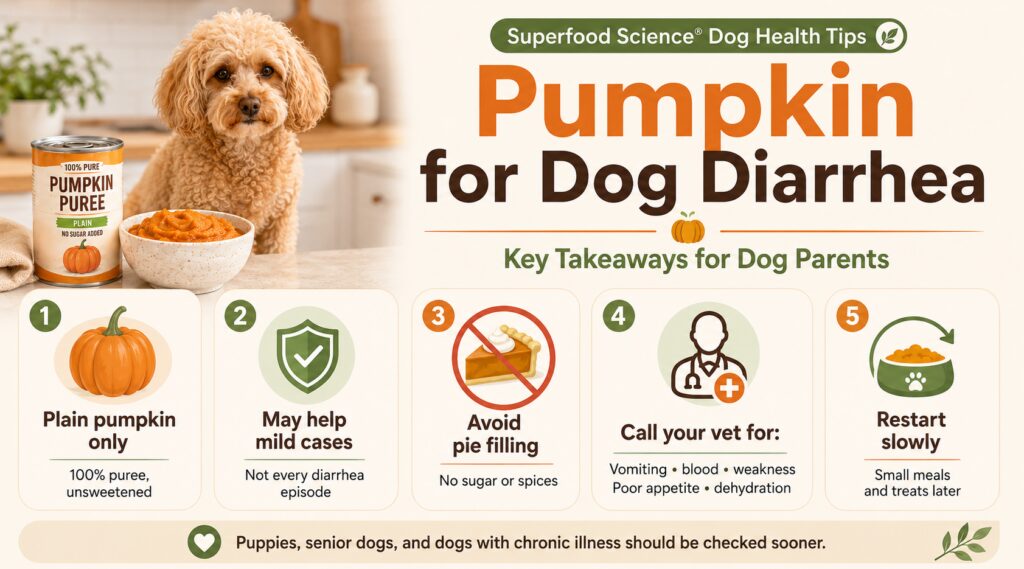
- Plain 100% pumpkin puree may help some mild dog diarrhea cases because dietary fiber can reduce free water in stool.^[1, 7]
- Pumpkin pie filling, sweetened pumpkin products, and pumpkin-flavored desserts are not appropriate for dogs.^[9]
- Diarrhea with vomiting, blood, weakness, poor appetite, dehydration, or repeated episodes requires veterinary attention, not more pumpkin.^[3, 4]
- Puppies, senior dogs, and dogs with chronic disease should usually be assessed sooner rather than later.^[3, 4]
- After a dog is stable again, food and treats should be reintroduced slowly and in very small portions.^[8]
Why Dog Parents Search for Pumpkin for Dog Diarrhea
Many dog parents ask whether pumpkin for dog diarrhea is a safe first step because it sounds simple, natural, and easy to find. Most dogs also find plain pumpkin puree palatable, unless they are nauseous.
There is a real reason the idea persists. Veterinary guidance supports the concept that fiber can help with motility disorders and mild, fiber-responsive large-bowel patterns. Fiber can reduce free water in feces, increase bulk, and support more normal transit time.^[1, 5, 7] Pumpkin contains fiber, so that part of the reasoning is grounded.
But pumpkin is not a diagnosis or a treatment. Diarrhea is a symptom, not a diagnosis.^[3, 5] A dog may have loose stool because of dietary indiscretion, an abrupt food change, stress, parasites, infection, pancreatitis, inflammatory bowel disease, endocrine disease, or many other causes.^[5, 6] Pumpkin fiber addresses none of those underlying issues directly.
The Nutritional Immunology Spark
Pumpkin contains both soluble and insoluble fiber. The insoluble fraction can add stool bulk, while soluble, fermentable fiber can act as a prebiotic substrate for the canine gut microbiome. When gut bacteria ferment these fibers in the colon, they produce short-chain fatty acids (SCFAs), including acetate, propionate, and butyrate; dog-focused nutrition research describes increased fecal SCFAs as one commonly reported benefit of dietary fiber.^[10]
Butyrate is notable because it serves as a primary energy pathway for colonocytes (the cells lining the colon) across mammalian species; veterinary immunology models suggest this plays a highly supportive role in maintaining normal epithelial barrier function and immune signaling.^[11] This explains the deeper nutritional-immunology reason pumpkin may support stool quality in mild cases, while still keeping the claim appropriately limited: pumpkin is not a treatment for infection, parasites, pancreatitis, or chronic gastrointestinal disease.
Can Dogs Eat Pumpkin for Diarrhea? What the Evidence Actually Supports
The most reasonable, conservative claim is this: plain pumpkin may be a small supportive add-on for some dogs with mild, uncomplicated diarrhea.^[1, 7]
Why it may help:
- Pumpkin contains fiber, and fiber can help bind excess water in stool.^[1, 7]
- Some dogs do better when a small amount of fiber is added to an otherwise simple feeding routine.^[7, 8]
- Pumpkin puree is soft, widely available, and easy to mix into food in modest amounts.^[9]
That said, ‘may help’ is the right phrase to keep in mind. Not every cause or presentation of diarrhea is fiber-responsive. Some dogs need a highly digestible or bland diet first. Others need fluid support. Some require diagnosis and treatment of an underlying condition.^[2, 5, 6]
What Pumpkin Does Not Do
Pumpkin should not be presented as a universal dose-once-and-fix-it remedy. It does not:
- diagnose the cause of diarrhea
- reliably address parasites or infection^[5, 6]
- replace hydration support^[3]
- fix hemorrhagic or severe diarrhea^[4, 6]
- make it safe to ignore vomiting or lethargy^[3, 4]
- guarantee a dog will tolerate treats or rich foods again right away^[8]
This is where many dog parents get misled. If stool looks a little better after one bowel movement, it can feel like the problem is solved. But if the dog is still quiet, off food, uncomfortable, or dehydrated, the overall problem may not have resolved.^[3, 5]
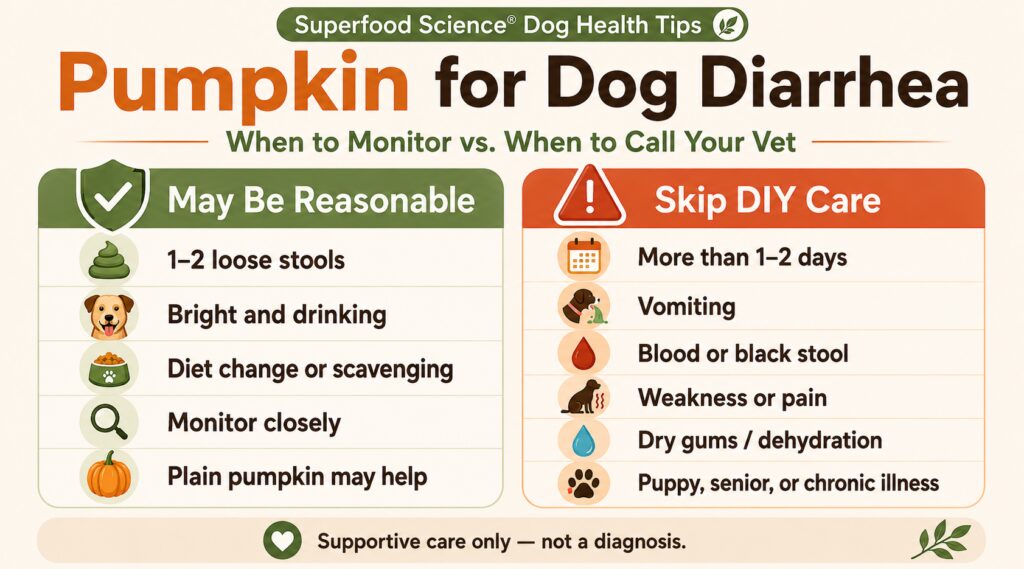
Decision Table: When Pumpkin May Be Reasonable vs. When to Skip DIY Care
| Situation | What it usually means | Safer next step |
| One or two loose stools, dog otherwise bright and drinking | A mild, uncomplicated episode may be possible | Monitor closely, keep water available, and plain pumpkin may be reasonable.^[1, 2] |
| Loose stool after an obvious diet change or scavenging, dog otherwise comfortable | Dietary upset is possible, not guaranteed | Simplify feeding, monitor closely, and pause extras.^[2, 8] |
| Repeated diarrhea for more than a day or two | No longer a casual wait-and-see situation | Call your veterinarian.^[3, 4] |
| Diarrhea plus vomiting | Higher dehydration risk and broader differential list | Veterinary guidance is the safer move.^[3, 4] |
| Blood in stool, black stool, marked straining, pain, or collapse | Potential urgent problem | Seek prompt veterinary care.^[4, 6] |
| Puppy, frail senior, or dog with chronic illness | Lower margin for home management | Contact your veterinarian sooner.^[3, 4] |
| Dry or pale gums, weakness, or inability to keep up with water intake | Dehydration risk | Prompt veterinary evaluation.^[3, 4] |
Which Pumpkin Is Safe for Dogs?
If pumpkin is used at all, it should be plain, 100% pumpkin puree, unsweetened, and unspiced.
When choosing canned pumpkin for dogs, avoid pumpkin pie filling, pumpkin desserts, pumpkin spice products, and any canned product with added sugar, xylitol, spices, or other flavorings.^[9]
This matters because ‘pumpkin’ on a label does not mean the product is dog-safe. Seasonal pumpkin foods often contain ingredients that are harmful to dogs.^[9] When dog parents ask if dogs can eat pumpkin for diarrhea, the answer depends partly on which product they reach for: plain puree only.^[9]
How Much Pumpkin Should You Give a Dog With Diarrhea?
The safest practical advice is to start small and avoid assuming that more is better.
This is one of the practical details that matters most when dog parents search ‘pumpkin for dog diarrhea’ and want a safe, proportionate answer. A little plain pumpkin mixed into food may be enough for some dogs. Large amounts can backfire by adding too much fiber at once, which can worsen stool consistency or cause gas.^[1, 7]
A vet-safe guide on pumpkin for dog diarrhea should not present pumpkin like a universal dose. When in doubt, ask your veterinarian about the right amount for your dog’s size, age, and condition.^[2, 3]
A Better Home-Care Mindset for Mild Diarrhea
The following guidance is supportive care, not a substitute for veterinary diagnosis or treatment.
For mild cases where owners are weighing pumpkin for dog diarrhea, the broader home-care framework matters as much as the pumpkin question itself.
- Watch the whole dog, not just the stool. Energy, hydration, appetite, comfort, and vomiting matter as much as stool consistency.^[3]
- Simplify the feeding plan. A highly digestible, simple diet is often more important than any single add-on.^[8]
- Keep water available. Fluid loss matters. Ongoing diarrhea can dehydrate dogs faster than many owners expect.^[3]
- Pause treats and extras. Even high-quality treats can complicate the picture when the gut is unsettled.^[2, 8]
- Escalate sooner if the pattern worsens. More episodes, blood, vomiting, pain, or poor appetite change the situation.^[3, 4]
When Pumpkin May Be the Wrong Fit
Pumpkin may be the wrong fit when:
- the dog is vomiting repeatedly^[3, 4]
- the stool is bloody or black^[4, 6]
- diarrhea is frequent or severe^[3, 5]
- the dog is lethargic or painful^[3, 4]
- dehydration is suspected^[3]
- there is a history of pancreatitis, chronic GI disease, or other significant health conditions^[5, 6]
- owners are using pumpkin to delay needed veterinary care^[2, 3]
The concern is not the pumpkin itself. The concern is using home care to postpone veterinary evaluation when the dog clearly needs professional attention.
Safety Guidance: When to Call a Vet
Contact your veterinarian promptly if your dog has:
- diarrhea lasting more than 24 to 48 hours^[3, 4]
- repeated vomiting^[3, 4]
- blood in the stool or black, tarry stool^[4, 6]
- weakness, collapse, marked lethargy, or abdominal pain^[3, 4]
- poor appetite or refusal to drink^[3]
- signs of dehydration such as dry or tacky gums or sunken eyes^[3]
- very frequent episodes in a short time^[4]
- underlying disease, or a puppy or senior dog^[3, 4]
Seek urgent care for severe bloody diarrhea, collapse, or weakness. Also seek immediate care for a swollen abdomen or inability to keep water down.^[4, 6]
How Superfood Science Treat Options Fit This Topic
For dogs that have fully returned to normal after a diarrhea episode, reintroducing treats thoughtfully is part of a careful, stable routine. Superfood Science treat options are made with clean-label, functional ingredients, giving owners a more intentional reward choice once their dog is clearly back to baseline.^[8]
This is educational brand positioning. No Superfood Science product treats diarrhea or digestive disease. Dogs with active or ongoing digestive symptoms should receive proper veterinary evaluation.
When a dog has active diarrhea, pause treats first. Focus on hydration, a simple feeding plan, and veterinary guidance if needed. Once the dog is clearly back to normal, Superfood Science products may fit as cleaner-label options in a gradual, intentional routine.^[8]
Dog parents who want to browse current Superfood Science dog treat options can visit: Shop Superfood Science Dog Treats.
Organic Turkey Dog Treats
For dogs that do well with turkey and are fully back to normal, Superfood Science Organic Turkey Dog Treats may fit as a simpler reintroduction option.
This line also includes beta-glucan-rich Agaricus mushrooms as part of a broader functional ingredient profile.
Organic Chicken Dog Treats
For dogs that tolerate chicken well and are fully back to normal, Superfood Science Organic Chicken Dog Treats may fit a straightforward, clean-label routine. This line includes ingredients such as turmeric and flaxseed as part of a more intentional formulation.
Plant-Based Protein Dog Treats
For owners who prefer a different ingredient direction after recovery, Superfood Science Plant-Based Protein Dog Treats may offer a thoughtful option. This line includes ingredients such as kelp, chia, and flaxseed as part of a broader plant-based ingredient profile.
The strongest compliant brand position is this: Superfood Science offers cleaner-label treat choices for dogs once they are stable and ready for a gradual, intentional treat routine.
Common Mistakes Dog Parents Make With Pumpkin
Knowing what not to do is just as important as knowing whether dogs can eat pumpkin for diarrhea safely.
- Using pumpkin pie filling instead of plain puree. Sweeteners, spices, and other add-ins can make things worse.^[9]
- Giving too much. Large amounts do not make pumpkin more therapeutic. Too much fiber can worsen stool consistency or cause gas.^[1, 7]
- Ignoring hydration. A stool-focused approach can miss the real risk: fluid loss. Dehydration can develop quickly in dogs with ongoing diarrhea.^[3]
- Restarting treats too quickly. Even after stool improves, the gut may still be sensitive. Rich chews or sudden treat reintroduction can trigger a setback.^[8]
- Waiting too long in a dog that is clearly not acting normal. A dog that is weak, vomiting, painful, or having frequent, urgent bouts of diarrhea is not a ‘try more pumpkin’ case. These signs call for veterinary evaluation.^[3, 4]
FAQs
Can dogs eat pumpkin for diarrhea?
Sometimes. Plain 100% pumpkin puree may help some mild diarrhea cases because fiber can help absorb excess water and support stool quality.^[1, 7] It is not appropriate for every situation, and it is not a substitute for veterinary care when the case is more serious.
Is pumpkin good for every dog with loose stool?
No. Some dogs need a highly digestible, bland diet, fluid support, diagnostic testing, or treatment of an underlying cause. Pumpkin may help in simple cases but is not universally appropriate.^[2, 5]
Is canned pumpkin safe for dogs?
Plain, unsweetened 100% pumpkin puree can be. Pumpkin pie filling and sweetened or spiced pumpkin products are not appropriate for dogs.^[9]
How fast should pumpkin work for dog diarrhea?
If it helps at all, owners may notice improvement within a bowel movement or two. The more important question is whether the whole dog is improving, not just the stool.^[2, 3]
Can pumpkin replace a bland diet for dogs?
Not really. Pumpkin is better viewed as a possible add-on, not a replacement for a simple, appropriate feeding strategy. A highly digestible diet is usually more important.^[8]
Should I give treats while my dog has diarrhea?
Not recommended. During active diarrhea, it is safer to pause treats and extras until the dog is stable again. Reintroduce gradually once clearly back to normal.^[8]
Conclusion
Pumpkin for dog diarrhea can be reasonable in mild, uncomplicated cases when the product is plain, unsweetened 100% pumpkin puree. But pumpkin is not the main story.^[1, 7]
The main story is whether your dog is hydrated, comfortable, eating, drinking, and improving overall.
For owners thinking more broadly about what to feed a dog with diarrhea, a simple, highly digestible diet is the foundation. Pumpkin for dog diarrhea is just one optional piece.
In mild cases, plain pumpkin may sometimes support stool quality. In persistent, bloody, or painful cases, or when vomiting is present, that is not a pumpkin moment. That is where dog parents do best by shifting from home remedies to veterinary guidance.^[3, 4]
Explore More Dog Health Tips
- Dog Diarrhea: What to Do First
- Probiotics and Prebiotics for Dogs: A Complete Guide
- What Are Superfoods? Hidden Hazards for Dogs and Cats
- Organic Dog Treats with Natural Ingredients: What Actually Matters
- Top-Rated Organic Dog Treats: How to Choose Safely Without Falling for the Hype
- Are Turkey Dog Treats Better Than Chicken for Dogs With Itching?
References
1. Merck Veterinary Manual. How Can Fiber Help with Diarrhea? Merck Veterinary Manual. Accessed May 29, 2026.
2. VCA Animal Hospitals. 8 Home Remedies for Diarrhea and 2 That Are Dangerous for Your Pet. VCA. Accessed May 29, 2026.
3. Cornell Richard P. Riney Canine Health Center. Diarrhea. Cornell University College of Veterinary Medicine. Accessed May 29, 2026.
4. American Animal Hospital Association. Help! Is This a Pet Emergency? AAHA. September 5, 2024. Accessed May 29, 2026.
5. Merck Veterinary Manual. Introduction to Digestive Disorders of Dogs. Merck Veterinary Manual. Accessed May 29, 2026.
6. Merck Veterinary Manual. Disorders of the Stomach and Intestines in Dogs. Merck Veterinary Manual. Accessed May 29, 2026.
7. Candellone A, Gianella P. Acute Diarrhea in Dogs: Current Management and Potential Role of Dietary Polyphenols. Animals. 2020;10(1):279.
8. Youngerman C. Nutritional Management of Gastrointestinal Disease. UC Davis School of Veterinary Medicine. April 12, 2019.
9. VCA Urgent Care. Fall Food Dos and Don’ts for Dogs. VCA. Accessed May 29, 2026.
10. Montserrat-Malagarriga M, et al. The Impact of Fiber Source on Digestive Function, Fecal Microbiota, and Immune Response in Adult Dogs. Animals. 2024;14(3):396. https://pmc.ncbi.nlm.nih.gov/articles/PMC10812474/ Accessed June 19, 2026.
11. Parada Venegas D, et al. Short Chain Fatty Acids (SCFAs)-Mediated Gut Epithelial and Immune Regulation and Its Relevance for Inflammatory Bowel Diseases. Front Immunol. 2019;10:277. https://www.frontiersin.org/journals/immunology/articles/10.3389/fimmu.2019.00277/full Accessed June 19, 2026.
