
Natural Peanut Butter for Dogs: Label Checks, Portions, and Xylitol Safety
A practical guide to choosing and portioning natural peanut butter for dogs without losing sight of the full treat budget
Quick Answer
Dogs can have small amounts of natural peanut butter when the ingredient list contains peanuts and no xylitol, birch sugar, wood sugar, or birch bark extract. Because peanut butter is calorie-dense and high in fat, use a thin measured smear, count it within the daily treat allowance, and ask a veterinarian about medical-diet restrictions.[1][3]
Key Takeaways
- Always read the current ingredient list; xylitol and its alternate names are toxic to dogs and require immediate veterinary or poison-control guidance after suspected ingestion.[1][2]
- Natural peanut butter for dogs should be plain and unsweetened, ideally with peanuts as the only ingredient or with minimal added ingredients.
- Peanut butter is calorie-dense and high in fat, so use a measured smear rather than an unmeasured spoonful.[3][4]
- Count peanut butter, training treats, chews, toppers, and table food within the same daily treat allowance.[4][5]
- Dogs with pancreatitis, obesity, diabetes, chronic GI disease, food allergy evaluation, or a veterinary therapeutic diet need individualized guidance.[3][6]
Is Natural Peanut Butter Safe for Dogs?
Plain, xylitol-free natural peanut butter for dogs can be used as an occasional reward, enrichment-food smear, or pill-hiding aid for many healthy dogs. The safety decision begins with the label, not the word natural on the front of the jar.
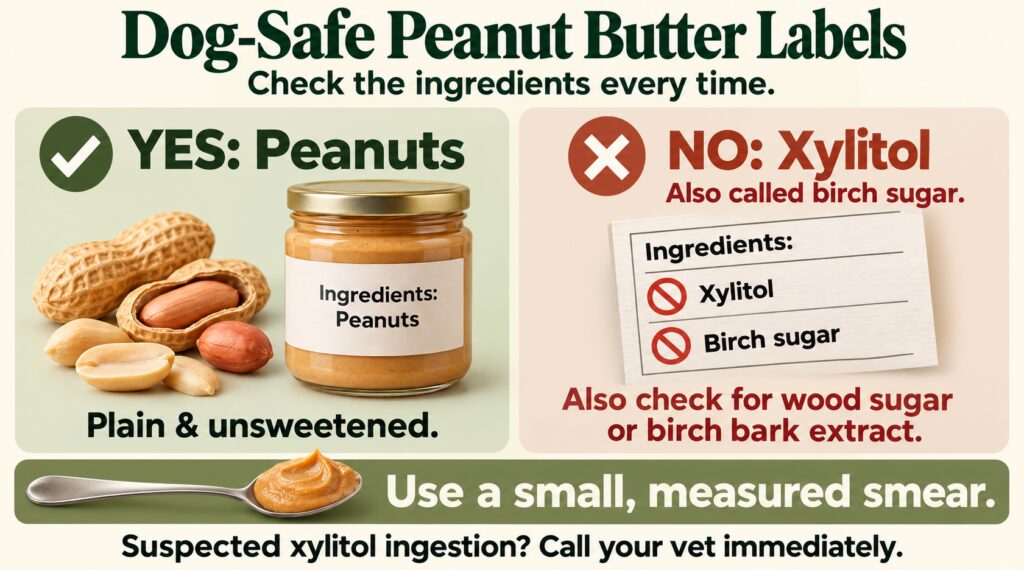
FDA warns that xylitol is dangerous to dogs and may also appear on labels as birch sugar, wood sugar, or birch bark extract. Merck Veterinary Manual explains that xylitol can trigger a rapid, dose-dependent insulin release in dogs, leading to profound hypoglycemia; larger exposures may also cause severe liver injury.[1][2]
| Emergency rule: If your dog may have eaten xylitol-containing peanut butter, do not wait for symptoms. Call your veterinarian, an emergency clinic, or animal poison control immediately.[1][2] |
How to Read a Peanut Butter Label for Your Dog
A short ingredient list makes the jar easier to evaluate, but every purchase deserves a fresh label check because formulations can change. Dog-safe peanut butter starts with the ingredient list, not sugar-free labeling, so choose xylitol-free peanut butter for dogs.[1]
| Label finding | What it means for dog parents | Action |
| Peanuts only | Simple, easy-to-understand formula | Use a small measured amount if appropriate for your dog |
| Peanuts plus salt | Adds sodium; may not fit every medical diet | Prefer unsalted or ask your veterinarian |
| Added sugar, syrups, or oils | Adds ingredients and may increase calorie density | Compare labels and keep portions small |
| Xylitol, birch sugar, wood sugar, birch bark extract | Potentially life-threatening for dogs | Do not feed; treat suspected exposure as an emergency |
| Unclear sugar alcohols or proprietary sweetener | The exact sweetener may be uncertain | Choose a clearly labeled alternative or contact the manufacturer |
How Much Natural Peanut Butter Can a Dog Have?
There is no universal peanut butter portion for dogs; each one depends on the individual. The safest practical method is to start with the dog’s veterinarian-recommended daily calorie target, reserve no more than about 10% for all treats, and check the peanut butter label for calories per tablespoon.[4][5]
Many peanut butters contain roughly 90 to 100 calories per tablespoon, although the exact number varies. That means one teaspoon can use around 30 calories before any training treats, chews, or table bites are counted. Verify the jar rather than relying on a generic estimate.
| Use case | Portion approach | Why it works |
| Lick mat or enrichment toy | Spread a very thin measured layer | Creates surface area without a large mound |
| Pill hiding | Use only enough to coat or conceal the medication | Keeps the calorie cost small |
| Training jackpot | Offer a tiny lick from a spoon or squeeze tool | High-value reward with measured delivery |
| First introduction | Start with a pea-sized taste | Makes tolerance easier to observe |
Peanut butter should not become the default way to fill an entire toy. A thin layer can provide the smell, taste, and licking experience dogs value while leaving room in the daily treat budget for countable rewards.
Natural Peanut Butter for Dogs vs. Countable Training Treats
Peanut butter and semi-soft treats solve different reward problems, since not all peanut butter dog treats are used the same way. Peanut butter is useful when licking duration or medication delivery matters; small mini-sticks are easier when precise timing, clean handling, portability, and calorie counting matter.
| Feature | Natural peanut butter | Semi-soft mini-stick |
| Best use | Licking enrichment, occasional high-value reward, pill concealment | Repeated training, walks, routine rewards |
| Portion visibility | Must be measured; thick smears are easy to underestimate | Countable full sticks that can be broken into smaller pieces |
| Handling | Sticky; needs a spoon, toy, or mat | Portable and easy to keep in a pouch |
| Primary safety check | No xylitol or ambiguous sweetener; watch total fat and calories | Protein fit, calories, texture, package freshness, individual tolerance |
How Superfood Science Treat Options Fit This Topic
Superfood Science semi-soft mini-sticks offer a countable alternative for moments when dog parents want cleaner handling and repeatable portions. Relevant options include organic turkey, organic chicken, and all-natural plant-based mini-sticks. The formulas are grain-free, non-GMO, made in the USA, and designed to be broken into smaller reward pieces.
Dog parents do not need to choose only one reward format. A measured smear of xylitol-free natural peanut butter can serve a high-value enrichment or medication moment, while semi-soft Superfood Science treats can handle the more frequent, countable rewards used during walks and training.
Choose the protein direction your dog already tolerates, introduce any new reward gradually, and count both peanut butter and mini-sticks within the same daily treat-calorie budget. For dogs on a veterinary therapeutic or elimination diet, ask the veterinarian before adding either option.[3][6]
Explore Superfood Science organic and natural dog treat options: Shop on Amazon
Safety Notes and When to Call a Veterinarian
The most urgent risk is xylitol exposure. Signs can include vomiting, weakness, lethargy, poor coordination, tremors, seizures, collapse, or coma, and signs may begin rapidly. Liver injury may appear later. Suspected exposure requires immediate professional guidance even if the dog still looks normal.[1][2]
- Call your veterinarian immediately for known or possible exposure to xylitol, birch sugar, wood sugar, or birch bark extract.
- Consult your veterinarian before using peanut butter for a dog with pancreatitis, hyperlipidemia, obesity, diabetes, chronic GI disease, or a prescribed low-fat diet.[3][6]
- Stop and seekprofessional veterinaryadvice for repeated vomiting, persistent diarrhea, abdominal pain, poor appetite, facial swelling, hives, or marked lethargy.
- Do not use peanut butter to hide medication unless the medication can be given with food and the full dose will be swallowed; ask the prescribing veterinarian when uncertain.
- Keep the jar and used enrichment toys away from dogs that may chew containers or swallow toy pieces.
Frequently Asked Questions
What natural peanut butter is safe for dogs?
Choose a clearly labeled product with peanuts as the only ingredient or a minimal ingredient list, ensuring no xylitol or alternate xylitol names, and preferably no added sugar or salt. Recheck every newly purchased jar because formulations can change.[1]
Can dogs have peanut butter every day?
A very small measured amount may fit some healthy dogs, but peanut butter is calorie-dense and high in fat. Daily use should stay within the full treat allowance and may not suit dogs with weight, pancreatic, metabolic, GI, or prescription-diet concerns.[3][4] It may also lose its effectiveness as a high-value treat if given every day.
How much peanut butter can I put in a dog toy?
Use a thin measured coating rather than filling the toy with an unmeasured amount. Check the label calories and subtract the serving from the dog’s total daily treat allowance.[4][5] Less is more: a dog that can swallow a glob of peanut butter in one gulp may lose interest sooner than one that has to lick up every square inch of a thin smear.
Is organic peanut butter automatically safe for dogs?
Organic sourcing can be a meaningful preference, but the ingredient list still controls the safety decision. Organic peanut butter must still be xylitol-free and appropriately portioned.
Can I use peanut butter to give my dog a pill?
Using peanut butter for pills works when given as a tiny, measured amount, but confirm that the medication can be given with food and that peanut butter fits the dog’s diet. Some medications should not be crushed or combined with certain foods.
What should I do if my dog ate xylitol peanut butter?
Call your veterinarian, an emergency clinic, or animal poison control immediately. Do not wait for symptoms and do not induce vomiting unless a veterinary professional specifically instructs you.[1][2]
What are known brands using xylitol?
Mainstream grocery brands such as Jif, Skippy, Peter Pan, and Smucker’s do not use xylitol, but specialty high-protein, keto, and low-carb nut butter brands frequently formulate with xylitol or its marketing aliases. Formulations change, so recheck the current label before every purchase.
Because xylitol is chemically a sugar alcohol (polyol) derived from plant fibers or hardwood, it may appear under several names on ingredient statements.[1] Common aliases include:
- Xylitol
- Birch sugar (sucre de bouleau)
- Wood sugar
- Birch bark extract
Known brands and product categories using xylitol:
- Nuts ‘N More (high-protein peanut spreads): One of the most prominent brands using xylitol across multiple flavored and protein-fortified peanut and almond spreads. A typical ingredient listing reads: peanuts, whey protein isolate, natural sweetener (xylitol), peanut oil, palm oil, and other ingredients.
- Krush Nutrition: Formulates specialty high-protein and dessert-flavored nut spreads sweetened explicitly with xylitol.
- P28 Foods (high-protein spreads): Uses xylitol in fortified nut spreads to keep sugar grams near zero while boosting protein content.
- Go Nuts, Co. and No Cow (formerly D’s Naturals): Specialty low-sugar and keto nut butter formulations historically using sugar alcohol blends that include xylitol.
Label verification checklist. When screening nut butters for xylitol or birch-derived sweeteners:
- Check the Total Carbohydrate panel: Look for a dedicated line for sugar alcohol (polyols). If it is non-zero and the product is marketed as sugar-free or low net carb, check the ingredient list immediately.
- Scan for alternative identifiers: In addition to xylitol, check for birch sugar, birch bark extract, wood sugar, or generic listings such as natural sweetener (xylitol derived).
Explore More Dog Health Tips
- Learn what natural ingredients mean on dog-treat labels
- Build a reward-value ladder for high-distraction training
- Compare daily portions in the low-calorie dog-treat guide
- Choose rewards thoughtfully for sensitive stomachs
- Review organic dog treats made in the USA
References
2. Merck Veterinary Manual. Xylitol Toxicosis in Dogs. Updated June 2025.
3. VCA Animal Hospitals. Treats to Skip and Treats to Share With Your Pet.
4. VCA Animal Hospitals. Using Food and Treats for Training Dogs. Updated May 22, 2026.
5. American Animal Hospital Association. 2014 AAHA Weight Management Guidelines for Dogs and Cats.
6. VCA Animal Hospitals. Dog Treats. Updated September 26, 2024.
