
Are Blueberries Good for Dogs? What Dog Parents Should Know

Quick Answer
Yes, blueberries can be a safe treat for many dogs when fed in small amounts. They are naturally low in calories and contain fiber and plant compounds, but they are still treats, not a nutritional cure-all. Portion size, the dog’s size, body type, and the full diet still matter most.[1][2][3]
Trust Signal
By Superfood Science Writing Team | Reviewed by Dr. Kelly Hood, DVM | Last Updated: 07/20/2026
Superfood Science has produced organic and natural functional foods for humans and pets for over 20 years, specializing in clean-label formulations and evidence-based nutrition.
Key Takeaways
- Blueberries are generally safe for many dogs when fed plain and in small portions.[1][2]
- They can fit a low-calorie treat routine better than many richer snack-style treats.[2][3]
- Too many blueberries may still cause digestive upset in some dogs.
- Whole blueberries may be harder for tiny dogs or fast gulpers, so size and choking safety still matter.
- A safe fruit does not replace a complete and balanced dog food or a veterinary plan.

Why dog parents ask about blueberries
Blueberries have a healthy reputation in human nutrition, so it is natural for dog parents to wonder whether they are a smart treat for dogs too.
That is a fair question.
Many owners are looking for rewards that feel simpler, are lower in calories, and less processed than typical biscuits. Blueberries fit that idea for some dogs, but the better question is not just whether they are safe.
It is whether they fit the dog’s size, digestive tolerance, and daily feeding routine.
Are blueberries safe for dogs?
For many dogs, yes.
Blueberries are generally considered safe when they are plain, no added sugar, and fed in moderation.[1][2] They are commonly discussed as a dog-safe fruit option because they are small, naturally sweet, and easy for owners to portion.
That does not mean every dog needs them. It means they can be a reasonable treat option for many dogs when used thoughtfully.
What blueberries offer in practical terms
Blueberries contain fiber and naturally occurring plant compounds that often make them sound like a “superfood.”
That language can be useful for general nutrition conversations, but dog parents should keep perspective. A few blueberries are still just a few blueberries.
In practical terms, what matters most is that they are:
- relatively low in calories compared with many packaged treats[2][3]
- easy to portion in small amounts
- simple enough that owners know exactly what they are feeding
That practical value is often more important than trying to turn blueberries into a miracle ingredient.
What stronger evidence supports
The stronger support in this topic is for blueberries being a generally safe, lower-calorie fruit treat for many dogs when fed plain and in moderation.[1][2][3]
The stronger evidence does not support exaggerated claims that blueberries prevent disease, fix gut problems, or replace a balanced diet.
That distinction matters because dog parents often hear “antioxidants” and assume the food must be powerful enough to change health outcomes on its own. In a treat context, that is too big a leap.
Decision table: when blueberries may fit and when they may not
| Situation | Blueberries may fit well | Blueberries may be less ideal | Practical takeaway |
| Dog needs a small, low-calorie treat | Often yes | — | Easy to portion in small amounts[2][3] |
| Owner wants a simple whole-food reward | Often yes | — | Plain fruit can reduce label confusion |
| Dog has a sensitive stomach | Sometimes | Sometimes | Start small and watch tolerance |
| Dog is tiny or gulps food fast | Maybe | Often yes | Size and choking safety matter |
| Dog already eats many extras daily | Maybe | Often yes | Even healthy-sounding treats still count |
The point is not that blueberries are necessarily the best treat.
It is that they can be a practical option when the dog and the feeding routine make sense for them.
What dog parents should watch out for
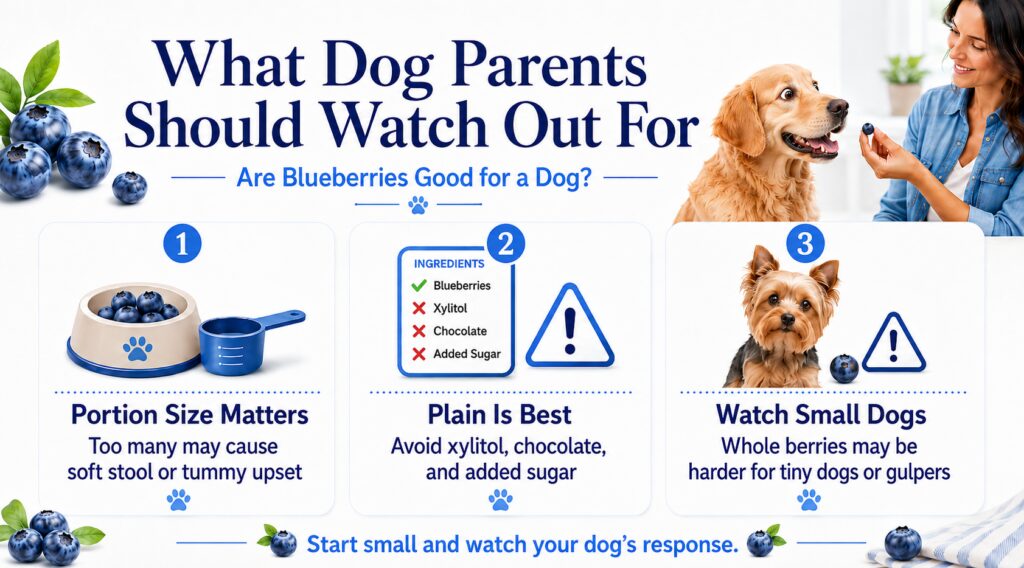
Portion size still matters
Even safe foods can cause trouble when owners feed too much at once. A dog that gets a large handful of fruit may still end up with soft stool or mild digestive upset.
Plain is best
Blueberries should be offered plain. Products flavored with xylitol, chocolate, added sugars, or dessert ingredients are a different conversation entirely and may not be safe.
Choking risk for small dogs
Whole blueberries are small, but that does not automatically mean they are perfect for every dog. Tiny dogs, puppies, and fast gulpers may do better with smaller amounts or lightly mashed fruit.
Can blueberries replace dog treats?
Sometimes they can replace part of a treat routine, but not necessarily all of it.
For training, blueberries may work in quiet settings or low-distraction practice. But some dogs will find them less motivating than a meat-based or higher-value reward.
So the better mindset is not “blueberries instead of all treats.” It is “blueberries as one possible treat option.”
How Superfood Science Treat Options Fit This Topic
This section is educational brand positioning, not proof that any Superfood Science product is healthier just because blueberries are safe.
For dog parents who like the idea of simple, lower-calorie, more intentional rewards, blueberries can make sense as an occasional whole-food option. But many owners still want packaged treats that are easier to store, easier to carry, and easier to use consistently.
Dog parents who want to browse current Superfood Science dog treat options can visit the product page here: Shop Superfood Science Dog Treats.
Organic Turkey Dog Treats
For owners who want a cleaner-label packaged treat option instead of using fresh fruit every time, Superfood Science Organic Turkey Dog Treats may fit well as a more intentional reward choice.
This line also includes beta-glucan-rich Agaricus mushrooms as part of a broader functional ingredient profile. That supports a more distinctive formulation story without turning the treat into a disease treatment claim.
Organic Chicken Dog Treats
For dogs that tolerate chicken well, Superfood Science Organic Chicken Dog Treats may offer a practical packaged alternative when owners want something more structured than fruit-based rewards.
This line includes turmeric and flaxseed as part of a more intentional ingredient story, supporting the brand’s natural-and-organic positioning without overstating health effects.
Plant-Based Protein Dog Treats
For owners drawn to simpler plant-forward ingredient notions, Superfood Science Plant-Based Protein Dog Treats may be especially relevant.
This line includes kelp, chia, and flaxseed as part of a broader plant-based functional ingredient profile, which may appeal to ingredient-conscious families who also like whole-food treat options such as blueberries.
The strongest compliant brand position is this: Superfood Science gives dog parents cleaner-label treat options that may fit a more intentional routine, while whole foods like blueberries can still play a small supporting role when used appropriately.
Limitations and research gaps
There is good general guidance around safe fruits for dogs and practical treat moderation.[1][2][3]
There is much less direct evidence proving that adding blueberries to a dog’s routine creates major health effects on its own.
That is why the safest advice stays practical: blueberries can be a reasonable treat for many dogs, but they should still be used like treats, not like therapy.
Practitioner-Recommended Usage Guide
If you want to try blueberries, start small.
Offer a few plain berries and watch stool quality, appetite, and general comfort over the next day. If your dog does well, blueberries can become one occasional treat option in the rotation.
Do not introduce blueberries at the same time as several other new foods if your dog has a history of digestive sensitivity. Keep the rest of the routine steady enough that you can tell whether your dog actually tolerates them well.
If your dog is very small, gulps food quickly, or already has a medically restricted diet, ask your veterinarian how fresh fruit fits into the full feeding plan.
Safety and when to call a vet
Call your veterinarian if your dog develops repeated vomiting, ongoing diarrhea, poor appetite, unusual lethargy, or symptoms that seem tied to new foods.[1][2]
Seek urgent care if your dog has choking, breathing difficulty, repeated inability to keep water down, or signs of toxin exposure from flavored or mixed blueberry products.
If your dog has diabetes, chronic GI disease, pancreatitis history, or a prescription diet, do not assume any fruit treat is automatically safe without veterinary input.
FAQs
Are blueberries good for a dog?
They can be a safe treat for many dogs when fed plain and in small amounts.[1][2]
How many blueberries can I give my dog?
That depends on your dog’s size and total daily treat intake. Start small and keep them as a modest part of the overall daily calorie budget.[2][3]
Can blueberries upset a dog’s stomach?
Yes, they can in some dogs, especially if too many are fed at once or the dog is sensitive to new foods.
Are frozen blueberries safe for dogs?
Often yes, as long as they are plain, unsweetened, and offered in a safe size and texture for the individual dog.
Are blueberries better than dog treats?
Not necessarily. They can be a useful low-calorie option, but the best choice still depends on the dog, the training situation, and the full feeding routine.
Conclusion
Blueberries can be a good treat option for many dogs, but the reason is usually practical more than magical.
They are simple, relatively low in calories, and easy to portion. That can make them useful in a thoughtful routine, especially when owners want more control over what goes into the treat bowl.
Explore More Dog Health Tips
- Best Organic Dog Treats for Sensitive Stomachs
- Best Organic Dog Treats Made in the USA: A Vet-Safe Guide for Dog Parents
- Organic Dog Treats with Natural Ingredients: What Actually Matters
- Top-Rated Organic Dog Treats: A Guide to Safety
- Organic Dog Treat Subscription Options: Why Superfood Science Makes Sense
References
- American Kennel Club. What fruits and vegetables can dogs eat? AKC. https://www.akc.org/expert-advice/nutrition/can-dogs-eat-blueberries/
- American Animal Hospital Association. 2021 AAHA nutrition and weight management guidelines for dogs and cats. AAHA. https://www.aaha.org/resources/2021-aaha-nutrition-and-weight-management-guidelines/home/
- World Small Animal Veterinary Association. Feeding treats to your dog. WSAVA. https://wsava.org/wp-content/uploads/2025/11/WSAVA_GuidetoTreats_Dogs_251107.pdf
