
Best Grain-Free Dog Treats: What Dog Parents Should Check First
Quick Answer
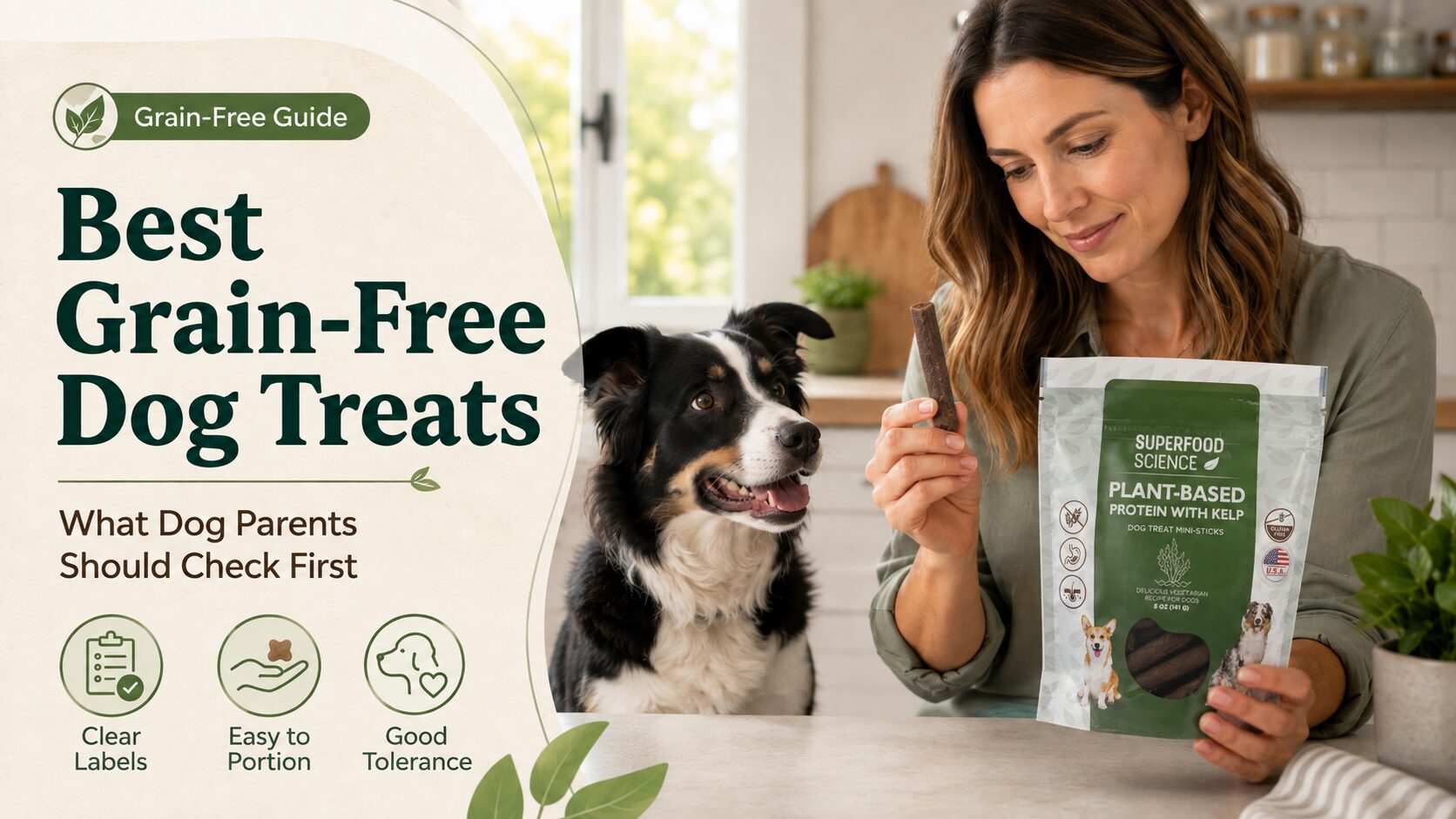
The best grain-free dog treats are clearly labeled, easy to portion, and well tolerated by your dog. Grain-free can be a smart clean-label preference, but it is not automatically better for every dog. The full formula, calories, protein source, and your dog’s real response matter most.^[1]^[2]^[3]
Trust Signal
By Superfood Science Writing Team | Reviewed by Dr. Kelly Hood, DVM | Last Updated: 8/6/2026
Superfood Science has produced organic and natural functional foods for humans and pets for over 20 years, specializing in clean-label formulations and evidence-based nutrition.
Key Takeaways
- Grain-free can be a meaningful formulation preference for dog parents who want a cleaner, more intentional treat routine.^[1]
- The best grain-free dog treat is not just “grain-free.” It is clear, portionable, and tolerated well by the individual dog.^[1]^[2]
- Treats should usually stay under about 10% of a dog’s daily calorie intake, even when they are organic, natural, or grain-free.^[3]
- Food reactions in dogs are often linked to specific proteins or full formulas, not grains alone.^[2]
- Dogs with chronic itching, digestive signs, weight loss, or known medical conditions need veterinary guidance before major diet changes, including treats.^[2]^[4]^[5]
Why dog parents look for the best grain-free dog treats
Dog parents often choose grain-free treats because the category feels cleaner, simpler, and more intentional. That preference can be reasonable, especially when the product also has clear ingredients, appropriate calories, and a format that is easy to use.
The key is to avoid judging the treat by one front-label claim. A grain-free dog treat still needs to fit the dog’s GI response, skin, weight, chewing style, and everyday routine.^[1]^[2]^[3]
What grain-free actually means
A grain-free dog treat does not contain cereal grains such as wheat, corn, rice, oats, or barley. That does not mean it is automatically simpler, low-calorie, low-carbohydrate, or allergy-free.
Many grain-free formulas use other carbohydrate sources, such as potato, sweet potato, tapioca, peas, lentils, chickpeas, or other legumes. These ingredients can work well in some formulas, but they still need to be evaluated as part of the whole recipe.^[1]^[4]^[5]
Think of grain-free as a useful formulation feature, not a complete quality guarantee.
What stronger evidence supports
Veterinary nutrition guidance generally supports choosing pet foods and treats by the full nutrition picture, the company’s quality controls, the label details, and the individual animal’s needs rather than by one marketing claim.^[1]
Most healthy dogs can digest properly prepared grains, so grain-free is not required for every dog. At the same time, a well-made grain-free treat can still be a strong fit for owners who prefer that style and for dogs that do well on a specific formula.^[1]^[2]
The strongest practical support is for choosing clear labels, keeping treats within the daily calorie plan, introducing changes gradually, and watching the dog’s actual response.^[1]^[2]^[3]
Why grain-free is not the same as allergy-free
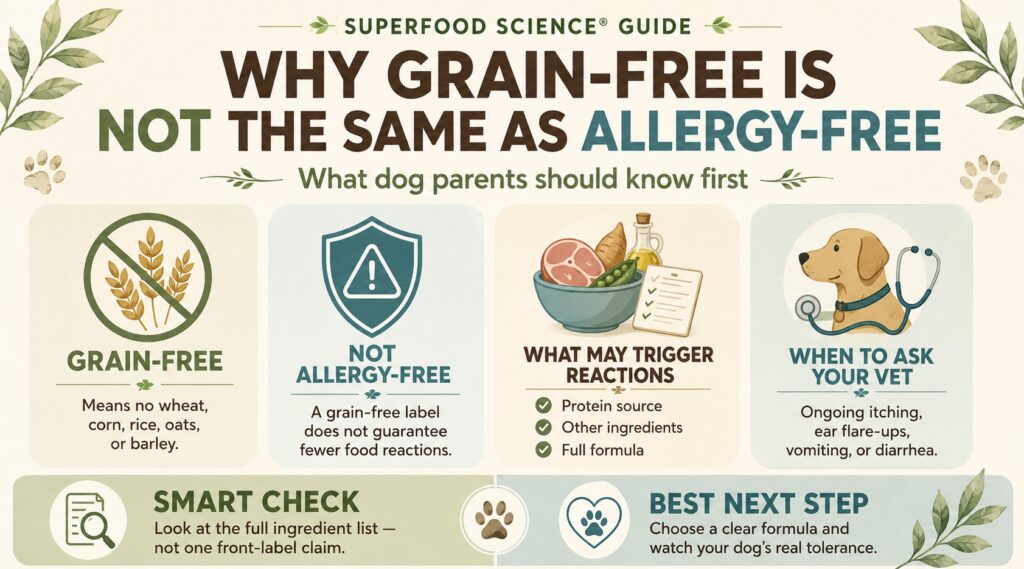
Grain-free does not automatically mean allergy-free. Dog food reactions are often linked to specific proteins or other ingredients in the total formula, not grains as a whole category.^[2]
That means a grain-free chicken treat may still be a poor fit for a dog that reacts to chicken. A grain-free treat with many added ingredients may also make it harder to identify what the dog actually tolerates or doesn’t.
For dogs with repeated itching, ear flare-ups, vomiting, diarrhea, or suspected food allergy, a veterinarian-guided food plan is safer than guessing from the front of the bag.^[2]
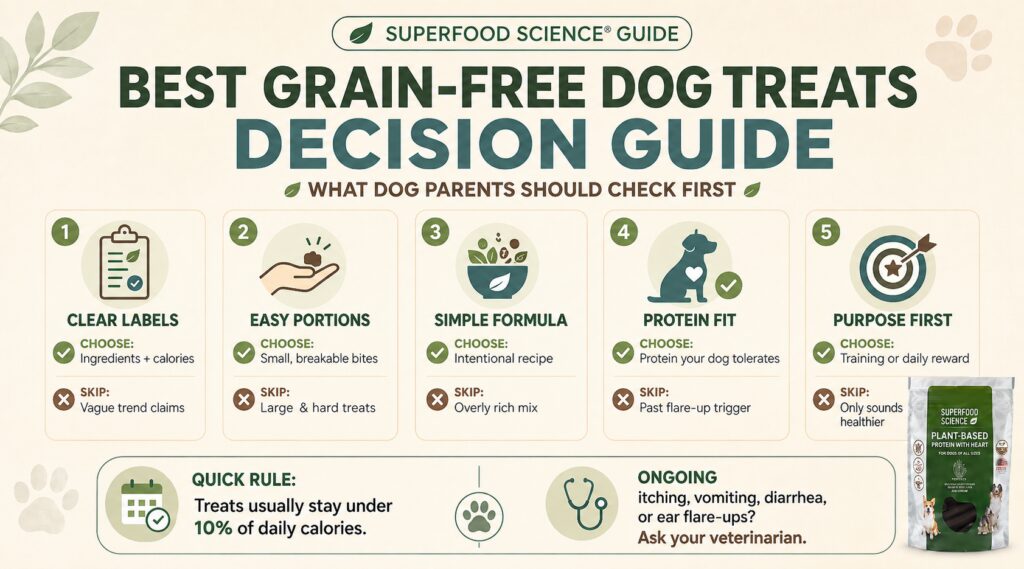
Decision table: what matters along with the grain-free label
| Treat feature | More helpful choice | Less helpful choice | Why it matters |
| Label clarity | Ingredient list and calorie details are easy to find | Trend-heavy wording with little practical information | Better decisions come from clearer information.^[1] |
| Portion control | Small, countable, breakable pieces | Large snack-style treats | Even grain-free treats still add calories.^[3] |
| Formula style | Clear, intentional recipe | Rich, highly mixed formula with many variables | A simpler routine makes tolerance easier to judge. |
| Protein fit | Protein source your dog already tolerates | Protein source tied to past flare-ups | Protein can matter more than grain status for some dogs.^[2] |
| Use case | Chosen for a clear reason: training, clean-label preference, or consistency | Chosen only because “grain-free” sounds healthier | Purpose helps prevent random treat changes. |
When grain-free treats may make especially good sense
Grain-free treats may make good sense when an owner already prefers that formulation style, the dog clearly does well on the formula, and the treat is otherwise clear, portionable, and easy to use.
They may also fit dog parents who want a cleaner-label reward routine, especially when the treat avoids unnecessary artificial colors, flavors, and hard-to-understand ingredient clutter. Ultimately, the dog’s real tolerance matters more than the category name.^[1]^[2]
Functional ingredients can add a cleaner-label story without becoming medicine
Premium grain-free treats often use non-grain carbohydrate sources or functional ingredients to create texture, flavor, and a more intentional nutrition story. This is where the full formula matters. Potato, tapioca, legumes, chia, flaxseed, kelp, turmeric, or mushrooms all have different roles in a recipe.
Beta-glucans are natural polysaccharides found in sources such as yeast and mushrooms. In canine nutrition research, beta-glucan ingredients have been studied for their ability to interact with gut-associated immune pathways and the fecal microbiome, but results depend on source, dose, diet, and dog population.^[6]^[7]
For a dog treat, that means beta-glucan-rich ingredients can be described as part of a functional ingredient profile that may support normal wellness. They should not be described as treating allergies, digestive sensitivities, immune disease, or any medical condition.^[6]^[7]
Treat Calorie Audit: the 10% rule in real life
A grain-free treat can still become “too much” if the daily treat total gets too high. WSAVA guidance says treats should generally make up no more than about 10% of a dog’s daily calories.^[3]
Use this simple audit before changing treat routines:
- Estimate your dog’s daily calorie target from your veterinarian, the food label, or a veterinary feeding plan.
- Multiply that number by 0.10. That is the rough daily calorie budget for dog treats.
- Check the treat’s calories per piece or per gram.
- Divide the treat-calorie budget by the calories per treat piece.
- Adjust meals if your veterinarian tells you to, especially for dogs with weight, pancreatitis, diabetes, or other medical concerns.
Example: If a dog’s daily target is 500 calories, the treat budget is about 50 calories. If one small treat piece is 5 calories, that is about 10 pieces per day. If you break a semi-soft treat into smaller rewards, you can make the same treat budget last longer during training. This is a planning shortcut, not a medical prescription.^[3]
The grain-free and DCM conversation
Some dog parents hear “grain-free” and feel reassured. Others hear it and worry about dilated cardiomyopathy, or DCM.
The FDA has investigated reports of non-hereditary DCM in dogs associated with both grain-free and grain-containing diets. The FDA has not concluded that grain-free alone is the single cause, and many reported diets had high levels of non-soy legumes or pulses such as peas and lentils.^[4]^[5]
The safe takeaway is neither panic nor blind confidence. Choose products thoughtfully, look beyond front-label claims, and involve your veterinarian if your dog has heart disease, breed risk, unusual tiredness, coughing, trouble breathing, or a need for a full diet review.^[4]^[5]
How Superfood Science Treat Options Fit This Topic
This section is educational brand positioning. No Superfood Science product diagnoses, treats, prevents, or cures any medical condition. The goal is to help dog parents understand how different clean-label treat options may fit a thoughtful routine.
For dog parents who care about ingredient clarity, semi-soft texture, and an intentional reward routine, grain-free can be an attractive feature when it is paired with organic ingredients, all-natural positioning, non-GMO standards, made-in-the-USA production, and practical portion control.
Dog parents who want to browse current options can visit: Shop Superfood Science Dog Treats.
Organic Turkey Dog Treats
Superfood Science Organic Turkey Dog Treats may fit dog parents who want a cleaner-label, grain-free reward built around a turkey protein direction. The semi-soft, organic, all-natural, non-GMO, made-in-the-USA format supports a premium routine that is easy to portion.
This line also includes beta-glucan-rich Agaricus mushrooms as part of a broader functional ingredient profile. A compliant way to explain this is that beta-glucans are nutrition-support compounds studied for gut-associated immune signaling and microbiome effects in dogs, while the treat itself remains a food reward, not a medical product.^[6]^[7]
Organic Chicken Dog Treats
Superfood Science Organic Chicken Dog Treats may fit dogs that tolerate chicken well and families who want a straightforward, clean-label reward. Its grain-free, semi-soft, organic, all-natural, non-GMO, made-in-the-USA positioning makes this treat a practical everyday option for portion-aware dog parents.
The best use case is not “chicken for every dog.” It is chicken for dogs that already do well with chicken and need a treat that fits the rest of the feeding plan.^[1]^[2]
Plant-Based Protein Dog Treats
Superfood Science Plant-Based Protein Dog Treats may fit dog parents who want a different ingredient direction while staying within a grain-free, semi-soft format. Ingredients such as kelp, chia, and flaxseed support a broader plant-forward formulation story.
This option may appeal to ingredient-conscious families looking beyond standard meat-based treats. As with any treat, the right fit depends on the individual dog’s tolerance, calories, and total diet.^[1]^[2]^[3]
The strongest compliant brand position is this: Superfood Science gives dog parents cleaner-label, grain-free treat choices that can fit a more intentional routine, while the dog’s actual tolerance and full feeding plan still matter more than one label alone.
Limitations and research gaps
There is good veterinary guidance around food selection, calorie control, food-reaction workups, and the need to avoid simplistic label claims.^[1]^[2]^[3]
There is much less strong evidence supporting blanket statements such as “grain-free is best for every dog.” There is also no single front-label term that can diagnose why a dog has itching, loose stool, ear flare-ups, or poor appetite.^[2]
The practical gap is real: owners often use “sensitive stomach” to describe many different problems. A dog may react to richness, portion size, protein source, treat frequency, abrupt diet change, or an unrelated medical issue. That is why a careful routine beats label guessing.^[2]^[3]
Suggested Care Guide
If your dog is doing well on the current routine, there is usually no evidence-based reason to change everything just because a new label sounds better.
If you want to try a grain-free treat, choose one that is clearly labeled, easy to portion, and otherwise simple. Keep the rest of the routine steady long enough to judge stool quality, appetite, activity, skin comfort, and general tolerance.^[1]^[2]
Introduce the new treat gradually. Start with a small amount, keep the daily treat calories under control, and watch for vomiting, diarrhea, itching, ear irritation, appetite changes, or behavior changes.^[2]^[3]
If your dog has recurring digestive or skin signs, simplify the full diet picture rather than focusing only on whether grains are present. Review treats, toppers, table scraps, chews, supplements, and recent food changes with your veterinarian.^[2]
Safety and when to call a vet
Call your veterinarian if your dog has chronic diarrhea, repeated vomiting, ongoing itching, recurrent ear flare-ups, weight loss, poor appetite, blood in stool, coughing, trouble breathing, or symptoms that keep returning around food changes.^[2]^[4]^[5]
Seek veterinary guidance before using restrictive homemade plans or major diet shifts for puppies, senior dogs, dogs with chronic medical conditions, suspected food allergy, pancreatitis history, heart disease, or dogs already eating a prescription diet.^[1]^[2]^[4]^[5]
FAQs
Are grain-free dog treats healthier?
Not necessarily. Grain-free can be a meaningful feature when the formula is clear, portionable, and tolerated well, but the full recipe and calorie plan matter more than the label alone.^[1]^[2]^[3]
Do dogs need grain-free treats?
Most dogs do not specifically need grain-free treats. Many healthy dogs can do well with properly prepared grains, but some dog parents prefer grain-free formulas and some dogs do well on a specific grain-free treat.^[1]^[2]
Can grain-free treats help sensitive stomachs?
Sometimes a specific grain-free formula may fit a dog better, but “grain-free” does not explain or resolve every sensitive-stomach issue. Portion size, richness, protein source, abrupt changes, and medical problems can all matter.^[2]^[3]
Are grain-free treats better for itchy dogs?
Not necessarily. Food-related skin issues are often tied to specific proteins or full formulas rather than grains alone. Dogs with ongoing itching or ear flare-ups should be evaluated by a veterinarian.^[2]
What matters most when choosing grain-free dog treats?
Look for clear labeling, appropriate calories, a protein source your dog tolerates, simple portion control, and a formula that fits the dog’s actual response over time.^[1]^[2]^[3]
How many grain-free treats can my dog have per day?
A helpful starting point is the 10% rule: treats should usually stay under about 10% of daily calories. Divide that treat-calorie budget by the calories per piece to estimate a daily limit.^[3]
Conclusion
The best grain-free dog treat is not the one with the loudest front-label claim. It is the one that fits the dog’s real needs, has a formula you can understand, and supports the cleaner, more intentional reward routine many dog parents want.
Grain-free can be a strong product feature. It works best when paired with clear ingredients, portion control, individual tolerance, and veterinary guidance when symptoms or medical conditions are part of the picture.
Explore More Dog Health Tips
- Best Organic Dog Treats for Sensitive Stomachs
- Best Organic Dog Treats Made in the USA: A Vet-Safe Guide for Dog Parents
- Organic Dog Treats with Natural Ingredients: What Actually Matters
- Top-Rated Organic Dog Treats: A Guide to Safety
- Organic Dog Treat Subscription Options: Why Superfood Science Makes Sense
References
1. World Small Animal Veterinary Association. Guidelines on selecting pet foods. WSAVA. https://wsava.org/wp-content/uploads/2021/04/Selecting-a-pet-food-for-your-pet-updated-2021_WSAVA-Global-Nutrition-Toolkit.pdf
2. VCA Animal Hospitals. Food allergies in dogs. VCA. https://vcahospitals.com/know-your-pet/food-allergies-in-dogs
3. World Small Animal Veterinary Association. Feeding treats to your dog. WSAVA. https://wsava.org/wp-content/uploads/2024/06/Feeding-treats-to-your-dog-v2.pdf
4. U.S. Food and Drug Administration. FDA investigation into potential link between certain diets and canine dilated cardiomyopathy. FDA. https://www.fda.gov/animal-veterinary/outbreaks-and-advisories/fda-investigation-potential-link-between-certain-diets-and-canine-dilated-cardiomyopathy
5. U.S. Food and Drug Administration. Questions and answers: FDA’s work on potential causes of non-hereditary DCM in dogs. FDA. https://www.fda.gov/animal-veterinary/animal-health-literacy/questions-answers-fdas-work-potential-causes-non-hereditary-dcm-dogs
6. Lin, C. Y., Carroll, M. Q., Miller, M. J., Rabot, R., & Swanson, K. S. (2020). Supplementation of yeast cell wall fraction tends to improve intestinal health in adult dogs undergoing an abrupt diet transition. Frontiers in Veterinary Science, 7, 597939. https://doi.org/10.3389/fvets.2020.597939
7. Marchi, P. H., Vendramini, T. H. A., Perini, M. P., et al. (2024). Effects of increasing levels of purified beta-1,3/1,6-glucans on the fecal microbiome, digestibility, and immunity variables of healthy adult dogs. Microorganisms, 12(1), 113. https://doi.org/10.3390/microorganisms12010113
