
Best Dog Treats for Sensitive Stomachs: A DVM-Reviewed 2026 Guide

Quick Answer: The best dog treats for sensitive stomachs are simple, clearly labeled, easy to portion, and introduced slowly. Look for a formula your dog tolerates within the full diet, not a treat that promises to “fix” symptoms. Repeated vomiting, diarrhea, poor appetite, weight loss, or blood in stool should prompt veterinary guidance.[1][2][3]
Trust Signal
By Superfood Science Writing Team | Reviewed by Dr. Kelly Hood, DVM | Last Updated: 08/19/2026
Superfood Science has produced organic and natural functional foods for humans and pets for over 20 years, specializing in clean-label formulations and evidence-based nutrition.
Key Takeaways
- “Sensitive stomach” is a useful owner observation, not a diagnosis by itself.[3][4]
- Simpler treat formulas reduce variables, which makes tolerance easier to track, but they do not diagnose food allergy.[3][4][5]
- Treats should generally stay under 10% of daily calories so the complete diet still does the nutritional work.[1][2]
- Large intact proteins and glycoproteins are more likely to matter in true food hypersensitivity; hydrolyzed or controlled-protein veterinary diets are used when a diagnostic diet trial is needed.[4][5][6]
- Functional ingredients such as beta-glucans should be discussed only as immune-support ingredients, using careful non-treatment language.
Why this topic gets confusing so quickly
Many dog parents use “sensitive stomach” to describe loose stool, occasional vomiting, gas, stomach noises, or a dog seeming worse after certain foods. That observation is useful, but it is still broad. Similar signs can happen after overfeeding, abrupt food changes, rich treats, food intolerance, food allergy, scavenging, parasites, infection, pancreatitis risk, or non-diet medical issues.[1][3][4]
That is why the best dog treats for sensitive stomachs are usually not the ones with the loudest marketing claim. They are the treats that make the routine easier to understand: fewer moving parts, reasonable portions, a clear ingredient story, and enough consistency that you can tell whether your dog is actually tolerating it.
What stronger evidence supports
The strongest practical evidence in this topic supports calorie awareness, nutrition assessment, ingredient clarity, and knowing when symptoms deserve a veterinary workup. AAHA nutrition guidance emphasizes body condition, diet history, calorie planning, and the role of the complete diet, while WSAVA’s treat guidance keeps treats as extras rather than the nutritional foundation.[1][2]
For suspected food allergy or adverse food reaction, veterinary sources support a structured elimination-challenge diet trial rather than casual treat swapping. A dog that improves after a simple treat change gives you useful information, but that improvement does not prove a specific allergy or replace a controlled diagnostic plan.[3][4][5]
The nutritional immunology “why”: why simpler treats may help owners see patterns
A simpler formula may help because it reduces the number of dietary antigens and nonessential extras entering the digestive routine. In true adverse food reactions, the immune system most often reacts to proteins or glycoproteins. When the intestinal mucosal barrier is irritated or compromised, larger intact food proteins may have more opportunity to interact with immune cells in the gut and contribute to hypersensitivity patterns in susceptible dogs.[4][5][6]
This does not mean every dog with loose stool has an allergy. It means a shorter, clearer treat formula can make the owner’s observation cleaner. If a dog is eating the same complete diet and you change only one treat variable, stool quality, vomiting, gas, appetite, and itch patterns are easier to interpret.
Hydrolyzed veterinary diets illustrate the deeper biology. Hydrolysis breaks proteins into smaller pieces so they are less likely to be recognized by the immune system, which is why hydrolyzed or novel-protein diets may be used in veterinary elimination trials. Retail treats are not a substitute for those trials, but the same logic explains why protein simplicity matters when a dog’s diet history is confusing.[4][6]
Retail limited-ingredient treats also have a practical limitation: they are not manufactured to the same diagnostic standard as prescription elimination diets. A treat labeled with a single protein may still be made in facilities or on conveyor lines that also handle other proteins. For a highly allergic dog, possible cross-contact is one reason a retail “pure turkey” or “single-protein” treat can fail even when the front label looks simple.[4][6]
What makes a treat a better fit for a sensitive stomach
A better-fit treat usually has a short, understandable ingredient story, moderate calories, and one clear protein direction. The goal is not to make the treat medically powerful. The goal is to make the feeding routine easier to manage.
For dogs with sensitive stomachs, consistency matters. Rotating between rich chews, table scraps, toppers, new treats, and new supplements can overload the digestive pattern and make it almost impossible to identify what changed. A steady routine, small portions, and a simple tracking period give dog parents better information than constant experimentation.[1][2][3]
Decision table: what usually helps more and what usually helps less
| Treat feature | More helpful choice | Less helpful choice | Clinical terms / physiological patterns | Why it matters |
| Ingredient list | Shorter, clearer formula | Long, highly mixed recipe | Food-responsive enteropathy / dietary intolerance | Fewer variables make tolerance easier to track.[3][4] |
| Calories | Small, moderate reward | Rich snack-style treat used often | Calorie excess / dietary indiscretion | Rich extras can crowd out the complete diet and upset digestion.[1][2] |
| Protein strategy | One main protein direction | Multiple meat sources plus extras | Adverse food reaction / food hypersensitivity | Protein clarity matters when reactions are suspected.[4][5] |
| Protein form | Clear retail protein for routine use; veterinary diet trial if symptoms persist | Casual “hypoallergenic” guessing | Elimination-challenge diet trial / hydrolyzed protein | Diagnosis requires a controlled veterinary plan.[4][6] |
| Stool pattern | Track stool, vomiting, appetite, energy, and itch | Change several foods at once | Osmotic diarrhea / dietary indiscretion patterns | Stable routines create better observations.[1][3] |
| Daily use | Planned small portions | Random extras throughout the day | Treat-related GI upset | Dose and frequency matter even with clean-label treats.[1][2] |
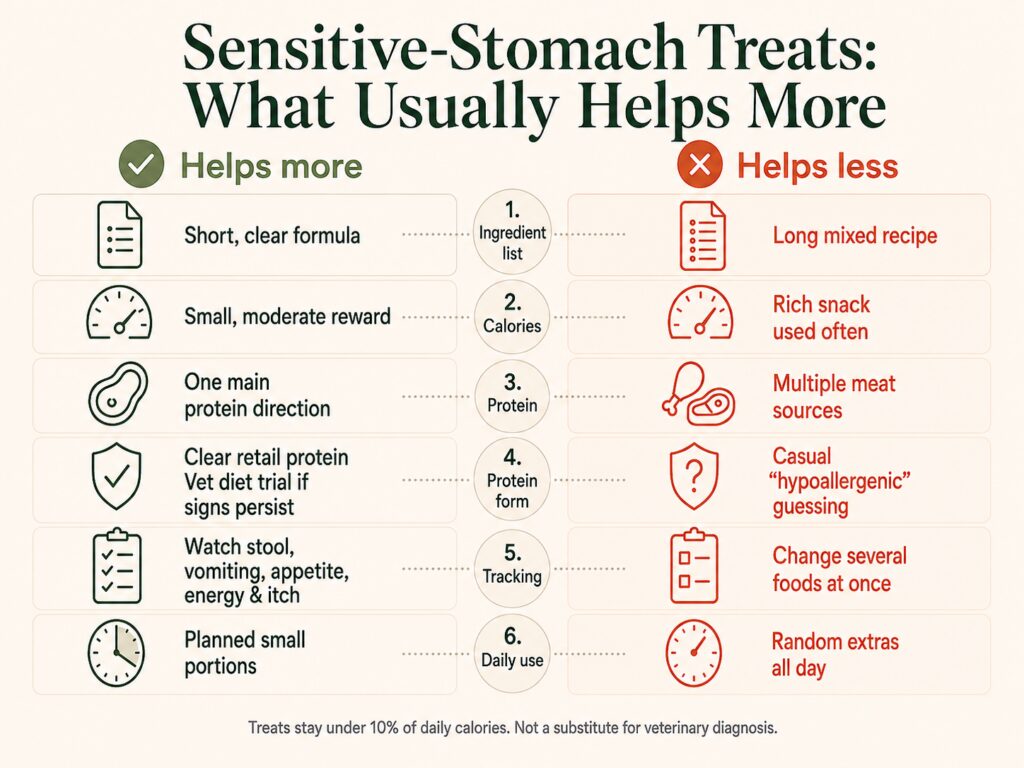
The point is not that every dog needs a limited-ingredient treat forever. It is that simpler choices usually make it easier to see what is actually working.
Why cleaner-label features can still be a real advantage
For many dog parents, clean-label dog treats matter. Organic, all-natural, grain-free, non-GMO, and made-in-the-USA positioning can be meaningful positives when owners want a more intentional routine and a clearer ingredient story.
Those features should not be presented as medical therapies for digestive distress. They are buying high-quality filters. The real sensitive-stomach screen is still practical: Does the formula fit the dog’s full diet, is the portion small enough, and does the dog tolerate it over repeated use?
A sensitive stomach is not always a food allergy
This distinction matters. A dog with digestive upset after treats does not automatically have a true food allergy. Veterinary guidance explains that food allergy confirmation depends on a structured elimination-challenge diet trial, not casual guesswork.[3][4]
If a dog has recurring vomiting, loose stool, poor appetite, weight loss, repeated ear or skin flare-ups, or mixed digestive and skin signs, the next step may be a more careful veterinary plan rather than another bag of treats.[3][4][5]
When dog parents should be more cautious
Some dogs need a lower threshold for veterinary input. That includes dogs with repeated vomiting, chronic diarrhea, weight loss, poor appetite, lethargy, black or bloody stool, recurring itchiness plus GI signs, known pancreatitis, chronic GI disease, prescription diets, or a very young age.[1][3][4]
In those dogs, even a clean-label treat still needs to fit the full medical picture. A treat can be part of routine maintenance, but it should not be used to manage ongoing clinical signs without veterinary guidance.
Life-stage nuance: why puppies need extra caution
Puppies are not simply small adult dogs. They are still building and developing immune, digestive, skeletal, and microbiome stability, and large-breed puppies have especially narrow growth-nutrition margins. Rich treats, raw treats, frequent extras, or high-mineral snacks can disrupt the balance of a complete puppy growth diet and may crowd out the controlled calcium, phosphorus, protein, and calorie profile the puppy actually needs.[1]
For a 3-month-old large-breed puppy with a sensitive stomach, the safer approach is boring on purpose: use tiny portions, avoid raw or overly rich retail treats, introduce only one new item at a time, and ask the veterinarian before adding treats if vomiting, diarrhea, poor growth, or poor appetite is present.[1][3]
How Superfood Science Treat Options Fit This Topic
If a dog is actively vomiting, losing weight, having chronic diarrhea, or showing blood in stool, the answer is not to keep cycling through random treats just because they are natural or organic.
Dog parents who want to browse current Superfood Science dog treat options can visit: Shop Superfood Science Dog Treats
Note: The following guidance is supportive care designed for routine dietary maintenance, not a substitute for professional veterinary diagnosis or therapeutic clinical trials.
Organic Turkey Dog Treats
If a dog seems sensitive with certain proteins or richer formulas, Superfood Science Organic Turkey Dog Treats may fit as a cleaner-label option in a more intentional treat routine. Its semi-soft texture can be easy to portion, while the organic, all-natural, grain-free, non-GMO, made-in-the-USA formulation supports the controlled routine many ingredient-conscious owners want.
This line also includes Agaricus mushroom as part of a broader functional ingredient profile. The compliant way to explain this ingredient is as a beta-glucan-containing mushroom component associated with immune-support nutrition, not as a treatment for GI disease. In dogs, oral beta-1,3/1,6-glucan has been studied for changes in total and antigen-specific IgA and IgM, and canine macrophage research suggests beta-glucans can influence trained innate immune responses.[7][8] In plain terms, this means the ingredient may support a healthy immune system.
Organic Chicken Dog Treats
For dogs that tolerate chicken well, Superfood Science Organic Chicken Dog Treats can still fit a structured clean-label routine. Chicken should not be treated as “bad” by default. It is only a concern when the dog’s history, veterinary plan, or elimination trial suggests chicken is worth avoiding due to previous adverse reactions.[4][5]
The practical fit is consistency: a semi-soft treat that can be portioned thoughtfully and used without adding many new variables to the dog’s day.
Plant-Based Protein Dog Treats
For owners who want a different ingredient direction, Superfood Science Plant-Based Protein Dog Treats may offer another thoughtful option. Its semi-soft, grain-free format stays brand-consistent, while kelp, chia, and flaxseed support a broader plant-based functional ingredient story.
This can appeal to ingredient-conscious families who want a different reward style within a simpler routine. As with any treat, the dog’s response and the full feeding plan matter more than the label category.
The strongest compliant brand position is this: Superfood Science gives dog parents more than one cleaner-label option to build a more intentional treat routine, but individual tolerance, portion control, and the full diet still matter more than any one product label.
How beta-glucans fit the immune-support story without overclaiming
Beta-glucans are structural polysaccharides found in fungal cell walls. In nutrition science, they are often discussed because immune cells such as macrophages and dendritic cells have pattern-recognition receptors, including Dectin-1, that can recognize certain beta-glucan structures. Canine macrophage research suggests beta-glucans can train innate immune responses in dogs, while oral beta-glucan research in dogs has measured changes in immunoglobulin patterns.[7][8]
For a sensitive-stomach treat article, the safe interpretation is modest. Agaricus mushroom helps create a distinctive functional ingredient story, but it does not make a treat a therapy for vomiting, diarrhea, food allergy, inflammatory bowel disease, or immune disease. The product role is routine wellness support within a tolerated diet, not clinical treatment.
Limitations and research gaps
There is useful veterinary guidance around GI red flags, food-allergy workups, treat moderation, hydrolyzed diets, and nutrition assessment.[1][2][3][4][6]
There is much less direct head-to-head evidence proving that one retail treat category is universally best for every dog with a so-called sensitive stomach. That is partly because “sensitive stomach” is not one diagnosis. It is a cluster of owner observations that can come from multiple causes.
That is why the safest advice stays practical: choose clearer, simpler treats, introduce them gradually, keep portions small, and pay close attention to what your dog actually tolerates.
Suggested Usage Guide
If your dog has a history of stomach sensitivity, simplify the treat routine first. Simple dog treats for sensitive stomachs make that easier: choose one treat direction, keep portions small, and avoid changing the food, treats, toppers, and supplements all at once.
Watch stool quality, vomiting, appetite, energy, gas, itchiness, and general comfort over several days. If your dog improves, that may be useful information, but it still does not diagnose a food allergy or GI condition. If symptoms keep returning, move from shopping decisions to a veterinary plan.[3][4]
Safety and when to call a vet
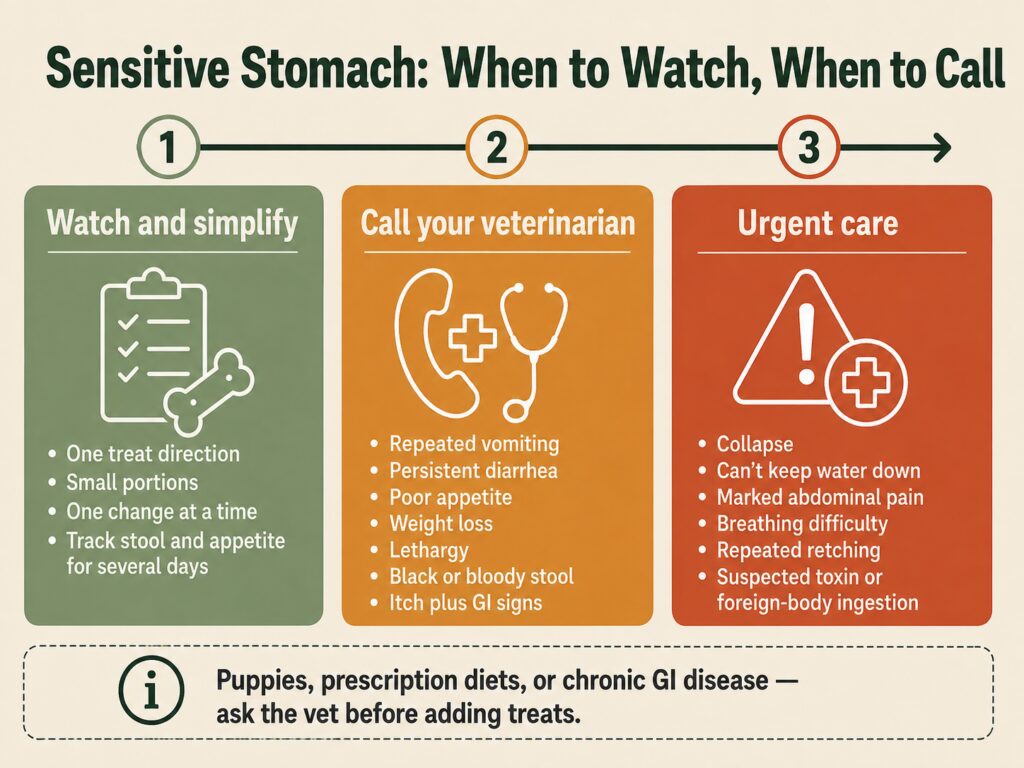
Call your veterinarian sooner rather than later if your dog has repeated vomiting, persistent diarrhea, poor appetite, weight loss, black or bloody stool, signs of weakness, or dehydration.[1][3][4]
Seek more urgent care if your dog has collapse, repeated inability to keep water down, marked abdominal pain, breathing difficulty, repeated retching, suspected toxin exposure, or suspected foreign-body ingestion.
If your dog is already on a prescription diet or has chronic GI disease, do not add treats casually without veterinary guidance.
FAQs
What are the best dog treats for sensitive stomachs?
Usually the best dog treats for sensitive stomachs are simple, clearly labeled treats that fit the dog’s overall diet, are given in small portions, and are well tolerated over repeated use.[1][2][3]
Can dog treats cause diarrhea?
Yes. Rich treats, abrupt ingredient changes, too many treats, or treats added on top of other diet changes can contribute to digestive upset in some dogs.[1][3]
Are natural treats better for dogs with sensitive stomachs?
Natural dog treats for sensitive stomachs can appeal to owners who value cleaner sourcing, and natural or organic features can be meaningful quality filters, but they do not guarantee digestive tolerance. Ingredient simplicity, calorie moderation, and the dog’s actual response matter most.
Are limited-ingredient dog treats the same as a food allergy diet trial?
No. Limited-ingredient dog treats for sensitive stomachs can reduce variables, but diagnosing food allergy requires a structured elimination-challenge diet trial guided by a veterinarian.[3][4][6]
Should I switch treats often to find the right one?
Usually no. Rapid switching makes it harder to understand what your dog actually tolerates. A steadier routine gives you clearer information.
When should I stop guessing and call the vet?
If vomiting, diarrhea, poor appetite, weight loss, blood in stool, or repeated flare-ups continue, it is time for veterinary guidance rather than more trial and error.[1][3][4]
Conclusion
The best dog treats for sensitive stomachs are usually not the most exciting ones. They are the treats that are simple, clearly labeled, moderate in richness, easy to portion, and easy to fit into a steady feeding routine.
Cleaner-label features can be real positives too, as long as they are framed correctly. They support a more intentional buying decision, not a medical promise. For dogs with ongoing symptoms, the smartest next step is veterinary guidance, not endless treat switching.
Explore More Dog Health Tips
- If you are looking for a curated selection, see our guide to the best organic dog treats for sensitive stomachs.
- For ingredient-conscious owners who care about sourcing, read best organic dog treats made in the USA.
- To understand label terms before you buy, review organic dog treats with natural ingredients.
- For a broader safety-first buying framework, compare our top-rated organic dog treats guide.
- If you prefer a planned routine instead of last-minute shopping, explore organic dog treat subscription options.
References
1. American Animal Hospital Association. (2021). 2021 AAHA nutrition and weight management guidelines for dogs and cats. AAHA. https://www.aaha.org/resources/2021-aaha-nutrition-and-weight-management-guidelines/home/ Accessed June 30, 2026.
2. World Small Animal Veterinary Association. (2025). Feeding treats to your dog. WSAVA. https://wsava.org/wp-content/uploads/2025/11/WSAVA_GuidetoTreats_Dogs_251107.pdf Accessed June 30, 2026.
3. VCA Animal Hospitals. (n.d.). Food allergies in dogs. https://vcahospitals.com/know-your-pet/food-allergies-in-dogs Accessed June 30, 2026.
4. VCA Animal Hospitals. (n.d.). Implementing an elimination-challenge diet trial: Dog. https://vcahospitals.com/know-your-pet/implementing-an-elimination-challenge-diet-trial-dog Accessed June 30, 2026.
5. Mueller, R. S., Olivry, T., & Prélaud, P. (2016). Critically appraised topic on adverse food reactions of companion animals (2): Common food allergen sources in dogs and cats. BMC Veterinary Research, 12, 9. https://doi.org/10.1186/s12917-016-0633-8
6. Cave, N. J. (2006). Hydrolyzed protein diets for dogs and cats. Veterinary Clinics of North America: Small Animal Practice, 36(6), 1251-1268. https://doi.org/10.1016/j.cvsm.2006.08.008
7. Stuyven, E., Verdonck, F., Van Hoek, I., Daminet, S., Duchateau, L., Remon, J. P., Goddeeris, B. M., & Cox, E. (2010). Oral administration of beta-1,3/1,6-glucan to dogs temporally changes total and antigen-specific IgA and IgM. Clinical and Vaccine Immunology, 17(2), 281-285. https://doi.org/10.1128/CVI.00344-09
8. Paris, S., Chapat, L., Pascal, G., Larcher, T., & Abadie, J. (2020). Beta-glucan-induced trained immunity in dogs. Frontiers in Immunology, 11, 566893. https://doi.org/10.3389/fimmu.2020.566893
