
Can Dog Treats Go Bad? Storage, Expiration, and Safety Signs
Quick Answer
Can dog treats go bad? Yes. Heat, humidity, oxygen, time, and damaged packaging can reduce freshness or increase safety concerns. Check the best-by date, reseal the original package, store treats below 80°F in a dry place, and discard any product with mold, insects, unusual moisture, malodor, discoloration, or damaged packaging.
Trust Signal
By Superfood Science Writing Team | Reviewed by Dr. Kelly Hood, DVM | Last Updated: 09/14/2026
Superfood Science has produced organic and natural functional foods for humans and pets for over 20 years, specializing in clean-label formulations and evidence-based nutrition.
Key Takeaways
- Dog treats can become stale, rancid, moldy, contaminated, or otherwise unsuitable for consumption when exposed to heat, moisture, oxygen, pests, or damaged packaging.
- Soft treats require careful resealing because their water activity is typically higher than that of bone-dry biscuits, which can make moisture control especially important.
- Natural antioxidants such as mixed tocopherols or rosemary extract can slow oxidation, but they do not replace airtight, cool, dark storage.
- Keep the original package and lot number, and discard treats with visible mold, insects, malodor, discoloration, greasy seepage, swelling, leaking, or unusual moisture — the clearest signs dog treats are spoiled.
- Call a veterinarian promptly if a dog develops vomiting, diarrhea, weakness, facial swelling, tremors, breathing difficulty, or another concerning change after eating a treat.
Why Dog Treat Freshness Matters
Just like human food, can dog treats go bad? Absolutely. Dog treats contain fats, proteins, carbohydrates, and moisture that can change over time. Heat speeds chemical reactions, oxygen promotes rancidity, humidity can raise available moisture, and damaged packaging can allow contamination or pests.
A treat may become stale without becoming dangerous, but appearance alone cannot prove safety. The best approach is to protect the package contents from the start, follow label directions, and pay attention to the best-by date, package integrity, odor, texture, and your dog’s response.
What Stronger Evidence Supports
FDA guidance recommends keeping pet food and treats in their original bags or containers whenever possible. The package preserves the product name, manufacturer, UPC, lot number, and best-by date, which are important if a quality concern or recall occurs. The FDA also recommends storing dry pet food in a cool, dry place below 80°F and using clean, dry, tightly fitting containers when secondary storage is needed.^[1]^[2]^[3]
These storage steps do more than prevent mess. They limit the three major drivers of quality loss: moisture migration, oxygen exposure, and heat. For soft treats, controlling moisture is especially important because microbial growth depends on water activity, not simply the percentage of water listed in the food.^[4]^[5]
Best-By Date Versus an Immediate Safety Deadline
So, do dog treats expire the moment the date passes? Not exactly. So, do dog treats expire the moment the date passes? Not exactly. A best-by date is generally a manufacturer’s quality marker, not a promise that a product becomes unsafe at midnight on that date. However, it should not be ignored. Package integrity, storage history, formulation, water activity, antioxidant system, and after-opening instructions all affect how well a treat holds its intended quality.
When in doubt, follow the label and contact the manufacturer. Do not rely on smell alone to prove safety, and do not keep a questionable product simply because your dog still wants it.
How Dog Treats Commonly Lose Quality
Heat Accelerates Chemical Change
Heat speeds many degradation reactions. FDA guidance recommends keeping dry pet food and treats below 80°F because excess heat and moisture can contribute to nutrient breakdown.^[2] A garage, parked car, sunny windowsill, or hot delivery area is not an ideal long-term storage location.
Water Activity Explains Why Soft and Semi-Soft Treats Need Care
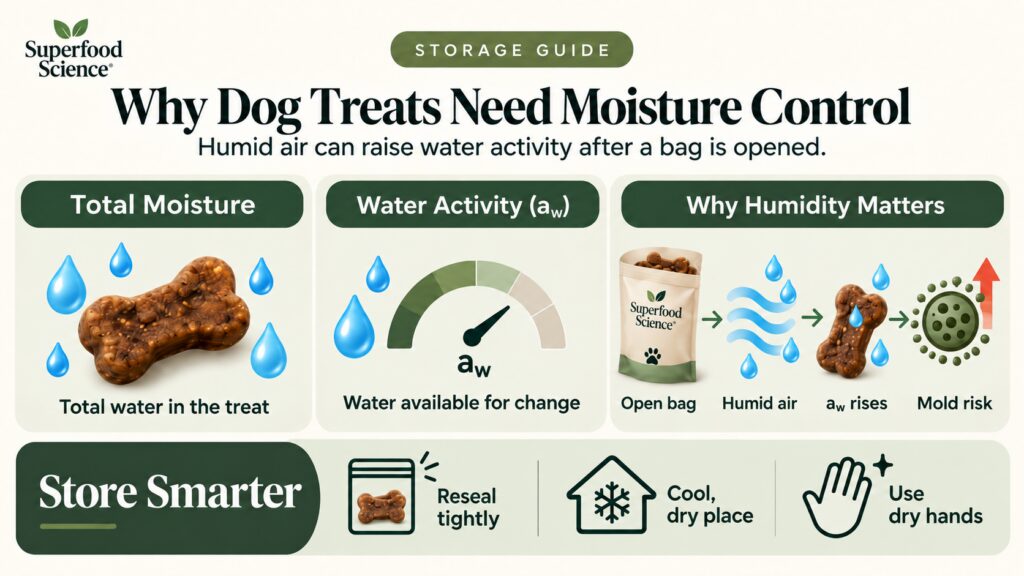
Water activity (a_w) measures how much water is available to support microbial activity and chemical change — understanding water activity in dog treats is key to preventing spoilage. It is different from total moisture. Two treats may have similar moisture percentages but different water activities because ingredients bind water differently.^[4]
Soft foods generally contain more available moisture than dry biscuits. Research on stored pet food found that water activity moved toward the surrounding humidity and that bacterial, yeast, and fungal counts increased as water activity rose.^[5] Research on semi-moist pet food likewise describes its higher moisture content as a reason mold control is necessary.^[8] This is why a resealable barrier package and dry handling matter: humid air, wet hands, or a damp scoop can shift the product toward conditions that favor spoilage.
Lipid Oxidation Creates Rancid Odors Before Mold Appears
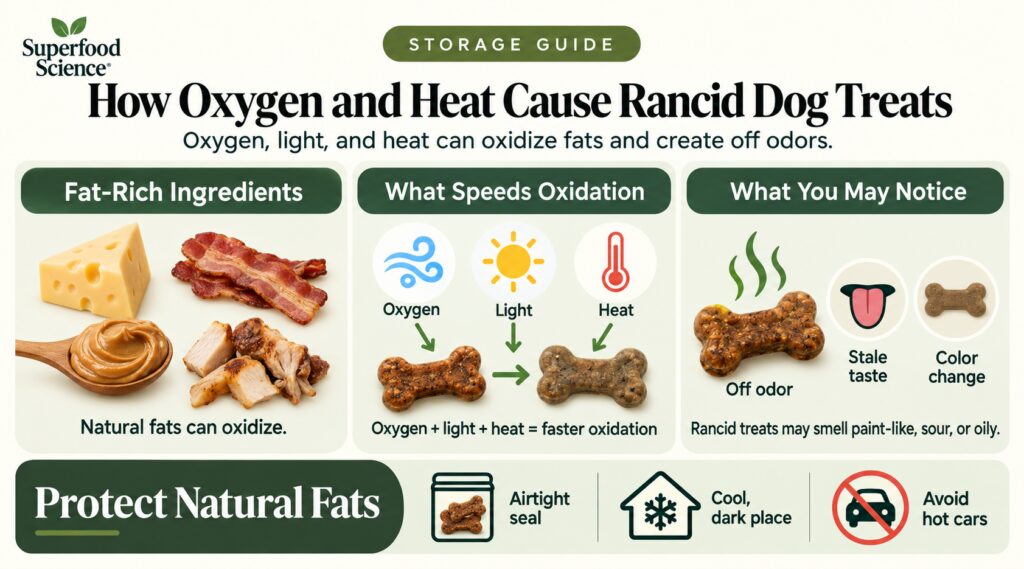
Chicken, turkey, flaxseed, chia, and other nutrient-rich ingredients naturally contain fats. When those fats are repeatedly exposed to oxygen, light, and heat, they can undergo lipid oxidation. The reaction forms oxidation products that change aroma, flavor, color, and nutrient quality. In pet food research, greater oxidation was associated with stronger rancid aroma during storage and lower consumer liking.^[6]
A dog’s sensitive nose may notice an odor change before a person sees mold. That does not make smell a complete competent safety test, but an unusual oily, paint-like, sour, or stale odor is one of the clearest signs of rancid dog treats and a practical reason to stop and inspect the package.
Natural Preservatives Slow Oxidation but Do Not Stop Time
Clean-label formulas may use natural antioxidant systems such as mixed tocopherols, which are forms of vitamin E, or rosemary extract. These ingredients can interrupt oxidation chain reactions and help protect fats. Food studies show that rosemary extract can delay oxidative deterioration, although performance depends on the food matrix, dose, packaging, oxygen exposure, and storage temperature.^[7]
Natural antioxidants and synthetic preservatives such as BHA or BHT work through different formulations and should not be treated as interchangeable on a one-for-one basis. The practical point for dog parents is simpler: even a well-designed antioxidant system has limits. Airtight, dark, cool storage remains a functional part of preserving clean-label treats, especially after opening.
Dirty Containers, Damaged Packaging, and Pests
Residual fat and crumbs from an older bag can remain in a container and expose the new product to stale oils or contamination. FDA recommends washing and thoroughly drying storage containers between bags.^[1] Tears, punctures, broken seals, or evidence of vermin are reasons to stop using the product; FDA also advises buyers not to purchase visibly damaged packages.^[2]
Decision Table: Keep It or Throw It Away?
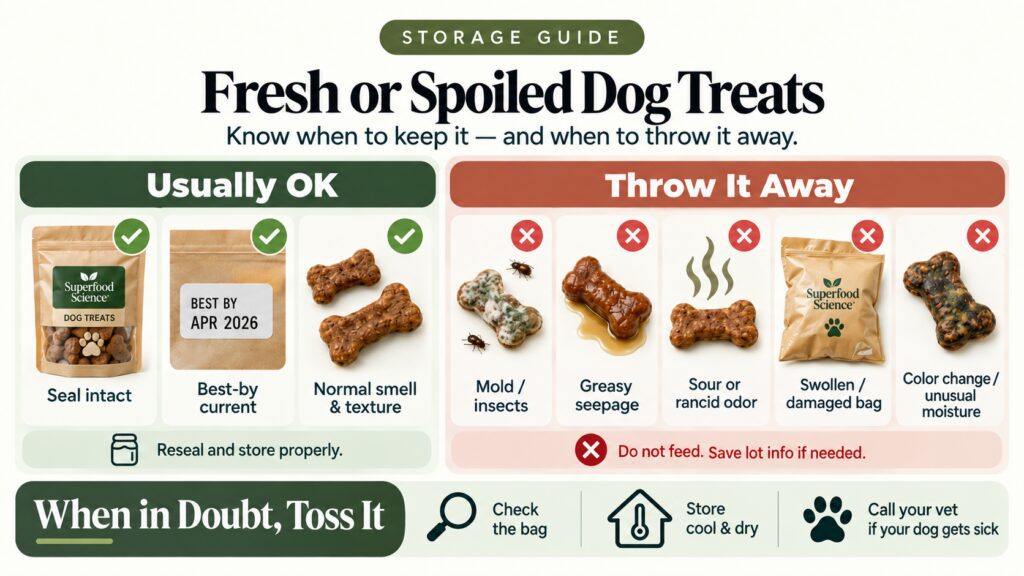
| What You Notice | What It May Mean | Recommended Action |
| Package intact, date current, normal odor and texture | Product appears consistent with proper storage | Reseal and continue following label directions |
| Treats are dry or slightly stale but otherwise normal | Quality or palatability may have declined | Replace if the texture or aroma is no longer acceptable; contact the manufacturer if unsure |
| Mold, insects, webbing, unusual moisture, or foreign material | Possible contamination or storage failure | Stop feeding and discard securely |
| Paint-like, sour, rancid, or unusual odor; discoloration; greasy seepage | Possible lipid oxidation, spoilage, or product defect | Stop feeding; preserve the package and contact the manufacturer |
| Swollen, leaking, torn, punctured, or broken package seal | Package integrity may be compromised | Do not feed; preserve lot details and report when appropriate |
| Dog vomits, has diarrhea, becomes weak or lethargic, develops facial swelling or hives, or is otherwise ill | Possible adverse event, although the cause is not proven | Stop the product, call a veterinarian, and save the package and lot details |
The Safest Storage Routine for Dog Treats
Still wondering, can dog treats go bad even when the bag looks normal? Yes, especially when repeated opening introduces humid air, crumbs, or contamination. Here’s how to store dog treats correctly, step by step, to reduce avoidable quality loss:
- Keep the original package whenever possible.
- Check the best-by date and photograph the lot number before discarding any packaging.
- Press out excess air and reseal the bag after every use.
- Store treats in a cool, dry, dark cabinet away from direct sun, appliances, garages, and hot vehicles.
- If using a secondary container, place the closed original bag inside it when practical.
- Wash and fully dry the container before adding a new product
- Use clean, dry hands or utensils; never return treats from a used training pouch to the main bag.
- Keep only a small daily amount in a training pouch and empty crumbs regularly.
- Follow any refrigeration or use-after-opening directions printed on the label.
How Superfood Science Treat Options Fit This Topic
This section provides educational brand context. No food package is immune to the normal risks of storage.
Superfood Science dog treats are semi-soft, all-natural, grain-free, non-GMO, and made in the USA. Its semi-soft eating experience makes moisture and package control especially relevant, which is the same logic behind proper soft and semi-soft dog treat storage. Resealing promptly helps protect texture and aroma, while cool, dark storage helps limit oxidation of naturally occurring fats.
Limitations and Research Gaps
There is no universal number of days that every opened dog treat remains ideal. Shelf life depends on formulation, processing, packaging barrier properties, water activity, antioxidant systems, storage conditions, and label instructions. The manufacturer’s package directions are therefore more useful than a generic rule.
Water activity also does not tell the whole safety story. Some organisms can survive in low-moisture foods even when they cannot grow, and appearance or smell cannot detect every hazard. If the product’s storage history is uncertain or the package has been compromised, replacement is usually the safer choice.^[4]
Suggested Usage Guide
Write the opening date on the package if the treats are used slowly. Keep only a practical amount in the daily training pouch, refill it with clean, dry hands, and do not mix a new bag into old crumbs. For travel, use a clean, sealed container and never leave treats in a hot vehicle.
If a treat looks, feels, or smells different from the same product you normally buy, pause before feeding it. Photograph the product, date code, and lot number, preserve the original package, and contact the manufacturer for product-specific guidance.
Safety and When to Call a Vet
Stop feeding a product and call your veterinarian if your dog develops repeated vomiting, persistent diarrhea, weakness, unusual lethargy, abdominal pain, tremors, trouble breathing, facial swelling, collapse, or another concerning change after eating it. The treat may or may not be the cause, but the symptoms deserve prompt attention. In short, can dog treats go bad? Yes — which is exactly why quick action matters. In short, can dog treats go bad? Yes — which is exactly why quick action matters.
FAQs
Can dog treats go bad before the best-by date?
Yes. Heat, humidity, oxygen exposure, damaged packaging, pests, wet handling, or contamination can affect a product before its printed date. A best-by date assumes the package has remained intact and the product has been stored as directed.^[1]^[2]
Are dog treats safe after the best-by date?
Not necessarily. A dog treat best-by date is usually a quality marker, but safety and suitability depend on the formula, package condition, storage history, and label instructions. Contact the manufacturer rather than relying on a universal grace period.
Do mixed tocopherols or rosemary extract prevent dog treats from spoiling?
They can help slow the oxidation of fats, but they do not make a product spoil-proof. Heat, oxygen, light, moisture, packaging, and time still influence quality, so the bag should remain tightly sealed and stored in a cool, dark, dry place.^[7]
Should dog treats be refrigerated after opening?
Only when the label says so, or the product is designed for refrigeration. Refrigerating a shelf-stable product unnecessarily can introduce condensation when the bag repeatedly warms and cools, so follow the manufacturer’s directions.
Can I put dog treats in a plastic storage container?
Yes, if it is food-safe, clean, fully dry, and tightly closed. Keeping the original bag inside the container is preferable because it retains the product label, best-by date, lot number, and package barrier.^[1]
Explore More Dog Health Tips
- Best Organic Dog Treats Made in the USA
- Organic Dog Treats with Natural Ingredients: What Actually Matters
- Top-Rated Organic Dog Treats: A Guide to Safety
- Organic Dog Treat Subscription Options
- Turkey vs. Chicken: Which Protein Is Better for Your Dog’s Treats?
References
1. U.S. Food and Drug Administration. Proper Storage of Pet Food & Treats. https://www.fda.gov/animal-veterinary/animal-health-literacy/proper-storage-pet-food-treats
2. U.S. Food and Drug Administration. Tips for Safe Handling of Pet Food and Treats. https://www.fda.gov/animal-veterinary/animal-health-literacy/tips-safe-handling-pet-food-and-treats
3. U.S. Food and Drug Administration. How to Report a Pet Food Complaint. https://www.fda.gov/animal-veterinary/report-problem/how-report-pet-food-complaint
4. U.S. Food and Drug Administration. Water Activity (a_w) in Foods. https://www.fda.gov/inspections-compliance-enforcement-and-criminal-investigations/inspection-technical-guides/water-activity-aw-foods
5. Gómez, R., Vioque, M., Sánchez, E., & Fernández-Salguero, J. (1997). Changes in water activity and some microbial groups during storage of pet feed. Acta Microbiologica et Immunologica Hungarica, 44(2), 155-164. https://pubmed.ncbi.nlm.nih.gov/9330664/
6. Chanadang, S., Koppel, K., & Aldrich, G. (2016). The impact of rendered protein meal oxidation level on shelf-life, sensory characteristics, and acceptability in extruded pet food. Animals, 6(8), 44. https://doi.org/10.3390/ani6080044
7. Guo, M., Yang, L., Li, X., Tang, H., Li, X., Xue, Y., & Duan, Z. (2023). Antioxidant efficacy of rosemary extract in improving the oxidative stability of rapeseed oil during storage. Foods, 12(19), 3583. https://doi.org/10.3390/foods12193583
8. Deliephan, A., et al. (2023). Effects of liquid smoke preparations on shelf life and inhibition of mold growth in semi-moist pet food. Journal of Animal Science. https://pubmed.ncbi.nlm.nih.gov/37152755/
