
Allergy Treats for Dogs: What Dog Parents Should Look For Before Buying

Quick Answer
The best allergy treats for dogs are simple, clearly labeled, easy to portion, and chosen around your dog’s real symptom pattern. They can support a cleaner at-home treat routine, but they cannot diagnose or treat a food allergy. If itching, ear flare-ups, vomiting, or diarrhea recur, ask your veterinarian before continuing to experiment. [1][2][3]
Trust Signal
By Superfood Science Writing Team | Reviewed by Dr. Kelly Hood, DVM | Last Updated: 07/17/2026
Superfood Science has produced organic and natural functional foods for humans and pets for over 20 years, specializing in clean-label formulations and evidence-based nutrition.
Key Takeaways
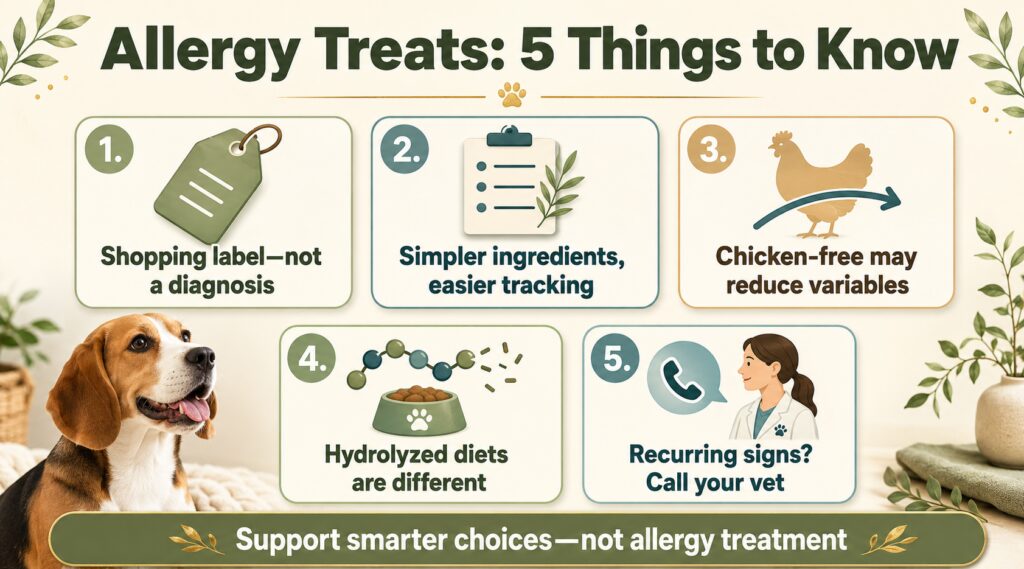
- “Allergy treats for dogs” is a useful shopping phrase, but it is not a diagnosis. [1][2]
- A limited-ingredient or chicken-free treat may help reduce at-home variables, but that strategy should not replace a veterinary food-allergy workup. [2][3]
- Chicken is among the more commonly reported food allergens in dogs, but many itchy dogs have non-food causes. [1][4]
- Hydrolyzed veterinary diets are different from retail “allergy treats” because the proteins are intentionally broken into smaller pieces for controlled diet trials. [3][5]
- Puppies, dogs with weight loss, chronic diarrhea, repeated vomiting, or recurring ear/skin flare-ups prompt accurate veterinary guidance. [1][6]
Why Dog Parents Search for Allergy Treats
Most dog parents do not begin with a confirmed diagnosis. They begin with a pattern: the dog seems itchy after certain treats, the ears flare again, stool becomes loose, or vomiting follows a diet change. Searching for allergy treats for dogs is often a practical attempt to make the routine simpler and safer.
That line of thought makes sense, but the next step should be structured. A retail treat may reduce ingredient variables and help you observe tolerance more clearly. It still cannot prove a food allergy by itself, and it should not be used to keep “testing” a dog whose symptoms are persistent or worsening. Veterinary sources consistently emphasize that suspected food allergy requires a controlled elimination and challenge process, not casual trial and error. [2][3][5]
What a Food Allergy Means Versus a Food Sensitivity
A true food allergy is an immune-mediated reaction to something in the diet, usually a protein or protein-associated molecule. In simple terms, the dog’s immune system misidentifies a normally harmless dietary component as a threat and overreacts to it. Veterinary references describe food allergy as an exaggerated immune response to an otherwise tolerated food component. [1]
Food sensitivity or intolerance is a looser at-home colloquial phrase. Dog parents often use it when a dog has loose stool, gas, vomiting, or digestive inconsistency after a food or treat, even when the mechanism has not been shown to be a classic immune allergy. That distinction matters because a treat-shopping strategy is not the same as a diagnostic strategy. [2][3]
The practical takeaway: limiting variables at home can be a reasonable management strategy while you observe patterns. It should be framed as better tracking or information gathering, not as a clinical diagnosis. If symptoms recur, your veterinarian can help decide whether a formal food trial, parasite testing, skin evaluation, or another diagnostic path is needed. [2][3]
Why Limited-Ingredient Treats Can Help With At-Home Tracking
Limited-ingredient treats are useful because they make the routine easier to interpret. When a dog eats food, three toppers, four treat types, chews, flavored medications, and table scraps, it becomes almost impossible to identify what changed.
A simpler treat does not “cure” food sensitivity. It simply gives dog parents fewer moving parts to monitor. This is why clearer labels, one main protein source, controlled portions, and consistent timing can be more helpful than dramatic front-of-bag claims. [2][3][7]
What About Hydrolyzed Protein?
Hydrolyzed protein is a veterinary diet innovation, not just a marketing word. In hydrolyzed diets, proteins are broken into smaller fragments, which can make them less recognizable to the immune system during a controlled food-allergy trial. This is one reason veterinary hydrolyzed diets may be used when a veterinarian is trying to evaluate a suspected food allergy. [3][5]
A retail allergy treat is not the same thing as a hydrolyzed veterinary diet. If your dog is in a formal elimination trial, random treats, chews, flavored toothpaste, pill pockets, or table scraps can interfere with the results. Follow your veterinarian’s diet-trial instructions closely. [3][5]
Why Some Treats Are Marketed as “Allergy Treats” for Dogs
Products in this category are usually built around one or more ideas: fewer ingredients, one main protein source, no chicken, no beef, softer texture, or cleaner-label ingredient choices. Those design goals can be useful, but they should be interpreted carefully.
Words such as “hypoallergenic,” “limited ingredient,” “natural,” and “organic” do not all mean the same thing. More importantly, none of those words guarantee that a treat will work for your dog. The dog’s response, the full diet, the symptom pattern, and veterinary guidance matter more than the front-label claim. [2][3][7]
What Stronger Evidence Supports
The strongest support in this topic is not that one retail “allergy treat” wins for every dog. The stronger support is for a controlled elimination-challenge approach when true food allergy is suspected. VCA describes an 8- to 12-week hypoallergenic diet trial as the best and most accurate way to diagnose food allergy, and the BMC Veterinary Research evidence review reports beef, dairy products, chicken, and wheat as likely canine food allergen sources in the evaluated literature. [2][4][5]
MSD Veterinary Manual also emphasizes that pruritus is a common cutaneous sign and that food allergy is only one possible cause of skin or gastrointestinal signs. In other words, a better treat may help simplify the routine, but a persistent itchy dog needs more than a shopping decision. [1]
Decision Table: What Usually Helps More and What Usually Helps Less
| Treat factor | More helpful choice | Less helpful choice | Why it matters |
| Ingredient profile | Shorter, clearer formula | Highly mixed or indulgent recipe | Easier to track tolerance and reduce at-home variables. [2][7] |
| Protein strategy | One clear protein direction | Multi-protein confusion | Simpler trials reduce guesswork, especially when chicken or beef is under suspicion. [4] |
| Daily use | Controlled portions | Random handfuls and extras | Frequent extras can blur the symptom pattern. |
| Diet context | Fits the full feeding plan | Added while many other changes happen | Too many changes make it hard to know what helped. [3] |
| Allergy workup | Vet-guided if signs persist | Endless home experimentation | Diagnosis requires a controlled plan, not casual treat rotation. [2][3][5] |
The point is not that every dog needs a limited-ingredient treat forever. The point is that simpler choices usually make the dog’s response easier to observe.
Why Chicken Often Becomes the First Ingredient Owners Question
Chicken is common in dog foods and treats, so it is often one of the first ingredients owners question when symptoms seem tied to diet. It is also among the more commonly reported sources of canine food allergens in the veterinary literature. [1][4]
That does not mean chicken is bad for all dogs. Many dogs tolerate chicken very well. It simply means chicken-free treats may be a logical option when the dog’s pattern points in that direction and the owner wants to reduce variables. This is still an at-home management strategy, not proof of diagnosis. [2][3]
What Dog Parents Should Look for in an Allergy Treat
A good allergy-oriented treat is not necessarily the fanciest treat. It is the one that makes the dog’s routine easier to understand.
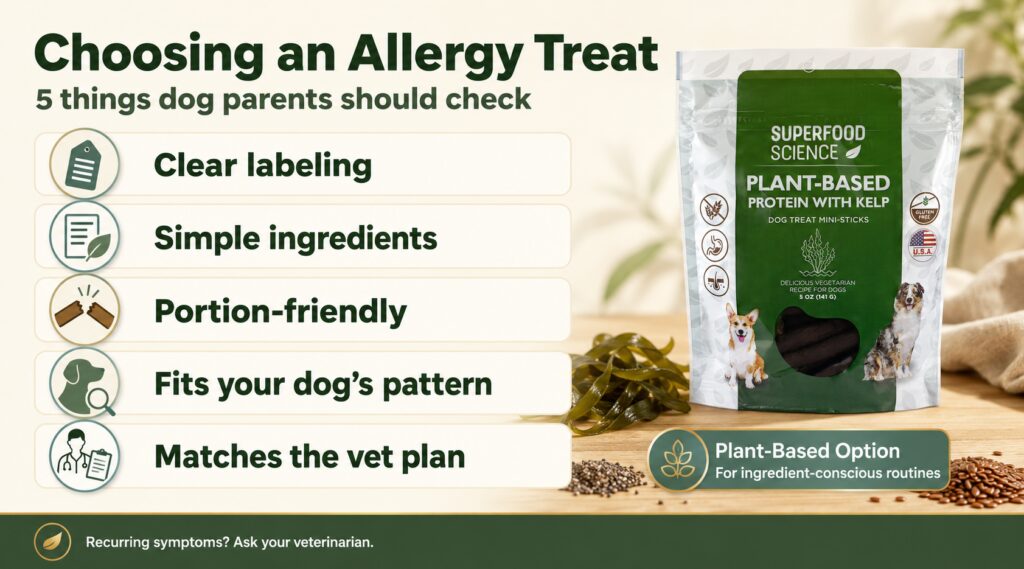
- Clear labeling: You should be able to identify the main protein and major ingredients quickly.
- Simple ingredient logic: Fewer moving parts can make tolerance tracking easier. [2][7]
- Portion control: Even a clean-label treat can cause trouble if it is too rich, too frequent, or too large.
- Fit with the symptom pattern: Itchy skin, ear flare-ups, soft stool, vomiting, and appetite changes do not all point to the same cause.
- Compatibility with the veterinary plan: If your dog is on a prescription diet or in a food trial, do not add treats without approval. [3]
Vet-Safety Sidebar: When to Stop Shopping and Call the Vet
| Situation | What it may mean | Safer next step |
| Recurring itchiness or ear flare-ups | Food allergy is possible, but so are fleas, environmental allergy, infection, mites, or other skin issues. [1] | Schedule a veterinary evaluation instead of repeatedly switching treats. |
| Vomiting or diarrhea keeps returning | The cause may be intolerance, parasites, infection, pancreatitis risk, dietary indiscretion, or another GI issue. | Stop casual treat trials and ask your veterinarian. |
| Puppy with vomiting, diarrhea, poor appetite, lethargy, or poor growth | Puppies are still developing and can decline faster than stable adult dogs. [6] | Call the veterinarian sooner, especially if signs recur or are more severe. |
| Dog is already on a prescription or elimination diet | Treats can invalidate the diet trial. [3][5] | Use only veterinarian-approved foods and rewards. |
| Facial swelling, trouble breathing, collapse, black/bloody stool, severe vomiting, or marked lethargy | These can be urgent warning signs. | Seek urgent veterinary care. |
Allergy Treat Does Not Mean a Veterinary Hypoallergenic Diet
This distinction matters. A retail allergy treat may fit a thoughtful treat routine, but it is not the same as a veterinary hypoallergenic or hydrolyzed diet used in a formal elimination trial. Veterinary diet trials require strict control because even small extras can confuse the result. [2][3][5]
If your dog’s signs are mild and occasional, simplifying the treat routine may be a reasonable first organizational step. If signs are chronic, recurring, or disruptive, the safer path is veterinary guidance.
How Superfood Science Treat Options Fit This Topic
This section is educational brand positioning, not proof that any Superfood Science product diagnoses, treats, cures, or prevents food allergy.
If a dog is actively itchy, repeatedly vomiting, having chronic diarrhea, losing weight, or undergoing a formal food-allergy workup, the answer is not to keep testing random treats because they are natural or organic. Ongoing symptoms still require veterinary guidance and a controlled plan. [2][3]
Dog parents who want to browse current Superfood Science dog treat options can visit: Shop Superfood Science Dog Treats

Organic Turkey Dog Treats
If chicken is the ingredient under suspicion, Superfood Science Organic Turkey Dog Treats are the most natural first fit for this topic. The compliant claim is not that turkey treats allergy. It is that a simpler turkey-based, natural-and-organic treat may be a more logical next trial when owners want to move away from chicken while keeping the ingredient story cleaner.
This line also includes beta-glucan-rich Agaricus mushrooms, a naturally occurring fiber often associated with immune support, as part of a broader functional ingredient profile. That supports a distinctive formulation story without turning the treat into a medical claim.
Organic Chicken Dog Treats
Not every dog needs to avoid chicken. For dogs that tolerate chicken well, Superfood Science Organic Chicken Dog Treats can still fit a clean-label routine. This matters because chicken should not be treated like the enemy when the individual dog is doing well on it.
This line includes turmeric, traditionally valued for its antioxidant properties, and flaxseed, a natural source of omega-3 fatty acids, as part of a more intentional formulation story that supports the brand’s natural-and-organic positioning without overstating what a treat can do.
Plant-Based Protein Dog Treats
For owners who want a different ingredient direction, Superfood Science Plant-Based Protein Dog Treats may offer another thoughtful option once the dog is stable and normal treat use is appropriate.
This line includes kelp, a sea vegetable naturally rich in minerals; chia, a plant-based source of fiber and omega-3s; and flaxseed, as part of a broader plant-based functional ingredient profile that may appeal to ingredient-conscious families seeking a non-poultry option. This should be framed as an ingredient-choice option, not a cure for food sensitivity.
Limitations and Research Gaps
There is useful veterinary guidance around food-allergy evaluation, elimination trials, and the limitations of casual home guessing. [1][2][3][5] There is much less direct head-to-head evidence proving that one retail allergy-treat category is always better than another across all dogs.
That gap exists because “allergy dog” is not one uniform group. Some dogs are itchy, while others show GI signs, and a number have both. In certain cases, the trigger is richness or a sudden diet change rather than a true allergy, and a few are not reacting to food at all. That is why the safest advice is dog-specific and symptom-specific.
Suggested Usage Guide
If you suspect your dog needs a more careful treat routine, simplify before you intensify. Choose one treat direction, keep portions small, and avoid changing the main food, treats, toppers, supplements, and chews all at once.
For several days, watch for itchiness, ear comfort, stool quality, vomiting, appetite, energy, and general behavior. If the pattern improves, that may be useful information, but it still does not prove a diagnosis. If symptoms keep coming back, move from casual shopping decisions to a veterinary plan. [2][3]
Safety and When to Call a Veterinarian
Call your veterinarian sooner rather than later if your dog has chronic itchiness, repeated ear flare-ups, ongoing vomiting, persistent diarrhea, weight loss, poor appetite, or symptoms that keep flaring up around diet changes. [1][2][3]
For puppies, move faster. A puppy with repeated vomiting, diarrhea, poor appetite, lethargy, poor growth, or signs of dehydration should not be managed through treat changes alone. AAHA life-stage guidance emphasizes that puppies have distinct developmental and preventive-care needs, so recurring symptoms prompt attention [6]
Seek urgent care if your dog has facial swelling, trouble breathing, collapse, severe vomiting, black or bloody stool, or marked lethargy. If your dog is already on a prescription diet or in the middle of an elimination trial, do not add treats casually without veterinary guidance. [3][5]
FAQs
What are allergy treats for dogs?
Usually, the term refers to treats designed to reduce potential trigger ingredients through a simpler formula, a different protein source, or clearer labeling. The phrase is useful for shopping, but it does not mean the treat can diagnose or treat a true food allergy. [2][3]
Do allergy treats prove my dog has a food allergy?
No. A better-tolerated treat may be useful information, but it does not prove a food allergy. Veterinary diagnosis usually depends on a structured elimination and challenge process. [2][3][5]
What ingredient should I avoid first if my dog is itchy?
There is no universal first ingredient for every dog. Chicken is among the more commonly reported food allergen sources in dogs, but many itchy dogs do not have a food allergy. The dog’s pattern and veterinary guidance should shape the plan. [1][4]
Are limited-ingredient dog treats better for dogs with allergies?
Sometimes they are easier to trial because they reduce variables. However, “limited ingredient” does not automatically mean hypoallergenic, and the best option still depends on the dog’s actual response and veterinary plan. [2][3][7]
Are hydrolyzed treats the same as allergy treats?
No. Hydrolyzed veterinary diets use proteins broken into smaller fragments and are often part of a controlled veterinary diet trial. Retail allergy treats may be simpler or chicken-free, but they are not automatically equivalent to hydrolyzed diets. [3][5]
When should I stop experimenting and call the vet?
If your dog has recurring itchiness, vomiting, diarrhea, ear flare-ups, weight loss, poor appetite, or symptoms despite treat changes, stop guessing and ask your veterinarian. Puppies with repeat signs should be evaluated faster. [1][2][6]
Conclusion
Allergy treats for dogs can be a helpful category when owners want a cleaner, more controlled choice. The best result usually comes from using simpler treats thoughtfully, watching the dog’s true pattern, and involving the veterinarian sooner when symptoms stop looking occasional and start looking persistent.
For ingredient-conscious dog parents, Superfood Science offers organic turkey, organic chicken, and plant-based treat options that can support a more intentional routine. The right choice is still the one that fits the individual dog, the full diet, and the veterinary plan.
Explore More Dog Health Tips
- Compare turkey vs. chicken dog treats for sensitive dogs
- Read the vet-safe guide to the best organic dog treats made in the USA
- Learn what natural ingredients in organic dog treats actually mean
- Use this top-rated organic dog treats safety checklist
- See why organic dog treat subscription options can simplify routines
- Explore chicken-free dog treats for sensitive dogs
References
1. MSD Veterinary Manual. (n.d.). Cutaneous food allergy in animals. MSD Veterinary Manual. https://www.msdvetmanual.com/integumentary-system/food-allergy/cutaneous-food-allergy-in-animals
2. VCA Animal Hospitals. (n.d.). Food allergies in dogs. VCA. https://vcahospitals.com/know-your-pet/food-allergies-in-dogs
3. VCA Animal Hospitals. (n.d.). Implementing an elimination-challenge diet trial: Dog. VCA. https://vcahospitals.com/know-your-pet/implementing-an-elimination-challenge-diet-trial-dog
4. Mueller, R. S., Olivry, T., & Prélaud, P. (2016). Critically appraised topic on adverse food reactions of companion animals (2): Common food allergen sources in dogs and cats. BMC Veterinary Research, 12, Article 9. https://doi.org/10.1186/s12917-016-0633-8
5. Olivry, T., Mueller, R. S., & Prélaud, P. (2015). Critically appraised topic on adverse food reactions of companion animals (1): Duration of elimination diets. BMC Veterinary Research, 11, Article 225. https://doi.org/10.1186/s12917-015-0541-3
6. Creevy, K. E., Grady, J., Little, S. E., Moore, G. E., Strickler, B. G., Thompson, S., & Webb, J. A. (2019). 2019 AAHA canine life stage guidelines. Journal of the American Animal Hospital Association, 55(6), 267-290. https://www.aaha.org/wp-content/uploads/globalassets/02-guidelines/canine-life-stage-2019/2019-aaha-canine-life-stage-guidelines-final.pdf
7. World Small Animal Veterinary Association Global Nutrition Committee. (2021). Selecting a pet food for your pet. WSAVA Global Nutrition Toolkit. https://wsava.org/wp-content/uploads/2021/04/Selecting-a-pet-food-for-your-pet-updated-2021_WSAVA-Global-Nutrition-Toolkit.pdf
